

OBD-II Code B1596: ABS System Fault Present
What B1596 means, why it triggers, and how to fix it
- Code B1596 is an informational flag indicating the ABS module has stored at least one primary 'C' (Chassis) code that requires diagnosis.
- Use an advanced OBD-II scanner capable of reading ABS modules to retrieve the primary fault code, as basic $20 readers will show '0 codes'.
- Inspect the wiring harness for breaks or corrosion before replacing parts, as damaged wiring causes over 50% of wheel speed sensor faults.
- Clear the codes and cycle the ignition completely off for 15 seconds, then back on, to permanently erase B1596 after completing a repair.
What Does B1596 Mean?

The B1596 code is an informational flag used primarily by Ford, Lincoln, and Mercury. It indicates the Anti-lock Brake System (ABS) module detected a fault and stored at least one specific trouble code. B1596 does not point to a broken part; it directs you to pull the primary ABS-related codes (usually starting with 'C') to identify the actual failure.
Technical definition: The SAE/ISO definition for Ford vehicles is "Service Continuous Codes." This indicates the ABS module detected and stored other Diagnostic Trouble Codes (DTCs) during a previous or current ignition cycle. B1596 is a secondary code signaling an ongoing issue stored in continuous memory.
Can I Drive With B1596?
Yes, But With Caution. Yes, but with extreme caution. Your Anti-lock Braking System (ABS) and traction control are disabled. Wheels will lock up during hard braking, increasing stopping distances and skidding risks on wet surfaces. Standard hydraulic brakes still function, but you lose critical emergency steering control.
Common Causes

- Faulty Wheel Speed Sensor (Very Common) — A wheel speed sensor provides rotation data to the ABS module. Internal sensor failures or erratic signals trigger a primary fault code (like C1296) alongside B1596.
- Damaged or Corroded ABS Wiring/Connectors (Very Common) — The wiring harness leading to wheel speed sensors or the ABS module is exposed to road debris and elements. Broken, chafed, or corroded wires cause signal loss, especially on trucks like the F-150 where harnesses rub against the frame.
- Failed ABS Control Module (Common) — The ABS control module fails internally due to electronic component breakdown or broken solder joints. This triggers specific internal module fault codes (like B1342) alongside B1596.
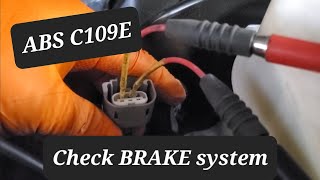
- Faulty Brake Booster Vacuum Sensor (Common) — On specific Ford F-150 engines, a faulty brake booster vacuum sensor sends incorrect data to the ABS module, triggering code C109E. The root cause is frequently a broken wire 12-18 inches from the sensor. 🎬 See this DIY fix for the C109E brake pressure sensor
- Poor Ground Connection (Less Common) — A corroded or loose ground connection for the ABS module causes intermittent voltage drops. On many trucks, the main ABS ground sits on the frame near the module and rusts heavily.
- Defective ABS Tone Ring (Less Common) — The tone ring, read by the wheel speed sensor, cracks, loses teeth, or accumulates heavy rust. This physical damage prevents the sensor from reading wheel speed accurately.
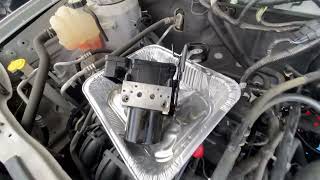
- Internal Hydraulic Control Unit (HCU) Failure (Less Common) — The HCU contains a pressure transducer that fails over time. If the ABS module reads brake pressure when the pedal is released, it sets codes like C1440 or C116A, requiring full HCU replacement.
- Low Brake Fluid Level (Rare) — A significantly low brake fluid level triggers ABS and brake warning lights. While it doesn't directly cause B1596, it causes a primary code that does.
Symptoms

- ABS Warning Light On — The amber ABS light on your dashboard illuminates immediately when the fault is detected.
- Traction Control/Stability Control Light On — Traction and stability control systems (like AdvanceTrac) use ABS sensors, so their warning lights illuminate simultaneously.
- Brake Warning Light On — The main red brake warning light illuminates if the fault relates to the ABS module, HCU, or brake pressure sensor.
- "Service AdvanceTrac" or "Check Brake System" Message — The vehicle's information display shows a text warning indicating a fault with the stability control or braking system.
- ABS System Not Working — During a hard stop on a wet or loose surface, wheels lock up and the vehicle skids. The pulsing sensation in the brake pedal is absent.
Diagnostic Flowchart

Tap your situation to follow the diagnostic path that matches what you're seeing on this code.
Common Fixes & Costs
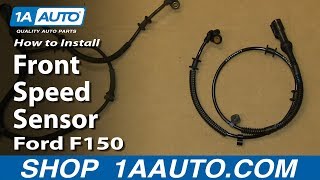
- Replace Wheel Speed Sensor
— Parts: $30-$175, Labor: $100-$225, ~1.2 hr book time
Ford F-150 (2009-2014, Rear): OEM AL3Z-2C190-A (Alt: Dorman 970-012, Motorcraft DY-1123)
Ford Explorer (2006-2010, Front): OEM 7L2Z-2C204-A (Alt: Motorcraft BRAB-161, Standard Motor Products ALS1715)
Ford Ranger (2019-2022, Front): OEM JB3Z-2C204-A (Motorcraft BRAB-520) (Alt: Duralast ABSB10542, NAPA Echlin VSS1536) - Repair Damaged ABS Wiring Harness — Parts: $10-$50 (for splice connectors/pigtail), Labor: $100-$600, ~2.5 hr book time
- Rebuild/Remanufacture ABS Control Module — Parts: $150-$400 (for the service), Labor: $150-$300, ~1.5 hr book time
- Replace ABS Control Module
— Parts: $760-$992+, Labor: $150-$377 (plus programming), ~2.5 hr book time
Ford F-150 (2009, 4WD): OEM 9L3Z-2C215-C
Ford Explorer (2008): OEM 7A2Z-2C219-E
Ford Ranger (2019): OEM KB3Z-2C405-B (replaces HB3Z-2C405-A) - Replace ABS Hydraulic Control Unit (HCU)
— Parts: $600-$1500+, Labor: $200-$400, ~2.8 hr book time
Ford Fusion (2010-2012): OEM BE5Z-2C219-D
DIY vs Professional
- Replace Wheel Speed Sensor — Beginner: yes
Tools: ['Jack and jack stands', 'Socket set', 'Torque wrench', 'Pliers', 'Penetrating oil'] - Repair Damaged ABS Wiring Harness — Beginner: no
Tools: ['Multimeter', 'Wire cutters/strippers', 'Soldering iron or quality crimp connectors', 'Heat shrink tubing', 'Wiring diagram'] - Rebuild/Remanufacture ABS Control Module — Beginner: yes
Tools: ['Socket set', 'Torx bit set'] - Replace ABS Control Module — Beginner: no
Tools: ['Socket set', 'Torx bit set', 'Advanced bidirectional scan tool (for programming)'] - Replace ABS Hydraulic Control Unit (HCU) — Beginner: no
Tools: ['Socket set', 'Flare nut wrenches (for brake lines)', 'Brake fluid', 'Brake bleeding equipment', 'Advanced bidirectional scan tool (for ABS bleed procedure)']
Used vs. New Parts: Buying Guide
When a used part is worth it: For an ABS Control Module, a used or remanufactured unit is a viable, cost-saving option, especially for older vehicles where a new part is expensive. For a Wheel Speed Sensor, the low cost and high reliability of a new aftermarket part make it the better choice.
Donor-vehicle mileage cap: roughly under 100000 miles for the part to have meaningful remaining life.
Donor quality checklist:
- For ABS modules, match the part number exactly. Even a slight variation is incompatible.
- Verify the used module comes with a warranty (30-90 days is common).
- Ensure the used module can be reprogrammed; some modules are locked to the original vehicle's VIN.
Decision logic:
- If The failed part is a wheel speed sensor → Buy a new OEM or quality aftermarket part. Savings on a used sensor are minimal and not worth the risk of premature failure.
- If The failed part is an ABS module and the vehicle is over 10 years old → A remanufactured or used module is a good option. Sending your original module for repair is best as it avoids reprogramming.
- If A new ABS module must be programmed and you lack the tools → Having a professional shop install and program a new or used part is the only option, as the vehicle is undrivable without a correctly programmed module.
Warranty tradeoff: Used parts typically have a 30-90 day warranty. Remanufactured modules often come with a 1-year or lifetime warranty. New aftermarket parts carry a 1-year to limited lifetime warranty, while new OEM parts have a 1-2 year warranty.
Worst-case if a used part fails: $300-$600 if a used ABS module fails after the warranty period, requiring repeat labor for removal, re-installation, and potential reprogramming.
What Happens If You Wait — Timeline
- 0-2 weeks: ABS, traction, and stability control lights are on. The systems are disabled. The vehicle's standard hydraulic brakes function normally. No physical damage is occurring yet. (MPG impact: 0%% · Added cost: $0)
- 2 weeks - 6 months: Continued operation without ABS/TCS safety systems. Increased risk of an accident in emergency braking or slippery conditions. In states like New York, the vehicle fails its annual safety inspection. (MPG impact: 0%% · Added cost: $0 (unless an accident occurs or inspection fails))
- 6+ months (if specific failure mode occurs): If the root cause is a fault making the ABS pump run continuously, the pump motor eventually burns out from overheating. This also drains the battery repeatedly. (MPG impact: 0%% · Added cost: $500-$2000 (A simple module repair becomes a full ABS module and HCU replacement, plus potential battery replacement.))
- Long-term (if root cause is fluid contamination): If the underlying issue is old, moisture-laden brake fluid, internal corrosion permanently damages the ABS module's solenoid valves and pump, making a simple repair impossible. (MPG impact: 0%% · Added cost: $1200-$2500+ (Full replacement of the ABS module/HCU assembly is required instead of a preventative fluid flush costing $100-$200.))
Cost of Not Fixing It
- Immediate: Loss of anti-lock braking, traction control, and stability control. Increased risk of skidding, loss of steering control during emergency braking, and longer stopping distances. (Added cost: Potentially infinite (cost of an accident, injury, or increased insurance premiums).)
- 1-6 months: No direct damage to other components occurs from an inactive ABS system. The primary risk remains significantly reduced vehicle safety. Driving without ABS requires adjusting driving habits. (Added cost: Negligible, unless an accident occurs.)
- 6+ months: If the underlying fault is an ABS module pump running continuously, it drains the battery or burns out the pump motor, requiring a more expensive HCU/module assembly replacement. (Added cost: $500-$2000+)
Diagnosis Steps
- Read All ABS Trouble Codes
The B1596 code proves there are other codes. Use an OBD-II scanner capable of reading ABS codes to retrieve all stored DTCs. The other codes (usually starting with 'C') point to the actual problem area. Do not proceed until you have these primary codes.
Tools: ['OBD-II Scanner with ABS capability'] - Visual Inspection of Wiring and Connectors
Based on the primary code, locate the corresponding component. Visually inspect the entire wiring harness from the sensor back to the main chassis harness. Look for chafing, melting, corrosion, or broken wires. Pay close attention to where the harness secures to the frame.
Tools: ['Flashlight', 'Jack and jack stands'] - Inspect the Wheel Speed Sensor and Tone Ring
Remove the wheel to view the sensor and the tone ring. Check the sensor for physical damage or metallic debris on its magnetic tip. Inspect the tone ring for cracks, missing teeth, or heavy rust buildup interfering with the sensor's reading.
Tools: ['Jack and jack stands', 'Lug wrench', 'Flashlight'] - Pro Tip: Perform a Harness Wiggle Test
While your multimeter monitors voltage or resistance, carefully wiggle the wiring harness along its entire length. If multimeter readings fluctuate wildly or drop out, you found an intermittent break or short in the wiring.
Tools: ['Multimeter'] - Check Live Data with an Advanced Scan Tool
While driving slowly (5-10 mph), monitor the speed reading from each wheel on the scanner. A sensor reading 0 mph, showing erratic data, or lagging behind the others is faulty. For pressure sensor codes (C1440), check the brake pressure PID; a high reading at rest points to a failed HCU transducer.
Tools: ['Advanced bidirectional scan tool'] - Pro Tip: Test the Specific Circuit with a Multimeter
Use a multimeter and wiring diagram to test the circuit indicated by the primary DTC. For a C109E code, check for a 5-volt reference and ground at the sensor connector. A reading like 2.9V points to a wiring issue, not a bad sensor.
Tools: ['Multimeter', 'Vehicle-specific wiring diagram'] - Advanced: Test Wheel Speed Sensor Resistance
Disconnect the sensor and measure resistance across its two pins. Most Ford passive sensors read between 900 and 2,000 Ohms. Infinite resistance (open circuit) or zero resistance (short circuit) confirms a failed sensor. Compare the reading to a known good sensor on the opposite side.
Tools: ['Multimeter', 'Vehicle-specific service manual'] (Advanced) - Check ABS Module Power and Grounds
If an internal module fault (B1342) is suspected, confirm the module has proper power and ground at its main connector. Check for resistance between the ground pin at the connector and a clean chassis ground; it must be less than 1 Ohm.
Tools: ['Multimeter', 'Wiring diagram'] - Advanced: Test Brake Booster Vacuum Sensor (C109E)
With the sensor connected and ignition on, back-probe the signal wire. Voltage must vary with engine vacuum. Check for continuity on the signal wire between the sensor and pin #10 at the ABS module connector. An open circuit here is a frequent failure.
Tools: ['Multimeter', 'Wiring diagram'] (Advanced) - Clear Codes and Perform Ignition Cycle
After performing a repair, clear all ABS codes with the scanner. On Ford vehicles, B1596 will not clear until the ignition is turned completely off, you wait 15 seconds, and then turn it back on. This cycle forces the ABS module to re-run its self-test.
Tools: ['OBD-II Scanner with ABS capability'] - Pro Tip: Analyze the Wheel Speed Sensor Waveform
Use an oscilloscope to view the wheel speed sensor's signal. A good sensor produces a clean, square-wave pattern increasing in frequency as the wheel spins faster. A missing or distorted waveform indicates a bad sensor, damaged tone ring, or electrical interference.
Tools: ['Oscilloscope', 'Back-probe pins']
When This Code Triggers (Freeze-Frame Conditions)
- Vehicle Speed: 5-70 mph (The fault is detected during the initial self-test at low speed (5-10 mph) or during normal driving.)
- System Voltage: 11-14.5 Volts (The code sets if system voltage is too low or if there are voltage drops from bad grounds or wiring.)
- Brake Pedal Status: On or Off (Faults related to pressure sensors (C1440) or wheel speed sensors trigger during a braking event.)
- Wheel Speed Sensor Readings: Mismatch detected (The primary code sets when one sensor's reading differs significantly from the others, indicating a fault.)
Related Codes
- B1342 — This code means the ABS module failed internally ('ECU Is Defective'). B1596 confirms a continuous fault exists within the module. Diagnosis focuses on verifying the ABS module has proper power and ground before replacing it.
- C109E — Points to a fault in the brake booster vacuum sensor circuit. Diagnosis involves using a multimeter to check for a 5-volt reference, ground, and signal voltage at the sensor's connector. The cause is frequently a broken wire 12-18 inches from the sensor.
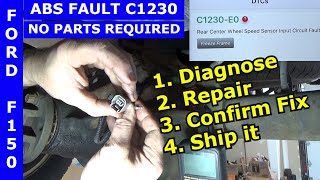
- C1230 — Indicates a fault with the Rear Wheel Speed Sensor circuit. Very common with B1596 on Ford trucks. The cause is often a broken or corroded wire inside the harness running along the rear axle.
- C1440 / C116A — Indicates a problem with the brake pressure transducer, integral to the Hydraulic Control Unit (HCU). C1440 points to a signal fault, while C116A indicates a mismatch between the pressure sensor and brake pedal switch. A high reading with the pedal released requires HCU replacement.
- C1296 — Points specifically to a fault in the Left Front Wheel Speed Sensor circuit. The problem lies with the left front sensor, its wiring, or the tone ring. B1596 flags that this C-code is stored.
Climate & Environmental Factors
- Cold Weather & Moisture: In freezing temperatures, moisture seeps into sensor connectors or cracks in wiring insulation and freezes, causing a temporary open circuit. The light disappears after the vehicle warms up, pointing to aging wiring or seals.
- Snow & Ice Buildup: Packed snow, ice, or road grime physically blocks the wheel speed sensor's view of the tone ring. This causes an erratic signal, disabling the ABS system until the obstruction clears.
- Road Salt & Humidity (Rust Belt): In regions using road salt, corrosion destroys wiring harnesses, corrodes ground connections on the frame, and causes rust buildup on the tone ring, damaging the sensor.
- High Heat: Sustained high temperatures in the engine bay accelerate the breakdown of electronic components and solder joints on the ABS module's circuit board, leading to internal module failures (Code B1342).
How to Talk to a Mechanic About This Code
Say this: "I have an ABS light on and my scanner shows code B1596, which I know is a general fault. I need a diagnostic to find the specific 'C' code causing the problem. Can you please retrieve the underlying ABS codes and diagnose from there?"
This signals you understand B1596 is not the root cause, preventing a shop from focusing on the wrong thing. It directs them to perform a proper diagnosis to find the primary fault (e.g., a wheel speed sensor circuit or module code) and avoids the 'just clear the codes' trap.
Avoid saying:
- 'My B1596 code needs to be fixed.'
- 'My ABS light is on, can you just look at it?'
- 'Just replace whatever is needed.'
Questions to ask before authorizing the repair:
- What was the specific 'C' code that you found?
- If you are recommending a wheel speed sensor, did you test the wiring harness for continuity and shorts first?
- If you are recommending an ABS module replacement, did you confirm it has proper power and a clean ground connection before condemning the module?
- Can you show me the old part you are replacing?
- What is the warranty on this specific repair and the new part?
Where to Take It: Dealer vs Independent vs Chain
- Dealer:
A safe but expensive choice. Necessary if a new ABS module needs to be sourced and programmed to your vehicle's VIN, which requires OEM software.
Best for: Vehicles under warranty, Complex repairs requiring module programming, When you want OEM parts exclusively and cost is not the primary concern
Downsides: Highest labor rates and part costs., Defaults to full module replacement over more nuanced wiring or sensor repairs. (Typical cost: +50% vs. baseline) - Independent Shop:
Best fit for most cases. An experienced independent technician efficiently diagnoses the underlying 'C' code and repairs wiring rather than replacing an entire harness, saving hundreds.
Best for: Out-of-warranty vehicles where cost is a factor., Diagnosing common B1596 causes like wheel speed sensors and wiring faults., Owners who want a relationship with their mechanic.
Downsides: Quality varies; ensure the shop has modern diagnostic tools for ABS systems and good reviews., May not have the expensive tools to program a brand new module, but installs rebuilt ones. (Typical cost: +0% vs. baseline) - Chain Shop:
AVOID for initial diagnosis. Acceptable only for a straightforward wheel speed sensor replacement after you confirm the diagnosis elsewhere.
Best for: Simple, clear-cut part replacements like a single wheel speed sensor if you already have a definitive diagnosis.
Downsides: High risk of misdiagnosis for complex or intermittent issues (wiring, module faults)., Technician skill varies widely; lacks advanced scanners or experience for this specific code., Pressures customers into unnecessary part replacements. (Typical cost: -10% vs. baseline)
When to Walk Away From the Repair
If the estimated repair cost for the ABS system exceeds 40-50% of your vehicle's current private-party value, pause and consider your options.
- Car worth $5000, fix is $2200: Walk away. The repair cost is nearly half the car's value. Driving without ABS is a safety risk, and passing a safety inspection is impossible in some states.
- Car worth $15000, fix is $800: Fix it. This repair is well below the threshold and restores a critical safety feature, preserving the vehicle's value and utility.
- Car worth $8000, fix is $350: Fix it, absolutely. A low-cost repair for a wiring issue or single sensor is a small price to pay for safety and peace of mind.
What Scan Tool You Need for This Code
Minimum: Must read manufacturer-specific ABS (Anti-lock Brake System) codes. A basic scanner that only reads engine codes (P-codes) is not sufficient and will not see the necessary 'C' codes.
A $20 scanner shows 'No Codes' or fails to connect to the ABS module, leaving you blind. The B1596 code's entire purpose is to flag a 'C' code stored in the ABS module, requiring a more capable scanner to access.
Budget: BlueDriver Pro or FORScan with compatible OBD2 Adapter (~$99) — Reads and clears specific Ford ABS codes ('C' codes). Displays live data, allowing you to watch wheel speed sensor readings in real-time to identify a faulty sensor.
Mid-range: Innova 5610 or Autel MaxiCheck MX808 (~$330) — Provides full system diagnostics, live data graphing, and crucial bidirectional controls. This allows you to perform an 'automated bleed' of the ABS pump/module after replacing a hydraulic component.
Professional: Autel MaxiSys MK906BT or XTOOL D7/D8 (~$500-1200) — Offers full OEM-level diagnostics, advanced bidirectional controls, and component coding/programming. Necessary if you replace and program a new ABS control module to the vehicle's VIN.
Rent vs buy: Some auto parts stores offer a free loaner tool program with a scanner capable of reading ABS codes, which is a great first step. If you plan to do the diagnosis and repair yourself, buying a mid-range scanner is a wise investment, as it's needed for both diagnosis and procedures like ABS bleeding.
How to Clear the Code After You Fix It
- Perform the specific repair for the primary 'C' code (e.g., replace sensor, fix wire).
- Use an OBD-II scan tool capable of accessing the ABS module to clear all DTCs.
- Turn the ignition completely OFF and wait for 15 seconds.
- Turn the ignition back ON. This key cycle is required by Ford for the ABS module to perform a self-test and clear the B1596 code.
Drive cycle (~10 minutes): After clearing codes and cycling the ignition, drive the vehicle above 10 mph. The ABS light extinguishes after the module completes its self-test and confirms the primary fault is gone. No complex drive cycle is required.
Readiness monitors affected: Not applicable. ABS faults do not affect emissions-related readiness monitors.
Watch out for:
- Forgetting to cycle the ignition key off and on after clearing codes is the most common reason B1596 appears 'stuck'.
- Using a basic scanner that cannot communicate with the ABS module to clear codes.
- Not fixing the root cause (the 'C' code), causing B1596 to return instantly upon the next self-test.
Will This Fail Emissions / State Inspection?
No — by itself this code doesn't fail OBD inspection (but it can keep readiness monitors from setting, which causes a separate fail).
- California: An illuminated ABS light will NOT cause a failure of the emissions (smog) inspection. The check is only concerned with the Check Engine Light and emissions-related systems.
- New York: An illuminated ABS light is a failure item on the annual safety inspection in New York. You will not pass inspection with this light on.
- Texas: An illuminated ABS light is NOT a cause for rejection during the annual safety inspection.
Most Commonly Affected Vehicles
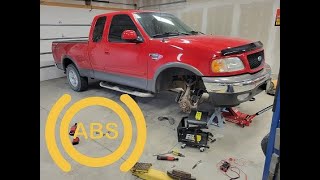
- Ford F-150 (2004-2014) — Extremely common. Prone to rear differential speed sensor (C1230) wiring damage along the axle/frame, ABS module failures (B1342), and brake booster vacuum sensor wiring (C109E) breaks. The 2009 model year has a one-year-only ABS module that is difficult to source.
- Ford Explorer (2006-2010) — Prone to wheel speed sensor failures. Front sensor part numbers include 6L2Z2C204A, 7L2Z2C204A, and ALS1715. Sensors are often integrated into the wheel hub assembly, increasing repair cost.
- Ford Ranger (2010-2023) — Triggers B1596 along with codes for the Hydraulic Control Unit (HCU) pressure transducer (C1440, C116A). Newer models have recalls and TSBs for software-related issues.
- Ford Expedition (2007-2014) — Shares a similar platform and ABS components with the F-150, making it susceptible to identical wiring and sensor issues, particularly the rear speed sensor harness.
- Lincoln Navigator (2007-2014) — As the luxury counterpart to the Expedition, it experiences identical ABS faults, including brake booster vacuum sensor and rear speed sensor harness failures.
- Ford Fusion (2010-2012) — Known for ABS Hydraulic Control Unit (HCU) failures triggering this code. The part exceeds $800, though sometimes a simple brake bleed resolves related symptoms.
- Mercury Grand Marquis / Mountaineer (2004-2011) — These vehicles share platforms with Ford models and exhibit the B1342 internal ABS module failure code along with B1596.
- Chevrolet / GMC Silverado / Sierra 1500 (2007-2013) — While B1596 is a Ford code, these GM trucks experience identical symptom sets caused by corroded ABS module ground wires on the frame under the driver's door. Cleaning the ground is a common fix.
Manufacturer-Specific Notes
- Ford / Lincoln / Mercury: This code is almost exclusively used by Ford brands. B1596 remains after fixing the primary fault until the ignition is cycled completely off and back on, allowing the module to perform a self-test. A suffix like '-20' (B1596-20) is for internal manufacturer data and doesn't change the diagnosis.
- General Motors (Chevrolet / GMC): GM does not use the B1596 code. However, an identical symptom set (ABS and Brake lights on) is commonly caused by a poor ground connection. The main ABS module ground is typically a black wire bolted to the frame rail below the driver's door.
- Toyota: Toyota does not use B1596. Their ABS system stores specific 'C' codes. For diagnosis without a scanner, jump terminals on the diagnostic connector to make the ABS light flash stored codes (e.g., code 31 is three flashes, a pause, and one flash).
- Mazda: As a former partner of Ford, some Mazda vehicles use similar diagnostic logic. However, B1596 is not a commonly reported code for Mazda. Their ABS faults are typically represented by specific 'C' codes or a flashing ABS light sequence.
Real Owner Stories
2008 Ford F-150 with ABS light on, B1596 won't clear after sensor replacement.
Owner scanned codes and found C1230 (Rear Speed Sensor) and B1596. They replaced the Vehicle Speed Sensor (VSS), which cleared the C1230 code, but the B1596 and the ABS light remained on.
Outcome: The true cause was a melted two-wire harness leading to the speed sensor on top of the differential. After splicing the wires, the problem resolved and the B1596 code cleared.
Lesson: If replacing a sensor doesn't fix the code, the wiring harness is the most likely culprit. Always visually inspect and test the wiring for continuity before assuming the new sensor or the ABS module is bad.
2011 Ford F-150 with C109E and B1596 codes.
The ABS and Traction Control lights were on. A scan revealed C109E (Vacuum Sensor Circuit Fault) and the accompanying B1596 code.
Outcome: A continuity test on the signal wire between the sensor and the ABS module revealed an open circuit. The wire was broken 12-18 inches away from the sensor. Repairing the wire fixed the problem completely.
Lesson: Code C109E is frequently a wiring issue, not a failed sensor. Testing the full circuit, including the signal wire's continuity back to the ABS module, is critical to avoid replacing a perfectly good sensor.
2008 Ford F-150 with B1342 (Internal Module Failure) and B1596.
ABS and parking brake lights were on. Scan showed code B1342, indicating a faulty ABS module. The owner sent the module for repair.
Outcome: The repair service did not successfully fix the internal module fault. The owner's next step is to contact the repair company. This highlights that professional rebuilding services are not always successful on the first try.
Lesson: When dealing with an internal module fault (B1342), using a reputable repair service with a good warranty is crucial. If the code returns after reinstalling a repaired module, the module itself remains the primary suspect.
How to Prevent This Code From Triggering
- Perform a brake fluid flush every 2-3 years or per manufacturer recommendation. (Every 2-3 years) — Brake fluid absorbs moisture over time. This moisture corrodes the sensitive internal components of the ABS module and HCU, leading to expensive failures. A flush replaces old, contaminated fluid.
- Periodically clean and inspect wheel speed sensors and wiring. (During tire rotations or brake service) — Cleaning metallic debris from sensor tips and removing dirt from connectors prevents signal interference. Inspecting wiring for chafing catches problems before a wire breaks completely.
- Apply dielectric grease to ABS-related electrical connectors. (Whenever a connector is disconnected for service) — Dielectric grease is a non-conductive sealant protecting metal pins from moisture and oxygen, preventing the corrosion that causes poor connections and signal loss.
- Protect wiring harnesses with loom or conduit in exposed areas. (As needed) — Adding protective sleeving to wiring running along the frame or near suspension components prevents damage from road debris, chafing, and heat.
- Clean ABS module ground connections. (If experiencing intermittent electrical issues) — The main ground connection for the ABS module corrodes over time. Removing the bolt, cleaning contact surfaces to bare metal, and re-securing it ensures the module has a stable voltage supply.
Frequently Asked Questions
Can I just clear the B1596 code and be done with it?
No. The B1596 code returns immediately if the underlying problem setting the primary ABS code is not fixed. You must diagnose and repair the primary 'C' codes first.
I replaced the wheel speed sensor, but the B1596 code and ABS light are still on. What now?
Ensure you cleared all codes and cycled the ignition fully off and on. If the light returns, the problem is likely a broken wire in the harness between the sensor and the ABS module. Perform a wiggle test and check continuity to find the break.
What is a common misdiagnosis with code B1596?
The most common mistake is focusing on the B1596 code itself, which has no diagnostic value. Another pitfall is replacing a sensor without testing the circuit, as the actual problem is frequently a broken wire.
Is it safe to drive with the B1596 code and my ABS light on?
Your regular hydraulic brakes still work, but anti-lock braking, traction control, and stability control are disabled. This increases your risk of skidding and losing control in an emergency stop. Drive with extra caution and repair it promptly.
Why won't my cheap code reader show the real ABS code?
Basic OBD-II scanners only read generic powertrain codes (starting with 'P'). To read manufacturer-specific Body ('B') and Chassis ('C') codes, you need a scanner that communicates with the ABS control module.
The shop quoted me over $1,000 to replace the ABS module. Is this realistic?
Yes, expect $760-$992 for a new module replacement and programming. A more affordable option is rebuilding your original module for $150-$400 plus labor. Rebuilding avoids expensive reprogramming fees.
What does the '-20' mean in a B1596-20 code?
The '-20' suffix is a Ford-specific identifier used for internal engineering and diagnostic purposes. It does not change the meaning or the diagnostic approach. B1596-20 still means 'Service Continuous Codes' are present.
Could a bad ground wire really cause all these lights?
Yes. A corroded or loose ground for the ABS module causes a voltage drop, leading to unpredictable behavior and multiple fault codes. Checking and cleaning the main ground connection on the frame is a critical diagnostic step.
Key Takeaways
- Code B1596 is an informational flag indicating the ABS module has stored at least one primary 'C' (Chassis) code that requires diagnosis.
- Use an advanced OBD-II scanner capable of reading ABS modules to retrieve the primary fault code, as basic $20 readers will show '0 codes'.
- Inspect the wiring harness for breaks or corrosion before replacing parts, as damaged wiring causes over 50% of wheel speed sensor faults.
- Clear the codes and cycle the ignition completely off for 15 seconds, then back on, to permanently erase B1596 after completing a repair.
Helpful Videos

The information in this article is provided for general reference and educational purposes only. Vehicle specifications, procedures, and part compatibility can vary by production date, trim level, and region. Always consult your vehicle's factory service manual and verify part numbers before purchasing or performing repairs. Safety-critical components such as airbags, seat belts, and braking systems should be installed by a qualified professional.
- 🎬 Helpful Videos
- What Does B1596 Mean?
- Can I Drive With B1596?
- Common Causes
- Symptoms
- Diagnostic Flowchart
- Common Fixes & Costs
- DIY vs Professional
- Used vs. New Parts: Buying Guide
- What Happens If You Wait — Timeline
- Cost of Not Fixing It
- Diagnosis Steps
- When This Code Triggers (Freeze-Frame Conditions)
- Related Codes
- Climate & Environmental Factors
- How to Talk to a Mechanic About This Code
- Where to Take It: Dealer vs Independent vs Chain
- When to Walk Away From the Repair
- What Scan Tool You Need for This Code
- How to Clear the Code After You Fix It
- Will This Fail Emissions / State Inspection?
- Most Commonly Affected Vehicles
- Manufacturer-Specific Notes
- Real Owner Stories
- 2008 Ford F-150 with ABS light on, B1596 won't clear after sensor replacement.
- 2011 Ford F-150 with C109E and B1596 codes.
- 2008 Ford F-150 with B1342 (Internal Module Failure) and B1596.
- How to Prevent This Code From Triggering
- Frequently Asked Questions
- Can I just clear the B1596 code and be done with it?
- I replaced the wheel speed sensor, but the B1596 code and ABS light are still on. What now?
- What is a common misdiagnosis with code B1596?
- Is it safe to drive with the B1596 code and my ABS light on?
- Why won't my cheap code reader show the real ABS code?
- The shop quoted me over $1,000 to replace the ABS module. Is this realistic?
- What does the '-20' mean in a B1596-20 code?
- Could a bad ground wire really cause all these lights?
- Key Takeaways
- 🎟️ Get 5% Off