

OBD-II Code B1560: Cellular Antenna Circuit Fault
What B1560 means, why it triggers, and how to fix it
- Code B1560 indicates a failure in the primary cellular 'shark fin' antenna circuit, affecting 2017+ Stellantis vehicles like the Ram 1500 and Jeep Grand Cherokee.
- The primary symptom is a 'Uconnect Box Requires Service' dashboard message accompanied by a red SOS light and disabled remote app features.
- Never replace the $500+ Telematics Box Module (TBM) without first reseating the blue FAKRA connector behind the glove box and checking for dealer software updates.
- The vehicle remains 100% mechanically safe to drive, but the automatic post-crash SOS emergency call function is completely disabled until the code is cleared.
What Does B1560 Mean?

B1560 is a manufacturer-specific Body Diagnostic Trouble Code (DTC) indicating the Telematics Box Module (TBM) detects an electrical open or short in the primary cellular antenna circuit. The system handling SOS emergency calls, stolen vehicle tracking, and remote app functions cannot communicate with the roof-mounted 'shark fin' antenna. The computer logs this fault if it fails to detect a proper connection for more than 60 seconds.
Technical definition: Stellantis (Chrysler, Dodge, Jeep, Ram) defines this code as 'Cellular Antenna 1 Circuit Fault'. Professional scan tools specify the failure type with a two-digit sub-code, such as B1560-13 (Circuit Open) or B1560-11 (Circuit Short to Ground).
Can I Drive With B1560?
Yes, But With Caution. The vehicle is mechanically safe to drive as this fault does not affect the engine, transmission, or braking systems. However, it disables critical communication features, including the automatic SOS emergency call function that activates after a crash. Because this important safety feature is inoperative, schedule a repair promptly.
Common Causes

- Loose or broken antenna coaxial cable connectors (Very Common) — Vibrations from driving loosen the antenna cable's plastic FAKRA connectors. The primary failure point is the connector at the back of the Telematics Box Module (TBM) behind the glove box, followed by the connector at the base of the roof antenna.
- TBM software glitch (Very Common) — The TBM's software logic is often too sensitive, incorrectly flagging a fault due to an 'improper DTC maturation time 🎬 See this quick fix for the Uconnect Box service message'. Manufacturers have released numerous Technical Service Bulletins (TSBs) resolving this with a dealer-installed software update.
- Faulty or water-damaged 'shark fin' roof antenna (Common) — The roof-mounted antenna gasket degrades over time, allowing water to seep in during rain or car washes. This corrodes the internal circuitry, creating an open or short circuit that triggers the code.
- Pinched or damaged antenna coaxial cable (Less Common) — The cable running from the roof antenna to the TBM gets pinched or chafed during prior repairs in the headliner, A-pillar, or dashboard area.
- Failed Telematics Box Module (TBM) hardware (Rare) — The TBM itself suffers an internal hardware failure, often failing to enter 'sleep mode' and causing a severe parasitic battery drain. Manufacturers advise ruling out all wiring and software issues before replacing this expensive unit.
- Failed TBM backup battery (Rare) — The TBM contains a small internal backup battery to ensure emergency calls function if the main battery disconnects in a crash. A dead backup battery triggers various TBM-related errors.
Symptoms

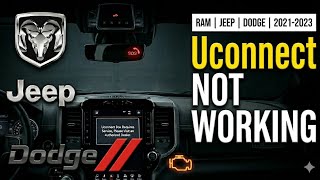
- 'Uconnect Box Requires Service' message on startup — A persistent pop-up warning appears on the vehicle's infotainment screen every time 🎬 Watch: How to reset and fix the Uconnect Box warning the ignition is turned on.
- Inoperative SOS/Assist buttons and red indicator light — The overhead console buttons for emergency services fail to function, and their status indicator lights turn red instead of green.
- Loss of connected services — Remote start, lock/unlock, vehicle location tracking, and the in-vehicle Wi-Fi hotspot are completely disabled.
- Parasitic battery drain overnight (also visible on scanner) — A faulty TBM failing to enter sleep mode draws continuous power, draining the main vehicle battery when the car is off.
Diagnostic Flowchart

Tap your situation to follow the diagnostic path that matches what you're seeing on this code.
Common Fixes & Costs
- Reseating loose antenna connectors — Parts: $0, Labor: $0 - $150, ~1.0 hr book time (DIY)
- TBM Software Update — Parts: $0, Labor: $150 - $250, ~1.2 hr book time (Professional)
- Replacing the 'Shark Fin' Roof Antenna
— Parts: $65 - $250, Labor: $150 - $400, ~2.5 hr book time
(Intermediate)
Chrysler 300 (2017-2022): OEM Mopar 68281292AA (Alt: N/A (OEM-specific part))
Ram 1500/2500 (2019+): OEM Mopar 68475114AA, 68328996AA (Alt: Dorman (Check application))
Chrysler Pacifica (2017-2025): OEM Mopar 6DE46xxxxA (Color code dependent) (Alt: N/A (OEM-specific part)) - Replacing the Telematics Box Module (TBM)
— Parts: $300 - $800, Labor: $150 - $300, ~1.8 hr book time
(Professional)
Ram 1500 (2022-2025): OEM Mopar 68528574AD (Alt: N/A (OEM-only, requires programming))
Jeep Grand Cherokee (2021-2025): OEM Mopar 68528574xx (Varies by VIN) (Alt: N/A (OEM-only, requires programming)) - Replacing the TBM Backup Battery
— Parts: $20 - $50, Labor: $100 - $200, ~0.8 hr book time
(Intermediate)
Stellantis (Various 2020-2026): OEM Mopar 68493347AA (Alt: N/A (OEM-specific part))
DIY vs Professional
- Reseating loose antenna connectors — Beginner:
Tools: Trim removal tools, basic socket/screwdriver set. - TBM Software Update — Beginner:
Tools: Dealer/professional-grade scan tool (e.g., wiTECH) and subscription to manufacturer software. - Replacing the 'Shark Fin' Roof Antenna — Beginner:
Tools: Trim removal tools, socket set, torque wrench, new gasket or sealant. - Replacing the Telematics Box Module (TBM) — Beginner:
Tools: Trim removal tools, socket set, and mandatory professional scan tool for programming. - Replacing the TBM Backup Battery — Beginner:
Tools: Trim removal tools, socket set to access TBM.
Used vs. New Parts: Buying Guide
When a used part is worth it: For the 'shark fin' antenna, a used OEM part from a low-mileage vehicle is a cost-effective choice. For the Telematics Box Module (TBM), buying used is highly discouraged unless you have a confirmed specialist who can program the VIN-locked module.
Donor-vehicle mileage cap: roughly under 60000 miles for the part to have meaningful remaining life.
Donor quality checklist:
- For antennas, ensure the part number matches exactly and there is no visible damage to the housing, seal, or connectors.
- Avoid antennas from regions with high sun exposure, which degrades the internal electronics and external seal.
- For TBMs, verify the donor vehicle's VIN and confirm with a programming specialist that the specific module can be reprogrammed BEFORE purchasing.
Decision logic:
- If The faulty part is the roof antenna → A new OEM or high-quality aftermarket antenna is recommended for longevity, but a used OEM part is an acceptable budget-friendly option.
- If The faulty part is the Telematics Box Module (TBM) → Buy a new OEM part from a dealer. The cost and complexity of reprogramming a used, VIN-locked module outweigh the savings.
Warranty tradeoff: Used parts typically have a 30-90 day warranty. New OEM parts installed by a dealer carry a 1-2 year warranty on both the part and labor.
Worst-case if a used part fails: $500 - $1000 if a used TBM cannot be programmed, requiring the purchase of a new unit plus wasted labor costs.
What Happens If You Wait — Timeline
- Immediate: Code B1560 is set. 'Uconnect Box Requires Service' message appears. All connected services (SOS, remote app, Wi-Fi) are disabled. (MPG impact: 0%% · Added cost: $0)
- 1-3 months: If the cause is a faulty TBM, it fails to enter sleep mode, causing a parasitic battery drain. The vehicle has a dead battery after being parked for 1-2 days. (MPG impact: 0%% · Added cost: $200 - $450)
- 3-12 months: If the cause is a leaking antenna gasket, repeated water intrusion corrodes the antenna base and drips onto the TBM/TCU module, destroying it. (MPG impact: 0%% · Added cost: $600 - $3,000)
- At time of resale/trade-in: A persistent warning message and a non-functional SOS system significantly lower the vehicle's trade-in value. (MPG impact: 0%% · Added cost: $500 - $1,500)
Cost of Not Fixing It
- Immediate: Loss of all connected services: Automatic SOS/Emergency Call, remote app functions (start, lock, locate), and in-vehicle Wi-Fi hotspot are disabled. (Added cost: $0)
- 1-3 Months: Potential for parasitic battery drain. A faulty TBM fails to enter 'sleep mode,' slowly draining the main 12V battery and leading to no-start situations. (Added cost: $200 - $450)
- 3+ Months / Resale: Persistent warning messages on the dashboard deter potential buyers and lower the vehicle's resale value. A non-functional safety system is a significant red flag. (Added cost: $500 - $1500)
Diagnosis Steps
- Check for Technical Service Bulletins (TSBs) and Software Updates
Search online or call a dealer with your VIN to check for TSBs related to B1560 (e.g., Stellantis S2508000101). A simple software update often fixes 'Stored' or 'Pending' codes without physical repairs.
Tools: Smartphone or computer (Beginner) - Perform a System Reset
Disconnect the negative battery terminal for 30 minutes to perform a hard reset on all vehicle modules. This clears temporary electronic glitches causing false codes.
Tools: 10mm wrench (Beginner) - Inspect and Reseat TBM Connections
Access the Telematics Box Module behind the glove box. Firmly disconnect and reconnect the coaxial cables (blue, white, or violet FAKRA connectors) until they click, ensuring they are fully seated.
Tools: Trim removal tools, Phillips/Torx screwdrivers (Intermediate) - Inspect Antenna Base Connections
Partially lower the rear of the headliner to access the base of the 'shark fin' antenna. Inspect the connectors for security and check for water intrusion or corrosion.
Tools: Trim removal tools (Intermediate) - Perform 'Wiggle Test' for Intermittent Faults
With a scan tool viewing live data for the code, gently wiggle the antenna cable and connectors at the TBM and antenna base. A change in fault status pinpoints the loose connection.
Tools: OBD-II Scan Tool (Intermediate) - Test Antenna Circuit Continuity and Resistance (Advanced)
Disconnect the antenna cable from the TBM and antenna base. Use a multimeter to measure resistance from end to end (should be < 5 Ohms) and from the center pin to ground (should be infinite/OL). Abnormal readings confirm a damaged cable.
Tools: Multimeter, trim removal tools (Advanced) - Isolate Fault with a Known-Good Test Antenna (Pro-Level)
Disconnect the vehicle's antenna cable from the TBM and plug in a specialty test antenna directly. If clearing the codes keeps B1560 away, the original antenna or cable is faulty. If it returns immediately, the TBM is bad.
Tools: Specialty Test Antenna (e.g., Mopar 9977-6-CELL), OBD-II Scan Tool (Advanced) - Analyze Live Data PIDs (Pro-Level)
Use a professional scan tool to monitor 'Cellular Antenna 1 Status' and 'Resistance' PIDs from the TBM. An 'Open' or 'Shorted' status provides direct confirmation of the fault type without manual multimeter probing.
Tools: Professional Grade Scan Tool (e.g., wiTECH) (Advanced)
When This Code Triggers (Freeze-Frame Conditions)
- Ignition Status: RUN (The fault is detected shortly after the vehicle starts and the Telematics module powers on.)
- Time Since Ignition On: > 60 seconds (The module continuously monitors the antenna circuit and sets the code if the fault condition persists for one minute.)
- System Voltage: 11-14 Volts (The self-test runs under normal vehicle operating voltage.)
- Module State: Active / Awake (The code is set when the Telematics Box Module (TBM) is fully awake and attempting to establish a network connection.)
Related Codes
- B1561 — Indicates a fault with 'Cellular Antenna 2'. If both B1560 and B1561 appear together, it points strongly toward a fault common to both, such as the TBM, a software glitch, or the main wiring harness.
- B1562 — Indicates a 'GPS Antenna Circuit' fault. The GPS and cellular antennas share the same 'shark fin' housing. Seeing B1560 and B1562 together makes a faulty shark fin assembly the primary suspect.
- B22A9 — Indicates an 'ECU Internal Performance Failure' within the TBM. When it appears alongside B1560, it strongly suggests an internal hardware failure of the Telematics Box Module requiring replacement.
- U0197 — Means 'Lost Communication With Telematics Control Module'. The TBM is completely offline due to a loss of power, ground, or a major internal failure, preventing it from reporting antenna faults properly.
Climate & Environmental Factors
- Humidity and Rain: The rubber gasket sealing the shark fin antenna degrades from sun exposure, allowing rain and car wash water to leak inside. This corrodes the antenna's circuit board and drips onto modules below, causing direct hardware failure.
- Extreme Temperatures: Cycles of extreme heat and cold accelerate the degradation of plastic FAKRA connectors and rubber antenna gaskets, making them brittle and prone to cracking.
How to Talk to a Mechanic About This Code
Say this: "I have a 'Uconnect Box Requires Service' message and I believe it's throwing a B1560 code. I'd like to schedule a diagnostic. Based on my research, I'd like you to first check for any software updates related to TSBs for the Telematics Box Module and inspect the antenna connections before quoting any part replacements."
This signals you're an informed customer. It directs the technician to the most common and cheapest fixes first (software and loose wires), preventing them from immediately quoting an expensive TBM replacement.
Avoid saying:
- 'My Uconnect is broken, please fix it.'
- 'The SOS light is red, can you check it out?'
- 'Just do whatever you think is needed to fix the message.'
Questions to ask before authorizing the repair:
- Was the code 'Active' or 'Stored'? (A 'Stored' code often points to software or intermittent connections).
- Did you check for TSBs and is my TBM software the latest version? If not, can we try flashing the update first?
- Did you physically inspect the FAKRA connectors at both the TBM and the antenna base to ensure they are fully seated?
- If you are recommending a TBM replacement, how did you rule out the antenna and its coaxial cable?
Where to Take It: Dealer vs Independent vs Chain
- Dealer:
Necessary for software updates or TBM replacement. If the problem is suspected to be a simple loose wire or a bad antenna on an out-of-warranty vehicle, a trusted independent shop is a more cost-effective first stop.
Best for: Vehicles under warranty., Fixes requiring a TBM software update, as they have exclusive access to the wiTECH scan tool and software., Replacing and programming a new Telematics Box Module (TBM), which is VIN-locked.
Downsides: Highest labor rates., Quick to suggest replacing the expensive TBM without ruling out simpler causes first. (Typical cost: +50% vs. baseline) - Independent Shop:
Best choice for out-of-warranty physical repairs like a bad antenna or loose connector. If they diagnose a software or TBM module failure, you must go to the dealer to complete the repair.
Best for: Out-of-warranty vehicles with physical faults., Diagnosing and replacing the shark fin antenna or its cable., Checking for loose connections behind the glove box or in the headliner.
Downsides: Cannot perform manufacturer-specific TBM software updates., Lack the expensive specialty tools (like a test antenna) to definitively isolate a TBM failure. (Typical cost: +0% vs. baseline) - Chain Shop:
AVOID. This type of complex electronic diagnosis is outside their area of expertise. They are highly unlikely to correctly diagnose or fix a B1560 code.
Best for: Oil changes, tires, and brakes.
Downsides: Lack the specific diagnostic tools and expertise for telematics and body control module issues., High potential for misdiagnosis, leading to unnecessary and costly repairs. (Typical cost: -10% vs. baseline)
When to Walk Away From the Repair
If the estimated repair cost for the B1560 fault exceeds 40-50% of your vehicle's current private-party value, pause and consider alternatives.
- Car worth $25000, fix is $1200: Fix it. The cost is well below the threshold and restores an important safety feature.
- Car worth $8000, fix is $2500: Borderline. This is a significant percentage of the car's value. Get a second opinion to confirm the diagnosis and cost before proceeding.
- Car worth $4000, fix is $2000: Walk away. The repair cost is 50% of the car's value for a non-drivetrain issue. It's not economically sensible to proceed.
What Scan Tool You Need for This Code
Minimum: A scanner that reads manufacturer-specific Body (B) codes for your vehicle's brand.
A basic $20 OBD-II reader from an auto parts store only reads Powertrain (P) codes and shows 'No Codes Found' for B1560. You cannot see or clear the actual fault.
Budget: BlueDriver Pro / MUCAR BT200 Max (~$90) — Reads and clears Body (B), Chassis (C), and Network (U) codes for most major brands, including Stellantis. It allows you to confirm the B1560 code and any related faults.
Mid-range: Foxwell NT510 Elite / XTOOL A30M (~$150) — Provides full system access to read/clear codes and view live data from the Telematics module. Some models offer limited bidirectional controls to help test components.
Professional: Autel MaxiCOM MK808BT / Launch X431 Series (~$450-700) — Offers extensive bidirectional controls to command modules and see responses. Crucially, these tools support FCA AutoAuth for secure gateway access on 2018+ Stellantis vehicles, necessary for clearing codes.
Rent vs buy: Auto parts stores typically rent out basic OBD-II readers that CANNOT read body codes. For this specific code, you must buy a scanner with the appropriate capabilities.
How to Clear the Code After You Fix It
- Reconnect any disconnected components (e.g., battery, TBM, antenna).
- Use a compatible OBD-II scan tool to erase the B1560 trouble code from the Telematics module.
- Perform a Uconnect soft reset by holding the volume and tuner knobs for 15 seconds.
- Cycle the ignition off, then on, and wait at least two minutes for the TBM to re-initialize and run its self-test.
Drive cycle (~10 minutes): A specific drive cycle is not required for this body code. The TBM runs its self-test upon startup. After clearing the code, start the vehicle and let it run for a few minutes. If the 'Uconnect Box Requires Service' message does not reappear and the SOS light is green, the repair is successful.
Readiness monitors affected: None
Watch out for:
- Clearing the code without fixing the underlying electrical fault results in the code returning almost immediately.
- Disconnecting the battery clears the code temporarily but does not resolve a persistent software glitch.
- Forgetting to clear the code with a scan tool after the repair leaves the warning message on the screen until the module's next self-test passes.
Will This Fail Emissions / State Inspection?
No — by itself this code doesn't fail OBD inspection (but it can keep readiness monitors from setting, which causes a separate fail).
- California: This is a Body (B) code and does not illuminate the Check Engine Light. It will not cause a failure of the California Smog Check.
- New York: B1560 is not an emissions-related code and will not cause a failure of the OBD-II test. An inspector could note the inoperative SOS system during the safety check, but it rarely causes a failure.
- Texas: The emissions test looks for codes that command the Check Engine Light on. Since B1560 is a body code, it will not cause a failure.
Most Commonly Affected Vehicles

- Dodge Charger / Challenger / Durango (2017-2025) — Often caused by a faulty shark fin antenna, its wiring, or software glitches addressed by TSB S2508000100.
- Ram 1500 / 2500 / 3500 (2019-2025) — Frequently caused by loose connections at the TBM behind the glove box. Certain 2022 Ram 1500s were subject to CSN Z91 for an incorrect TBM.
- Jeep Grand Cherokee / Grand Wagoneer / Cherokee (2021-2025) — Prone to this code due to loose connectors and software glitches. TSB S2508000101 specifically mentions 'improper DTC maturation time' requiring a software update.
- Jeep Gladiator (JT) (2020-2025) — The TBM is located under the dashboard to the side of the steering column. TSB OTHERDOC_133 directly links B1560 to loose antenna connections.
- Chrysler Pacifica / 300 / Voyager (2017-2025) — A loose antenna connector at the TBM is the most frequent cause. TSB S228A000005 is highly relevant for diagnosis.
- Alfa Romeo Giulia / Stelvio (2018-2025) — Shares the same core telematics architecture as other Stellantis brands and suffers from identical antenna circuit faults.
- BMW X3 / X5 / X7 and others (2017-2023) — Experiences a nearly identical symptom ('Emergency Call System Malfunction') caused by a leaking shark fin antenna seal destroying the Telematics Control Unit (TCU) beneath it.
- Fiat Various Models with Uconnect (2017-2025) — Shares the same telematics architecture as other Stellantis brands and suffers from the same antenna circuit faults.
Manufacturer-Specific Notes
- Stellantis (Chrysler, Dodge, Jeep, Ram, Fiat, Alfa Romeo): This code is extremely common. TSBs consistently advise technicians to check software and wiring connections before replacing the TBM. A 'Stored' code is almost certainly a software logic issue.
- Volkswagen: On VW models, code B1560 means 'Cruise Control Switch Circuit Fault', pointing to a problem with the cruise control buttons or the clock spring.
- Toyota: For Toyota models, B1560 means 'Motor Control Disconnected', indicating a communication error on the AVC-LAN network between the multi-media receiver and the display module.
- Nissan: On Nissan models, B1560 is defined as 'Door Lock Cylinder Circuit Open', pointing to a fault in the key cylinder switch in the driver's door.
- General Motors (Chevrolet, GMC): On some GM vehicles, B1560 means 'Mirror right control switch circuit malfunction', completely unrelated to the telematics system.
Real Owner Stories
2022 Ram 1500 with 'Uconnect Box Requires Service' Message
The 'Uconnect Box Requires Service' message appeared on the infotainment screen every time the truck was started. Remote app features and SOS were not working.
What they tried:
- Performed a soft reset of the Uconnect system multiple times with no change.
- Disconnected the battery for 30 minutes, which cleared the message temporarily.
- Took it to the dealer who initially couldn't find the issue.
Outcome: The owner removed the glove box, located the Telematics Box Module (TBM), and found a blue FAKRA connector that was not fully clipped in. After firmly reseating the connector until it clicked, the code cleared permanently. Total cost: $0.
Lesson: Always check the TBM connectors behind the glove box first. This is the most common cause across many Stellantis vehicles and is a free, simple fix.
2019 Jeep Grand Cherokee with a dealer misdiagnosis
The 'Service Uconnect' message appeared, and the dealer immediately recommended replacing the Telematics Box Module (TBM) for over $1,000.
What they tried:
- The owner declined the initial repair and researched the code online.
- Found TSBs mentioning that 'Stored' codes should not lead to TBM replacement.
Outcome: The owner took the vehicle to a different dealership, referenced TSB S2508000101, and requested a software check. The second dealer found the code was 'Stored' and performed a TBM software update for a one-hour labor charge ($180), permanently fixing the issue.
Lesson: Do not automatically approve an expensive TBM replacement. Ask the service advisor if the code is 'Active' or 'Stored'. For 'Stored' codes, insist they follow manufacturer TSBs pointing to a software update.
2019 BMW X3 with 'Emergency Call System Malfunction'
After a heavy rainstorm and a car wash, the 'Emergency Call System Malfunction' message appeared. The dealer quoted over $2,000 for the repair.
What they tried:
- The owner researched the symptom and found it was a widespread BMW issue caused by a leaking shark fin antenna seal.
Outcome: Water leaked through the faulty antenna gasket and destroyed the Telematics Control Box (TCB) located directly underneath it. The repair involved replacing the TCB module and the shark fin antenna assembly.
Lesson: On BMWs, this error is almost always caused by a water leak from the antenna gasket. Prevent this expensive failure by proactively sealing the edge of the shark fin antenna with clear automotive silicone sealant.
2022 Ram Rebel with recurring B1560 code
A persistent 'Uconnect Box Requires Service' message appeared. The dealer attempted a fix, but the message returned a few months later.
What they tried:
- The first dealer visit resulted in them claiming it was a 'loose wire'.
- When the message returned, the dealer said the TBM module was bad but on backorder.
Outcome: The owner replaced the shark fin antenna themselves. The part cost $150, and accessing the mounting bolt through the center brake light opening permanently resolved the code.
Lesson: If a simple connector reseat or software update doesn't work, the next most likely culprit is the shark fin antenna itself, not the expensive TBM.
How to Prevent This Code From Triggering
- Inspect and Clean the Shark Fin Antenna Gasket (Annually or during vehicle waxing) — The rubber gasket perishes from UV exposure. Checking for cracks identifies a potential failure before it allows water to leak into the vehicle and destroy the antenna or TBM.
- Apply a Bead of Sealant Around the Antenna Base (Once, as a preventative measure on out-of-warranty vehicles) — Applying a thin bead of clear automotive silicone sealant around the seam where the antenna meets the roof provides a durable, waterproof barrier.
- Exercise Caution During Dash/Headliner Work (During any related repairs) — The antenna's coaxial cable and FAKRA connectors are fragile. Be mindful of the cable's location to avoid pinching or accidentally disconnecting it.
- Keep Telematics Software Updated (Check with dealer during routine service) — Manufacturers release software updates to fix logic errors. Keeping the software current prevents false positive B1560 codes.
- Visually Inspect FAKRA Connectors (When TBM is accessible (e.g., changing cabin air filter)) — Plastic locking tabs on FAKRA connectors become brittle. A quick visual check ensures they are fully seated, preventing intermittent connection issues.
Frequently Asked Questions
What is the most common misdiagnosis for code B1560?
The most common and expensive mistake is replacing the radio head unit, as B1560 is set by the separate Telematics Box Module (TBM). Another error is replacing the TBM before thoroughly checking the antenna and its coaxial cable connections.
Why does my Uconnect say 'Box Requires Service'?
The Telematics Box Module (TBM) detects a fault and cannot establish a reliable electrical connection with the cellular roof antenna. This disables services relying on it, such as the SOS button and remote app features.
The dealer wants to replace the expensive TBM right away. Is this necessary?
Not usually. Manufacturer TSBs explicitly warn technicians not to replace the TBM for this code if it is 'Stored' or 'Pending'. The problem is much more likely a loose connector, a software glitch requiring an update, or a faulty antenna.
What is a Telematics Box Module (TBM)?
The TBM is a dedicated computer responsible for all telematics and connected services. It houses a cellular modem, a GPS receiver, and a backup battery to manage SOS calls, remote app commands, and the Wi-Fi hotspot.
Can a bad car battery cause Uconnect problems?
Yes, indirectly. A weak main battery causes low voltage, leading to unpredictable behavior in electronic modules like the TBM. Conversely, a faulty TBM failing to enter 'sleep mode' causes a parasitic drain that kills a healthy battery.
How do you perform a reset on the Uconnect system?
A 'soft reset' is done with the vehicle on by pressing and holding the radio's volume and tuner knobs simultaneously for 15 seconds until the screen reboots. A 'hard reset' involves disconnecting the vehicle's negative battery terminal for 30 minutes to reset all electronic modules.
Can I fix code B1560 myself?
Yes, in many cases. The most common cause is a loose connector behind the glove box, which a DIYer easily accesses and reseats.
Will clearing the code fix the problem?
No. Clearing the code only makes the warning message disappear temporarily. The TBM detects the hard electrical fault on the next ignition cycle and the code returns immediately.
Key Takeaways
- Code B1560 indicates a failure in the primary cellular 'shark fin' antenna circuit, affecting 2017+ Stellantis vehicles like the Ram 1500 and Jeep Grand Cherokee.
- The primary symptom is a 'Uconnect Box Requires Service' dashboard message accompanied by a red SOS light and disabled remote app features.
- Never replace the $500+ Telematics Box Module (TBM) without first reseating the blue FAKRA connector behind the glove box and checking for dealer software updates.
- The vehicle remains 100% mechanically safe to drive, but the automatic post-crash SOS emergency call function is completely disabled until the code is cleared.
Helpful Videos

The information in this article is provided for general reference and educational purposes only. Vehicle specifications, procedures, and part compatibility can vary by production date, trim level, and region. Always consult your vehicle's factory service manual and verify part numbers before purchasing or performing repairs. Safety-critical components such as airbags, seat belts, and braking systems should be installed by a qualified professional.
- 🎬 Helpful Videos
- What Does B1560 Mean?
- Can I Drive With B1560?
- Common Causes
- Symptoms
- Diagnostic Flowchart
- Common Fixes & Costs
- DIY vs Professional
- Used vs. New Parts: Buying Guide
- What Happens If You Wait — Timeline
- Cost of Not Fixing It
- Diagnosis Steps
- When This Code Triggers (Freeze-Frame Conditions)
- Related Codes
- Climate & Environmental Factors
- How to Talk to a Mechanic About This Code
- Where to Take It: Dealer vs Independent vs Chain
- When to Walk Away From the Repair
- What Scan Tool You Need for This Code
- How to Clear the Code After You Fix It
- Will This Fail Emissions / State Inspection?
- Most Commonly Affected Vehicles
- Manufacturer-Specific Notes
- Real Owner Stories
- 2022 Ram 1500 with 'Uconnect Box Requires Service' Message
- 2019 Jeep Grand Cherokee with a dealer misdiagnosis
- 2019 BMW X3 with 'Emergency Call System Malfunction'
- 2022 Ram Rebel with recurring B1560 code
- How to Prevent This Code From Triggering
- Frequently Asked Questions
- What is the most common misdiagnosis for code B1560?
- Why does my Uconnect say 'Box Requires Service'?
- The dealer wants to replace the expensive TBM right away. Is this necessary?
- What is a Telematics Box Module (TBM)?
- Can a bad car battery cause Uconnect problems?
- How do you perform a reset on the Uconnect system?
- Can I fix code B1560 myself?
- Will clearing the code fix the problem?
- Key Takeaways
- 🎟️ Get 5% Off