

B1500 on 2014-2016 Subaru Forester: Fuel Level Sensor Fault Causes & Fixes
On a 2014-2016 Subaru Forester, code B1500 almost always indicates a faulty fuel level sensor (or sending unit) inside the gas tank, causing an erratic or incorrect fuel gauge. The fix involves replacing either the main or sub-level sensor, a job best left to professionals, with a typical shop cost of $250 to $500. In less common cases, this code can point to a keyless entry system malfunction, so diagnosis should be guided by symptoms.
- B1500 on a 2014-2016 Forester almost always means a bad fuel level sensor, causing an erratic or stuck fuel gauge.
- The vehicle has two fuel level sensors (main and sub); either can fail and cause the code.
- It's critical to distinguish this from the less common B1500 fault related to the keyless entry system by checking symptoms first.
- Repair involves accessing the fuel tank from under the rear seat and carries a fire risk, making professional service highly recommended.
- In very rare cases, a faulty upstream O2 sensor can cause identical fuel gauge symptoms after the level sensors have been ruled out.
What's Unique About the 2014-2016 Subaru FORESTER

The B1500 code on this generation of Forester is confusing because Subaru has used it for two completely different issues. While TSB 09-63-16 clearly defines it as a Fuel Level Sensor fault, an earlier bulletin, TSB 07-83-14, defines B1500 as a "Keyless UART Communication Malfunction" for the 2014-2015 Forester. Diagnosis must be based on symptoms: if your fuel gauge is inaccurate, you have the fuel sensor issue. If your keyless entry is not working, you have the communication issue. This guide focuses on the more common fuel sensor problem, which is complicated by the dual-sensor system required for the AWD platform's saddle-style fuel tank.
Diagnostic Flowchart
Tap your situation to follow the diagnostic path that matches what you're seeing on this vehicle.
Symptoms You May Notice
- Inaccurate or erratic fuel gauge (e.g., bouncing between full and empty).
- Fuel gauge stuck at a specific level (e.g., 1/4 tank or 3/4 tank) regardless of the actual amount of fuel.
- Running out of gasoline even though the gauge indicates fuel is still present, a common complaint on forums.
- Check Engine Light or other malfunction indicator may be illuminated.
- Fuel gauge reads correctly until it reaches a certain point (like 1/2 or 1/4 tank) and then stops moving.
- For the less common keyless entry issue: Key fobs for remote entry stop working simultaneously.
- Replacing the fuel pump when only the sending unit is bad. The sending unit is often part of the fuel pump module but can be replaced separately.
- Replacing only one of the two sending units without confirming which one is faulty, leading to the problem persisting.
- Confusing the fuel-related B1500 code with the keyless entry-related B1500 code, leading to unnecessary diagnostics on the wrong system.
- Replacing fuel level sensors when the actual, though rare, cause is a faulty upstream O2 sensor affecting fuel calculations.
Most Likely Causes

- Failed Main or Sub Fuel Level Sensor 🔴 High Probability The sending units use a variable resistor with a wiper arm that moves with a float. Over time, the resistive strip can wear out, get coated with fuel deposits (sometimes treatable with an additive like Techron), or the wiper contact can fail, causing an open or incorrect reading. This is a widely reported failure on Subaru forums.
How to confirm: A technician can use a professional scan tool to monitor the live resistance (Ω) data from both the main and sub sensors. A reading that is erratic, stuck, or shows 'open' (often defined as over 550 Ω) when the tank level changes confirms a bad sensor. A typical Subaru sensor should read a low resistance (e.g., 0-5 ohms) when full and a higher resistance (e.g., 90-100 ohms) when empty; the two sensors are read in series.
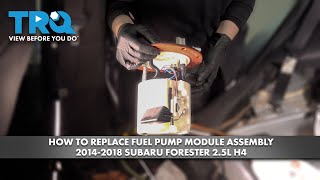
Typical fix: Replace the faulty fuel level sensor assembly. Since there are two, proper diagnosis is needed to identify which one has failed, 🎬 Watch: How to test and replace the fuel level sensors. though some owners and mechanics recommend replacing both at the same time. Both are accessed via panels under the rear seat.
Est. part cost: $70-$120 per sensor
Rare But Worth Checking
- Damaged Wiring or Corroded Connector: The wiring harness leading to the fuel tank can be damaged, or the connector pins can corrode, causing an open or short circuit that mimics a sensor failure. This should be inspected before replacing parts.
- Faulty Upstream Oxygen (A/F) Sensor: In some rare cases, a failing but not-yet-code-setting upstream O2 (Air/Fuel) sensor can cause the ECU to miscalculate fuel consumption, leading to an inaccurate 'distance to empty' and fuel gauge reading, even with good fuel level sensors. A forum member with a 2014 Forester XT reported this as the ultimate fix after replacing both sending units did not solve the problem.
- Faulty Combination Meter (Instrument Cluster): It is possible, but very unlikely, for the instrument cluster itself to fail in a way that it can no longer properly interpret the signals from the fuel level sensors.
- Keyless Entry Control Module Failure: If the symptom is non-working key fobs, the B1500 code points to a communication failure between the Body Integrated Unit (BIU) and the Keyless Entry Control Module, as outlined in TSB 07-83-14. This can be caused by a faulty module or a wiring issue.
Diagnosis Steps
- Confirm the primary symptom is an inaccurate fuel gauge to distinguish from the keyless entry issue.
- Connect an OBD-II scanner and check for B1500 in the Body/Combination Meter module.
- Use the scanner's live data function to observe the resistance values reported by the 'Main Fuel Level Sensor' and 'Sub Fuel Level Sensor'.
- Add or remove a known quantity of fuel and watch if the resistance values change smoothly and logically. A sensor that is stuck or shows an open circuit (very high resistance, >550 Ω) is faulty.
- If scan tool access is limited, perform a manual resistance check at the sensor connectors under the rear seat using a multimeter.
- If both sensors appear to respond correctly, inspect the wiring harness between the sensors and the combination meter for any visible damage, corrosion, or loose connections. Check for continuity (<1.0 Ω) on signal wires and for shorts to ground (>10 kΩ).
- If symptoms point to keyless entry failure, follow the diagnostic procedure in TSB 07-83-14, which involves checking the harness and connectors between the Body Integrated Unit and the keyless entry module.
- As a final, rare check for a persistent fuel gauge issue after sensor replacement, consider the performance of the upstream O2 sensor. 🎬 See this walkthrough for replacing the oxygen sensor.
Parts You'll Likely Need

- Fuel Level Sensor (Main)
(OEM #42081SG000)— This is one of the two sensors responsible for reading the fuel level. It is a common failure item that directly causes code B1500. This part is often called 'Level Sensor Main' or 'Meter Unit Assembly-Fuel,Main'.
Trusted brands: Subaru (Genuine), Denso
OEM price range: $90-$140
Aftermarket price range: $70-$100 - Fuel Level Sensor (Sub)
(OEM #42081FJ010)— This is the second of two sensors in the saddle-style tank. It is also a common failure point and must be tested alongside the main sensor. This part is often called 'Level Sensor Sub Pzv'.
Trusted brands: Subaru (Genuine), Duralast
OEM price range: $170-$250
Aftermarket price range: $60-$90
Technical Service Bulletins (TSBs) & Recalls
- Bulletin #09-63-16: Reminds technicians to follow proper procedures when a B1500 code leads to replacing a faulty main and/or sub fuel level sensor. It also lists the 2012-16 Impreza and 2013-16 Crosstrek as affected by the same issue.
- Bulletin #07-83-14: Provides diagnostic information for B1500 when it relates to a 'Keyless UART Communication Malfunction', a separate issue using the same code number on 2014-15 Foresters, Imprezas, and Crosstreks.
Platform-Specific Known Issues
- Subaru has issued TSB 09-63-16 specifically for DTC B1500, acknowledging the issue and providing a clear diagnostic path pointing to the main and/or sub fuel level sensors. The TSB advises draining the tank if over 2/3 full and inspecting for debris during replacement.
- The use of a saddle-style fuel tank in AWD models necessitates two sensors, doubling the potential points of failure compared to a single-sensor system.
- A Reddit user on r/SubaruForester with a 2014 XT reported a long-fought battle with an inaccurate gauge (stuck at 1/4 tank) that was only resolved by replacing the upstream O2 sensor, even after replacing both fuel sending units.
Mechanic-Grade Diagnostic Values

- Total Fuel Sender Circuit Resistance — expected: ~5-200 Ω, depending on fuel level (total of both sensors in series).. Failure: An average input signal of 550 Ω or more detected consecutively. This indicates an open circuit.
- Continuity of Harness (Meter to Sensor) — expected: Below 1.0 Ω. Failure: Infinite resistance (OL), indicating a wire break.
- Harness Short to Ground (Meter to Sensor) — expected: 10 kΩ or higher. Failure: Low resistance, indicating a short circuit to the vehicle body.
Scan Tool Commands That Help
- Subaru Select Monitor (SSM): Draining Fuel with Select Monitor — This is a work support/bidirectional function used to safely empty the fuel tank using the vehicle's own fuel pump before service, as recommended by TSB 09-63-16 if the tank is more than 2/3 full.
- Subaru Select Monitor (SSM) or equivalent: Current Data Display / Live Data — To monitor the resistance readings in Ohms (Ω) from the main and sub fuel level sensors in real-time while rocking the vehicle or adding fuel to see if the values change smoothly, which helps isolate a faulty sensor.
Wiring & Ground Locations
- Fuel Pump / Sender Assembly Connectors — Under the rear seat, beneath access panels on the left and right sides of the vehicle floor.. These are the primary connection points for the main and sub fuel level sensors. Corrosion or loose pins at these connectors are a common cause of an open circuit, mimicking a failed sensor. They must be inspected before replacing parts.
- Combination Meter Connector — On the rear of the instrument panel cluster, accessed by removing the meter visor and cluster assembly.. This is the destination for the fuel level sensor signals. A poor connection here can prevent the gauge from receiving the correct resistance reading. Technicians test for voltage and continuity at specific pins on this connector.
Real Owner Repair Stories
- Reddit user on r/SubaruForester (2014 Subaru Forester XT) — Fuel gauge would drop to empty, then get stuck at 1/4 tank. Distance-to-empty was also inaccurate.
❌ Tried (didn't work) Replacing the main fuel sending unit., Replacing the sub fuel sending unit.
✅ What actually fixed it Replacing the upstream Oxygen (Air/Fuel Ratio) sensor. Though it was not setting a code, the faulty O2 sensor was causing incorrect fuel trim calculations, which corrupted the computer's estimation of fuel consumption and, in turn, the gauge reading.
When the Usual Fixes Don't Work
- While B1500 almost always points to a failure in the fuel level sending units or their direct wiring, there is a documented case where the root cause was a faulty upstream O2 sensor. After replacing both sending units failed to resolve an inaccurate fuel gauge on a 2014 Forester XT, replacing the O2 sensor provided the final fix. This suggests the Combination Meter may use fuel consumption data (influenced by the O2 sensor) to 'smooth' or interpret the raw data from the level sensors, and a fault in that data can corrupt the gauge reading even with good sensors.
Model Year Variations Within This Range
- 2014-2015: On these specific model years, DTC B1500 has a dual meaning. It can indicate the common Fuel Level Sensor fault (TSB 09-63-16) OR a 'Keyless UART Communication Malfunction' (TSB 07-83-14). Diagnosis must start by confirming the symptom: inaccurate fuel gauge vs. non-functional keyless entry.
Helpful Videos

We Have This Part in Stock



The information in this article is provided for general reference and educational purposes only. Vehicle specifications, procedures, and part compatibility can vary by production date, trim level, and region. Always consult your vehicle's factory service manual and verify part numbers before purchasing or performing repairs. Safety-critical components such as airbags, seat belts, and braking systems should be installed by a qualified professional.
- Subaru FORESTER:
- 🎬 Helpful Videos
- 🛍️ Shop This Part
- What's Unique About the 2014-2016 Subaru FORESTER
- Diagnostic Flowchart
- Symptoms You May Notice
- Most Likely Causes
- Rare But Worth Checking
- Diagnosis Steps
- Parts You'll Likely Need
- Technical Service Bulletins (TSBs) & Recalls
- Platform-Specific Known Issues
- Mechanic-Grade Diagnostic Values
- Scan Tool Commands That Help
- Wiring & Ground Locations
- Real Owner Repair Stories
- When the Usual Fixes Don't Work
- Model Year Variations Within This Range
- 🎟️ Get 5% Off