

B1471 on 2017-2019 Ford F-350 SD & Platform Mates: Multi-Contour Seat Failure Causes and Fixes
On a 2017-2019 F-350 SD with multi-contour (massaging) seats, code B1471 is almost always caused by a poor electrical connection at the seat module. The official fix, detailed in Ford TSB 19-2390, is to replace the connector pigtail, which costs about $40-$60, rather than the expensive module itself. This is a known issue across many Ford and Lincoln vehicles.
- Code B1471 on a 2017-2019 F-350 SD almost always points to a bad connector for the multi-contour seat module, not a failed module.
- The official fix is documented in Ford TSB 19-2390 and involves replacing the connector with a pigtail kit (Part No. KU2Z-14S411-FA).
- Do not replace the expensive seat module until the TSB wiring repair has been attempted first.
- The repair requires cutting, soldering, and heat-shrinking wires inside the seat backrest, so it is a moderately difficult DIY job.
- This issue is often accompanied by communication codes U024B and U024C.
What's Unique About the 2017-2019 Ford F-350 SD
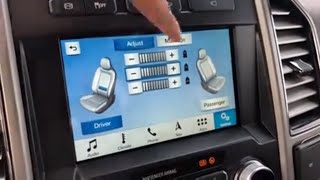
The higher-trim F-350 models of this generation offered complex multi-contour seats with air bladders, pumps, and dedicated control modules. 🎬 Watch: See these multi-contour seats and massage functions in action. Ford has acknowledged that the design is prone to connection failures at the module connector, which is located inside the seatback. The issue, called 'terminal fretting,' is caused by microscopic vibrations leading to a loss of electrical contact, which is why the official fix involves replacing and rerouting the connector harness to prevent future strain.
Diagnostic Flowchart
Tap your situation to follow the diagnostic path that matches what you're seeing on this vehicle.
Symptoms You May Notice
- Multi-contour seat functions (massage, lumbar, side bolsters) are inoperative.
- Seat adjustment controls on the SYNC infotainment screen are greyed out or unresponsive.
- Physical buttons on the side of the seat for massage and lumbar do not work.
- System works intermittently, failing and then suddenly working again after hitting a bump or restarting the truck.
- Air pump inside the seat may be heard running, but no massage or lumbar movement occurs.
- A warning message may appear on the instrument cluster.
- Replacing the entire Driver Multi-Contour Seat Module (SCMG) without first performing the TSB wiring repair. The connector is the cause of the problem in the vast majority of cases.
- Replacing the seat switch assembly. The switch is rarely the point of failure for this specific code.
- Replacing the entire seat assembly, which is extremely expensive and unnecessary.
Most Likely Causes
- Terminal Fretting at Multi-Contour Seat Module Connector 🔴 High Probability This is a known design issue documented by Ford in TSB 19-2390. Normal vehicle vibrations cause microscopic wear and corrosion on the connector pins for the SCMG (driver) and SCMH (passenger) modules, leading to a poor connection.
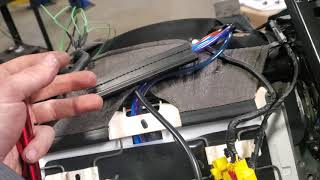
How to confirm: Visually inspect the main electrical connector at the SCMG module, located inside the driver's seat backrest. Access requires unzipping or unclipping the rear seat cover. 🎬 See this walkthrough on accessing the module and fixing the wiring. Look for signs of corrosion, backed-out pins, or fine black dust (fretting) on the terminals. Wiggling the connector may temporarily restore function, confirming a bad connection.
Typical fix: Replace the module connector with an updated pigtail kit (Ford part KU2Z-14S411-FB). The TSB explicitly specifies that the new wires must be soldered and heat-shrunk for a permanent repair; butt connectors included with some kits should not be used for this specific repair. The TSB also mandates creating a 105mm (4.13 in) service loop in the new harness and securing it with a zip tie to prevent future strain and vibration.
Est. part cost: $40-$70 - Failed Driver Multi-Contour Seat Module (SCMG) ⚪ Low Probability
How to confirm: If replacing the connector pigtail does not resolve the issue, the module itself may have failed. This requires testing with a professional scan tool to confirm the module is unresponsive after the wiring has been verified as good per the pinpoint tests.
Typical fix: Replace the SCMG module. Note that a new module often requires programming with a Ford-specific scan tool (like FDRS or FORScan) to function correctly. A likely part number for cross-reference is DU5Z-14F548-F, though it's best to confirm with a dealer using your VIN.
Est. part cost: $250-$650 - Damaged Wiring Harness ⚪ Low Probability
How to confirm: Inspect the wiring leading to the SCMG connector for any visible signs of chafing, breaks, or pinching, particularly where the harness routes through the seat frame.
Typical fix: Repair the specific damaged section of wire.
Est. part cost: $5-$20
Rare But Worth Checking
- Blown Fuse: While unlikely to be the sole cause without other symptoms, it's a simple and crucial first check. On related F-150 and Super Duty models, owners have confirmed fuse #19 (10A) in the engine bay fuse box (BJB) is for the multi-contour seats. This can be confusing as the owner's manual may label it generically as 'Power Seats', and other power seat functions may still operate normally. Always verify the correct fuse for your specific F-350 in the owner's manual.
Diagnosis Steps
- Verify the symptoms: Confirm that the multi-contour seat and massage functions are inoperative from both the seat switch and the SYNC screen.
- Scan for codes: Use an OBD-II scanner capable of reading BCM codes to confirm the presence of B1471 and any accompanying codes like U024B. Note any fault subtypes, such as ':11', which indicates a short to ground.
- Check the fuse: Consult the owner's manual to locate the fuse for the multi-contour seats. On many Super Duty trucks, this is fuse #19 (10A) in the under-hood fuse box.
- Access the module: The SCMG module is located inside the driver's seat backrest. You will need to unclip the J-clips holding the bottom of the rear seat cover and unzip the cover to gain access. You may need to unbolt the seat from the floor (often requiring a Torx Plus TP55 bit) and tilt it back for better access.
- Inspect the connector: Disconnect the main electrical connector from the SCMG module. Carefully inspect both the module pins and the connector terminals for any signs of corrosion, wear, or fine black dust which indicates fretting.
- Perform Pinpoint Tests (Optional but Recommended): Using a multimeter, check for greater than 10 volts between the power input pins and ground. Then, with the battery disconnected, check for less than 5 ohms of resistance between the ground pins and a known good chassis ground.
- Perform the TSB repair: If fretting is suspected or confirmed, the recommended fix is to replace the connector. Purchase the pigtail kit (KU2Z-14S411-FB) and follow the TSB 19-2390 instructions. 🎬 Watch: Professional diagnostic and repair steps for TSB 19-2390. This involves cutting the old connector off, soldering the new pigtail wires one by one, and covering each splice with heat-shrink tubing.
- Reroute and secure the harness: The TSB provides specific instructions for creating a 105mm service loop with the new harness and securing it with a zip tie to prevent future strain and vibration. The new harness should be wrapped in Coroplast tape.
- Clear codes and test: Reconnect the battery, clear all diagnostic trouble codes using a scan tool, and test all seat functions to confirm the repair was successful.
Parts You'll Likely Need
- Connector Pigtail Kit
(OEM #KU2Z-14S411-FA (superseded by KU2Z-14S411-FB))— This is the official part specified by Ford in TSB 19-2390 to permanently fix the terminal fretting issue at the seat module connector.
Trusted brands: Motorcraft
OEM price range: $40-$70 - Driver Multi-Contour Seat Module (SCMG)
(OEM #DU5Z-14F548-F (F-150 P/N for reference, confirm with VIN))— This part is only needed in the rare case that the module itself has failed and the wiring repair did not fix the issue. Requires programming.
Trusted brands: Motorcraft
OEM price range: $600-$750
Aftermarket price range: $250-$400 (Remanufactured/Used)
Related Codes That Often Appear With This One
- U024B — This code means 'Lost Communication With Seat Control Module G' (Driver's side). It often appears with B1471 because the underlying wiring issue at the connector prevents the main vehicle computers from communicating with the seat module.
- U024C — This code means 'Lost Communication With Seat Control Module H' (Passenger's side). It's common to see this code if the passenger seat has the same connector fretting issue, as the TSB repair is often performed on both front seats at the same time.
Technical Service Bulletins (TSBs) & Recalls
- TSB 19-2390: Intermittent Multi-Contour Seat Operation And/Or Massage And Lumbar Adjust Inoperative. This TSB is the primary source for diagnosing and fixing this issue.
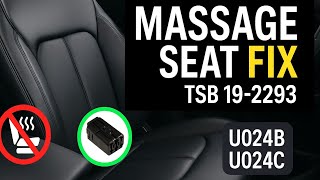
- TSB 19-2293: This is the earlier, superseded version of TSB 19-2390. The information is largely the same but was updated to include more model years.
Platform-Specific Known Issues
- TSB 19-2390, issued by Ford, directly addresses code B1471 and the inoperative multi-contour seats on 2017-2019 F-Super Duty trucks. It identifies the cause as terminal fretting at the SCMG/SCMH connectors and provides a detailed procedure for replacing the connector pigtail. The official warranty labor time for this repair on a Super Duty is 3.6 hours for both front seats. The TSB mandates that the new pigtail wires must be soldered and the harness rerouted to prevent recurrence.
Mechanic-Grade Diagnostic Values
- Voltage at SCMG power input pins — expected: Greater than 10 volts. Failure: Voltage below 10V indicates a power supply issue upstream of the module.
- Resistance between SCMG ground pins and chassis ground — expected: Less than 5 ohms. Failure: Resistance above 5 ohms indicates a poor ground connection, which is a common cause of module communication issues.
Hidden / Shadow Codes Worth Checking
- B1471:11: The ':11' is a Failure Type Byte (FTB) indicating the fault is a 'Circuit Short To Ground'. This provides a more specific diagnostic path than the base code alone. (see via Advanced scan tools like FORScan or the Ford dealer's IDS can display these fault subtypes.)
Scan Tool Commands That Help
- FORScan: SCMG/SCMH Module Self-Test — Run this before disassembling the seat to confirm if the module is communicating. If the self-test fails or the module isn't detected, it strongly points to the power/ground connector issue detailed in TSB 19-2390.
- FORScan: IPC Module Configuration: 'Multi-contour Seat' & 'Enhance Multi-Contour Seat' — This is required when retrofitting multi-contour seats into a vehicle that was not originally equipped with them. The feature must be enabled in the Instrument Panel Control module for the SCMG/SCMH to be recognized and function.
- FORScan / Ford IDS: Clear All DTCs — After the physical repair (pigtail replacement) is complete, all related fault codes (B1471, U024B, U024C) must be cleared from the modules' memory before testing seat functions to verify the fix.
Wiring & Ground Locations
- SCMG / SCMH Connector — Inside the seat backrest of the driver (SCMG) and passenger (SCMH) seats, clipped to the seat frame.. This is the primary failure point. TSB 19-2390 identifies terminal fretting within this connector as the root cause of code B1471 and the associated loss of function.
- Harness Service Loop — At the SCMG/SCMH connector, inside the seat backrest.. The TSB repair mandates creating a 105 mm (4.13 in) service loop and securing it with a zip tie. This provides slack and strain relief, preventing the vibrations that cause terminal fretting from recurring.
- General Ground Point — A common grounding point for interior electronics is a bolt located in the passenger-side kick panel area, near the fuse box.. While the SCMG is grounded through its harness, if a ground-related fault is suspected beyond the connector itself, checking main cabin ground points like this one is a valid next step.
Real Owner Repair Stories
- Ford Truck Enthusiasts forum user 'mfsmith57' (2017 F-450 King Ranch) — Inoperative multi-contour seat functions.
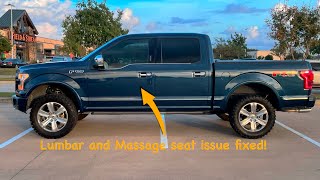
✅ What actually fixed it The user followed TSB 19-2390, purchased the pigtail kit from a Ford dealer for $24, and performed the repair on the driver's seat themselves. It took about 2 hours, with most of the time spent on soldering and heat-shrinking the wires. This completely resolved the issue. - F150forum.com user (2016 Ford F-150 Platinum) — Lumbar and Massage functions were not working.
❌ Tried (didn't work) A dealer performed a TSB for ventilation hoses which did not fix the lumbar/massage issue.
✅ What actually fixed it The owner located and replaced a blown 10A fuse in the under-hood fuse box (position #19). Even though the manual labeled it generically as 'Power Seats' and other seat motors worked, this fuse was the specific cause for the multi-contour system failure.
OEM Part Supersession History
KU2Z-14S411-FA→KU2Z-14S411-FB— The reason for the supersession is not officially documented, but it is common for manufacturers to release updated parts to improve durability or resolve known issues like terminal fretting.
Heads up: None. KU2Z-14S411-FB is the correct and current replacement for KU2Z-14S411-FA. The part is also known by its Motorcraft service name, WPT-1585.
Model Year Variations Within This Range
- 2018+: On related F-150 platforms, the heated/cooled seat module (SCME) location was changed starting in the 2018 model year, moving from under the passenger seat to potentially under the driver's seat. While the multi-contour module (SCMG/H) location inside the seatback remains consistent for the TSB repair, this highlights that module locations and wiring can change mid-generation, making it important to verify locations on your specific vehicle.
Helpful Videos
We Have This Part in Stock


The information in this article is provided for general reference and educational purposes only. Vehicle specifications, procedures, and part compatibility can vary by production date, trim level, and region. Always consult your vehicle's factory service manual and verify part numbers before purchasing or performing repairs. Safety-critical components such as airbags, seat belts, and braking systems should be installed by a qualified professional.
- Ford F-350 SD:
- 🎬 Helpful Videos
- 🛍️ Shop This Part
- What's Unique About the 2017-2019 Ford F-350 SD
- Diagnostic Flowchart
- Symptoms You May Notice
- Most Likely Causes
- Rare But Worth Checking
- Diagnosis Steps
- Parts You'll Likely Need
- Related Codes That Often Appear With This One
- Technical Service Bulletins (TSBs) & Recalls
- Platform-Specific Known Issues
- Mechanic-Grade Diagnostic Values
- Hidden / Shadow Codes Worth Checking
- Scan Tool Commands That Help
- Wiring & Ground Locations
- Real Owner Repair Stories
- OEM Part Supersession History
- Model Year Variations Within This Range
- 🎟️ Get 5% Off