

B1447 on 2015-2019 Lexus RC 350: Rear Air Mix Damper Circuit Failure Guide
Code B1447 on a 2015-2019 Lexus RC 350 means there's a fault with the Rear Air Mix Damper Servo. This is a common issue where the small motor that controls rear cabin temperature fails. The part is relatively inexpensive (~$70-$150), but replacement is extremely labor-intensive, often requiring dashboard removal, so professional repair is highly recommended. Lexus acknowledged the issue with TSBs and a warranty extension program (20LE01).
- B1447 means the small motor controlling your rear seat temperature has failed.
- The most common symptom is a clicking noise from the dashboard or incorrect rear air temperature.
- Before replacing parts, ask a dealer to check if an A/C amplifier software update (per TSB L-SB-0019-20) applies to your vehicle.
- The repair is not DIY-friendly. The servo motor is buried deep in the dashboard, making replacement a job for a professional.
- Check with a Lexus dealer about potential coverage under Customer Support Program 20LE01, even if your vehicle is out of the basic warranty.
What's Unique About the 2015-2019 Lexus RC 350
The third-generation Lexus IS platform, which includes the RC and GS models, is known for issues with its HVAC servo motors. These small Denso-made motors can fail due to wear on their internal electrical potentiometer contacts, causing them to 'hunt' for the correct position. The problem became so widespread that Lexus issued Technical Service Bulletins (TSBs) and a Customer Support Program (20LE01) to address the failures, which included the servo related to code B1447. The primary challenge on the RC 350 is the difficult location of this specific servo, making repair a significant undertaking.
Diagnostic Flowchart
Tap your situation to follow the diagnostic path that matches what you're seeing on this vehicle.
Symptoms You May Notice
- Incorrect air temperature from rear vents (e.g., stuck on full hot or full cold).
- Inability to adjust rear passenger temperature.
- A faint clicking, whirring, or buzzing sound from deep within the dashboard, sometimes described as sounding like a CD changer. 🎬 Watch: Hear what a failing Lexus servo motor sounds like.
- Uneven temperature between the front and rear vents.
- Little to no airflow from the rear vents.
- Replacing the main A/C control panel on the dashboard. The issue is almost never with the user interface buttons, but rather the deeper components like the servo motor or A/C amplifier.
- Replacing the servo motor without first attempting the A/C amplifier software update as recommended by Lexus TSBs.
Most Likely Causes
- Failed Rear Air Mix Damper Servo Motor 🔴 High Probability These servo motors are a known common failure point on this Lexus platform due to wear of internal potentiometer contacts over time.
How to confirm: Use a diagnostic scan tool (like Toyota Techstream) to monitor the servo's live data while commanding temperature changes. If the 'Actual Pulse' value does not match the 'Target Pulse' value, or if clicking is heard with no movement, the servo has failed.
Typical fix: Replace the faulty servo motor. This is a labor-intensive job that often requires removing the dashboard for access and should only be performed after attempting a software update.
Est. part cost: $70-$150 - A/C Amplifier Software Glitch 🟡 Medium Probability Lexus has issued TSBs (L-SB-0019-20 and L-SB-0001-21 Rev) that recommend reprogramming the A/C amplifier as the first step to fix erratic servo behavior.
How to confirm: A Lexus dealership or a shop with access to Toyota's Techstream software can check the current software calibration and update it if a newer version is available per the TSBs.
Typical fix: Flash reprogram the A/C amplifier with the latest software calibration file. This should be done before attempting mechanical repairs, as it can resolve the fault without part replacement.
Est. part cost: $0 - Wiring or Connector Issue ⚪ Low Probability
How to confirm: Once the servo motor is accessed, inspect its electrical connector and wiring for any signs of damage, corrosion, or looseness. Use a multimeter to test for continuity between the servo connector (R58) and the A/C amplifier connector (J48). Resistance should be below 1 Ω.
Typical fix: Repair the damaged section of the wiring harness or clean/replace the connector.
Est. part cost: $5-$50
Rare But Worth Checking
- Failed A/C Amplifier (Control Module): While rare, the control module itself can fail, sending incorrect signals or no signal at all to the servo motor. This is typically only suspected after a new servo motor and verified wiring fail to resolve the issue.
- Mechanically Jammed Damper Door: It is possible for the damper door itself to be stuck due to a foreign object or breakage, which would prevent the servo motor from moving it and could trigger a circuit code. Service information warns to check for mechanical lock issues before replacing parts.
Diagnosis Steps
- Connect a diagnostic scan tool capable of reading Lexus-specific Body (B) codes, such as Toyota Techstream.
- Confirm that B1447 is present in the Air Conditioner module.
- Check for applicable TSBs. For 2017-2019 models, reference L-SB-0019-20. For 2015-2017 models, reference L-SB-0001-21 Rev.
- As per the TSBs, the first step is to flash reprogram the A/C amplifier with the latest calibration file if an update is available.
- After reprogramming (or if no update is available), use the scan tool to perform a 'Servo Motor Initialization' routine. This forces the system to relearn damper positions. This may resolve the issue without part replacement.
- If the code returns, TSB L-SB-0001-21 Rev advises using a 'servo cleaning' utility via Techstream, which cycles the motors to try and clear internal contact issues.
- Access the HVAC live data stream on the scan tool. Command the rear temperature from full hot to full cold and observe the 'Air Mix Servo Targ Pulse(R)' and 'Air Mix Servo Actual Pulse(R)' values. If the 'Actual' value is stuck or does not match the 'Target' value after the previous steps, the servo or its circuit is faulty.
- Listen carefully for clicking or buzzing noises from within the dashboard when changing temperature settings. These noises are a strong indicator of a failing servo with stripped gears or a faulty motor.
- If the software update and cleaning utility do not work, the final step is physical replacement. This requires significant dashboard disassembly to access the servo. 🎬 See this walkthrough of the labor-intensive servo motor replacement.
- Once the servo is accessible, check its electrical connector (R58) and wiring. Test for continuity on the harness between the servo and the A/C amplifier (J48). Resistance should be less than 1 Ω. Test for short to ground; resistance should be 10 kΩ or higher.
Parts You'll Likely Need
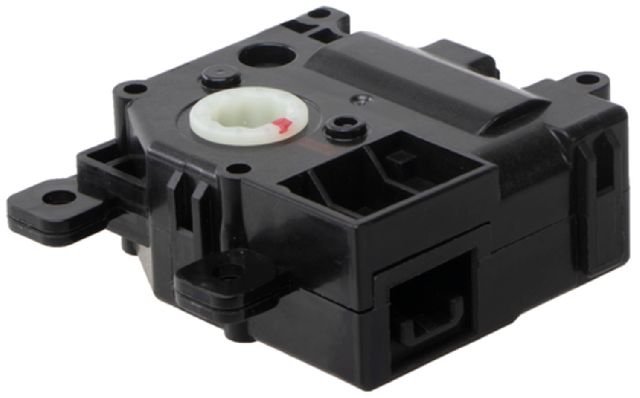
- Damper Servo Sub-Assembly (Rear Air Mix)
(OEM #87106-30540)— This is the electric motor that fails, causing the B1447 code. It is the most common component to be replaced for this issue. Note: TSBs and parts catalogs show conflicting information. TSB L-SB-0001-21 lists 87106-30560 for the GS, while parts diagrams indicate 87106-30540 for the IS/RC. Part number 87106-30520 is for a different servo and should not be used for this repair. Always confirm the part number with a dealer using your VIN.
Trusted brands: Lexus (OEM), Denso
OEM price range: $90-$150
Aftermarket price range: $70-$120
Related Codes That Often Appear With This One
- B1441 — For the Front Passenger Side Air Mix Servo. It's common for multiple servo motors to fail around the same time as they are of similar age and design.
- B1446 — For the Driver Side Air Mix Servo. Seeing this code with B1447 points to a systemic weakness in the HVAC servos.
- B1449 — For the Rear Air Outlet Damper Servo. This servo is also part of the rear HVAC system and may fail concurrently.
Technical Service Bulletins (TSBs) & Recalls
- L-SB-0019-20: HVAC Servo Motor Malfunction (for 2017-2019 models).
- L-SB-0001-21 Rev: HVAC Servo Motor Malfunction (for 2015-2017 models).
- 20LE01: Customer Support Program for A/C Servo Motor Malfunction.
Platform-Specific Known Issues
- Lexus issued Technical Service Bulletin L-SB-0019-20 for 2017-2019 models, which addresses HVAC malfunctions and lists B1447. The procedure involves reprogramming the A/C amplifier.
- Lexus also released TSB L-SB-0001-21 Rev for 2015-2017 models, which provides a comprehensive diagnostic flow: reprogram, clean servo with scan tool, then replace if necessary.
- A Customer Support Program (20LE01) was initiated by Lexus to extend warranty coverage for these failing A/C servo motors on 2015-2017 RC 350 models. Primary coverage ended January 12, 2022, but a secondary coverage for 7 years or 125,000 miles from the date of first use may still apply. Owners should check with a dealer for eligibility, but be aware that some owners have reported needing to pay a diagnostic fee if the servo is not found to be the cause.
Mechanic-Grade Diagnostic Values
- Techstream Live Data: 'Air Mix Servo Actual Pulse(R)' vs 'Air Mix Servo Targ Pulse(R)' — expected: The 'Actual Pulse' value should quickly match the 'Targ Pulse' value after a temperature change. For example, MAX COLD is a pulse value of 254 and MAX HOT is 299.. Failure: The 'Actual Pulse' value is stuck, or remains significantly different from the 'Targ Pulse' value.
- Wiring Harness Continuity (Servo to A/C Amp) — expected: Below 1 Ω. Failure: Higher resistance or an open circuit (OL) indicates a broken wire.
- Wiring Harness Short to Ground — expected: 10 kΩ or higher. Failure: Low resistance indicates a short circuit to ground in the harness.
Scan Tool Commands That Help
- Toyota Techstream: Utility -> AC Servomotor Initialization — This function should be used after replacing a servo, after disconnecting the battery, or as a first-step diagnostic procedure. It forces the A/C amplifier to relearn the end-points of all servo motors and can sometimes resolve erratic behavior without replacing parts.
- Toyota Techstream: Utility -> AC damper servo operation check tool ('Servo Cleaning') — As per TSB L-SB-0001-21 Rev, this utility should be used on 2015-2017 models if the code persists after a software update. It rapidly cycles the servos to attempt to clean oxidation from the internal potentiometer contacts.
Wiring & Ground Locations
- R58 — The electrical connector on the Rear Air Mix Damper Servo itself, located deep within the dashboard as part of the main HVAC unit.. This is the connection point for testing the servo motor directly or checking for signals from the A/C amplifier.
- J48 — The electrical connector at the A/C Amplifier (control module), typically located behind the glove box or in the center console area.. This is the source of the signals for the servo. Testing for continuity between R58 and J48 confirms the integrity of the wiring harness.
Real Owner Repair Stories
- ClubLexus Forum User (2015 Lexus RC350) — Driver side blowing warm while passenger side is cold; multiple HVAC servo codes present.
❌ Tried (didn't work) Initially considering expensive servo replacement based on codes.
✅ What actually fixed it A system reset procedure. First, codes were cleared. Then, the negative battery terminal was disconnected for 10 minutes. After reconnecting, the car was put into accessory mode (push start button twice without brake) to allow the servos to re-initialize on their own. This cleared old, erroneous codes and restored proper function for some servos.
OEM Part Supersession History
87106-30540→— This appears to be the correct and current part number for the Rear Air Mix servo on the RC platform.
Heads up: Part number 87106-30560 is listed in TSB L-SB-0001-21 for code B1447, but this TSB also covers the GS model, for which that part is correct. For the RC, parts catalogs consistently specify 87106-30540. Using the wrong servo can result in incorrect operation even if it physically fits.
Model Year Variations Within This Range
- 2015-2017: These models are covered by TSB L-SB-0001-21 Rev, which has a multi-step diagnostic process: 1) Reprogram A/C Amplifier, 2) Run 'Servo Cleaning' utility, 3) Replace servo if code persists. This suggests the hardware may be more prone to internal contact failure that can sometimes be cleaned by cycling.
- 2017-2019: These models are covered by TSB L-SB-0019-20, which points primarily to reprogramming the A/C Amplifier as the fix. This implies a different software logic or amplifier version was used in later models, and the fault is more often a software glitch than a hardware failure requiring the 'cleaning' step.
Helpful Videos
We Have This Part in Stock

The information in this article is provided for general reference and educational purposes only. Vehicle specifications, procedures, and part compatibility can vary by production date, trim level, and region. Always consult your vehicle's factory service manual and verify part numbers before purchasing or performing repairs. Safety-critical components such as airbags, seat belts, and braking systems should be installed by a qualified professional.
- Lexus RC 350:
- 🎬 Helpful Videos
- 🛍️ Shop This Part
- What's Unique About the 2015-2019 Lexus RC 350
- Diagnostic Flowchart
- Symptoms You May Notice
- Most Likely Causes
- Rare But Worth Checking
- Diagnosis Steps
- Parts You'll Likely Need
- Related Codes That Often Appear With This One
- Technical Service Bulletins (TSBs) & Recalls
- Platform-Specific Known Issues
- Mechanic-Grade Diagnostic Values
- Scan Tool Commands That Help
- Wiring & Ground Locations
- Real Owner Repair Stories
- OEM Part Supersession History
- Model Year Variations Within This Range
- 🎟️ Get 5% Off