

B1443 on 2015-2019 Lexus RC F: Air Outlet Damper Servo Failure Causes and Fixes
B1443 means the servo motor that directs air to your dash vents (face, feet, defrost) has failed. This is a very common issue on this platform and its relatives (IS, GS). The part, OEM #87106-30570, costs around $120-$250, but it is buried deep in the dashboard. Lexus's own service bulletin confirms the entire HVAC unit must be removed for replacement, making professional repair extremely expensive due to 5-8+ hours of labor, often totaling $1,200-$2,500.
- B1443 almost always means the Air Outlet Damper Servo (87106-30570) has failed.
- This is a known, common problem for the 2015-2019 Lexus RC F and its platform mates (IS, GS).
- The vehicle is safe to drive, but you will not be able to control where the air blows inside the cabin, with it often defaulting to the defrost vents.
- The repair is extremely labor-intensive and expensive because Lexus's own service procedure requires removing the entire dashboard and HVAC unit to access this specific servo.
- This is not a recommended DIY job for beginners. Get quotes from both a Lexus dealer and a trusted independent shop specializing in Toyota/Lexus, as labor rates can vary significantly.
What's Unique About the 2015-2019 Lexus RC F
The 2015-2019 RC F, along with its sibling platforms like the IS and GS, is notorious for HVAC servo motor failures. Lexus has issued multiple Technical Service Bulletins (TSBs) acknowledging the high failure rate. Specifically for code B1443, TSB L-SB-0001-21 Rev confirms that the 'Air Outlet Servo (D)' requires the complete removal of the main A/C heater unit from behind the dashboard to be replaced. This specific requirement is what makes the repair so labor-intensive and costly, a common and major frustration for owners of this generation of Lexus vehicles.
Diagnostic Flowchart
Tap your situation to follow the diagnostic path that matches what you're seeing on this vehicle.
Symptoms You May Notice
- Air blows from the wrong vents (e.g., stuck on defrost or floor vents)
- Airflow defaults to the defrost vents regardless of setting
- Inability to change airflow direction using the MODE button
- Clicking, grinding, or buzzing noises from behind the dashboard when changing climate settings
- Uneven or weak airflow from certain vents
- No air coming from face-level vents
- Replacing the climate control head unit on the dash. The control panel is almost never the cause; the fault lies with the motor it's trying to command.
- Replacing the wrong servo motor. There are multiple servos in the HVAC unit. A misdiagnosis can lead to a costly repair that doesn't fix the original problem, as one owner experienced when a dealer replaced a defrost servo instead of the correct air mix servo.
Most Likely Causes
- Failed Air Outlet Damper Servo Motor 🔴 High Probability This is a widely documented common failure part on this Lexus platform, as confirmed by TSBs and extensive owner forums. The internal plastic gears and electric motor wear out over time. Lexus officially calls this part 'SERVO SUB-ASSY, DAMPER, NO.5'.
How to confirm: Listen for clicking/grinding noises from the dash when changing modes. A professional scan tool (like Toyota Techstream) can attempt to actuate the servo; if it fails to move or reports an invalid position, the servo is bad.
Typical fix: Replace the faulty servo motor (Part No. 87106-30570). 🎬 Watch: A quick look at the servo motor replacement process. This is extremely labor-intensive as the entire dashboard and HVAC unit must be removed to access it, per Lexus TSB L-SB-0001-21 Rev.
Est. part cost: $115-$260
Rare But Worth Checking
- Mechanically Jammed Damper Door or Linkage: Less common than motor failure, but the plastic linkage arms can sometimes bind, break, or become disconnected, preventing the servo from moving the door. This can happen if debris enters the HVAC case, sometimes during a cabin air filter change. A technician can operate the dampers by hand after removing the servo to check for smooth movement.
- Wiring or Connector Fault: An open or short in the wiring harness between the A/C amplifier and the servo motor, or a corroded connector pin, can trigger this code. This is unlikely unless the dashboard has been previously removed or serviced.
- Faulty A/C Amplifier: This is the least likely cause. The A/C Amplifier is the control module that commands all the servos. TSB L-SB-0019-20 notes that for some 2017-2019 models, a software re-flash may be part of the solution, but outright failure is rare. It should only be considered after the servo motor and wiring have been proven to be good.
Diagnosis Steps
- Connect a high-end scan tool (like Toyota Techstream) to the vehicle's OBD-II port.
- Read the codes from the Air Conditioning module. Confirm B1443 is present and active.
- Use the scan tool's 'Active Test' function to command the Air Outlet Damper Servo to move. Listen for noises (clicking, grinding) or a lack of noise from the driver's side of the dashboard.
- Observe the live data from the servo's position sensor on the scan tool. If the value does not change when commanded, the servo is either jammed or electrically failed.
- For 2017-2019 models, consult TSB L-SB-0019-20, as a flash reprogram of the A/C amplifier may be required as part of the diagnostic procedure.
- Due to the servo's location, physical inspection is not feasible without major dashboard disassembly. Trust the scan tool data.
- If the servo does not move but has a good connection (verified after disassembly), it is faulty and needs to be replaced.
- If the servo is confirmed to be good, the wiring harness between the servo and the A/C amplifier must be tested for continuity and shorts—a task best left to a professional.
- In the rare event that both the servo and wiring are good, the A/C amplifier may be at fault.
Parts You'll Likely Need
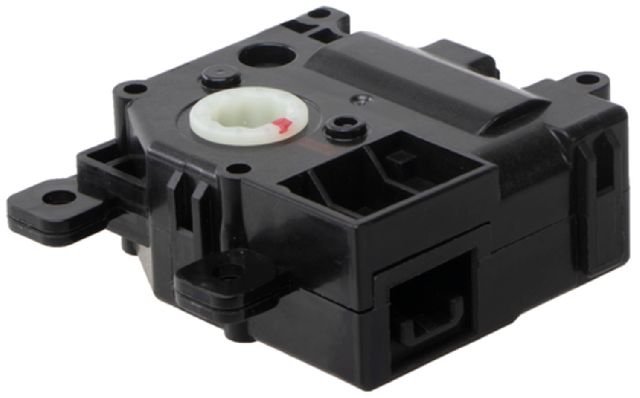
- Air Outlet Damper Control Servo Motor (SERVO SUB-ASSY, DAMPER, NO.5)
(OEM #87106-30570)— This is the component that almost always fails, containing a small motor and position sensor that wear out. It is used across a wide range of Lexus models from this era.
Trusted brands: Lexus (OEM), Toyota (OEM)
OEM price range: $116-$251
Aftermarket price range: $80-$150
Related Codes That Often Appear With This One
- B1441 — This code is for the passenger-side air mix servo. It's common to see multiple servo motor codes together as they are of the same design and age, and often fail around the same time.
- B1442 — This code is for the air inlet (recirculation) servo. Like other HVAC servos in the system, it is prone to failure and can appear alongside B1443.
Technical Service Bulletins (TSBs) & Recalls
- L-SB-0001-21 Rev: HVAC Servo Motor Malfunction (2013-2017 Models): This is the primary TSB for this issue on early models. It lists B1443 and provides a 77-page guide for diagnosis and replacement. It confirms that replacing the servo for B1443 requires removing the entire A/C unit from the vehicle. It also details a Customer Support Program (now likely expired) related to this issue. [⭐ MANUFACTURER TSB — highest authority]
- L-SB-0019-20: HVAC Servo Motor Malfunction (2017-2019 Models): This TSB applies to later models and also lists B1443 as a known fault code for improper HVAC function. It includes procedures that may involve flash reprogramming the A/C amplifier in addition to potential servo replacement. [⭐ MANUFACTURER TSB — highest authority]
Platform-Specific Known Issues
- TSB Confirms Extreme Labor: Lexus issued Technical Service Bulletin L-SB-0001-21 Rev, which includes diagnostic procedures for B1443. Crucially, its internal guide for technicians identifies the 'Air Outlet Servo (D)' corresponding to B1443 as requiring the entire A/C heater unit to be removed from the vehicle for replacement, unlike some other servos that can be accessed in-place. This is the primary reason for the 8+ hour labor charge. [⭐ MANUFACTURER TSB — highest authority]
- Owner Experience: Intermittent Failure and Default to Defrost: A user on the r/LexusRC subreddit with a 2015 RC 350 F Sport reported intermittent HVAC failure where air would only blow from the defrost vents, despite hearing the fan running. A self-diagnostic check revealed code '43', which corresponds to B1443, confirming this as a common failure mode.
- source — A 2015 RC F owner on ClubLexus detailed a lengthy and frustrating dealer visit for a 'no driver's side heat' issue. The dealer first replaced a defrost servo under a service campaign, which did not fix the problem. They then quoted the owner ~$3,500 for a complete A/C box assembly, claiming all other servos tested fine. This highlights the diagnostic difficulty and potential for high costs even at the dealer.
- Intermittent Nature: Owners have reported that sometimes the issue can temporarily resolve itself after restarting the car, but it almost always returns, indicating an impending mechanical failure of the servo.
Mechanic-Grade Diagnostic Values
- Techstream Live Data: 'A/O DAMP POS' (Air Outlet Damper Position) vs 'A/O DAMP TARG' (Target) — expected: The 'POS' value should closely track the 'TARG' value as modes are changed. For example, 'FACE' mode target is -10.0%, 'FOOT' is 33.5% or 49.0%, and 'FOOT/DEF' is 69.0% or 95.0%.. Failure: The 'POS' value is stuck, does not match the 'TARG' value, or shows a fixed value like 50.0% which can indicate an open circuit.
- Servo Motor Bench Test: Voltage Application — expected: Applying 12V DC to terminals 4 and 5 of the servo motor should cause the lever to move smoothly to one end of its travel (e.g., 'FACE' position). Reversing the polarity should move it smoothly to the other end ('DEF' position).. Failure: No movement, jerky movement, or grinding indicates a failed internal motor or stripped gears.
- Harness Resistance Check — expected: Less than 1 Ω of resistance between the corresponding pins at the A/C Amplifier connector and the servo motor connector.. Failure: High resistance or an open circuit (OL) reading indicates a break or corrosion in the wiring harness.
Scan Tool Commands That Help
- Toyota Techstream: Body -> Air Conditioner -> Active Test — This is the primary diagnostic step. It allows a technician to command the 'Air Outlet Servo Pulse (D)' to move without disassembling the dash. If the servo does not respond or makes noise, it confirms a fault in the motor or its circuit.
- Toyota Techstream: Body -> Air Conditioner -> Data List — Used to monitor the 'Target Pulse' and 'Actual Pulse' (or 'A/O DAMP TARG' vs 'A/O DAMP POS') of the servo in real-time. A mismatch between the commanded value and the actual reported value confirms the failure.
- Toyota Techstream: Body -> Air Conditioner -> Utility -> Servomotor Initialization — This procedure is required after replacing a servo motor to allow the A/C amplifier to relearn the travel end-points of all dampers. It can sometimes temporarily resolve an intermittent fault by re-syncing a stuck motor, but it is not a permanent fix for a failing part.
Wiring & Ground Locations
- A/C Amplifier Assembly — Located in the center of the dashboard, generally behind or below the radio and glove box area.. This is the control module that sends power and control signals to the B1443 servo motor. All circuit testing for the servo originates from this module's connectors.
- Instrument Panel Ground Points (e.g., J1, J2) — Primary ground points for the instrument panel harness are located in the driver's side kick panel (J1) and on the left side of the shift lever assembly under the console (J2).. The A/C Amplifier and servo circuits rely on a solid ground connection. A loose or corroded ground at these common points can cause erratic behavior or a complete failure of the servo motor, leading to a B1443 code.
- Air Outlet Damper Servo Connector — Directly on the servo motor body, which is located deep within the HVAC unit. Per TSB L-SB-0001-21, this specific servo is on the driver's side of the unit. Some sources suggest it may have a blue connector.. This is the final connection point before the motor itself. Testing for power and signal must be done here to confirm if the fault is in the wiring or the motor, though access is nearly impossible without major disassembly.
Real Owner Repair Stories
- YouTube video by 'Carbo Garage' (2015 Lexus GS 350 (similar HVAC architecture)) — No air coming from the left side vents, only the right side. Code B1443 was present.
❌ Tried (didn't work) The servo motor itself was tested and found to be working correctly when commanded by a scan tool.
✅ What actually fixed it The plastic linkage arm connected to the servo motor had broken and jammed the damper door. The technician was able to access the broken piece by removing the audio system and a side air duct, without full dashboard removal. He removed the broken plastic piece, freeing the door, which restored airflow. This was presented as a way to avoid a full dashboard-out repair if the motor itself is still good. - Reddit user on r/LexusIS (2014 Lexus IS250) — Identical symptoms to B1443 failure (incorrect airflow).
❌ Tried (didn't work) Mechanic replaced the servo motors., Mechanic then replaced the A/C Amplifier.
✅ What actually fixed it The issue was still not resolved after $4,000 in repairs. The owner eventually took it to a Lexus dealership, who found no issue at the time of inspection, and the problem did not return. This highlights the intermittent nature and diagnostic difficulty, and the risk of expensive, incorrect repairs by non-specialists.
OEM Part Supersession History
87106-30570→87106-30570— No supersession found. This part number appears to be the consistent and current part for the specified application across its model years.
Model Year Variations Within This Range
- 2017-2019: TSB L-SB-0019-20 applies to these later models and introduces the possibility of a flash reprogram for the A/C amplifier as part of the diagnostic and repair procedure, which is not mentioned for earlier years covered by TSB L-SB-0001-21 Rev.
Helpful Videos
We Have This Part in Stock

The information in this article is provided for general reference and educational purposes only. Vehicle specifications, procedures, and part compatibility can vary by production date, trim level, and region. Always consult your vehicle's factory service manual and verify part numbers before purchasing or performing repairs. Safety-critical components such as airbags, seat belts, and braking systems should be installed by a qualified professional.
- Lexus RC F:
- 🎬 Helpful Videos
- 🛍️ Shop This Part
- What's Unique About the 2015-2019 Lexus RC F
- Diagnostic Flowchart
- Symptoms You May Notice
- Most Likely Causes
- Rare But Worth Checking
- Diagnosis Steps
- Parts You'll Likely Need
- Related Codes That Often Appear With This One
- Technical Service Bulletins (TSBs) & Recalls
- Platform-Specific Known Issues
- Mechanic-Grade Diagnostic Values
- Scan Tool Commands That Help
- Wiring & Ground Locations
- Real Owner Repair Stories
- OEM Part Supersession History
- Model Year Variations Within This Range
- 🎟️ Get 5% Off