

B1442 on 2015-2019 Lexus RC 350: Air Inlet Damper Servo Fault Causes and Fixes
On a 2015-2019 Lexus RC 350, code B1442 points to a failure of the Air Inlet Damper Servo Motor. This part controls the fresh-air/recirculation flap. The motor itself is the common failure point, a known issue for this Lexus platform. The part costs around $150-$250, but replacement is labor-intensive due to its location deep in the dashboard. Lexus acknowledged this with a Customer Support Program (20LE01) that extended warranty coverage.
- B1442 on your RC 350 means the motor that controls the fresh air vs. recirculated air flap has failed.
- This is a very common and well-documented problem for this generation of Lexus vehicles.
- The primary symptom is being stuck in either fresh or recirculate mode, often accompanied by a clicking sound from the dash.
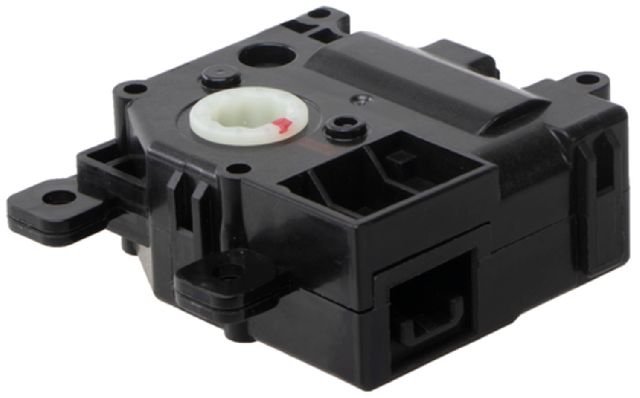
- The fix is to replace the Air Inlet Damper Servo Motor (OEM P/N 87106-30500).
- While the part is affordable, the repair is labor-intensive (DIY difficulty 4/5) as it requires removing the glove box and accessing a tight space deep in the dashboard.
What's Unique About the 2015-2019 Lexus RC 350
The Lexus RC platform and its relatives from this era (like the IS and GS) are known for HVAC servo motor failures. Lexus acknowledged this widespread issue by issuing multiple Technical Service Bulletins (TSBs) and a Customer Support Program (20LE01) that extended warranty coverage for these specific parts due to a high rate of internal electrical malfunctions. While the code points to a simple motor, its location deep within the dashboard assembly makes the repair unusually difficult and labor-intensive for this specific vehicle, often requiring removal of the entire A/C unit.
Diagnostic Flowchart
Tap your situation to follow the diagnostic path that matches what you're seeing on this vehicle.
Symptoms You May Notice
- Inability to switch between fresh air and recirculation modes.
- Outside odors, like exhaust from other cars, entering the cabin when recirculation is selected.
- A/C performance seems poor, especially on hot days (if stuck in fresh air mode).
- Clicking, grinding, or buzzing noises from the passenger side of the dashboard, particularly behind the glove box, upon startup or when pressing the recirculation button. 🎬 Watch this to understand why your dashboard is making clicking noises.
- The 'Auto' A/C light turns on by itself at startup, stays on for about 30 seconds, then turns off. A ClubLexus user with a B1442 code specifically reported this symptom.
- The code may only set when the system is in 'fresh air' mode, but not when in 'recirculate' mode, as noted by an owner using Techstream for diagnostics.
- Replacing the A/C Compressor: The compressor is unrelated to the air source control. A failure here would typically set different codes and result in a total loss of cooling.
- Recharging the A/C System: Low refrigerant will not cause a servo motor circuit code. It will cause poor cooling but will not affect the fresh/recirculation door.
Most Likely Causes
- Failed Air Inlet Damper Servo Motor 🔴 High Probability These servo motors are a known high-failure item across the Lexus lineup from this period, as documented in TSBs L-SB-0019-20 and L-SB-0001-21. The internal electronics or plastic gears are prone to failure, leading to an internal electrical malfunction.
How to confirm: Use a diagnostic scan tool (like Toyota Techstream) to command the air inlet servo to move. If the 'Actual Pulse' value in the data stream does not match the 'Target Pulse', the motor has failed. Alternatively, press the recirculation button and listen for a clicking/whirring sound from behind the glovebox with no corresponding change in airflow; this indicates a failed motor.
Typical fix: Replace the Air Inlet Damper Servo Motor.
Est. part cost: $150-$250 - A/C Amplifier Software/Calibration Issue 🟡 Medium Probability Lexus released updated calibration files for the A/C Amplifier (control module) to address conditions that could lead to servo motor-related DTCs. TSB L-SB-0001-21 Rev includes flash reprogramming as a key procedure. Sometimes, re-flashing the module with the latest software can resolve the issue without replacing parts.
How to confirm: This requires a dealer or a specialized shop with access to Toyota's TIS (Technical Information System) to check the current calibration ID against the latest available version. A Reddit user noted a new calibration file became available in 2020 that solved the issue for many.
Typical fix: Reprogram (re-flash) the A/C Amplifier with the latest software calibration file.
Est. part cost: $0 (if done under warranty/CSP) or $100-$250 for labor - Damaged Wiring or Loose Connector ⚪ Low Probability While less common than motor failure, the wiring harness leading to the servo can be damaged, particularly if other dash work has been performed. The servo is located behind the glove box, making its connector susceptible to being disturbed.
How to confirm: After accessing the servo motor, visually inspect its electrical connector and nearby wiring for any signs of damage, chafing, or loose pins. Use a multimeter to check for power and ground signals at the connector when the recirculation button is pressed.
Typical fix: Repair the damaged section of the wiring harness or re-secure the connector.
Est. part cost: $5-$50
Rare But Worth Checking
- Faulty A/C Amplifier (Control Module): This is rare. The control module itself can fail, but this should only be considered after the servo motor and wiring have been ruled out. A faulty amplifier often causes multiple, simultaneous servo motor codes, not just B1442 alone. A Reddit user reported a dealer diagnosing all 8 servos as failed, which could point to an amplifier issue.
- Mechanically Jammed Damper Door: It is possible for the damper door itself or its linkage to become physically stuck. This can happen if the cabin air filter was replaced incorrectly without first putting the HVAC system into recirculate mode, which moves the linkage out of the way. Forcing the filter housing can dislodge the linkage arm.
Diagnosis Steps
- Confirm code B1442 is present using an OBD-II scanner capable of reading Body (B) codes.
- Press the recirculation button on the climate control panel. Listen for sounds from the passenger side dashboard. A clicking or grinding noise with no change in airflow suggests a failed servo.
- As a potential quick fix, disconnect the 12V battery for 30 minutes. This can sometimes force the HVAC system to re-initialize the servos and may temporarily clear the code, though the fault often returns.
- If the code returns, access the Air Inlet Damper Servo. This requires removing the glove box assembly and potentially the A/C amplifier for better access.
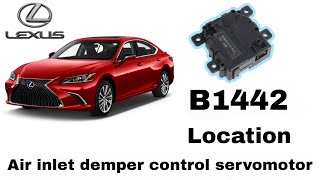
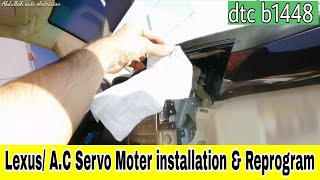
- With the servo visible, press the recirculation button again and observe if the servo's arm attempts to move. No movement or erratic movement confirms a bad servo. A YouTube video shows the location visually. 🎬 Watch this video to see the exact servo motor location.
- If the servo does not move, disconnect its electrical connector and test for power and ground with a multimeter when the button is pressed. If power is present, the servo is confirmed bad.
- If power is not present, the problem lies in the wiring or the A/C amplifier, which requires more advanced diagnostics.
- After replacing the servo, perform a 'Servo Motor Initialization' using a capable scan tool like Toyota Techstream to ensure the new motor learns its proper end-stop positions. This is a required step in the official TSB repair procedure.
Parts You'll Likely Need
- Air Inlet Damper Servo Motor
(OEM #87106-30500)— This is the component that fails most frequently, causing the B1442 code. It is the motor responsible for moving the fresh air/recirculation door.
Trusted brands: Lexus (OEM), Denso
OEM price range: $190-$260
Aftermarket price range: $150-$200
Related Codes That Often Appear With This One
- B1441 — This code is for the Passenger Side Air Mix Damper Servo. These servos are of similar design and age, and often fail around the same time. Both are cited in the same TSBs.
- B1443 — This code is for the Air Outlet Damper Control Servo. Like B1441, it's a related servo motor that is prone to failure and is mentioned in the same service bulletins.
Technical Service Bulletins (TSBs) & Recalls
- L-SB-0019-20: Notes that B1442 is one of several HVAC DTCs related to servo motor circuit failures.
- L-SB-0001-21 Rev: Also lists B1442 as a known HVAC servo DTC and provides detailed repair flowcharts, including procedures for reprogramming the A/C amplifier and replacing the servo motors.
- Customer Support Program 20LE01: Not a TSB, but a formal program by Lexus to cover repairs for this specific issue. It covers 2015-2017 RC 350 models, among many others.
Platform-Specific Known Issues
- Lexus issued Customer Support Program 20LE01, extending warranty coverage for failing A/C servo motors on certain models, including the 2015-2017 RC 350. Primary coverage was offered until January 12, 2022, regardless of mileage. Secondary coverage is for 7 years or 125,000 miles from the date of first use. The repair is performed free of charge at a dealer if the diagnosis confirms the specific internal electrical malfunction.
- TSB L-SB-0001-21 Rev and L-SB-0019-20 were released to address this and other related HVAC servo motor codes, providing diagnostic and repair procedures. The TSBs cover a wide range of codes from B1441 to B1455.
- Owners on forums have noted that dealers may require a diagnostic fee (e.g., ~$270) to confirm the issue, which is only waived if the repair is covered under the Customer Support Program.
Mechanic-Grade Diagnostic Values
- Techstream Live Data: Air Inlet Damper Target vs. Actual Pulse — expected: The 'Actual Pulse' value should match the 'Target Pulse' value as the recirculation button is pressed. For example, 'Target Pulse' may command 7 for FRESH and 19 for RECIRC; 'Actual Pulse' should follow. Some newer software versions may show values like 220 for FRESH and 256 for RECIRC.. Failure: The 'Actual Pulse' value does not change, or it is stuck at a maximum value (e.g., 254 or 255) and does not match the target value.
- Servo Position Sensor Resistance (at servo connector) — expected: Between terminals 1 and 3: Constant 4.2 - 7.8 kΩ. Between terminals 3 and 5: 0.8 - 1.6 kΩ at FRESH position, 3.1 - 5.8 kΩ at RECIRC position.. Failure: Resistance values are outside the specified ranges, indicating a faulty internal position sensor.
- Wiring Harness Continuity (between A/C Amplifier and Servo) — expected: Below 1 Ω on all signal and power lines.. Failure: Resistance is above 1 Ω or reads OL (Open Loop), indicating a break or high resistance in the wiring.
Hidden / Shadow Codes Worth Checking
- 42: This is a 2-digit flash code that corresponds to the full B1442 DTC. It can be retrieved without a scan tool by using a self-diagnostic procedure involving the climate control panel. (see via By initiating the onboard HVAC diagnostic mode, which flashes the 'AUTO' light in a sequence to output 2-digit codes.)
Scan Tool Commands That Help
- Toyota Techstream: Servomotor Initialization — This utility, found under 'Body Electrical / Air Conditioner / Utility', is required after replacing a servo motor or disconnecting the battery. It forces the A/C amplifier to relearn the end-stop positions of all servo motors. Running this procedure multiple times can sometimes resolve a temporary glitch without replacing parts.
- Toyota Techstream: Active Test: Air Inlet Damper Targ Pulse — This function, found under 'Body / Air Conditioner / Active Test', allows a technician to manually command the servo motor to a specific pulse value. It is used to verify if the motor responds to commands while observing the 'Actual Pulse' value in the Data List.
Wiring & Ground Locations
- A/C Amplifier (HVAC Control Module) — Located behind the glove box assembly. It is often a blue module with three main connectors.. This module sends the power and control signals to the air inlet servo. All wiring for the servo originates from this module, making its connectors a key inspection point for loose pins or corrosion.
- Main Battery Ground Cable — The main ground cable runs from the battery's negative terminal to the inner fender on the right (passenger) side of the engine bay. Additional ground straps connect the chassis/firewall to the engine block.. While a poor ground is a rare cause for this specific code, an unstable system ground can cause unpredictable behavior in various electronic modules, including the A/C Amplifier. Verifying a clean, tight main ground connection is a fundamental step in diagnosing any complex electrical issue.
Real Owner Repair Stories
- ClubLexus user 'bfromguam' (Lexus RC (year not specified, but platform relevant)) — Difference in temperature coming from the passenger side vents.
❌ Tried (didn't work) Initial diagnosis pointed towards servo failure.
✅ What actually fixed it The user was advised to first clear all historical codes and then perform the 'Servomotor Initialization' utility in Techstream multiple times (up to 5 times was suggested). This recalibration process can often restore proper function if the failure is due to a loss of position memory rather than a hard mechanical or electrical failure. - ClubLexus user 'icegbe' (2015 Lexus RC350) — Driver side blows warm air while the passenger side is cold; HVAC system making noises.
❌ Tried (didn't work) Spending money on new servos or dealer labor.
✅ What actually fixed it The user created a definitive guide. The first step is to clear all codes and reset the system by disconnecting the battery ground terminal for 10 minutes. After reconnecting, turn on auxiliary power (push start button twice without brake) and wait for all servo initialization sounds to stop before starting the car. This re-initialization fixed the issue.
OEM Part Supersession History
87106-30500→87106-30500— No supersession found. This part number appears to be the consistent and current part for the specified vehicle range.
Helpful Videos
We Have This Part in Stock

The information in this article is provided for general reference and educational purposes only. Vehicle specifications, procedures, and part compatibility can vary by production date, trim level, and region. Always consult your vehicle's factory service manual and verify part numbers before purchasing or performing repairs. Safety-critical components such as airbags, seat belts, and braking systems should be installed by a qualified professional.
- Lexus RC 350:
- 🎬 Helpful Videos
- 🛍️ Shop This Part
- What's Unique About the 2015-2019 Lexus RC 350
- Diagnostic Flowchart
- Symptoms You May Notice
- Most Likely Causes
- Rare But Worth Checking
- Diagnosis Steps
- Parts You'll Likely Need
- Related Codes That Often Appear With This One
- Technical Service Bulletins (TSBs) & Recalls
- Platform-Specific Known Issues
- Mechanic-Grade Diagnostic Values
- Hidden / Shadow Codes Worth Checking
- Scan Tool Commands That Help
- Wiring & Ground Locations
- Real Owner Repair Stories
- OEM Part Supersession History
- 🎟️ Get 5% Off