

OBD-II Code B1431: A Split-Personality Fault - Wiper Circuit Failure or Critical Airbag Fault
Why B1431 means something completely different depending on your car, and how to diagnose it
- Code B1431 is manufacturer-specific, meaning it flags a wiper failure on a Ford but a critical airbag fault on a Nissan.
- On Ford, GM, and Dodge vehicles, B1431 indicates a failed wiper motor park switch, requiring a $150 to $400 wiper motor replacement.
- On Nissan, Hyundai, Kia, and Mitsubishi models, B1431 flags a critical Supplemental Restraint System (SRS) failure that disables the airbags.
- Never attempt DIY repairs on SRS components like seat belt pretensioners; use a professional scan tool to read live resistance data before replacing parts.
What Does B1431 Mean?

B1431 is a manufacturer-specific code with drastically different meanings. For domestic vehicles (Ford, GM, Dodge), it indicates the Body Control Module (BCM) lost the signal from the 'park switch' inside the windshield wiper motor, which tells the wipers when to stop at the base of the windshield. For Asian vehicles (Hyundai, Kia, Nissan, Mitsubishi), B1431 is a critical Supplemental Restraint System (SRS) code indicating a fault, such as an open or short circuit, in a side airbag or seat belt pretensioner.
Technical definition: The official SAE/OBD-II definition for code B1431 varies by manufacturer. For Ford and GM, it is 'Wiper Brake/Run Relay Circuit Failure' or 'Wiper Park Sense Circuit Failure'. For Toyota/Lexus, it refers to an 'Air Mix Damper Position Sensor Circuit' fault in the HVAC system. For Nissan, Hyundai, Kia, and Mitsubishi, it indicates a critical fault in the Supplemental Restraint System (SRS), such as 'Side Airbag Squib (LH) Circuit Open' or 'RH seat belt pre-tensioner circuit short to power'.
Can I Drive With B1431?
depends_on_manufacturer. The answer depends on your vehicle's make. If the code is for a 'Wiper Circuit Failure' (common on Ford, GM), you can drive, but your visibility is dangerously compromised in bad weather. If the code indicates an 'Airbag System Fault' (common on Nissan, Hyundai, Kia, Mitsubishi), driving is NOT recommended. This signifies a critical failure in the safety system; the airbags will NOT deploy in a collision. Have the vehicle inspected by a professional immediately.
Common Causes

- Faulty Wiper Motor / Internal Park Switch (Very Common) — For wiper-related faults, this is the primary cause. The park switch is integrated into the wiper motor assembly. When it fails, you must replace the entire motor.
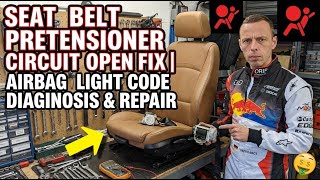
- Failed Seat Belt Pretensioner (Common) — On Nissan and other makes, B1431 points directly to a fault in the seat belt pretensioner 🎬 See this walkthrough for diagnosing seat belt pretensioner circuit faults, which uses an explosive charge to tighten the belt in a crash. The internal wiring or the charge itself fails.
- Faulty Airbag Module (Squib) (Common) — On Hyundai, Kia, and Mitsubishi, the code indicates an open or short circuit in the airbag igniter, known as the squib. This requires replacing the airbag module.
- Blown Fuse or Faulty Relay (Common) — A blown fuse for the wiper or SRS circuit causes a loss of power. A faulty wiper relay causes wiper-specific issues. Always check fuses first as it is a simple inspection.
- Damaged Wiring or Connectors (Common) — Wires leading to the wiper motor or an SRS component fray, corrode, or suffer rodent damage. A bad connection at the plug interrupts the signal.
- Faulty Clock Spring (Common) — For SRS faults related to the driver's airbag, the clock spring in the steering column is a frequent failure point. The internal ribbon cables break from repeated turning, causing an open circuit.
- Water Intrusion into BCM/GEM/Fuse Box (Less Common) — On 1997-2004 Ford F-150s, a leaky windshield seal allows water to drip directly onto the Generic Electronic Module (GEM) or fuse box 🎬 Watch: How a windshield leak damages the Ford GEM module, causing corrosion and electrical faults.
- Faulty Body Control Module (BCM) or SRS Module (Rare) — The control module itself fails rarely. Exhaustively rule out all other possibilities (wiring, component, fuses) before replacing this expensive part.
Symptoms

- Illuminated Airbag Warning Light — On Hyundai, Kia, Nissan, and Mitsubishi vehicles, this light indicates a serious safety system fault and remains on until repaired. 🎬 Watch: Common reasons for Hyundai and Kia airbag warning lights
- Wiper Malfunctions — On Ford, GM, and Dodge vehicles, wipers stop in the middle of the windshield, run erratically, or fail to turn on completely.
- Incorrect HVAC Temperature or Airflow — On Toyota and Lexus vehicles, this code points to a climate control system problem, causing incorrect air temperature or improper vent routing.
Diagnostic Flowchart
Tap your situation to follow the diagnostic path that matches what you're seeing on this code.
Common Fixes & Costs
- Replace Wiper Motor Assembly
— Parts: $60-$350, Labor: $130-$200, ~1.2 hr book time
(Intermediate)
Ford F-150 (2004-2008): OEM 8L3Z-17508-B (Alt: Dorman 602-306, WAI WPM2067)
Dodge Challenger (2015-2023): OEM 68385090AC (Alt: Dorman 602-211AS) - Replace/Rebuild Seat Belt Pretensioner
— Parts: $150-$400, Labor: $150-$300, ~1.5 hr book time
(Intermediate)
Nissan Frontier (2005-2019): OEM 86885-9CA7D (Alt: Mail-in rebuild services (e.g., Safety Restore)) - Replace Airbag Module (in seat or dash)
— Parts: $200-$800, Labor: $130-$250, ~1.3 hr book time
(Professional)
Hyundai Sonata (2015-2017): OEM 85010-C2000 (Left Curtain Airbag) (Alt: N/A) - Repair Damaged Wiring/Connector — Parts: $10-$50, Labor: $150-$800, ~2.5 hr book time (Intermediate)
- Replace SRS Control Module
— Parts: $400-$800, Labor: $130-$200, ~1.0 hr book time
(Professional)
Kia Sorento (2011-2012): OEM 95910-1U150 (Alt: N/A) - Replace Body Control Module (BCM) — Parts: $400-$600, Labor: $130-$250, ~1.5 hr book time (Professional)
Used vs. New Parts: Buying Guide
When a used part is worth it: A used OEM wiper motor from a reputable auto recycler is a cost-effective option. Buying used SRS components (airbags, pretensioners, modules) is NOT recommended due to extreme safety risks and potential hidden damage.
Donor-vehicle mileage cap: roughly under 100000 miles for the part to have meaningful remaining life.
Donor quality checklist:
- For Wiper Motors: Match the part number exactly. Ensure the donor vehicle was not scrapped due to front-end collision damage. Avoid parts with visible corrosion.
- For SRS Components: Buy new OEM parts or use a professional mail-in repair service. If considering a used non-deployed airbag, it must be from a certified automotive recycler.
Decision logic:
- If The part is an airbag, clock spring, or seat belt pretensioner → Buy new OEM or use a certified rebuild service. The safety risk of a faulty used part is too high.
- If The part is a wiper motor and the vehicle is over 100K miles → A used OEM part from a low-mileage donor is a good budget option.
- If The part is a BCM or SRS control module → Buy a new OEM part or use a specialized remanufacturing service that offers programming and a warranty.
Warranty tradeoff: Used parts typically have a 30-90 day warranty. Aftermarket new parts often have a 1-year to limited lifetime warranty. New OEM parts carry a 12-month manufacturer warranty.
Worst-case if a used part fails: $200-$500 if a used wiper motor fails (repeat labor + another part). For a used airbag, the worst-case cost is injury or death.
What Happens If You Wait — Timeline
- Immediate: For SRS Fault: Airbag light is on. The entire safety system is disabled. For Wiper Fault: Wipers fail to park correctly, stopping in the middle of the glass. (MPG impact: 0%% · Added cost: $0 (but infinite safety risk for SRS fault))
- 1-3 Months: For SRS Fault: System remains disabled. Risk of failing state safety inspection increases. For Wiper Fault: The issue progresses to intermittent operation or the wipers running continuously, causing a parasitic battery drain. (MPG impact: 0%% · Added cost: $0-$250 (Potential for a new battery if parasitic drain develops))
- 3-6 Months: For SRS Fault: The root cause (e.g., moisture in a connector) leads to corrosion, making the repair more expensive. For Wiper Fault: The motor fails completely. If the cause is a water leak, the GEM/BCM suffers significant corrosion. (MPG impact: 0%% · Added cost: $200-$800 (A simple wiring repair becomes a module replacement due to corrosion))
- 6+ Months: For SRS Fault: You continue to drive without functional airbags. For Wiper Fault (Water Leak Cause): The GEM/BCM is destroyed, causing multiple random electrical failures across the vehicle. (MPG impact: 0%% · Added cost: $800-$1500+ (Major electrical system overhaul involving module replacement and programming))
Cost of Not Fixing It
- Immediate (SRS Fault): The entire Supplemental Restraint System (airbags, pretensioners) is disabled and will NOT deploy in a collision. This represents a critical safety risk. (Added cost: N/A (Safety Risk))
- Immediate (Wiper Fault): Wipers fail to park correctly, run erratically, or fail completely. This is a major safety hazard in bad weather and results in traffic tickets. (Added cost: $100-$250 (Potential Ticket))
- 1-6+ Months (Wiper Fault): A shorted wiper motor or wiring creates a parasitic battery drain, leading to a dead battery and the need for a replacement. (Added cost: $150-$350 (New Battery & Labor))
- Long-Term (SRS Fault): Ignoring the SRS light leads to an automatic failure of the safety inspection in many states. (Added cost: Incalculable)
Diagnosis Steps
- Verify the Code's Meaning for Your Vehicle
Confirm what B1431 means for your specific make and model. A quick search for '[Your Make] B1431' dictates whether you are diagnosing a wiper issue, an HVAC issue, or a critical SRS fault.
Tools: Internet access (Beginner) - Check Fuses and Relays
Locate the fuse box using your owner's manual. Inspect the fuses for the wipers and/or SRS system. For wiper issues, swap the wiper relay with an identical one (like the horn relay) to see if the problem changes.
Tools: Owner's manual, fuse puller (Beginner) - Visual Inspection of Wiring
For wiper issues, inspect the wiring harness going to the wiper motor under the cowl. For SRS issues, inspect the visible wiring under the seats and at the base of the steering column. Look for damage, corrosion, or loose connectors.
Tools: Flashlight (Beginner) - Pro Tip (Wiper): Test for Power and Ground at the Motor
Unplug the wiper motor. Check for 12V power on the appropriate pin when the wiper switch is on. Check for good ground (less than 1 ohm of resistance to the chassis) on the ground pin. If power and ground are present but the motor doesn't run, the motor is bad.
Tools: Multimeter, vehicle-specific wiring diagram (Intermediate) - Pro Tip (SRS): Live Data Resistance Check
Using a professional scan tool, view the live data for the SRS module. Select the resistance value (in ohms) for the specific circuit mentioned in the code. A good circuit has a stable reading between 2.0 and 3.5 ohms. A reading of 'Open' or a very high resistance points to a break in the circuit.
Tools: Professional scan tool (Advanced) - Pro Tip (Wiper): Check Park Switch Signal Voltage
With the wiper motor unplugged and ignition on, back-probe the park switch signal wire. Manually move the wiper linkage. The voltage should switch between 0V and either 5V or 12V as the wipers reach their park position. If voltage doesn't change, the problem is in the wiring or BCM.
Tools: Multimeter, back-probe kit, wiring diagram (Advanced) - Pro Tip (Toyota HVAC): Test Air Mix Damper Sensor
Access the Air Mix Damper Servomotor. Measure the voltage between terminals TP and SG of the A/C control assembly connector while changing the temperature setting. The voltage should change smoothly. If not, test the sensor's internal resistance (normal is 4.2 to 7.8 kΩ).
Tools: Multimeter, vehicle-specific wiring diagram (Advanced) - Pro Tip (SRS): Squib Circuit Resistance Test (Advanced Users ONLY)
WARNING: This is extremely dangerous and causes accidental airbag deployment if done incorrectly. NEVER use a standard ohmmeter on an airbag circuit. After disconnecting the battery for 30 minutes, use a specialized SRS load tool to substitute the component with a 2-3 ohm resistor to see if the fault code changes from 'Open' to 'Resistance Too Low'.
Tools: SRS load tool/resistors, wiring diagram, non-conductive picks (Professional) - Diagnose the Control Module
If all components, wiring, and connectors test good, suspect the control module (BCM or SRS module). This requires an advanced scan tool to check for internal module faults.
Tools: Advanced scan tool (Professional)
When This Code Triggers (Freeze-Frame Conditions)
- System Voltage: 11.5-14.5V (Normal operating voltage. The SRS and BCM modules run continuous self-tests whenever the ignition is on.)
- Ignition Status: ON / RUN (Fault is detected and stored moments after the vehicle is started during the module's power-on self-test.)
- Wiper Switch Status: OFF to ON transition (For wiper-related faults, the code sets when the BCM expects to see a 'park' signal after the wipers are turned off but does not receive it.)
- Vehicle Speed: 0 mph to 70+ mph (The fault is not speed-dependent. SRS circuit monitoring is continuous, and wiper park faults log when the wipers are used.)
Related Codes
- B1346 — On Hyundai/Kia vehicles, this code for 'Driver Airbag Resistance Too High' is often a companion to other SRS codes. Diagnosing it involves checking the clock spring.
- B1432 — Often appears with a wiper-related B1431, indicating a short to the battery in the wiper brake/run relay circuit. B1431 is an open failure, while B1432 points to a short to power.
- B1446 — This is another Ford code for 'Wiper Park Sense Circuit Failure.' The diagnostic process for B1446 and a wiper-related B1431 is functionally identical.
- B1131 — On newer Ford models, this indicates a communication failure with the wiper motor module over the LIN bus network, requiring digital network diagnostics rather than simple voltage checks.
Climate & Environmental Factors

- Water Intrusion / High Humidity: A primary cause of B1431 on Ford F-150s where a leaking windshield seal allows water to corrode the GEM/BCM. For SRS faults, high humidity causes moisture to enter connectors, leading to corrosion.
- Cold Weather: Extreme cold causes the grease inside a windshield wiper motor to thicken, increasing internal resistance. This leads to the motor running slowly, intermittently, or failing completely.
How to Talk to a Mechanic About This Code
Say this: "If you have a Wiper Fault: 'I have a B1431 code and my wipers are not parking correctly. Please have the technician test the wiring, ground, and signal at the wiper motor connector before recommending a motor replacement.' If you have an Airbag Light: 'My airbag light is on with a B1431 code. I need to schedule a diagnostic with a technician experienced with SRS systems. Can you confirm you have the tools to properly diagnose airbag circuits?'"
For wiper faults, this prevents a shop from immediately replacing an expensive part without proper diagnosis. For airbag faults, it communicates the seriousness of the issue and ensures the shop is qualified for safety-critical repairs.
Avoid saying:
- 'My airbag light is on, can you just reset it?' (This is impossible for a hard fault).
- 'My wipers are acting funny, just fix it.' (This invites unnecessary parts replacement).
- 'A guy online said it's the...' (Let the shop do their diagnosis; use your knowledge to ask smart questions).
Questions to ask before authorizing the repair:
- For a Wiper Fault: 'What were the voltage and ground readings at the motor connector? Did the park switch signal change when the linkage was moved?'
- For an Airbag Fault: 'What is the specific description of the B1431 code on my vehicle?'
- For an Airbag Fault: 'Are you recommending an OEM part for this repair? If not, what is the warranty and certification on the part you are using?'
- Will you provide me with the old parts you are replacing?
- What is your warranty on both the parts and the labor for this repair?
Where to Take It: Dealer vs Independent vs Chain
- Dealer:
Highly Recommended for SRS/Airbag Faults. The dealer has the specialized training, parts, and liability coverage for this safety-critical system.
Best for: SRS/Airbag-related B1431 faults, especially on Hyundai, Kia, and Nissan., Vehicles under warranty or with a related open recall., Complex electrical diagnostics requiring manufacturer-specific software and tools.
Downsides: Highest labor rate, typically 1.5-2x more than an independent shop., Defaults to replacing entire assemblies rather than performing a nuanced wiring repair. - Independent Shop:
Best Fit for Wiper Faults. For SRS/Airbag faults, ONLY use an independent shop if they explicitly specialize in SRS or complex electrical diagnostics.
Best for: Wiper-related B1431 faults on out-of-warranty vehicles., Shops with a good reputation and ASE-certified technicians specializing in electrical systems.
Downsides: Quality and expertise vary widely. Not all independent shops are equipped or trained for SRS repairs., May not have the latest manufacturer-specific diagnostic tools. - Chain Shop:
AVOID for both wiper and airbag versions of this code. The diagnostic complexity is beyond the scope of most chain shops.
Best for: Simple, unrelated maintenance like oil changes or tires.
Downsides: High pressure to upsell, technician skill varies dramatically, and they are generally not equipped for complex electrical or SRS diagnostics., Risk of misdiagnosis is high for a code like B1431.
When to Walk Away From the Repair
If the estimated repair cost exceeds 50% of the car's current private-party value, seriously consider selling the vehicle as-is or trading it in.
- Car worth $5000, fix is $800: Fix it. The repair cost is well below the 50% threshold and restores a key function or safety system.
- Car worth $4000, fix is $2100: Walk away. The repair cost is over 50% of the vehicle's value. It is not an economical repair.
- Car worth $2500, fix is $1200: Borderline. This is right at the threshold. Get a second opinion on the repair cost before deciding.
What Scan Tool You Need for This Code

Minimum: A scanner that reads Body (B-prefix) and SRS (B-prefix) codes. A basic $20 engine code reader is NOT sufficient and will show 'No Codes' even if the fault is active.
This code is not stored in the engine control unit. You need a tool that accesses the Body Control Module (for wiper faults) or the Supplemental Restraint System module (for airbag faults).
How to Clear the Code After You Fix It
- For SRS Faults: The code is a 'hard code' and CANNOT be cleared until the physical fault is repaired. Once repaired, use a professional SRS-compatible scan tool to clear the code.
- For Wiper Faults: Use a standard OBD-II scan tool to erase the code from the Body Control Module (BCM) after the repair.
- Reconnect the battery if it was disconnected during the repair.
Drive cycle (~15 minutes): For a wiper-related fault, turn the ignition on, run the wipers in all modes, and turn them off. Verify they park correctly and the code does not return. For SRS faults, no drive cycle is needed; if the repair was successful, the code clears immediately.
Readiness monitors affected: None. B-codes (Body) and SRS codes do not affect emissions readiness monitors., Disconnecting the battery for the repair resets all emissions readiness monitors to 'incomplete' status.
Watch out for:
- For SRS faults, attempting to clear the code before the repair is complete fails; the light immediately returns.
- Disconnecting the battery does NOT clear an SRS fault code.
- For wiper faults, if the code returns immediately, the fault is in the wiring or BCM, not the replaced motor.
Will This Fail Emissions / State Inspection?
No — by itself this code doesn't fail OBD inspection (but it can keep readiness monitors from setting, which causes a separate fail).
- California: An illuminated airbag light will NOT cause a failure of the California Smog Check, which is only concerned with emissions.
- New York: An illuminated airbag warning light is noted during the annual safety inspection but is considered an advisory and is NOT cause for rejection on its own.
- Texas: An illuminated airbag light will NOT cause a failure of the Texas safety inspection.
- Virginia / Pennsylvania: In states with stricter annual safety inspections, an illuminated airbag light is an automatic inspection failure.
Most Commonly Affected Vehicles
- Ford F-150 (1997-2008) — Prone to wiper issues. On 1997-2004 models, this is often caused by a leaking windshield seal allowing water into the Generic Electronic Module (GEM).
- Ford Explorer (2002-2010) — Commonly experiences wiper motor failure. Water intrusion into the BCM or fuse box is also a frequent cause.
- Dodge Challenger (2015-2023) — Wiper-related fault. The park switch is integrated into the motor; wiring damage from rodents near the cowl area is a known issue.
- Chevrolet Silverado (2007-2014) — BCM failures are a known issue on these trucks, which manifest as wiper problems and code B1431.
- Jeep Grand Cherokee (2011-2021) — Wiper motor failures are common. Note the part number difference between 2011-2013 and 2014+ models.
- Hyundai Sonata / Genesis (2010-2020) — CRITICAL: On these vehicles, B1431 is an SRS code, often for 'Left-hand Rear Side Airbag Short To Ground'. Immediate professional diagnosis is required.
- Kia Optima / Sorento (2011-2020) — CRITICAL: B1431 on Kia models is an airbag system code. This is a safety system fault and must be addressed immediately.
- Nissan Frontier / Rogue / Altima (2005-2019) — CRITICAL: On many Nissan models, B1431 points to a fault in the seat belt pre-tensioner circuit, a key part of the airbag system.
- Mitsubishi Eclipse / Outlander (2006-2012) — CRITICAL: This code indicates 'Side-airbag Module (LH) (Squib) System (Open Circuit)'. It requires diagnosing the airbag squib circuit.
Manufacturer-Specific Notes
- Toyota / Lexus: On these vehicles, B1431 does NOT relate to wipers or airbags. It indicates a fault in the 'Air Mix Damper Position Sensor Circuit' for the climate control system.
- Hyundai / Kia: CRITICAL SAFETY INFO: Many 2010-2019 models were subject to recalls for faulty Airbag Control Units (ACUs) that fail due to electrical overstress. Any SRS code requires immediate professional diagnosis.
- Nissan: CRITICAL SAFETY INFO: B1431 often points to a seat belt pretensioner fault. Nissan has issued multiple recalls for seat belt and occupant sensor issues that cause SRS failures.
- Ford: Ford acknowledged the F-150 windshield leak causing GEM/BCM failure by releasing multiple Special Service Messages (SSMs) detailing the diagnosis and repair procedure.
- Honda / Acura: B1431 is not a recognized DTC in the Honda/Acura system. The string 'B1431' corresponds to a popular aftermarket Baldwin oil filter part number, causing search confusion.
- BMW / Volkswagen / Subaru: B1431 is not a standard trouble code for these manufacturers. If you see this code, it is likely an error from a generic scan tool.
Real Owner Stories
2002 Ford F-150 at 155K miles - The 'Gremlin' Fix
Owner experienced bizarre electrical issues after a heavy rainstorm: wipers wouldn't turn off, dome light stayed on, and the battery drained overnight. Code B1431 was present.
What they tried:
- Replaced the wiper motor, but the problem persisted.
- Replaced the Generic Electronic Module (GEM), which temporarily fixed it until the next rain.
- Inspected the fuse box and found corrosion and water stains.
Outcome: The root cause was a leaking windshield seal near the driver's side A-pillar. Water dripped directly onto the back of the fuse box and GEM. The final fix involved resealing the windshield ($85), cleaning the fuse box connectors, and installing a third GEM.
Lesson: On 1997-2004 F-150s, if you have wiper issues combined with other strange electrical problems, suspect a water leak before replacing expensive electronic modules.
2016 Nissan Rogue at 80K miles - The Airbag Light Scare
The airbag warning light came on suddenly. A scan revealed code B1431, 'RH seat belt pre-tensioner circuit is shorted to a power supply circuit'.
What they tried:
- Attempted the Nissan 'key-on/key-off' manual airbag light reset procedure, but the light returned immediately.
- Checked the wiring connector under the passenger seat, which appeared secure.
Outcome: An independent mechanic confirmed the fault was internal to the passenger-side seat belt pretensioner. The owner used a mail-in repair service for a rebuild at a cost of $150, rather than paying over $400 for a new OEM part. After reinstalling, the code cleared.
Lesson: A B1431 code on a Nissan is a critical safety fault. Using a certified rebuild service for a pretensioner saves significant money over buying a new one from the dealer.
2013 Hyundai Sonata at 110K miles - Misdiagnosis and Clock Spring
Airbag light came on. Horn and steering wheel audio controls stopped working simultaneously. The owner's basic scan tool could not read SRS codes.
What they tried:
- Suspected the clock spring based on forum posts and replaced it themselves.
- The horn and audio controls worked again, but the airbag light remained on.
Outcome: A professional scan revealed two codes: one for the clock spring (now fixed) and a persistent B1431 for 'Left-hand Rear Side Airbag Short To Ground'. The actual fault was a damaged wire under the rear seat. The shop bill for diagnosis and wiring repair was $220.
Lesson: Multiple symptoms don't always have a single cause. Without a proper SRS scan tool, you may only fix part of the problem.
How to Prevent This Code From Triggering
- Inspect and clean windshield cowl and drain paths (Every 6 months) — Debris clogs the cowl drains, causing water to overflow into the wiper motor assembly or firewall, accelerating corrosion.
- Periodically inspect windshield and rear window seals (Annually) — On vehicles like the Ford F-150, a dried-out windshield seal causes water leaks that destroy the GEM/BCM. Catching a bad seal early prevents expensive electronic damage.
- Treat SRS connectors with care (During any interior work) — When cleaning under seats, avoid hitting the yellow SRS connectors. A loose connector is a common cause of intermittent airbag lights.
- Maintain a healthy battery (Ongoing) — Low system voltage during startup causes spurious fault codes in sensitive modules like the SRS and BCM.
Frequently Asked Questions
What is a seat belt pretensioner and why does it cause an airbag light?
A seat belt pretensioner uses a small explosive charge to rapidly tighten the seat belt during a collision. It is a critical part of the Supplemental Restraint System (SRS). If its circuit fails, the SRS control module disables the entire system and triggers the airbag warning light.
Can I reset the airbag light myself for a B1431 code?
No. The airbag light indicates a hard fault in a critical safety system and only turns off after repairing the underlying electrical fault. Clearing the code with a scanner or disconnecting the battery will not fix the problem.
I replaced the wiper motor, but the code came back. What's next?
The fault is likely in the wiring harness or the Body Control Module (BCM). Meticulously inspect the wiring between the motor and the BCM for breaks, corrosion, or loose pins. Verify the wiper motor ground wire has a clean, tight connection to the vehicle's chassis.
My wipers stopped in the up position. Is this code B1431?
Yes, this is a classic symptom of a B1431 wiper fault. When the park switch fails, the motor loses the signal to stop at its home position. The wipers freeze wherever they are on the glass when turned off.
Can I just replace the park switch instead of the whole wiper motor?
No. On almost all modern vehicles, the park switch is an internal, non-serviceable part of the wiper motor assembly. You must replace the entire motor.
My airbag light is on for B1431. Will my other airbags still work?
No. When the SRS module detects a critical fault like B1431, it disables the entire system to prevent accidental deployment. None of your airbags will deploy in a crash until a professional fixes the fault and resets the system.
The parts store gave me a B1431 for my Toyota, but my wipers work fine. Why?
On Toyota and Lexus vehicles, B1431 indicates a fault in the heating and A/C system, not the wipers. The problem is with your climate control, likely a failed air mix servo motor. This highlights why code definitions must be verified by vehicle make.
Key Takeaways
- Code B1431 is manufacturer-specific, meaning it flags a wiper failure on a Ford but a critical airbag fault on a Nissan.
- On Ford, GM, and Dodge vehicles, B1431 indicates a failed wiper motor park switch, requiring a $150 to $400 wiper motor replacement.
- On Nissan, Hyundai, Kia, and Mitsubishi models, B1431 flags a critical Supplemental Restraint System (SRS) failure that disables the airbags.
- Never attempt DIY repairs on SRS components like seat belt pretensioners; use a professional scan tool to read live resistance data before replacing parts.
Helpful Videos



The information in this article is provided for general reference and educational purposes only. Vehicle specifications, procedures, and part compatibility can vary by production date, trim level, and region. Always consult your vehicle's factory service manual and verify part numbers before purchasing or performing repairs. Safety-critical components such as airbags, seat belts, and braking systems should be installed by a qualified professional.
- 🎬 Helpful Videos
- What Does B1431 Mean?
- Can I Drive With B1431?
- Common Causes
- Symptoms
- Diagnostic Flowchart
- Common Fixes & Costs
- Used vs. New Parts: Buying Guide
- What Happens If You Wait — Timeline
- Cost of Not Fixing It
- Diagnosis Steps
- When This Code Triggers (Freeze-Frame Conditions)
- Related Codes
- Climate & Environmental Factors
- How to Talk to a Mechanic About This Code
- Where to Take It: Dealer vs Independent vs Chain
- When to Walk Away From the Repair
- What Scan Tool You Need for This Code
- How to Clear the Code After You Fix It
- Will This Fail Emissions / State Inspection?
- Most Commonly Affected Vehicles
- Manufacturer-Specific Notes
- Real Owner Stories
- 2002 Ford F-150 at 155K miles - The 'Gremlin' Fix
- 2016 Nissan Rogue at 80K miles - The Airbag Light Scare
- 2013 Hyundai Sonata at 110K miles - Misdiagnosis and Clock Spring
- How to Prevent This Code From Triggering
- Frequently Asked Questions
- What is a seat belt pretensioner and why does it cause an airbag light?
- Can I reset the airbag light myself for a B1431 code?
- I replaced the wiper motor, but the code came back. What's next?
- My wipers stopped in the up position. Is this code B1431?
- Can I just replace the park switch instead of the whole wiper motor?
- My airbag light is on for B1431. Will my other airbags still work?
- The parts store gave me a B1431 for my Toyota, but my wipers work fine. Why?
- Key Takeaways
- 🎟️ Get 5% Off