

B1298 on 2014-2017 Ram 2500: Park Assist Sensor Failure Causes and Fixes
This code indicates a fault with the rear driver's side parking sensor (#11). The most common cause is an obstruction like snow, mud, or ice. Cleaning the sensor often fixes the issue. If not, the sensor itself has likely failed and needs replacement. Wiring harness corrosion at the main connector near the spare tire is another known, though less common, culprit.
- B1298 specifically faults the rear driver's side park assist sensor (#11).
- Always start by thoroughly cleaning the sensor face; obstructions are the most common cause per a manufacturer TSB.
- If cleaning doesn't work, swapping the sensor with an adjacent one is a free, effective way to confirm if the sensor itself is bad.
- Replacing a single sensor is an affordable and straightforward DIY job that most owners can complete in under an hour.
- If multiple park assist codes are present, suspect a wiring harness issue at the main connector near the spare tire rather than multiple failed sensors.
What's Unique About the 2014-2017 Ram 2500
For this generation of Ram trucks, the ParkSense® system is known to be sensitive to environmental factors. Ram issued a Technical Service Bulletin (TSB #9003059) specifically pointing out that snow, mud, or ice—even accumulating behind the bumper where it isn't visible—can cause a B1298-25 fault. This makes cleaning the first and most important diagnostic step, as external debris is a manufacturer-acknowledged common cause that can save a trip to the mechanic.
Diagnostic Flowchart
Tap your situation to follow the diagnostic path that matches what you're seeing on this vehicle.
Symptoms You May Notice
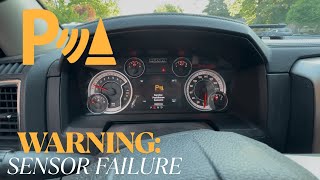
- "Service Park Assist System" message on the dashboard
- The Park Assist system is disabled and cannot be turned on
- The system may beep erratically or not at all when approaching an object
- The Park Assist OFF switch light may be illuminated
- System works in reverse but displays the service message immediately after shifting into drive and exceeding ~10 mph.
- Replacing the Park Assist Module (PAM) before testing the sensors and wiring. Module failure is uncommon compared to sensor or wiring issues.
- Replacing a sensor without first checking for a simple obstruction or cleaning the sensor face.
- Using incompatible aftermarket sensors. Some owners report issues where aftermarket sensors work in reverse but trigger a service message when driving forward, often with 'short to battery' codes like B1298-12.
Most Likely Causes
- Sensor Obstruction 🔴 High Probability As per TSB #9003059, these sensors are sensitive to blockage from snow, mud, ice, or other debris, which can get lodged on the sensor face or accumulate behind the bumper. High-pressure car washes can also force moisture into the sensor's connector, causing a temporary fault.
How to confirm: Visually inspect the #11 sensor (rear, driver's side, inner) for any dirt, snow, or physical blockage. Clean the sensor face and, if possible, check behind the bumper for packed mud or ice.
Typical fix: Clean the sensor and the area around it. Clear the code with a scan tool. The fault may clear on its own after a few drive cycles once the obstruction is removed and any moisture has dried.
Est. part cost: $0 - Faulty Park Assist Sensor 🟡 Medium Probability The sensors are plastic components located on the bumper, making them vulnerable to damage from minor impacts, rock chips, and moisture intrusion over time, leading to internal failure.
How to confirm: Swap the suspected faulty sensor (#11) with an adjacent one (like #10). Clear the codes. If the code changes to B1297 (for sensor #10), the sensor is bad. If B1298 returns, the problem is in the wiring. You can also listen for a faint clicking sound from each sensor when the vehicle is in reverse; a silent sensor is likely dead.
Typical fix: Replace the faulty park assist sensor. This can often be done by reaching behind the bumper to release the clips without removing the bumper itself. 🎬 Watch: This walkthrough shows how to replace a faulty sensor. Ensure the new sensor's gasket is seated properly.
Est. part cost: $20-$100 - Damaged Wiring or Connector ⚪ Low Probability The rear bumper wiring harness is exposed to road spray and debris. A key failure point is the main 16-pin or 24-way harness connector (sometimes referred to as C4 or XY630A) located on the driver's side frame rail, often near the spare tire. This connector is known to collect moisture, leading to corroded pins (the 'green crusties'). Wires can also chafe where they pass near the cab mount.
How to confirm: After confirming the sensor is good (via the swap test), unplug the main harness connector and inspect for corrosion, moisture, or pushed-out pins. Visually inspect the wiring harness leading from the connector to the sensor for breaks, chafing, or pinch points.
Typical fix: Clean corroded pins in the connector with a terminal cleaning tool and apply dielectric grease to prevent future moisture intrusion. Repair any broken or chafed wires with solder and heat shrink. If the connector or harness is severely damaged, it may need to be replaced. Mopar offers a service kit (part number 68353351AA) for the XY630A connector.
Est. part cost: $10-$150
Rare But Worth Checking
- Failed Park Assist Module (PAM): This is rare for a single sensor code. The module should only be considered as the cause after all sensors and wiring have been thoroughly tested and confirmed to be good. Multiple sensor codes appearing simultaneously are a stronger indicator of a potential PAM issue.
Diagnosis Steps
- Read the trouble codes with a scan tool capable of accessing Body Control Module (BCM) or Parktronics (PTS) codes, such as AlfaOBD or a professional shop scanner, to confirm B1298 is active.
- Visually inspect and thoroughly clean the #11 sensor (rear bumper, driver's side, inner position). Also clean the area behind the bumper if accessible.
- Clear the codes and test the system. Put the truck in reverse and see if the "Service Park Assist" message returns.
- If the code returns, put the truck in reverse (with the parking brake on) and listen for a faint clicking/buzzing noise from each rear sensor. A silent sensor at position #11 is a strong indicator of failure.
- To definitively test the sensor, swap sensor #11 with sensor #10 (the adjacent one). This can usually be done by hand from under the bumper. Clear the codes and re-scan. If the code changes to B1297, the sensor you moved is faulty.
- If code B1298 returns after the swap, the problem is in the wiring. Locate the main bumper harness connector on the driver's side frame rail near the spare tire. Disconnect it and inspect for green/white corrosion, bent pins, or moisture. 🎬 See how to find and fix common harness connector issues.
- If the connector is corroded, clean it and apply dielectric grease. If wiring is visibly damaged, repair it.
- If the sensor is confirmed faulty, replace it.
Parts You'll Likely Need
- Park Assist Sensor
(OEM #6MK25TZZAA, 1EW63TZZAA)— This is the most common point of failure for this code after ruling out a simple obstruction. 1EW63TZZAA is a common unpainted black replacement, while 6MK25TZZAA and its variants are often for pre-painted or chrome bumper applications.
Trusted brands: Mopar, Dorman, Standard Motor Products (SMP)
OEM price range: $90-$145
Aftermarket price range: $20-$60
Related Codes That Often Appear With This One
- B1295, B1296, B1297 — These are codes for the other rear park assist sensors (#8, #9, #10). If multiple codes appear at once, it strongly suggests a problem with the shared wiring harness, the main connector, or the Park Assist Module, rather than multiple sensors failing simultaneously.
- B1298-11 or B1298-12 — These are more specific versions of the fault. B1298-11 indicates a 'Circuit Short to Ground', while B1298-12 indicates a 'Circuit Short to Battery'. These codes point more directly toward a wiring issue rather than an internal sensor failure.
Technical Service Bulletins (TSBs) & Recalls
- 9003059: Addresses stored DTCs for signal shape/waveform failure, including B1298-25, and recommends checking for and cleaning obstructions like snow, mud, or ice from the sensors, specifically mentioning to check behind the bumper.
Platform-Specific Known Issues
- TSB #9003059 explicitly states that a 'Signal Shape / Waveform Failure' fault like B1298-25 can be caused by snow, mud, or ice, and that the area behind the bumper should also be checked for obstructions.
- The main rear harness connector on the driver's side frame rail is a known weak point for water intrusion and corrosion, which can cause single or multiple sensor faults.
Mechanic-Grade Diagnostic Values
- Sensor Signal Circuit Voltage (Key On, In Reverse) — expected: ~8.0 V. Failure: Voltage significantly different from other sensors, or no waveform present on an oscilloscope when in reverse.
- Sensor Ground Circuit Resistance — expected: < 5.0 Ohms. Failure: Resistance greater than 5.0 Ohms indicates a poor ground connection.
- Sensor Signal Circuit to Ground Resistance (Testing for a short) — expected: > 10k Ohms. Failure: Resistance below 10k Ohms suggests a short to ground in the signal wire.
- Sensor Supply Voltage (at sensor connector, key on) — expected: 8.0V to 10.0V. Failure: Voltage outside this range points to a problem with the Park Assist Module or the supply circuit wiring.
Hidden / Shadow Codes Worth Checking
- B1298-11: PTS Sensor 11 - Circuit Short To Ground. This points directly to a wiring fault where the signal wire is touching a ground source. (see via Professional scan tools or advanced DIY tools like AlfaOBD that can read manufacturer-specific body codes.)
- B1298-12: PTS Sensor 11 - Circuit Short To Battery. This indicates the signal wire is shorted to a power source, often due to chafed wiring or internal sensor failure. (see via Professional scan tools or advanced DIY tools like AlfaOBD.)
- B1298-92: PTS Sensor 11 - Performance or Incorrect Operation. This is a more general performance code that can be set if the sensor's signal is erratic but not completely shorted or open. (see via Professional scan tools or advanced DIY tools like AlfaOBD.)
Scan Tool Commands That Help
- wiTECH (Dealer Tool): Reprogram the Park Assist Module (PAM) — Used to apply software updates that can resolve issues like false detections or a system that is unavailable at startup, as outlined in various TSBs. This is typically done after confirming hardware (sensors, wiring) is functional.
- wiTECH (Dealer Tool): Restore BCM Proxi Configuration — This procedure is often required after reprogramming or replacing a module to ensure all vehicle components are properly communicating with each other.
- AlfaOBD: Read/Clear Faults in Parktronics (PTS) Module — Essential for initial diagnosis to retrieve the specific B1298 sub-code (e.g., -11, -12, -25) and to clear codes after a repair. Standard OBD-II readers often cannot access the PTS module.
Wiring & Ground Locations
- XY630A — Behind the rear left wheel liner, on the driver's side frame rail, near the spare tire.. This is the main 24-way inline connector for the rear bumper harness. It's a very common point for water intrusion and corrosion, which can cause faults for single or multiple rear park assist sensors.
- D710 — This is the circuit designation for the Park Assist Sensor #11 Signal wire, running from the sensor to the Park Assist Module (PAM).. When diagnosing a wiring fault after a sensor swap test fails to move the code, all electrical tests (voltage, resistance, short-to-ground) are performed on this specific circuit.
- G304 — A body ground point located at the center of the body.. While not the direct ground for the sensor, a poor body ground can cause a variety of difficult-to-diagnose electrical issues in body-related modules like the PAM.
- Park Assist Module (PAM) — Located under the dash, near the emergency brake pedal area.. This is the control unit for the system. All sensor wiring terminates here. While module failure is rare for a single sensor code, its location is necessary for advanced wiring diagnostics.
Real Owner Repair Stories
- YouTube channel 'Rain City Wrench' (2012 Ram (similar system)) — Service Park Assist message with all four rear sensor codes active (B1295, B1296, B1297, B1298) with 'short to ground' faults.
❌ Tried (didn't work) A coworker had already replaced the Park Assist Module (PAM).
✅ What actually fixed it The technician verified the 8.5V supply and communication lines were good at the module. He then disconnected the rear harness and the shorts cleared, isolating the fault to the rear. He replaced all four rear sensors with aftermarket units, which resolved all codes. This indicated multiple sensors had failed internally, causing the short-to-ground condition. - YouTube channel 'Pine Hollow Auto Diagnostics' (2015 Dodge Ram 2500 6.7L) — Service Park Assist message with code B1298 for sensor #11.
❌ Tried (didn't work) Visual inspection of the sensor face, which appeared clean.
✅ What actually fixed it Using a PicoScope, the technician compared the signal waveforms of all four rear sensors. Sensors 8, 9, and 10 produced clear, active waveforms when in reverse. Sensor #11 produced a flatline signal, showing no activity. This definitively proved the sensor itself was internally dead, despite having correct power and ground. Replacing the #11 sensor fixed the issue.
OEM Part Supersession History
1EW631AUAA, 1EW63DX8AA, 1EW63RXFAA, and many others→1EW63TZZAA— Consolidation of multiple colored/painted part numbers into a single, unpainted (or paint-to-match) service part.
Heads up: 1EW63TZZAA is the primary service replacement for unpainted/black textured bumpers for this vehicle generation.6MK25KBUAA, 6MK25KXJAA, 6MK25PR4AA, and others→6MK25TZZAA— Consolidation of various painted part numbers into a single service part, often for chrome or body-colored bumper applications.
Heads up: This part is listed for positions 8, 9, 10, and 11 and is often associated with newer models or different trim packages but may be cross-compatible. Always verify with VIN.
Helpful Videos

We Have This Part in Stock


The information in this article is provided for general reference and educational purposes only. Vehicle specifications, procedures, and part compatibility can vary by production date, trim level, and region. Always consult your vehicle's factory service manual and verify part numbers before purchasing or performing repairs. Safety-critical components such as airbags, seat belts, and braking systems should be installed by a qualified professional.
- Ram 2500:
- 🎬 Helpful Videos
- 🛍️ Shop This Part
- What's Unique About the 2014-2017 Ram 2500
- Diagnostic Flowchart
- Symptoms You May Notice
- Most Likely Causes
- Rare But Worth Checking
- Diagnosis Steps
- Parts You'll Likely Need
- Related Codes That Often Appear With This One
- Technical Service Bulletins (TSBs) & Recalls
- Platform-Specific Known Issues
- Mechanic-Grade Diagnostic Values
- Hidden / Shadow Codes Worth Checking
- Scan Tool Commands That Help
- Wiring & Ground Locations
- Real Owner Repair Stories
- OEM Part Supersession History
- 🎟️ Get 5% Off