

OBD-II Code B1298: Park Assist Sensor 11 Fault
What B1298 means, why it triggers, and how to fix it
- Code B1298 specifically identifies a failure in sensor #11, the inner rear park assist sensor on the driver's side of Ram, Dodge, Chrysler, and Jeep vehicles.
- Clean the sensor face and the area directly behind the bumper first, as mud or ice buildup is the most common trigger per manufacturer TSB 9003059.
- Swap sensor #11 with adjacent sensor #10 to confirm the diagnosis; if the fault code changes to B1297, the sensor is dead and requires replacement.
- Inspect the main 24-way bumper harness connector (XY630A) for corrosion if multiple sensor codes appear simultaneously, as 4 sensors rarely fail at once.
- Check TSB 08-082-20 if you own a 2019-2020 Ram 1500 with code B1298-25, as a $100-$200 dealer software update fixes this specific false alarm.
What Does B1298 Mean?

B1298 means the Park Assist Module (PAM) or Body Control Module (BCM) detects a problem with park assist sensor #11. On Dodge, Ram, Chrysler, and Jeep vehicles, sensor #11 is the inner ultrasonic sensor on the driver's side of the rear bumper. The fault indicates the sensor's signal is missing, incorrect, or distorted.
Technical definition: The Park Assist Module (PAM) detects a fault on the circuit for Park Assist Sensor #11. The most common variant is B1298-25 (Signal Shape / Waveform Failure), meaning the ultrasonic signal is present but illogical. Other variants include B1298-11 (Circuit Short To Ground), B1298-12 (Circuit Short To Battery), and B1298-92 (Performance or Incorrect Operation).
Can I Drive With B1298?
Yes. Your vehicle is mechanically safe to drive. However, the parking assist system is disabled. The lack of audible warnings increases the risk of low-speed collisions, which cause cosmetic damage costing $300-$1500 to repair.
Common Causes

- Obstructed Park Assist Sensor (Very Common) — The primary cause is mud, snow, ice, or heavy rain blocking the sensor's face. Debris also lodges behind the bumper, interfering with operation. Manufacturer TSB 9003059 confirms this is the first item to check.
- Failed Park Assist Sensor #11 (Common) — Internal electronic failure stops the sensor from sending signals or causes it to send corrupt data. This weather-exposed component degrades over time and vibration.
- Damaged or Corroded Wiring Harness/Connector (Common) — Road spray and debris corrode connectors or chafe wiring. The main 24-way bumper harness connector (part XY630A on Ram trucks) is a known weak point for water intrusion, as noted in TSB S2108000060 REV A.
- Park Assist Module (PAM) Software Glitch (Less Common) — For 2019-2020 Ram DT models, TSB 08-082-20 states code B1298-25 sets erroneously due to a software bug. The required fix is a dealer-installed software update, not hardware replacement.
- Incompatible Aftermarket Sensor (Less Common) — Installing cheap aftermarket sensors triggers new codes, such as B1298-92 (Performance) or B1298-12 (Short to Battery). The system appears to work in reverse but throws a fault when driving forward.
- Faulty Park Assist Module (PAM) (Very Rare) — The control module rarely fails. Consider this only after proving the sensor, wiring, and software are fully functional. Multiple simultaneous sensor codes point to a shared harness issue, not a PAM failure.
Symptoms

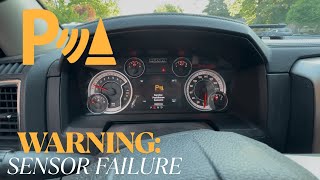
- 'Service Park Assist System' Message — A warning message appears on the instrument cluster or infotainment screen.
- Parking Assist System Disabled — The system automatically turns off, failing to produce audible warning beeps or emitting a solid, continuous error tone when shifted into reverse.
- False Alerts or Automatic Braking — A faulty sensor causes the system to give false warnings or apply the brakes when no object is present, a condition addressed by TSB 08-082-20 for 2019-2020 Ram trucks.
Diagnostic Flowchart

Tap your situation to follow the diagnostic path that matches what you're seeing on this code.
Common Fixes & Costs
- Clean the Park Assist Sensor — Parts: $0, Labor: $0, ~0.1 hr book time (DIY)
- Replace Park Assist Sensor #11
— Parts: $20-$100 (Aftermarket: $20-$50, OEM: $60-$100)., Labor: $75-$150 (Shop labor)., ~0.7 hr book time
(DIY)
Ram 1500 (2013-2018 'DS' Classic): OEM
Ram 2500/3500 (2014-2018): OEM
Dodge Charger (2015-2023): OEM - Clean or Replace Main Bumper Wiring Harness Connector
— Parts: $20-$80 (Connector pigtail or Mopar kit 68353351AA)., Labor: $150-$250, ~1.5 hr book time
(Intermediate)
Ram Trucks (General): OEM - Repair Damaged Wiring — Parts: $5-$20 (Wire, connectors, tape), Labor: $150-$250, ~2 hr book time (Professional)
- Perform Park Assist Module (PAM) Software Update — Parts: $0, Labor: $100-$200 (Dealer labor for flash), ~1 hr book time (Professional)
Used vs. New Parts: Buying Guide
When a used part is worth it: Buying a used park assist sensor is not recommended due to the high risk of premature failure. Use a used sensor only for temporary diagnosis or if budget constraints are severe.
Donor-vehicle mileage cap: roughly under 50000 miles for the part to have meaningful remaining life.
Donor quality checklist:
- Match the OEM part number exactly, as different model years use incompatible sensors.
- Inspect the connector for any signs of corrosion or damage.
- Avoid parts from vehicles in rust-belt regions due to weather-related failure.
Decision logic:
- If A new, quality aftermarket sensor is available for under $50 → buy new. The small savings from a used part aren't worth the risk.
- If The vehicle is old and budget is the primary concern → purchase a used part from a reputable seller with at least a 30-day warranty.
- If Multiple codes are present and you are swapping sensors for diagnosis → using a known-good used sensor from another position on the car is the best first step.
Warranty tradeoff: Used parts typically have a 30-90 day warranty. New aftermarket parts from reputable brands offer limited lifetime warranties. OEM parts carry a 1-2 year warranty.
Worst-case if a used part fails: $100-$250 if a used or faulty new part fails after installation, requiring repeat labor costs.
What Happens If You Wait — Timeline
- 0-1 month: Intermittent fault. The 'Service Park Assist' message appears during rain or cold weather. The code clears on its own when conditions dry. The system is unreliable. (MPG impact: 0%% · Added cost: $0)
- 1-3 months: Permanent single sensor fault. The B1298 code is active constantly due to a failed sensor or beginning corrosion on connector pins. The system is always disabled. (MPG impact: 0%% · Added cost: $20-$100 (cost of a new sensor))
- 3-9 months: Corrosion spreads in the main harness connector (XY630A). Additional sensor codes (B1295, B1296, B1297) appear. (MPG impact: 0%% · Added cost: $150-$400 (cost to repair or replace the main harness connector))
- 9+ months: Critical harness or module failure. Severe corrosion causes multiple wires to short together, potentially damaging the Park Assist Module (PAM). (MPG impact: 0%% · Added cost: $400-$800+ (cost of a new PAM plus programming))
Cost of Not Fixing It
- Immediate: The disabled park assist system provides no audible warnings, significantly increasing the risk of a low-speed collision. (Added cost: $0)
- 0-6 months: High probability of backing into an object, causing cosmetic or structural bumper damage. (Added cost: $300-$1500)
- 6+ months: A minor parking impact costs $300-$800 for bumper cover repairs, while a hit involving sensor or reinforcement bar damage exceeds $1,500.
Diagnosis Steps
- Read the Specific Fault Code
Use an OBD-II scanner capable of reading Body (B) codes to confirm B1298. Note suffix numbers (-11, -12, -25) as they pinpoint the specific electrical fault.
Tools: Advanced OBD-II Scanner (capable of reading BCM/PAM codes) (Beginner) - Clean and Inspect Sensor #11
Locate sensor #11 (inner driver's side rear bumper). Thoroughly clean its surface. Remove any mud, ice, or debris packed behind the bumper, as this is a primary cause noted in TSBs.
Tools: Soft cloth, water, car wash soap (Beginner) - Clear Codes and Test the System
Clear the trouble codes with your scanner. The system remains disabled until the stored fault is cleared. Start the vehicle, shift into reverse, and see if the message returns. If not, the obstruction was the issue.
Tools: Advanced OBD-II Scanner (Beginner) - Listen for Sensor Activity
Turn the ignition on, set the parking brake, and shift into reverse. Place your ear close to each rear sensor. A healthy sensor emits a faint, rapid clicking. A silent sensor at position #11 indicates failure.
Tools: None (Beginner) - Perform a Sensor Swap
Swap sensor #11 with adjacent sensor #10 to isolate the fault. Clear codes and rescan. If the code changes to B1297, the sensor is dead. If B1298 returns, the wiring at position #11 is faulty.
Tools: Trim removal tools (optional) (Intermediate) - Inspect Wiring and Connectors
If the fault remains at position #11, inspect the wiring for cuts or chafing. Check the main 24-way bumper harness connector (XY630A on Ram trucks) near the spare tire for moisture and corrosion per TSB S2108000060 REV A.
Tools: Flashlight (Intermediate) - Check Scan Tool Live Data
Access Park Assist Module live data. Look for 'Sensor Distance' PIDs. A faulty sensor shows a fixed, illogical distance (e.g., 0 cm or 255 cm) or a 'Fault' status while other sensors report changing distances as you approach an object.
Tools: Advanced OBD-II Scanner (with live data capability) (Advanced) - Perform Multimeter Tests for Voltage and Ground
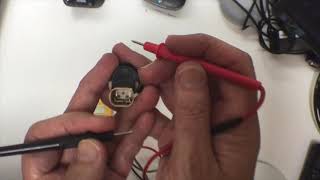
Disconnect the sensor. With the key on, check for 8.0-10.0 Volts between the supply and ground pins. Measure resistance between the ground pin and chassis ground; it must be under 5.0 Ohms.
Tools: Digital Multimeter (Advanced) - Perform Multimeter Tests for Circuit Faults
To test for a short to ground (B1298-11), measure resistance between the disconnected signal wire and chassis ground; it must exceed 10k Ohms. For a short to voltage (B1298-12), measure voltage on the signal wire; it must be under 10.0 volts.
Tools: Digital Multimeter (Advanced) - Analyze Sensor Signal with an Oscilloscope
Back-probe the signal wire. With the system active, a good sensor shows a clean, repeating digital pulse pattern of about 8 volts. A distorted or flat-lined waveform confirms internal sensor failure.
Tools: Oscilloscope (PicoScope or similar) (Professional)
When This Code Triggers (Freeze-Frame Conditions)
- Ignition Status: On / Run (The system self-tests when the ignition is turned on.)
- Gear Selector: Reverse (The code sets when the park assist system activates by shifting into reverse.)
- Vehicle Speed: < 10 mph (The fault is monitored when the vehicle is in reverse at low speeds.)
- System Voltage: 11-14 Volts (The Body Control Module requires normal battery voltage to operate and run diagnostics.)
Related Codes
- B1295, B1296, B1297 — These indicate faults in the other rear sensors (#8, #9, #10). Seeing all four codes simultaneously points to a shared main wiring harness failure (connector XY630A) or a bad ground, not four individually failed sensors.
- B1298-11 — Indicates the sensor's signal circuit is shorted to ground. A low resistance reading (under 10k Ohms) between the signal wire and ground confirms a short in the harness.
- B1298-12 — Indicates the sensor's signal circuit is shorted to battery voltage. Voltage above 10.0 volts on the signal wire confirms a short to a power source in the harness.
- B1298-96 — Indicates a 'Component Internal Failure.' This points definitively to an internal electronic fault within the sensor itself, requiring replacement rather than cleaning.
Climate & Environmental Factors
- Cold Weather (Snow/Ice): Snow and ice pack onto the sensor's face or behind the bumper, obstructing the ultrasonic signal and triggering a B1298-25 code per TSB 9003059.
- High Humidity / Heavy Rain / Car Washes: High-pressure car washes force water into the main harness connector (XY630A), causing temporary shorts or long-term corrosion.
- Road Salt (Rust Belt Regions): Road salt accelerates corrosion of wiring connectors and ground connections. The main bumper harness connector collects moisture and salt, leading to circuit faults like B1298-11 (Short to Ground).
How to Talk to a Mechanic About This Code
Say this: "My scanner shows code B1298 for sensor #11. I've already cleaned the sensor face and behind the bumper. Please diagnose whether the sensor failed or if there is a wiring harness issue. Also, check if TSB 08-082-20 applies to my VIN."
This tells the shop you've done the first steps and are aware of common failures and TSBs. It focuses their diagnostic time, saving you money, and prevents them from charging you for a simple cleaning.
Avoid saying:
- 'My parking sensors don't work.' (too vague)
- 'The beeping thing is broken, can you fix it?'
- 'Just do whatever it takes to fix it.' (invites expensive, unnecessary repairs)
Questions to ask before authorizing the repair:
- Did you perform a sensor swap to confirm the sensor is bad before recommending replacement?
- If it's a wiring issue, did you find corrosion in the main harness connector or a break in the wire?
- If you're recommending a software update, can you confirm my VIN falls under the TSB?
- Will you show me the failed part or the corroded connector?
Where to Take It: Dealer vs Independent vs Chain
- Dealer:
Best for: Vehicles under warranty., 2019-2020 Ram 1500s where TSB 08-082-20 (software update) is the likely fix., Complex wiring issues where manufacturer-specific diagnostic tools (wiTECH) are a major advantage.
Downsides: Highest labor rates, typically $150-$250 per hour., May be quicker to replace an entire harness rather than repair a single wire. (Typical cost: +50% vs. baseline) - Independent Shop:
Best fit for most scenarios, unless you have a 2019-2020 Ram 1500 that needs the specific TSB software flash. A good independent shop easily handles sensor replacement and wiring repairs.
Best for: Out-of-warranty vehicles with a confirmed bad sensor or a suspected wiring/connector problem., Cost-conscious owners who want a thorough diagnosis without dealer prices.
Downsides: Quality varies; look for shops with strong reviews and experience in modern vehicle electronics., Cannot perform the specific TSB software update for 2019-2020 Ram trucks. (Typical cost: +0% vs. baseline) - Chain Shop:
Use with caution. Acceptable for a simple sensor swap if you've done your own diagnosis, but AVOID for any diagnostic work, as they are likely to misdiagnose a wiring or software issue.
Best for: No-frills parts replacement if you have already 100% diagnosed a bad sensor yourself.
Downsides: Technician skill varies dramatically., High pressure to upsell services., Generally not equipped for in-depth electrical diagnosis, wiring repair, or software updates. (Typical cost: -10% vs. baseline)
When to Walk Away From the Repair
If the estimated repair cost exceeds 40-50% of the vehicle's private-party value, you might reconsider. However, for B1298, the repair is almost always worth it.
- Car worth $25000, fix is $350: Fix it. The repair cost is a tiny fraction of the vehicle's value and restores an important safety feature. Not fixing it increases the risk of a parking collision that costs $1,500+.
- Car worth $5000, fix is $350: Fix it. Even on an older, lower-value vehicle, the cost to prevent a parking accident is a smart investment.
- Car worth $2500, fix is $1500: Walk away. If a shop quotes an extremely high price to fix a simple sensor code, they are likely trying to scam you. Get a second opinion.
What Scan Tool You Need for This Code
Minimum: An OBD-II scanner capable of reading Body (B) codes for FCA vehicles. A basic $20 engine-only (P-code) reader cannot see this code.
B1298 is a Body code stored in the Park Assist Module or Body Control Module, not the engine computer. A basic scanner reports 'No Codes Found' even when the 'Service Park Assist' message is on.
Budget: BlueDriver Pro (~$90) — Confirms and clears Body (B) codes for FCA vehicles. It provides code definitions and access to freeze-frame data, which is everything a DIYer needs to confirm the code.
Mid-range: Foxwell NT510 Elite / NT680 Pro (~$200) — Reads/clears B-codes and views live sensor data from the Park Assist Module. This allows you to see what each sensor reports in real-time, making it easier to confirm a dead sensor.
Professional: Autel MaxiCOM MK808 / MaxiSys MS906Pro (~$500-1200) — Provides full, dealer-level diagnostics. Offers full bidirectional control to test modules and sensors, comprehensive live data graphing, and access to all vehicle modules.
Rent vs buy: Most auto parts stores offer free code reading, but their loaner tools often cannot read Body (B) codes. Given the low cost of a capable budget scanner like the BlueDriver, buying one is a smart investment.
How to Clear the Code After You Fix It
- Use an OBD-II scan tool capable of reading Body (B) codes to clear the fault.
- Cycle the ignition off, then on.
- Shift the transmission into reverse to re-activate and test the system.
Drive cycle (~1 minutes): A traditional emissions drive cycle is not required. The Park Assist Module re-evaluates the sensors upon the next key cycle and activation (shifting into reverse). If fixed, the 'Service Park Assist' message will not reappear.
Readiness monitors affected: None
Watch out for:
- Using a basic OBD-II scanner that cannot read or clear Body (B) trouble codes.
- Forgetting to clear the stored code after the repair; the system remains disabled until cleared.
- The code returning immediately, indicating the root cause (wiring, obstruction, faulty new part) was not resolved.
Will This Fail Emissions / State Inspection?
No — by itself this code doesn't fail OBD inspection (but it can keep readiness monitors from setting, which causes a separate fail).
- California: This code will NOT cause a failure on a California smog check. Emissions inspections check powertrain (P) codes, not body (B) codes.
- New York: A B1298 code will not cause a failure of the NYS emissions inspection. It is not explicitly listed as a safety inspection failure item.
- Texas: As of 2025, annual safety inspections are no longer required for most non-commercial vehicles. This code does not cause a failure in emissions-only tests.
Most Commonly Affected Vehicles
- Ram 1500 (2013-2020) — Extremely common. For 2019-2020 DT models, TSB 08-082-20 advises a software update for B1298-25 before replacing parts.
- Ram 2500 (2014-2017) — Prone to this code due to sensor failure and corrosion at the main rear harness connector (XY630A) near the spare tire.
- Ram 3500 (2014-2017) — TSB 9003059 specifically mentions checking for mud/snow/ice as the first step on these heavy-duty trucks.
- Dodge Charger (2010-2023) — Service manuals document this code for failures in the Park Assist Sensor 11 circuit.
- Dodge Ram 1500 (2011-2012) — On some 2012 models, the Park Assist Module is located in the headliner, making access more difficult.
- Jeep Wrangler (2018-2022) — Owners report codes B1298-11 related to incorrect wiring repairs or harness damage.
- Chrysler Pacifica (2017-2021) — The diagnostic principles are identical to Dodge and Ram vehicles.
- Jeep Grand Cherokee (2014-2020) — Shares the same ParkSense system and sensor numbering as other FCA vehicles.
Manufacturer-Specific Notes
- Ram/Dodge/Chrysler/Jeep: FCA vehicles number sensors starting at the front driver's side (#1) clockwise. Rear-only systems skip 7 and 12, making the rear sensors #8, #9, #10, and #11. Sensor #11 is always the inner driver's side rear sensor.
- Ram: TSB 9003059 advises that a primary cause is sensor obstruction. TSB S2108000060 REV A points to corrosion in the main rear harness connector (XY630A) as a cause for -11 (short to ground) variants.
- Ram: For 2019-2020 DT models, TSB 08-082-20 notes code B1298-25 sets incorrectly. The fix is a software update for the Park Assist Module, not a hardware replacement.
- Ram/Dodge: The Park Assist Module (PAM) location varies. On older trucks (e.g., 2012 Ram), it is in the headliner. On newer models (2013+), it is under the driver's side dash or behind a kick panel.
Real Owner Stories
2015 Ram 2500 with B1298-25
The 'Service Park Assist' message appeared on the dash after driving through a snowstorm.
What they tried:
- Initially ignored the message, assuming it was a temporary glitch.
- Thoroughly washed the truck, paying special attention to the rear bumper sensors.
Outcome: After washing the truck and clearing the code, the system returned to normal operation. The cause was packed snow and ice behind the bumper obstructing sensor #11, as noted in TSB 9003059.
Lesson: Always start with the simplest fix. Before ordering parts, thoroughly clean the face of the sensor and the area behind the bumper.
2019 Ram 1500 DT with B1298-25 and false braking
The park assist system gave false alerts and applied the brakes automatically when reversing, even with no obstacles present. Code B1298-25 was active.
What they tried:
- Replaced sensor #11, but the problem continued.
- Took the truck to the dealership, suspecting a wiring issue.
Outcome: The dealership identified TSB 08-082-20, which states this exact code and symptom is caused by a software glitch on 2019-2020 models. They performed a software update on the Park Assist Module (PAM), resolving the issue completely for approximately $150.
Lesson: For 2019-2020 Ram 1500s, check for applicable TSBs before replacing hardware. A software bug mimics a hardware failure.
2014 Ram 1500 with multiple sensor codes (B1295, B1296, B1297, B1298)
The park assist system failed, and a scan revealed codes for all four rear sensors with a '-12' suffix (Circuit Short to Battery).
What they tried:
- Replaced all four rear sensors with aftermarket parts.
- The system worked in reverse but immediately faulted when the truck was put in drive and exceeded 10 mph.
Outcome: The issue was incompatibility between the aftermarket sensors and the Ram's Park Assist Module. The owner replaced them with OEM sensors to fix the problem.
Lesson: If multiple sensor codes appear at once, be cautious of aftermarket sensor compatibility. Using OEM sensors or a single known-good sensor for testing prevents expensive misdiagnosis.
2021 Ram with multiple B129x-11 codes (Short to Ground)
The rear park assist system stopped working, showing short-to-ground codes for all four rear sensors (B1295-11 through B1298-11).
What they tried:
- A sensor swap test showed the sensors themselves were good.
- A visual inspection of the rear bumper wiring harness revealed a section where the wires had been pinched and severed.
Outcome: The owner repaired the broken wires in the harness, restoring the connection to all four sensors and clearing all fault codes.
Lesson: When all sensors on a single harness fail simultaneously with the same fault type, the problem is almost always a shared wiring or connector issue. Inspect the main harness for damage before replacing components.
How to Prevent This Code From Triggering
- Periodically Clean Sensors (Monthly or after off-roading/snow) — Regularly washing the sensor faces prevents the buildup of road grime or dirt that obstructs ultrasonic waves and causes B1298-25 faults.
- Apply Dielectric Grease to Connector Seals (Whenever a sensor or harness is replaced or disconnected) — Applying dielectric grease to the rubber seals keeps moisture and road salt out, preventing corrosion on the electrical pins.
- Inspect Rear Bumper Harness During Other Maintenance (During tire rotations or brake service) — Visually inspect the wiring harness along the rear bumper for signs of chafing or pinching to catch damage before a wire breaks.
- Use High-Quality or OEM Replacement Sensors (When a sensor fails) — Using OEM or reputable aftermarket sensors ensures compatibility with the Park Assist Module, avoiding performance codes or system-wide faults.
Frequently Asked Questions
Can I fix code B1298 myself?
Yes, in many cases. The most common cause is a dirty sensor, which you can clean for free. Replacing the sensor is also a beginner-friendly job that usually doesn't require removing the bumper.
Why is it always sensor #11?
Sensor #11 is the designation for the inner driver's side rear sensor on Ram/Dodge/Jeep vehicles. Its location on the driver's side exposes it to more road spray and debris from the road crown and oncoming traffic, leading to a higher failure rate.
What tools do I need to fix B1298?
For a basic diagnosis, you only need soap, water, and a soft cloth. To confirm the diagnosis, use an advanced OBD-II scanner capable of reading 'B' codes. Advanced electrical testing requires a digital multimeter and potentially trim removal tools.
What is the most common misdiagnosis for B1298?
The most common misdiagnosis is replacing the Park Assist Module (PAM) before thoroughly testing the sensor and wiring. Another frequent mistake is replacing the sensor without first cleaning debris from behind the bumper or inspecting the main harness connector for corrosion.
I replaced all the sensors with aftermarket ones and now I have more codes. What happened?
Some aftermarket sensors are not fully compatible with the vehicle's Park Assist Module, causing 'Performance' or 'Short to Battery' codes to set across all sensors. The system appears to work in reverse but sets a fault as soon as you drive forward. Use OEM or high-quality aftermarket brands to avoid this compatibility problem.
I replaced the sensor, but the code came back. What now?
If a new, known-good sensor doesn't fix the issue, the problem is in the wiring or software. Perform a sensor swap to ensure the new sensor isn't faulty, then inspect the sensor's connector and the main bumper wiring harness for damage. For 2019-2020 Ram 1500s, check if TSB 08-082-20 applies to your vehicle.
Does the new sensor need to be an expensive OEM part?
While OEM (Mopar) sensors guarantee compatibility, high-quality aftermarket brands like Dorman or Bosch work well. Avoid ultra-cheap, unverified aftermarket sensors, as they frequently cause new codes and diagnostic headaches.
Key Takeaways
- Code B1298 specifically identifies a failure in sensor #11, the inner rear park assist sensor on the driver's side of Ram, Dodge, Chrysler, and Jeep vehicles.
- Clean the sensor face and the area directly behind the bumper first, as mud or ice buildup is the most common trigger per manufacturer TSB 9003059.
- Swap sensor #11 with adjacent sensor #10 to confirm the diagnosis; if the fault code changes to B1297, the sensor is dead and requires replacement.
- Inspect the main 24-way bumper harness connector (XY630A) for corrosion if multiple sensor codes appear simultaneously, as 4 sensors rarely fail at once.
- Check TSB 08-082-20 if you own a 2019-2020 Ram 1500 with code B1298-25, as a $100-$200 dealer software update fixes this specific false alarm.
Helpful Videos

The information in this article is provided for general reference and educational purposes only. Vehicle specifications, procedures, and part compatibility can vary by production date, trim level, and region. Always consult your vehicle's factory service manual and verify part numbers before purchasing or performing repairs. Safety-critical components such as airbags, seat belts, and braking systems should be installed by a qualified professional.
- 🎬 Helpful Videos
- What Does B1298 Mean?
- Can I Drive With B1298?
- Common Causes
- Symptoms
- Diagnostic Flowchart
- Common Fixes & Costs
- Used vs. New Parts: Buying Guide
- What Happens If You Wait — Timeline
- Cost of Not Fixing It
- Diagnosis Steps
- When This Code Triggers (Freeze-Frame Conditions)
- Related Codes
- Climate & Environmental Factors
- How to Talk to a Mechanic About This Code
- Where to Take It: Dealer vs Independent vs Chain
- When to Walk Away From the Repair
- What Scan Tool You Need for This Code
- How to Clear the Code After You Fix It
- Will This Fail Emissions / State Inspection?
- Most Commonly Affected Vehicles
- Manufacturer-Specific Notes
- Real Owner Stories
- 2015 Ram 2500 with B1298-25
- 2019 Ram 1500 DT with B1298-25 and false braking
- 2014 Ram 1500 with multiple sensor codes (B1295, B1296, B1297, B1298)
- 2021 Ram with multiple B129x-11 codes (Short to Ground)
- How to Prevent This Code From Triggering
- Frequently Asked Questions
- Can I fix code B1298 myself?
- Why is it always sensor #11?
- What tools do I need to fix B1298?
- What is the most common misdiagnosis for B1298?
- I replaced all the sensors with aftermarket ones and now I have more codes. What happened?
- I replaced the sensor, but the code came back. What now?
- Does the new sensor need to be an expensive OEM part?
- Key Takeaways
- 🎟️ Get 5% Off