

B1294 on 2013-2017 Ram 1500: Park Assist Sensor Fault Causes and Fixes
Code B1294 on a 2013-2017 Ram 1500 points to a short-to-ground in the circuit for the #9 rear park assist sensor (inner passenger side). The most common cause is a corroded or damaged wiring harness behind the rear bumper, especially the XY630A connector. A faulty sensor is the second most likely cause. Diagnosis involves inspecting the wiring and swapping sensors before replacing parts.
- B1294 on a Ram 1500 is a specific code for the #9 rear park assist sensor circuit (inner passenger side), usually indicating a short to ground.
- Before buying any parts, thoroughly inspect the wiring harness behind the rear bumper for damage, especially near the large gray XY630A connector behind the driver's side wheel liner.
- A simple way to test the sensor is to swap it with an adjacent one and see if the fault code follows the sensor.
- The most likely cause is bad wiring, followed by a bad sensor; the control module is rarely the problem.
What's Unique About the 2013-2017 Ram 1500

On fourth-generation Ram 1500s, the rear bumper and its associated wiring harness are exposed to significant road spray, debris, and flexing. This makes the wiring for the ParkSense® system, particularly the main connector XY630A behind the driver's side rear wheel, a common point of failure due to corrosion and wire damage. While sensor failure can occur, wiring issues are a much more frequent cause for this code on this specific truck platform compared to other vehicles.
Diagnostic Flowchart

Tap your situation to follow the diagnostic path that matches what you're seeing on this vehicle.
Symptoms You May Notice

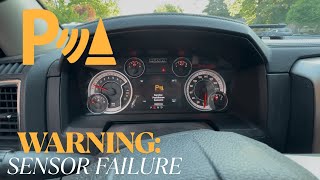
- "Service Park Assist System" or "Park Sense Unavailable" message on the dashboard display.
- The Park Assist system will be disabled and will not detect objects when reversing.
- The switch to manually turn the park assist system on or off may have a constant warning light. 🎬 Check this quick video to see if a fuse is blown.
- A constant, steady tone when the vehicle is put into reverse, indicating a system fault.
- Replacing the Park Assist Module (PAM) before thoroughly checking the wiring harness. The module is expensive and rarely the cause of a single sensor circuit fault.
- Replacing a sensor without first inspecting the wiring harness. Given the high frequency of harness issues on this platform, the wiring should always be the first suspect.
Most Likely Causes

- Damaged Rear Bumper Wiring Harness 🔴 High Probability The harness is routed along the frame and behind the bumper, making it highly susceptible to damage from road debris, moisture, and corrosion. A specific weak point is the 24-way connector XY630A located behind the rear left wheel liner, which is explicitly called out in a manufacturer STAR case for inspection. Wires can also chafe or break where they are clipped to the frame or near the spare tire.
How to confirm: Visually inspect the entire length of the harness from the sensors to the main connector. Look for chafed insulation, broken wires, or green/white corrosion inside the connectors. Per STAR Case S2108000060, perform a slight pull test on the wires entering connector XY630A to check for loose or pushed-out terminals.
Typical fix: Repair the broken or corroded wires using solder and heat-shrink tubing. If the connector itself is damaged, it may need to be repinned or replaced. FCA/Mopar offers a terminal repair kit (part #68353351AA) 🎬 Watch: How to find and fix common rear harness failures. for the XY630A connector. In some cases of widespread corrosion, the entire rear bumper harness may need to be replaced.
Est. part cost: $10-$150 - Faulty Park Assist Sensor (#9) 🟡 Medium Probability The sensors are electronic components mounted on the exterior of the vehicle, making them vulnerable to moisture intrusion, physical impact from road debris, and age-related failure.
How to confirm: Swap the suspected faulty sensor (#9) with a known-good adjacent sensor (e.g., #8 or #10). Clear the codes and re-scan. If the code changes to follow the sensor (e.g., B1293 or B1295), the sensor is bad. A simpler initial test is to activate the system and listen closely to each sensor; a working sensor will emit a faint clicking or buzzing sound that can also be felt with a fingertip. A silent sensor is likely dead.
Typical fix: Replace the faulty park assist sensor. They are held in place by clips and are typically easy to access from behind the bumper by releasing two small tabs. 🎬 See this walkthrough on how to swap a faulty sensor.
Est. part cost: $25-$90
Rare But Worth Checking
- Faulty Park Assist Module (PAM): This is rare and should only be considered after exhaustively ruling out wiring and sensor issues. The module is located inside the cab, protected from the elements. Misdiagnosing a bad module is common when the actual fault is in the external wiring harness.
Diagnosis Steps
- Connect an OBD-II scanner capable of reading body codes to confirm B1294-11 is active or stored.
- Visually inspect the #9 park assist sensor (inner passenger side) for physical damage, cracks, or being pushed into the bumper.
- With the ignition on and truck in reverse, perform a 'Listen and Touch Test'. Place your ear and fingertip on each sensor. A healthy sensor will have a faint clicking/buzzing sound and vibration. A silent sensor is a strong indicator of failure.
- Get under the rear of the truck and trace the wiring harness from the sensors back towards the driver's side.
- Locate the main 24-way gray connector (XY630A) behind the driver's side rear wheel well liner. Disconnect it and inspect for any signs of corrosion (green or white powder), moisture, or pushed-out pins.
- Carefully inspect the entire harness for any points where it may have rubbed against the frame, spare tire, or bumper brackets, looking for broken or exposed wires.
- If no visual damage is found, swap sensor #9 with sensor #10. Clear the codes, put the truck in reverse to activate the system, and re-read the codes.
- If the code is now B1295, the sensor you moved is faulty and needs to be replaced.
- If the code remains B1294, the fault is in the wiring to that specific sensor location. You will need to test the signal wire for a short to ground using a multimeter.
Parts You'll Likely Need
- Rear Park Assist Sensor
(OEM #1EW63TZZAA)— This is the part to replace if diagnosis confirms the sensor itself has failed. This part number is a common replacement for many previous versions and is used across several FCA vehicles. Note that OEM sensors come unpainted.
Trusted brands: Mopar, Dorman, Standard Motor Products (SMP), TRQ
OEM price range: $60-$100
Aftermarket price range: $20-$60 - Wiring Harness Connector Repair Kit
(OEM #68353351AA)— Needed if the main harness connector (XY630A) is corroded or damaged beyond simple cleaning. This kit provides new terminals and seals.
Trusted brands: Mopar
OEM price range: $40-$70
Related Codes That Often Appear With This One
- B1293 — Relates to the adjacent sensor (#8, outer passenger side). If multiple codes are present, it strongly suggests a wiring harness issue affecting several sensor circuits, rather than multiple simultaneous sensor failures.
- B1295 — Relates to the adjacent sensor (#10, inner driver side). Like B1293, its presence points towards a harness problem.
- B1296 — Relates to the adjacent sensor (#11, outer driver side). Its presence with other park sensor codes reinforces the likelihood of a wiring harness problem.
Technical Service Bulletins (TSBs) & Recalls
- 9003059: Lists B1294-11 as a Short to Ground fault code.
- S2108000060 (STAR Case): Identifies the symptom as 'Service Park Assist Message', links it to B1294-11 (and other sensor codes), and directs technicians to inspect the XY630A connector and harness for corrosion, loose terminals (TPO), and damage. Recommends repair kit 68353351AA if needed.
Platform-Specific Known Issues
- A known issue involves corrosion and terminal failure at the gray 24-way connector XY630A, located behind the rear left wheel liner. A slight pull test on the wires can reveal loose terminals.
- The rear bumper wiring harness is prone to chafing and breaking where it is secured to the frame or bumper, leading to open or shorted circuits.
- Owners on forums report that the harness can be damaged near the spare tire area from rubbing or during tire changes.
Mechanic-Grade Diagnostic Values
- Park Assist Sensor Supply Voltage — expected: Above 10.0 volts. Failure: Voltage below 10.0 volts indicates a problem with the supply circuit from the Park Assist Module.
- Park Assist Sensor Ground Circuit Resistance — expected: Below 5.0 Ohms. Failure: Resistance above 5.0 Ohms indicates high resistance or an open in the ground circuit (X750).
- Park Assist Sensor Signal Circuit Resistance to Ground — expected: Above 10k Ohms. Failure: Resistance below 10k Ohms indicates a short to ground in the signal wire for the specific sensor.
Hidden / Shadow Codes Worth Checking
- B1294-25: Indicates a 'Signal Shape/Waveform Failure' for the #9 sensor. This is a more specific fault than a simple short or open, suggesting the sensor is producing an erratic or implausible signal, which could be caused by internal sensor failure or severe interference. (see via Advanced scan tools like AlfaOBD or the dealer's wiTECH tool can often read these more detailed sub-codes.)
Scan Tool Commands That Help
- AlfaOBD: Connect to the 'Parktronics Sensor' (PTS) module, read fault codes, and clear fault codes. — Use this to confirm the specific sensor circuit at fault (e.g., B1294-11) and to clear codes after a repair or after swapping sensors to see if the fault code moves to a different sensor circuit. No special programming or flashing is needed after replacing a sensor.
Wiring & Ground Locations
- Park Assist Module (PAM/PTSPAM) — Located in the headliner, typically above the rear seating area for this generation.. This is the control unit for the system. While module failure is rare, knowing its location is necessary for advanced diagnostics, such as testing for power, ground, and signal continuity at the module's C2 harness connector.
- XY630A — A gray 24-way connector located behind the driver's side rear wheel liner, clipped to a frame bracket.. This is the main inline connector for the entire rear bumper harness, including all park assist sensors. It is a very common point of failure due to corrosion and pushed-out terminals.
- X700 / X750 — These are circuit designators, not physical components. X700 is the Park Assist Sensor Supply circuit, and X750 is the Park Assist Sensor Ground circuit.. When performing multimeter tests, you are checking the integrity of these specific circuits between the PAM and the sensor connector.
Real Owner Repair Stories
- YouTube user 'Troubleshooting the Rear Park Assist in Your 2021 RAM' (Ram Truck (model year in video is 2021, but process is identical for 2013-2017)) — Service Park Assist message with codes for two sensors (B1295-11 and B1296-11).
❌ Tried (didn't work) Swapping the suspect sensors with known good ones from the other side of the bumper. The fault codes remained for the same sensor locations, proving the sensors themselves were not the problem.
✅ What actually fixed it A visual inspection of the wiring harness along the bumper revealed a chafe point. After peeling back the loom, three broken wires were discovered. Splicing and repairing these wires resolved the fault codes. - Carly community comments (2012 Ram 1500) — Park assist system failed completely, sensors and camera inactive.
❌ Tried (didn't work) Initial suspicion of a bad control module.
✅ What actually fixed it A specialized shop found a damaged cable connection near the control module. Repairing the faulty wiring fixed the entire system. The total cost was 95€.
OEM Part Supersession History
Multiple (e.g., 1EW631AUAA, 1EW63DX8AA, 1EW63RXFAA)→1EW63TZZAA— Standard part consolidation and minor revisions over the production run.
Heads up: The current part number, 1EW63TZZAA, is the correct service replacement for a wide range of previous part numbers used on this platform and is fully compatible.
Helpful Videos
We Have This Part in Stock


The information in this article is provided for general reference and educational purposes only. Vehicle specifications, procedures, and part compatibility can vary by production date, trim level, and region. Always consult your vehicle's factory service manual and verify part numbers before purchasing or performing repairs. Safety-critical components such as airbags, seat belts, and braking systems should be installed by a qualified professional.
- Ram 1500:
- 🎬 Helpful Videos
- 🛍️ Shop This Part
- What's Unique About the 2013-2017 Ram 1500
- Diagnostic Flowchart
- Symptoms You May Notice
- Most Likely Causes
- Rare But Worth Checking
- Diagnosis Steps
- Parts You'll Likely Need
- Related Codes That Often Appear With This One
- Technical Service Bulletins (TSBs) & Recalls
- Platform-Specific Known Issues
- Mechanic-Grade Diagnostic Values
- Hidden / Shadow Codes Worth Checking
- Scan Tool Commands That Help
- Wiring & Ground Locations
- Real Owner Repair Stories
- OEM Part Supersession History
- 🎟️ Get 5% Off