

B1293 on 2014-2017 Ram 3500: Park Assist Sensor Fault Causes and Fixes
On a 2014-2017 Ram 3500, code B1293 points to a fault with Park Assist Sensor #6, the outermost sensor on the front passenger-side bumper. The most common cause is an obstruction like mud, snow, or ice. Clean the sensor thoroughly, including behind the bumper, before replacing any parts. If cleaning fails, the sensor itself has likely failed.
- B1293 refers specifically to the outermost park assist sensor on the front passenger-side bumper (Sensor #6).
- Always start by thoroughly cleaning the sensor. This resolves the issue in many cases, as confirmed by a manufacturer TSB. Critically, this includes cleaning behind the bumper where mud and ice can hide.
- If cleaning doesn't work, swapping the sensor with an adjacent one is the best way to confirm a failed sensor before buying a new part.
- The repair is DIY-friendly, with sensor replacement being a simple plug-and-play job that requires minimal tools, often just a small screwdriver or pick to release the clips.
- Do not replace the expensive Park Assist Module unless all other possibilities (sensor, wiring, software) have been definitively ruled out.
What's Unique About the 2014-2017 Ram 3500
On Ram heavy-duty trucks, the front park assist sensors are particularly exposed to the elements. A manufacturer Technical Service Bulletin (TSB #9003059) directly addresses this code, noting that the primary cause is often contamination from snow, mud, or ice. This contamination can accumulate not just on the face of the sensor, but also get packed behind the bumper, which isn't easily visible and requires a more thorough cleaning to resolve the fault.
Diagnostic Flowchart
Tap your situation to follow the diagnostic path that matches what you're seeing on this vehicle.
Symptoms You May Notice
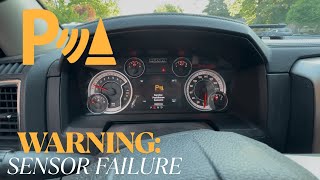
- "Service Park Assist System" message on the dashboard.
- "ParkSense Unavailable" message on the instrument cluster.
- The indicator light on the Park Assist button may be lit or flashing.
- A constant, steady tone when the vehicle is put into Reverse, indicating a system fault.
- The system will not produce audible beeps when approaching an obstacle.
- The park assist system may be completely disabled.
- Replacing the sensor without first cleaning it thoroughly, including behind the bumper.
- Replacing the Park Assist Module (PAM) when the fault is a simple wiring or sensor issue.
- Assuming the sensor is bad when the plastic mounting bezel is loose or damaged, which can misalign the sensor and cause false readings.
Most Likely Causes
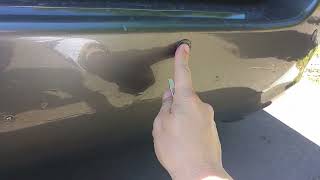
- Obstructed or Dirty Sensor 🔴 High Probability As confirmed by TSB #9003059, the sensors on these trucks are susceptible to blockage from snow, mud, ice, or other debris. The debris can get lodged on the sensor face or, critically, accumulate behind the bumper where it is not immediately visible, still causing the fault. Some owners report that even a thin film of dirt or ice 🎬 Watch: How to clean sensors and clear the ParkSense warning. on the front and back of the sensor can cause a fault.
How to confirm: Visually inspect the face of the front passenger-side outer sensor. Clean it thoroughly with a soft cloth and water. Also, inspect behind the bumper for packed mud or ice if possible. A loose or damaged sensor bezel can also cause false readings.
Typical fix: Thoroughly clean the sensor face and the area around and behind it. After cleaning, cycle the ignition (off for 10 seconds, then on) and place the vehicle in reverse to allow the system to re-activate and clear the fault. It may take a short period of driving for the fault to clear.
Est. part cost: $0 - Failed Park Assist Sensor 🟡 Medium Probability Sensors can fail internally from age, moisture intrusion, or minor impacts, leading to the 'waveform failure' detected by the module. Water ingress into the sensor body is a common failure mode.
How to confirm: After cleaning, if the code persists, swap the suspected faulty sensor (#6) with an adjacent one (e.g., sensor #5). Clear the codes. If the code changes to B1292 (for sensor #5), the sensor is confirmed bad. If B1293 returns, the problem is in the wiring or module. Another method is to turn the ignition on, place the vehicle in reverse, and listen closely to each sensor; a healthy sensor will emit a faint clicking or buzzing sound. A silent sensor is likely dead.
Typical fix: Replace the faulty park assist sensor. This is a plug-and-play part held in by plastic clips. 🎬 See this walkthrough on how to replace a faulty sensor.
Est. part cost: $30-$80 - Wiring or Connector Issue ⚪ Low Probability The wiring harness is located in a vulnerable area behind the bumper and can be damaged by road debris, moisture, or corrosion. The connector pins themselves can corrode or get pushed out.
How to confirm: Unplug the sensor connector and inspect for corrosion, moisture, or bent/damaged pins. Trace the wiring harness back from the sensor, looking for any signs of chafing, breaks, or pinch points, especially where it passes through the frame or near brackets.
Typical fix: Clean the connector with electrical contact cleaner and apply dielectric grease. Repair any broken or chafed wires by splicing, soldering, and heat-shrinking. If the connector or pigtail is severely damaged, it will need to be replaced.
Est. part cost: $5-$50
Rare But Worth Checking
- Park Assist Module (PAM) Failure: This is very rare. The module should only be considered as the cause after all sensors and wiring have been thoroughly tested and ruled out. A module failure typically causes multiple sensor codes, communication errors, or all sensors to fail at once, not just a single sensor fault.
- Park Assist Module Software Glitch: For some Ram trucks (primarily 2019+ models, but relevant as a possibility), TSBs like 08-082-20 and 08-047-19 were issued to update the PAM software to prevent erroneous 'Signal Shape/Waveform Failure' DTCs from being set. If the issue is intermittent and cleaning/swapping sensors doesn't help, a dealer software update could be a potential fix.
Diagnosis Steps
- Read the Diagnostic Trouble Codes (DTCs) with a scan tool capable of reading Body (B) codes to confirm B1293 is the active or stored code.
- Visually inspect Park Assist Sensor #6 (front bumper, passenger side, outermost position) for any dirt, mud, snow, ice, or physical damage.
- Thoroughly clean the sensor and the surrounding bumper area, including behind the bumper if accessible.
- Clear the DTCs. Cycle the ignition off, wait 10 seconds, turn the ignition on, and place the vehicle in reverse to re-test the system.
- If the B1293 code returns, perform a sensor swap. Move sensor #6 to the location of sensor #5 (the adjacent inner sensor).
- Clear the codes and re-test. If the code changes to B1292 (fault for sensor #5), the original sensor is faulty and must be replaced.
- If the B1293 code returns after the swap, the problem lies in the wiring harness or connector for that specific location.
- Inspect the wiring and connector for sensor #6. Check for damaged wires, corrosion in the connector (green crust), or pushed-out pins. Trace the harness for pinch points or breaks.
- If the wiring appears intact, use a multimeter to check for the 8V supply voltage, ground, and signal integrity at the sensor connector, referencing a service manual for the correct pinout and values.
- Check the plastic sensor mounting bezel to ensure it is secure and not broken, as a loose bezel can cause the sensor to report false signals.
Parts You'll Likely Need
- Park Assist Sensor
(OEM #1EW63TZZAA)— This is the most common part to fail after ruling out obstructions. The internal electronics of the sensor can fail, causing the waveform error. This part number is a common Mopar sensor used across many Chrysler, Dodge, Jeep, and Ram vehicles.
Trusted brands: Mopar, Standard Motor Products (TRQ), Dorman, Bosch
OEM price range: $60-$100
Aftermarket price range: $25-$60
Related Codes That Often Appear With This One
- B1292, B1291, etc. — If multiple park assist sensor codes are present, it may indicate a more widespread issue like a damaged wiring harness common to all sensors, a loose main inline connector for the bumper harness, or a failing Park Assist Module.
- B1293-25 — The '-25' is the manufacturer-specific suffix for 'Signal Shape / Waveform Failure'. This confirms the nature of the fault detected by the Park Assist Module.
Technical Service Bulletins (TSBs) & Recalls
- Bulletin #9003059: Addresses 'Signal Shape / Waveform Failure' faults (B1293-25) and explicitly states to check for and clean snow, mud, or ice from both the front and back of the sensor before any other repairs.
- Bulletin #08-082-20 / 08-047-19: While for newer 2019+ models, these bulletins address the same family of waveform failure codes and indicate that FCA has released software updates to the Park Assist Module (PAM) to prevent them from being set erroneously.
Platform-Specific Known Issues
- As per TSB #9003059, these vehicles are known to set this specific 'Signal Shape / Waveform Failure' code due to obstructions like snow, mud, or ice accumulating on or behind the sensor.
- Owners on forums report that even a fine mist that freezes on the sensors can be enough to trigger a 'WIPE' message or cause false alerts, highlighting the system's sensitivity on these trucks.
Mechanic-Grade Diagnostic Values
- Park Assist Sensor Supply Circuit Voltage — expected: Approximately 8V with ignition on.. Failure: No voltage or significantly low voltage indicates an open or high resistance in the supply circuit from the PAM.
- Park Assist Sensor Ground Circuit Resistance — expected: Below 5.0 Ohms.. Failure: Resistance above 5.0 Ohms indicates high resistance or an open in the ground circuit.
- Park Assist Sensor Signal Circuit Resistance to Ground — expected: Greater than 10k Ohms.. Failure: Resistance below 10k Ohms indicates a short to ground in the signal circuit.
Hidden / Shadow Codes Worth Checking
- B1293-12: A related code variant where the 'Set Condition' is defined as the sensor 'ring down time' exceeding a limit of 1450 microseconds. This provides a more technical insight into what the module considers a 'waveform failure'. (see via A capable OBD-II scanner that can read manufacturer-specific Body (B) codes, such as AlfaOBD or the dealer's wiTECH tool.)
Scan Tool Commands That Help
- wiTECH (Dealer Tool): Reprogram the PAM — Used to apply software updates that can resolve intermittent or erroneous fault codes, as detailed in various TSBs.
- wiTECH (Dealer Tool): Restore Configuration and Align PROXI — This procedure is required after replacing or reprogramming the Park Assist Module to ensure it communicates correctly with other vehicle modules.
- AlfaOBD / Capable Scan Tools: Read Codes in PTS (Parktronics Sensor) module — To read the specific B-series trouble codes and determine which sensor is faulting before starting any physical repairs.
- Scan Tool with Live Data: Monitor PAM DataLogger — Can be used to monitor PIDs like transmission gear selection (TRANSGR) to ensure the module is receiving the correct input to activate the system.
Wiring & Ground Locations
- Park Assist Module (PAM) — Located to the left of the emergency brake pedal, behind the driver's side kick panel and insulation. It is accessed by removing the driver's door sill trim and the kick panel.. This is the control unit for the entire system. All sensor wiring terminates here. Checking connections at the module is a final step if wiring issues are suspected.
- Main Body Ground — A primary body ground point is located on the radiator core support near the battery.. A poor main body ground can cause a variety of difficult-to-diagnose electrical issues across multiple systems, including the Park Assist Module.
- Dash Frame Ground — A ground point is available on the metal frame of the lower dash, often near the side kick panels.. The Park Assist Module is located in this area and may use a nearby ground point. Ensuring this ground is clean and tight is crucial for the module's operation.
- Sensor Connector — Directly on the back of each park assist sensor, inside the bumper.. This 3-pin connector is the most common point of failure for wiring issues due to its exposure to moisture and debris.
Real Owner Repair Stories
- YouTube channel 'Troubleshooting the Rear Park Assist in Your 2021 RAM' (2021 Ram (demonstrates a universally applicable diagnostic process)) — Service Park Assist message with multiple sensor codes active (B1295-11, B1298-11).
❌ Tried (didn't work) Initially suspected faulty sensors.
✅ What actually fixed it The owner swapped the suspect sensors with known good ones from other locations on the bumper. When the fault codes did not move with the sensors, it confirmed the sensors were good and the problem was in the wiring. A visual inspection of the harness revealed a pinched and broken wire. The fix was to solder the broken wire, seal it with heat shrink, and tape the harness. This resolved all codes.
Helpful Videos


We Have This Part in Stock


The information in this article is provided for general reference and educational purposes only. Vehicle specifications, procedures, and part compatibility can vary by production date, trim level, and region. Always consult your vehicle's factory service manual and verify part numbers before purchasing or performing repairs. Safety-critical components such as airbags, seat belts, and braking systems should be installed by a qualified professional.
- Ram 3500:
- 🎬 Helpful Videos
- 🛍️ Shop This Part
- What's Unique About the 2014-2017 Ram 3500
- Diagnostic Flowchart
- Symptoms You May Notice
- Most Likely Causes
- Rare But Worth Checking
- Diagnosis Steps
- Parts You'll Likely Need
- Related Codes That Often Appear With This One
- Technical Service Bulletins (TSBs) & Recalls
- Platform-Specific Known Issues
- Mechanic-Grade Diagnostic Values
- Hidden / Shadow Codes Worth Checking
- Scan Tool Commands That Help
- Wiring & Ground Locations
- Real Owner Repair Stories
- 🎟️ Get 5% Off