

B1293 on 2014-2017 Ram 2500: Front Park Assist Sensor 6 Causes and Fixes
B1293 indicates a fault with the outermost park assist sensor on the front passenger-side bumper. The most common cause is an obstruction like snow, mud, or ice. Before buying parts, thoroughly clean the sensor face and the area behind the bumper, as noted in a manufacturer TSB. If cleaning doesn't resolve the issue, the sensor itself has likely failed and can be replaced as a DIY job.
- B1293 points specifically to the outermost park assist sensor on the front passenger-side bumper.
- The most probable and cost-free fix is to thoroughly clean the sensor, paying special attention to the area behind the bumper for trapped debris like mud or ice.
- If cleaning fails, the sensor itself has likely failed. A simple DIY test is to swap it with a neighboring sensor to see if the fault code follows.
- Do not replace the expensive Park Assist Module unless the sensor and its wiring have been definitively ruled out as the cause.
What's Unique About the 2014-2017 Ram 2500
For this generation of Ram trucks, the ParkSense® system is notably sensitive to environmental factors. Manufacturer service bulletins specifically highlight that snow, mud, or ice can become trapped *behind* the bumper, obstructing the sensor's operation even if the front face appears clean. This makes a thorough cleaning of both the front and back of the sensor a critical and unique first diagnostic step before assuming a part has failed. TSB #9003059 explicitly details this cleaning procedure for the B1293-25 fault.
🎬 Watch: How to clean sensors to clear the ParkSense warning.Diagnostic Flowchart
Tap your situation to follow the diagnostic path that matches what you're seeing on this vehicle.
Symptoms You May Notice
- "Service Park Assist System" or "ParkSense Unavailable" message on the instrument cluster display.
- The ParkSense system turns off automatically, and the deactivation switch light on the dashboard stays illuminated.
- No audible beeping or warning arcs on the display when approaching obstacles from the front.
- A constant, steady tone may sound when the system tries to activate, instead of the normal intermittent beeps.
- Replacing the sensor without first thoroughly cleaning it, including the area behind the bumper.
- Replacing the Park Assist Module (PAM) before properly diagnosing the sensor and its wiring.
- Assuming the sensor is bad when the connector is simply not fully seated.
Most Likely Causes
- Obstructed Park Assist Sensor 🔴 High Probability As noted in Ram TSB #9003059, the sensor's location makes it highly susceptible to buildup of snow, ice, mud, or road grime, which can get lodged both on the sensor face and behind the bumper, causing a Signal Shape / Waveform Failure.
How to confirm: Visually inspect the front passenger-side outer sensor. Clean the face thoroughly with soap and water. Reach behind the bumper to check for and remove any debris packed between the sensor and the bumper housing.
Typical fix: Thoroughly clean the sensor and the area behind it. Per the TSB, after cleaning, cycle the ignition and place the vehicle in Reverse to allow the system to re-check the sensor and move the fault to 'Stored' status if the issue is resolved.
Est. part cost: $0 - Failed Park Assist Sensor #6 🟡 Medium Probability The sensors are electronic components exposed to constant weather, vibration, and potential impacts from road debris, which can lead to internal failure over time.
How to confirm: If cleaning the sensor does not resolve the code, perform a 'Listen and Touch Test' by putting the truck in reverse (with parking brake on) and feeling for a faint clicking or vibration from the sensor; a silent sensor is likely dead. The most definitive test is to swap the suspected bad sensor (#6) with an adjacent sensor (e.g., sensor #5, the inner front passenger sensor). Clear the codes. If the code changes to B1292 (for sensor #5), the sensor you moved is faulty.
Typical fix: Replace the faulty park assist sensor. The sensor is accessed from behind the bumper and held in by two small plastic clips. It can be unclipped, disconnected, and replaced without special tools. 🎬 Watch: Step-by-step walkthrough for replacing a faulty sensor.
Est. part cost: $35-$100 - Wiring or Connector Issue ⚪ Low Probability The wiring harness runs along the bumper, where it is exposed to moisture, road salt, and potential physical damage, which can lead to corrosion or broken wires at the sensor connector or main harness plug.
How to confirm: After confirming the sensor is good, disconnect the 3-pin sensor connector and inspect for green/white corrosion, bent or pushed-out pins, or visible wire damage. TSB #9003059 also advises ensuring the connector is fully seated with an audible click. A pull test on the wires at the connector can reveal a loose terminal.
Typical fix: Clean the connector terminals with an electrical contact cleaner or repair the damaged section of the wiring harness. The connector pigtail (Standard Motor Products S-1497) can be replaced if corrosion is severe.
Est. part cost: $10-$50
Rare But Worth Checking
- Faulty Park Assist Module (PAM): This is very unlikely to be the cause for a single sensor fault code. The PAM should only be considered if multiple sensor codes are present or if all other diagnostic steps have failed.
- Blown Fuse: A blown fuse typically disables the entire Park Assist system, not just a single sensor. However, it's a simple check. On 2013-2018 Rams, the fuse for the Park Assist Module is F95 in the under-hood fuse box (Power Distribution Center).
Diagnosis Steps
- Read the fault codes with a scan tool capable of accessing the Park Assist Module (PAM) to confirm B1293 is active. Note if it has a suffix like '-25' (Signal Shape Failure) or '-11' (Short to Ground).
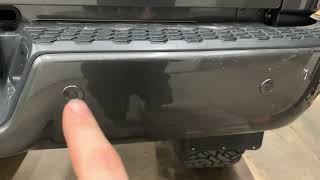
- Locate Park Assist Sensor #6 on the front bumper – it is the outermost sensor on the passenger side, closest to the wheel well. 🎬 See this guide to locate each sensor on your bumper.
- Thoroughly clean the sensor face and the area behind it to remove any dirt, snow, ice, or mud, as recommended by TSB #9003059.
- Clear the trouble codes. Cycle the ignition off for 10 seconds, then turn the engine on and place the vehicle in REVERSE to activate the sensors and see if the code returns.
- If the code persists, perform a 'Listen and Touch Test'. With the ignition on and in Reverse, listen and feel for a faint clicking/buzzing from each front sensor. A silent sensor #6 indicates it has likely failed.
- If the sensor is silent or the code remains, perform a 'swap test'. Exchange sensor #6 with the adjacent sensor #5 (inner passenger side).
- Clear the codes again. If the fault code changes to B1292, the sensor is confirmed bad and must be replaced.
- If the fault code remains B1293 after the swap, the problem lies in the wiring to that specific sensor location. Inspect the wiring connector for sensor #6 for damage, corrosion, or loose pins. Ensure it is fully seated.
- If wiring appears damaged, repair the affected circuit. If all wiring and the sensor are confirmed good, the Park Assist Module may be at fault, though this is rare.
Parts You'll Likely Need
- Front Park Assist Sensor
(OEM #1EW63TZZAA)— This sensor is the most common part to fail if cleaning does not resolve the B1293 code. It is an electronic component exposed to the elements. Note that this part number often comes unpainted (black plastic) and may need to be painted to match the bumper.
Trusted brands: Mopar, Dorman (p/n 684-007), Standard Motor Products (p/n PPS45), Crown Automotive
OEM price range: $50-$100
Aftermarket price range: $35-$60 - Park Aid Sensor Connector
(OEM #S-1497 (Standard Motor Products))— If the connector at the sensor is damaged by corrosion or impact, the pigtail will need to be spliced in to restore proper connection.
Trusted brands: Standard Motor Products
OEM price range: $25-$40
Aftermarket price range: $15-$30
Related Codes That Often Appear With This One
- B1292 — This code is for the adjacent sensor (#5). Seeing them together could indicate a localized wiring issue affecting both sensors or a large obstruction covering that side of the bumper.
- B1291 — This is the code for sensor #4. Multiple front sensor codes can point to an issue with the main front bumper wiring harness connector.
Technical Service Bulletins (TSBs) & Recalls
- Bulletin #9003059: Recommends checking for and cleaning snow, mud, or ice from the sensor face and behind the bumper for Signal Shape / Waveform Failure faults like B1293-25. Also advises checking for fully seated connectors.
- Bulletin #08-071-14: For early 2014 models, this TSB addresses false detections and codes like B1293-25 by updating the Park Assist Module software to reduce sensitivity.
Platform-Specific Known Issues
- TSB #9003059 specifically notes that for a B1293-25 code, debris such as snow, mud, or ice can accumulate *behind* the bumper and sensor, causing a fault even if the visible surface is clean.
- TSB #08-071-14 was issued for 2014 models built before June 14, 2014, to address overly sensitive front sensors causing false detections and setting codes like B1293-25. The fix was a Park Assist Module (PAM) software update.
Mechanic-Grade Diagnostic Values
- Park Assist Sensor Supply Voltage — expected: ~8.5 Volts. Failure: No voltage or significantly lower voltage indicates a wiring or PAM issue.
- Sensor Signal Circuit Short to Ground — expected: Above 10k Ohms. Failure: Resistance below 10k Ohms indicates a short to ground in the signal wire.
- Sensor Signal Circuit Short to Battery — expected: Below 1.0 Volt. Failure: Voltage above 10.0 Volts indicates a short to battery voltage in the signal wire.
- Sensor Ground Circuit Resistance — expected: Below 5.0 Ohms. Failure: Resistance above 5.0 Ohms indicates an open or high resistance in the ground circuit.
Hidden / Shadow Codes Worth Checking
- B1293-11: PTS Sensor 6 - Circuit Short to Ground (see via A professional scan tool capable of reading body control module fault code suffixes.)
- B1293-12: PTS Sensor 6 - Circuit Short to Battery (see via A professional scan tool capable of reading body control module fault code suffixes.)
- B1293-25: PTS Sensor 6 - Signal Shape / Waveform Failure (see via A professional scan tool capable of reading body control module fault code suffixes.)
- B1295-92: PTS Sensor 8 - Performance or Incorrect Operation (Example of another sensor's performance code) (see via A professional scan tool capable of reading body control module fault code suffixes.)
Scan Tool Commands That Help
- wiTECH: Reprogram the PAM (Park Assist Module) — Used to apply software updates that can resolve issues like false alerts or system unavailability, as detailed in TSBs #08-071-14, #08-094-15, and others.
- wiTECH: Restore Configuration and Align PROXI — This procedure is required after reprogramming or replacing the Park Assist Module to ensure it communicates correctly with the rest of the vehicle's systems.
- Professional Scan Tool: Clear Fault Codes — Crucial after any repair. Some owners have found that even after replacing a faulty sensor with a new one, the system would not work until the stored DTCs were cleared with a scan tool.
Wiring & Ground Locations
- Front Park Assist Sensor Supply — Gray with Orange stripe wire in the front bumper harness.. This wire provides the ~8.5V operating voltage to all front sensors. A fault in this wire will disable multiple sensors.
- Front Park Assist Sensor Ground — Circuit identified as (X751) in service manuals. Physical location is often a shared ground point on the front core support near the battery or headlamps.. A poor ground connection can cause erratic sensor behavior and set codes. The resistance to chassis ground should be less than 5 ohms.
- Sensor #6 Signal Wire — Circuit identified as (D709) in service manuals, running from the sensor connector to the Park Assist Module (PAM).. This is the specific wire that carries the signal from sensor #6. A short or open on this wire will cause a B1293 code.
Real Owner Repair Stories
- RamForum.com user (2017 Ram 2500) — "Service ParkSense" message on the dash.
❌ Tried (didn't work) Initially installing the new sensors.
✅ What actually fixed it The user replaced the faulty sensors with new aftermarket ones, but the system only began working correctly after the stored DTC (Diagnostic Trouble Code) was cleared with a scan tool. - RamForum.com user (2018 RAM) — "Service rear sensor" light and chime after having a new bumper installed.
❌ Tried (didn't work) Assuming the new installation was perfect.
✅ What actually fixed it The owner used their phone's video camera to listen for the 'tick, tick, tick' sound of working sensors and found only one was active. They replaced the three non-working OEM sensors. The error persisted but disappeared after a couple of key cycles, restoring normal function.
OEM Part Supersession History
Multiple, including 1ew631auaa, 1ew63dx8aa, 1ew63lauaa, etc.→1EW63TZZAA— Part consolidation and revision over many model years and vehicle lines.
Heads up: The final part number 1EW63TZZAA is a universal, unpainted sensor. The numerous superseded part numbers were often pre-painted for specific vehicle colors. When replacing a colored sensor with 1EW63TZZAA, it will be black plastic and require painting to match the bumper.
Model Year Variations Within This Range
- 2014 (built before 06/14/2014): These models may have overly sensitive PAM software, causing false alerts. TSB #08-071-14 advises a software update rather than hardware replacement.
- 2016-2017: Starting in the 2016 model year, the ParkSense system can auto-detect the installation of a new sensor set. After installing sensors, place an obstacle near them and shift to reverse with the park brake on. The system will detect the obstacle and auto-enable the new sensors.
Helpful Videos


We Have This Part in Stock


The information in this article is provided for general reference and educational purposes only. Vehicle specifications, procedures, and part compatibility can vary by production date, trim level, and region. Always consult your vehicle's factory service manual and verify part numbers before purchasing or performing repairs. Safety-critical components such as airbags, seat belts, and braking systems should be installed by a qualified professional.
- Ram 2500:
- 🎬 Helpful Videos
- 🛍️ Shop This Part
- What's Unique About the 2014-2017 Ram 2500
- Diagnostic Flowchart
- Symptoms You May Notice
- Most Likely Causes
- Rare But Worth Checking
- Diagnosis Steps
- Parts You'll Likely Need
- Related Codes That Often Appear With This One
- Technical Service Bulletins (TSBs) & Recalls
- Platform-Specific Known Issues
- Mechanic-Grade Diagnostic Values
- Hidden / Shadow Codes Worth Checking
- Scan Tool Commands That Help
- Wiring & Ground Locations
- Real Owner Repair Stories
- OEM Part Supersession History
- Model Year Variations Within This Range
- 🎟️ Get 5% Off