

OBD-II Code B1293: Parking Assist Sensor Fault
What B1293 means, why it triggers, and how to fix it
- Code B1293 is specific to Stellantis vehicles (Chrysler, Dodge, Jeep, Ram) and almost always indicates a failure of Sensor #6, the outermost sensor on the front passenger-side bumper.
- The cheapest and most common fix is thoroughly cleaning the sensor face and removing hidden mud or ice packed behind the bumper.
- Diagnose a dead sensor without tools by turning the system on and listening closely; a healthy sensor emits a faint clicking sound, while a failed sensor is completely silent.
- Confirm a bad sensor before buying parts by swapping it with an adjacent working sensor to see if the trouble code moves to the new location.
What Does B1293 Mean?

B1293 is a manufacturer-specific Body Diagnostic Trouble Code (DTC) used primarily by Chrysler, Dodge, Jeep, and Ram (Stellantis). It indicates the Park Assist Module (PAM) detected a fault with a specific parking sensor. In the vast majority of cases, it points to 'Sensor #6', which is the outermost sensor on the front passenger-side bumper.
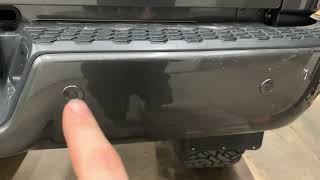
🎬 Watch: See exactly where each sensor is located on your RAM.Technical definition: For Stellantis vehicles, B1293 translates to a 'PTS Sensor 6 Circuit' fault. A suffix specifies the exact fault type: B1293-11 is 'Circuit Short to Ground', B1293-12 is 'Circuit Short to Battery', and the most common, B1293-25, is 'Signal Shape / Waveform Failure'.
Can I Drive With B1293?
Yes. Driving is safe, but your parking assist system will not work, requiring extra caution during low-speed maneuvers. There is no risk to the engine or core safety systems, so you can continue driving indefinitely without causing mechanical damage.
Common Causes

- Obstructed or Dirty Sensor (Very Common) — Dirt, mud, snow, ice, or heavy wax covers the sensor face. Debris trapped behind the bumper also interferes with sensor operation, even if the front appears clean.
- Failed Park Assist Sensor (Common) — Water ingress or physical impacts damage the sensor's internal electronics, causing corrosion or short circuits.
- Damaged or Loose Wiring (Common) — Road debris or moisture damages the vulnerable wiring harness behind the bumper. Connectors also back out from vibration, breaking the electrical circuit.
- Damaged Sensor Bezel (Less Common) — A broken plastic bracket misaligns the sensor, disrupting the ultrasonic signal return and triggering a waveform fault.
- Aftermarket Interference (Less Common) — Bull bars, snowplow mounts, or oversized license plate frames physically block the ultrasonic beam.
- PAM Software Glitch (Rare) — On 2014 Ram and Jeep models built before June 14, 2014, overly sensitive software triggers false faults from ground reflections (addressed by TSB 08-071-14).
- Failed Park Assist Module (PAM) (Very Rare) — The control module itself fails, usually causing multiple, persistent sensor codes to appear simultaneously.
Symptoms

- "Service Park Assist" Warning Message — A warning message appears on the instrument cluster or infotainment display.
- System Disabled (No Proximity Beeps) — The system turns off as a fail-safe, providing no audible or visual alerts when approaching obstacles.
- Constant, Steady Tone — The system emits a single, continuous tone upon activation (e.g., shifting into reverse), indicating a hard fault.
- Erratic Distance Readings — A failing or dirty sensor gives false alerts, showing phantom objects on the display.
Diagnostic Flowchart

Tap your situation to follow the diagnostic path that matches what you're seeing on this code.
Common Fixes & Costs
- Clean the Park Assist Sensor — Parts: $0, Labor: $0, ~0.1 hr book time (DIY)
- Replace the Faulty Park Assist Sensor — Parts: $20-$150, Labor: $75-$150, ~0.5 hr book time (DIY)
- Repair Damaged Wiring or Connector — Parts: $15-$35, Labor: $100-$200, ~1.0 hr book time (Intermediate)
- Update PAM Software — Parts: $0, Labor: $100-$200, ~1.0 hr book time (Professional)
- Replace the Park Assist Module (PAM) — Parts: $160-$450, Labor: $100-$200, ~1.5 hr book time (Professional)
DIY vs Professional
- Clean the Park Assist Sensor — Beginner:
- Replace the Faulty Park Assist Sensor — Beginner:
- Repair Damaged Wiring or Connector — Beginner:
- Update PAM Software — Beginner:
- Replace the Park Assist Module (PAM) — Beginner:
Used vs. New Parts: Buying Guide
When a used part is worth it: A used OEM sensor from a low-mileage vehicle is a good budget-friendly option. Aftermarket sensors offer a reliable middle ground between used and new OEM pricing.
Donor-vehicle mileage cap: roughly under 100000 miles for the part to have meaningful remaining life.
Donor quality checklist:
- Verify the part number matches exactly.
- Source from a reputable salvage yard with a return policy.
- Be prepared to paint the sensor to match your bumper.
Decision logic:
- If Vehicle is under warranty or budget is not a concern → Buy a new OEM part for guaranteed compatibility.
- If Budget is tight and you are comfortable with DIY repair → A used OEM or new aftermarket sensor offers significant savings.
- If A shop is performing the repair → Buy a new part, as shops rarely warranty customer-supplied or used parts.
Warranty tradeoff: Used parts typically have a 30-day warranty. New aftermarket parts offer 1-year warranties. New OEM parts carry a 1-2 year warranty.
Worst-case if a used part fails: $100-250 if a cheap part fails, requiring repeat labor.
What Happens If You Wait — Timeline
- Immediate: The 'Service Park Assist System' message appears, and the system is completely disabled as a fail-safe. (MPG impact: 0%% · Added cost: $0)
- 0-3 Months: The driver must rely solely on mirrors. The risk of a low-speed collision increases due to the lack of proximity alerts. (MPG impact: 0%% · Added cost: $0 (risk only))
- 3-6 Months: A minor parking incident occurs, scuffing the bumper paint on a wall or another car. (MPG impact: 0%% · Added cost: $150 - $600)
- 6+ Months: A significant parking collision cracks the bumper cover or dents another vehicle, potentially leading to an insurance claim. (MPG impact: 0%% · Added cost: $500 - $2,000+)
Cost of Not Fixing It
- Immediate: The ParkSense system is disabled, resulting in no audible or visual alerts when parking. (Added cost: $0)
- 0-6 Months: Increased risk of low-speed collisions with objects or other vehicles during parking maneuvers. (Added cost: $300 - $1,500)
- 6+ Months: Continued risk of a parking-related accident leading to significant body damage and insurance claims. (Added cost: $500 - $2,500)
Diagnosis Steps
- Read the Code and Suffix
Use a scanner capable of reading Body ('B') codes to confirm B1293. Note the suffix (-11, -12, or -25) to identify the specific electrical fault.
Tools: OBD-II Scanner (capable of reading B-codes) (Beginner) - Visually Inspect and Clean
Clean sensor #6 (front passenger-side outer). Check behind the bumper and remove any packed mud or ice.
Tools: Soft cloth, soap, water, flashlight (Beginner) - Listen for Clicking
Turn the ignition 'On' (engine off) and activate park assist. Place your ear near each sensor. A healthy sensor emits a faint clicking sound; a silent sensor has failed.
Tools: None (Beginner) - Inspect Wiring Visually
Inspect the electrical connector and wires going to the suspect sensor. Look for green corrosion on the pins, chafed wires, or a loose connection. Ensure it clicks into place.
Tools: Flashlight (Intermediate) - Perform a Sensor Swap Test
Unplug the silent sensor (#6) and swap it with a working adjacent sensor (#5). Clear codes and re-test. If the code changes to B1292, the sensor is bad. If B1293 returns, the wiring is faulty.
Tools: Trim removal tool or small flathead screwdriver (Intermediate) - Test Circuit with a Multimeter
If the swap test points to wiring, use a multimeter on the connector. Verify ~8-9V on the power wire and <5 ohms on ground. Ensure the signal wire has infinite resistance to ground (testing for B1293-11) and 0 volts with ignition on (testing for B1293-12).
Tools: Multimeter, vehicle-specific wiring diagram (Advanced) - Analyze Sensor Waveform
For a persistent B1293-25 code, connect a lab scope to the signal wire. A healthy sensor shows a clean burst of pulses; a failing sensor shows a dampened or noisy waveform.
Tools: Oscilloscope, back-probe pins (Professional)
When This Code Triggers (Freeze-Frame Conditions)
- Ignition Status: On/Run (The ignition must be on for the Park Assist Module to run diagnostics.)
- Vehicle Speed: < 10 mph (16 km/h) (The park assist system is only active at low speeds during parking maneuvers.)
- Gear Selector: Reverse or Drive (The system is monitored when shifting into Reverse (rear sensors) or Drive (front sensors).)
- Sensor Ring Down Time: Out of Range (<700 or >1450 μs) (The module sets specific fault suffixes based on the sensor's signal return time.)
Related Codes
- B1292 — This code is for the adjacent sensor (#5). If you swap the suspect sensor from position #6 to #5 and the code changes to B1292, you have proven the sensor is faulty.
- B1290, B1291 — Multiple simultaneous sensor codes point to a disconnected main bumper harness or a shared power/ground wire issue, not individual sensor failures.
- B1293-11 — Indicates 'Circuit Short to Ground'. The module sets this code when the sensor 'ring down time' is under 700 microseconds, pointing to a wiring short.
- B1293-12 — Indicates 'Circuit Short to Battery'. The module sets this code when the sensor 'ring down time' is over 1450 microseconds, pointing to a power short.
- B1293-25 — Indicates a 'Signal Shape / Waveform Failure.' The signal is distorted by a physical obstruction, an internally failing sensor, or a software sensitivity issue.
Climate & Environmental Factors
- Snow and Ice: A layer of snow or ice blocks the ultrasonic waves, causing a B1293-25 fault. The system resumes normal function after clearing the sensor.
- Mud and Dirt: Dried mud or road grime obstructs the sensor, especially common on trucks used in off-road or rural conditions.
- Road Salt and Moisture: Salt spray penetrates the electrical connector over time, causing pin corrosion that leads to short circuits and B1293-11 faults.
How to Talk to a Mechanic About This Code
Say this: "I have a 'Service Park Assist' message and my scanner shows code B1293, pointing to the front passenger-side outer sensor. I've cleaned it, so I'd like a diagnosis. Please check if the sensor is clicking and perform a swap test before quoting a wiring repair."
This signals you've done basic research and guides the technician toward efficient diagnostic steps, preventing them from starting with expensive wiring checks.
Avoid saying:
- 'My parking beepers are broken.'
- 'The dash says Service Park Assist, can you fix it?'
- 'Just replace the bad sensor.'
Questions to ask before authorizing the repair:
- Did you confirm the sensor was bad with a swap test, or is it a wiring issue?
- If it's a wiring issue, can you show me the damaged section?
- Does the quoted price include clearing the B1293 code from the module?
Where to Take It: Dealer vs Independent vs Chain
- Dealer:
Recommended only if the vehicle is under warranty or if a known TSB software update applies.
Best for: Vehicles still under bumper-to-bumper warranty., Cases where a software update is the suspected cause., Complex wiring issues requiring manufacturer-specific tools.
Downsides: Highest labor rates and OEM part prices., Less flexible on using aftermarket parts. (Typical cost: +50% vs. baseline) - Independent Shop:
Best fit for most B1293 repairs. An experienced technician easily diagnoses and replaces a faulty sensor at a lower cost than a dealer.
Best for: Out-of-warranty vehicles where cost is a factor., Straightforward sensor replacements or simple wiring repairs.
Downsides: Quality varies, so check reviews and ASE certifications. (Typical cost: +0% vs. baseline) - Chain Shop:
Acceptable with caution. Do not rely on them for the initial diagnosis, especially if it involves wiring.
Best for: Simple, visible repairs where you provide the specific part.
Downsides: May lack scanners that read manufacturer-specific Body codes., High pressure to upsell unnecessary services. (Typical cost: -10% vs. baseline)
When to Walk Away From the Repair
If the estimated repair cost exceeds 50% of the car's value, consider alternatives. For B1293, the repair cost is almost always low, making it a definitive 'fix it' decision.
- Car worth $15000, fix is $150: Fix it. This is a minor cost relative to the vehicle's value and improves safety.
- Car worth $4000, fix is $150: Fix it. The repair cost is well below the threshold and makes the car easier to sell.
- Car worth $2000, fix is $1500: Walk away. A B1293 code should not cost this much. This indicates a grossly overpriced quote.
What Scan Tool You Need for This Code
Minimum: A scanner that reads and clears manufacturer-specific Body ('B') codes for Chrysler/Dodge/Jeep/Ram vehicles.
A standard $20 code reader only checks for engine ('P') codes and will not see the B1293 code at all.
Budget: BlueDriver Pro (~$100) — Reads and clears enhanced codes (ABS, Airbag, Body) for Stellantis vehicles, allowing you to see the B1293 code and its suffix.
Mid-range: Foxwell NT510 Elite for Chrysler (~$180) — Provides full system diagnostics for all modules, including the PAM. Offers bi-directional control to test components directly.
Professional: Autel MaxiCOM MK808S (~$500) — Offers OE-level diagnostics, live data viewing, and bi-directional controls suitable for complex wiring issues.
Rent vs buy: Buy an affordable scanner like the BlueDriver. Free scans at auto parts stores often cannot read Body codes, and you need the tool to clear the code after the repair.
How to Clear the Code After You Fix It
- Perform the physical repair (e.g., clean or replace sensor).
- Use an OBD-II scan tool capable of reading Body codes to erase the DTC.
- Cycle the ignition off for at least 10 seconds, then turn it back on.
- Activate the system by shifting into Reverse or Drive to allow the module to perform a self-test.
Drive cycle (~1 minutes): A formal drive cycle is not required. Activating the ParkSense system is sufficient for the module to re-evaluate the sensor and turn off the warning message.
Readiness monitors affected: None
Watch out for:
- Using a basic OBD-II scanner that cannot read or clear manufacturer-specific Body ('B') codes.
- Forgetting to cycle the ignition after clearing the code.
- Assuming disconnecting the battery will clear the code from the Park Assist Module's memory.
Will This Fail Emissions / State Inspection?
No — by itself this code doesn't fail OBD inspection (but it can keep readiness monitors from setting, which causes a separate fail).
- California: This code will NOT cause a smog check failure. California focuses on emissions-related 'P' codes.
- New York: This code will NOT cause an emissions inspection failure. NYVIP3 checks for emissions faults, not body codes.
- Texas: This code will NOT cause a vehicle to fail its inspection.
Manufacturer-Specific Notes
- Chrysler/Dodge/Jeep/Ram (Stellantis): These brands use a clockwise numbering system. Front sensors are #1 (driver) through #6 (passenger). Rear sensors are #8 (passenger) through #11 (driver).
- Chrysler/Dodge/Jeep/Ram (Stellantis): The module defines a 'short to ground' (-11) as a sensor ring down time of less than 700 microseconds, providing advanced insight into the electrical fault.
- Ford, GM, Toyota: These manufacturers do not use the B1293 code for parking sensor faults. Ford uses B1B44, and Toyota uses C1AEB.
Real Owner Stories
2018 Ram 1500 with 'Service ParkSense' message
The warning appeared on the dashboard, disabling the system after driving in dirty winter conditions.
What they tried:
- Purchased a set of four aftermarket sensors online for $35.
Outcome: The owner replaced the sensors and found a gummy substance on the back of the failed unit. The system worked perfectly after installation.
Lesson: Replacing sensors is a fast DIY job. Aftermarket sensors are cost-effective, and physical damage is often the root cause.
2014 Ram 1500 with B1293-25 after sensor replacement
An owner replaced the #6 sensor to fix a B1293-25 code, but the warning message remained.
What they tried:
- Replaced the sensor with a new aftermarket part.
Outcome: The system only functioned after the stored DTC was cleared from the Park Assist Module using a proper scan tool.
Lesson: You must clear stored fault codes from the PAM using a capable scan tool; disconnecting the battery is rarely sufficient.
2012 Dodge Ram with multiple sensor codes
A technician faced a truck reporting codes for all four rear sensors shorted to ground.
What they tried:
- A previous mechanic replaced the Park Assist Module, which did not fix the problem.
Outcome: The technician found the main wiring harness common to the rear sensors was shorted, not the sensors or the module.
Lesson: When multiple sensors fail simultaneously, inspect the main wiring harness or shared ground before replacing expensive modules.
How to Prevent This Code From Triggering
- Regularly Wash Sensors and Bumper Area (Weekly or after driving on dirty/salty roads) — Prevents the buildup of mud and ice that obstructs the ultrasonic beam, the leading cause of B1293-25 faults.
- Apply Automotive Wax to Sensors (Seasonally) — Creates a hydrophobic surface that prevents ice and mud from sticking to the sensor face.
- Apply Dielectric Grease to Connector Pins (Whenever a sensor is disconnected) — Seals the electrical connection from moisture, preventing pin corrosion and short circuits.
Frequently Asked Questions
Can I drive my car with a B1293 code?
Yes, it is perfectly safe to drive. The code only affects a driver convenience feature, leaving your engine and core safety systems intact. You simply need to exercise extra caution when parking.
How much does it cost to fix code B1293?
Cleaning a dirty sensor costs nothing. Replacing a failed sensor costs $20 to $150 for the part and $75 to $150 for labor. Wiring repairs typically range from $115 to $235 total.
What is the sensor numbering for my Ram/Jeep/Dodge?
Stellantis front sensors are numbered 1 through 6, starting at the driver's side and counting clockwise. Rear sensors are numbered 8 through 11, starting at the passenger's side. Code B1293 almost always indicates a failure of sensor #6.
Can I fix a B1293 code myself?
Yes, this is a very DIY-friendly repair. Cleaning the sensor requires no tools, and replacing it is usually a simple plug-and-play job. You only need a small trim tool to release the bumper clips.
Do I need to get the new sensor painted?
Yes, replacement sensors usually arrive in unpainted black plastic. Apply very thin, even coats of paint, keeping total thickness under 120 microns. Thick paint obstructs the ultrasonic signal and triggers a new fault code immediately.
My sensor is clean but the code is still there. What's next?
The next most likely cause is a failed sensor. Swap the suspect sensor with a known good adjacent sensor. If the trouble code moves to the new location, you have definitively found the bad part.
What does the little number after the code mean?
That manufacturer-specific suffix provides critical diagnostic detail. For example, -11 means 'Circuit Short to Ground,' while -12 means 'Circuit Short to Battery.' The most common suffix, -25, indicates a 'Signal Shape / Waveform Failure' caused by an obstruction or bad sensor.
Do I need to calibrate the new sensor after replacing it?
No formal calibration is required for most Stellantis vehicles. The system performs a self-test upon activation after you clear the codes. If the new sensor and wiring are good, the system functions normally.
Key Takeaways
- Code B1293 is specific to Stellantis vehicles (Chrysler, Dodge, Jeep, Ram) and almost always indicates a failure of Sensor #6, the outermost sensor on the front passenger-side bumper.
- The cheapest and most common fix is thoroughly cleaning the sensor face and removing hidden mud or ice packed behind the bumper.
- Diagnose a dead sensor without tools by turning the system on and listening closely; a healthy sensor emits a faint clicking sound, while a failed sensor is completely silent.
- Confirm a bad sensor before buying parts by swapping it with an adjacent working sensor to see if the trouble code moves to the new location.
Helpful Videos

The information in this article is provided for general reference and educational purposes only. Vehicle specifications, procedures, and part compatibility can vary by production date, trim level, and region. Always consult your vehicle's factory service manual and verify part numbers before purchasing or performing repairs. Safety-critical components such as airbags, seat belts, and braking systems should be installed by a qualified professional.
- 🎬 Helpful Videos
- What Does B1293 Mean?
- Can I Drive With B1293?
- Common Causes
- Symptoms
- Diagnostic Flowchart
- Common Fixes & Costs
- DIY vs Professional
- Used vs. New Parts: Buying Guide
- What Happens If You Wait — Timeline
- Cost of Not Fixing It
- Diagnosis Steps
- When This Code Triggers (Freeze-Frame Conditions)
- Related Codes
- Climate & Environmental Factors
- How to Talk to a Mechanic About This Code
- Where to Take It: Dealer vs Independent vs Chain
- When to Walk Away From the Repair
- What Scan Tool You Need for This Code
- How to Clear the Code After You Fix It
- Will This Fail Emissions / State Inspection?
- Manufacturer-Specific Notes
- Real Owner Stories
- 2018 Ram 1500 with 'Service ParkSense' message
- 2014 Ram 1500 with B1293-25 after sensor replacement
- 2012 Dodge Ram with multiple sensor codes
- How to Prevent This Code From Triggering
- Frequently Asked Questions
- Can I drive my car with a B1293 code?
- How much does it cost to fix code B1293?
- What is the sensor numbering for my Ram/Jeep/Dodge?
- Can I fix a B1293 code myself?
- Do I need to get the new sensor painted?
- My sensor is clean but the code is still there. What's next?
- What does the little number after the code mean?
- Do I need to calibrate the new sensor after replacing it?
- Key Takeaways
- 🎟️ Get 5% Off