

B1292 on 2014-2017 Ram 2500: Park Assist Sensor Fault Causes and Fixes
On a 2014-2017 Ram 2500, code B1292 indicates a signal failure from Park Assist Sensor #5, located in the front bumper. The most common cause is an obstructed or dirty sensor, followed by sensor failure. Cleaning the sensor often resolves the issue; if not, a replacement sensor costs between $25 and $100.
- B1292 specifically identifies a fault with the front park assist sensor located second from the passenger side.
- Always start by thoroughly cleaning the sensor, as obstructions from dirt, snow, or ice are the most common cause. [⭐ TSB #9003059]
- The 'sensor swap' is the most effective DIY diagnostic to confirm a faulty sensor versus a wiring issue.
- After any repair, the fault code may need to be cleared with a scan tool before the system will reactivate.
- Early 2014 models may require a dealer-installed software update to resolve this code per TSB 08-071-14.
What's Unique About the 2014-2017 Ram 2500
On Ram 2500 trucks, the park assist sensors are mounted on the front and rear bumpers, where they are highly exposed to the elements. As noted in manufacturer technical service bulletins, this makes them particularly susceptible to being obstructed by mud, snow, ice, and road debris, which is a primary trigger for this code. [⭐ TSB #9003059] This is often the first and easiest thing to check before assuming a part has failed. Forum users on Ram Heavy Duty forums frequently report false alarms and 'WIPE' messages in misty or freezing conditions, confirming the system's sensitivity on these trucks.
Diagnostic Flowchart
Tap your situation to follow the diagnostic path that matches what you're seeing on this vehicle.
Symptoms You May Notice
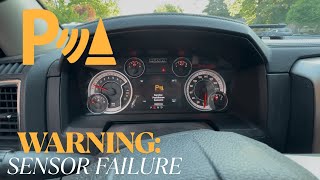
- "Service Park Assist System" message on the instrument cluster display.
- The park assist system automatically deactivates.
- No audible beeps when approaching an object while parking.
- Constant or erratic beeping from the park assist system.
- A message to "WIPE" the sensors appears on the dash, even if they are clean.
- Replacing the sensor before checking for obstructions. Always clean the sensor first, as this is the most common fix and costs nothing.
- Replacing the Park Assist Module (PAM) when the fault is with a single sensor or its wiring.
- Forgetting to clear the DTC after a repair. On some vehicles, the system will remain disabled until the fault code is cleared with a scan tool.
Most Likely Causes
- Obstructed Sensor Face 🔴 High Probability The sensor's location on the bumper makes it vulnerable to blockage from mud, snow, ice, or even heavy rain, as noted in TSB #9003059. Heavy duty truck owners frequently report this issue in winter conditions.
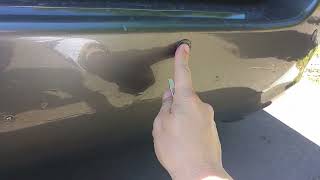
How to confirm: Visually inspect the face of the front bumper sensor that is second from the passenger side. Clean the sensor thoroughly with a soft cloth and water. Some owners have also had success using WD-40 to displace moisture.
Typical fix: Clean the sensor face. Clear the codes and test the system. If the code does not return, the issue is resolved. A code reset may be necessary before the system will function again.
Est. part cost: $0 - Faulty Park Assist Sensor 🟡 Medium Probability Sensors can fail internally over time due to moisture intrusion, vibration, or electronic failure. Water ingress is a common cause of failure.
How to confirm: The most effective method is to swap the suspect sensor (#5) with an adjacent sensor (like #4 or #6). Clear the codes and re-test. If the code changes to B1291 (Sensor #4) or B1293 (Sensor #6), the sensor is faulty. Another simple test is to activate the system and listen closely to each sensor; a working sensor will emit a faint clicking or buzzing sound. A silent sensor is likely dead.
Typical fix: Replace the failed park assist sensor. It is typically held in by clips and has a single electrical connector, making it a plug-and-play repair. 🎬 See this walkthrough on how to replace a bumper sensor.
Est. part cost: $25-$100 - Wiring or Connector Issue ⚪ Low Probability The wiring harness is located under the vehicle and can be damaged by road debris, moisture, or corrosion at the connector. A STAR Case bulletin notes that loose connectors can cause this DTC. Forum users have also reported finding bent pins inside the connector after service work or finding the harness pinched between the bumper and frame.
How to confirm: If the code remains after swapping sensors, visually inspect the wiring harness and the 3-pin connector for sensor #5. Check for corrosion, pushed-out pins, or chafed/broken wires. Ensure the connector is fully seated and locked.
Typical fix: Repair the damaged section of the wiring harness or clean/replace the connector. Applying dielectric grease to the connector can help prevent future moisture intrusion.
Est. part cost: $5-$50
Rare But Worth Checking
- Park Assist Module (PAM) Failure: This is very rare. The module is the central computer for the system and should only be suspected if a specific sensor code (like B1292) persists after the sensor and wiring have been proven to be good.
- Software Glitch: For early 2014 models, TSB 08-071-14 recommends a software update to the PAM to fix erroneous sensor codes. If you have a 2014 model built before June 14, 2014, this could be the root cause.
Diagnosis Steps
- Read the trouble codes with a scanner capable of accessing the Body Control Module (BCM) or Park Assist Module (PAM) to confirm B1292 is active. Note any suffix, like '-25' for waveform failure or '-11' for a short to ground.
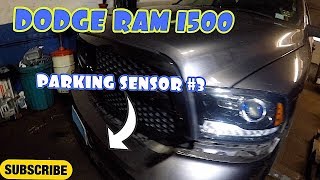
- Locate Park Assist Sensor #5 on the front bumper (second from the passenger side).
- Thoroughly clean the face of the sensor with a soft cloth and mild cleaner to remove any dirt, mud, snow, or ice. [⭐ TSB #9003059]
- Clear the DTCs and test the system. Some systems require turning the engine off, waiting 10 seconds, and shifting into Reverse to reactivate the sensors.
- If the code returns, perform a 'listen test'. With the ignition on and park assist active, place your ear next to each sensor. A healthy sensor will make a faint clicking/buzzing sound. If sensor #5 is silent, it has likely failed.
- If the listen test is inconclusive, perform a sensor swap. Disconnect and swap sensor #5 with an adjacent sensor (e.g., #6, which would be code B1293). Access is from behind the bumper.
- Clear the codes again and re-test. If the code changes to B1293, the sensor you moved is faulty and must be replaced.
- If code B1292 returns, the problem lies in the wiring to that specific sensor location. Inspect the 3-pin connector for corrosion, damage, or loose pins. Check for continuity and shorts on the signal and ground wires if you have a multimeter.
- If wiring is confirmed to be good and you have an early 2014 model, check with a dealer about TSB 08-071-14 for a potential software update.
- If all else fails, the final step would be to suspect the Park Assist Module, though this is uncommon.
Parts You'll Likely Need
- Park Assist Sensor
(OEM #6MK25TZZAA)— This is the component that fails most often after ruling out obstructions, triggering the B1292 code. This part number is used across many Chrysler, Dodge, Jeep, and Ram vehicles.
Trusted brands: Mopar, Standard Motor Products, Dorman, Master Tailgaters
OEM price range: $80-$145.
Aftermarket price range: $25-$60.
Related Codes That Often Appear With This One
- B128F — This code corresponds to Park Assist Sensor #2. It's common to see multiple sensor codes if there is a widespread issue like an aftermarket bumper interfering with sensor operation or a wiring harness problem affecting multiple sensors.
- B1290, B1291, B1293, etc. — These are codes for the other park assist sensors. Seeing them together with B1292 could point to a systemic issue like a problem with the main fuse, 🎬 Watch: How to check the park assist fuse on your Ram. a faulty wiring harness, or a required software update as per TSB 08-071-14.
Technical Service Bulletins (TSBs) & Recalls
- 9003059: Notes that codes including B1292-25 are for Park Assist Sensor signal failures and instructs to first check for and clean any obstructions from the sensors.
- 08-071-14: Pertains to early 2014 models and involves a software update for the Park Assist Module (PAM) to prevent false DTCs like B1292-25 from being set.
- S2208000107 (STAR Case): Suggests that a B1292-92 code can be caused by a loose sensor connector and the fix is to reseat it.
Platform-Specific Known Issues
- Per TSB #9003059, Ram specifically calls out that an active or stored B1292-25 code for 'Signal Shape / Waveform Failure' should first be addressed by checking for and cleaning any obstructions like snow, mud, or ice from the sensors.
- TSB 08-071-14 was released for 2014 Ram 1500 and Grand Cherokee models (built before 06/14/2014) to update the Park Assist Module software, which could erroneously set B1292-25 and other sensor codes.
- A STAR Case bulletin (S2208000107) notes that DTCs with a '-92' suffix (incorrect operation) can be caused by a loose electrical connector at the sensor. The fix is to simply disconnect and reconnect it to ensure it is fully seated.
- Owners on forums frequently report issues with aftermarket bumpers causing constant false alerts or triggering fault codes like B1292, as the sensor angle or position is altered.
Mechanic-Grade Diagnostic Values
- Park Assist Sensor Supply Voltage — expected: ~8.0 Volts. Failure: No voltage or significantly low voltage points to an issue with the Park Assist Module or the wiring harness.
- Park Assist Sensor Signal Circuit Voltage — expected: < 10.0 Volts. Failure: Voltage above 10.0V indicates a short to battery and will set a B1292-12 code.
- Park Assist Sensor Signal Circuit Resistance to Ground — expected: Greater than 10k Ohms (Open circuit). Failure: Resistance below 10k Ohms indicates a short to ground and will set a B1292-11 code.
- Park Assist Sensor Ground/Return Circuit Resistance — expected: < 5.0 Ohms. Failure: Resistance above 5.0 Ohms indicates an open or high resistance in the sensor's ground circuit.
Hidden / Shadow Codes Worth Checking
- B1292-11: Indicates the sensor's signal circuit is shorted to ground. This points to a wiring issue between the sensor and the module. (see via A professional scan tool or advanced DIY tool like AlfaOBD capable of reading body module fault codes.)
- B1292-12: Indicates the sensor's signal circuit is shorted to battery voltage. This can be a fault in the wiring harness or an internal failure of the sensor itself. (see via A professional scan tool or advanced DIY tool like AlfaOBD.)
- B1292-13: Indicates an open circuit for the sensor. This means there is a break in the wiring for the power, ground, or signal wire to the sensor. (see via A professional scan tool or advanced DIY tool like AlfaOBD.)
- B1292-92: Indicates a 'Performance or Incorrect Operation' fault. This can be caused by a loose connector, data corruption, or interference from aftermarket equipment. (see via A professional scan tool or advanced DIY tool like AlfaOBD.)
Scan Tool Commands That Help
- AlfaOBD / Professional Scan Tool: Read Faults from Parktronic System (PTS) / Park Assist Module (PAM) — This is the first step in any diagnosis to identify the specific sensor and fault type (e.g., B1292-11 vs B1292-25) before swapping or replacing parts.
- AlfaOBD / Professional Scan Tool: Clear Faults — After performing a repair (like cleaning a sensor, fixing wiring, or replacing a sensor), the fault code must be cleared. The system may remain disabled until the stored code is erased.
- Professional Scan Tool: Body Verification Test — Service manuals call for this test to be performed after a repair to verify that the entire system is functioning correctly and no new DTCs are set.
Wiring & Ground Locations
- F95 Fuse — In the main under-hood fuse box (Power Distribution Center), it is fuse number 95.. This is the primary fuse for the Park Assist system. If multiple or all sensors are inoperative, this fuse should be checked first.
- Sensor Connector (C1) — Directly on the back of each park assist sensor.. This 3-pin connector is where to test for power, ground, and signal. It is a common point of failure due to moisture, corrosion, or pushed-out pins. Pin 1 is typically 8V supply (Gray/Orange), Pin 2 is Signal, and Pin 3 is Ground (Gray/Blue).
- Front Harness Connector — The main harness for the front sensors has a central connector located between the frame rails, behind the front bumper.. If multiple front sensors are faulting, this main connector could be loose, corroded, or damaged, causing a system-wide failure for the front sensors.
- PAM Ground — A user performing a retrofit grounded the Park Assist Module at the passenger kick panel.. While not a factory diagram, this provides a likely location for the module's main ground point. A poor ground here could cause erratic behavior across the entire system.
Real Owner Repair Stories
- RamForum.com user 'VanLaar' (2015 Ram 2500 Laramie) — Backup sensors gave a false reading when it rained. After inspecting, all sensors faulted and the system shut down.
❌ Tried (didn't work) Re-connecting all sensors., Replacing the wiring harness and fixing a bent pin on a sensor did not immediately solve the problem.
✅ What actually fixed it After finding a DTC (B1297-11), the code had to be cleared with an OBD reader. The system then began working correctly, highlighting that a hard fault can disable the system until it is manually reset.
When the Usual Fixes Don't Work
- While a software update (TSB 08-071-14) is a known fix for some early 2014 models, it is not a universal solution. One owner of a newer model (2019) reported that a dealer-performed software update costing $300 failed to resolve their intermittent ParkSense error, indicating that physical causes like sensor or wiring faults should not be overlooked even if a software update seems applicable.
OEM Part Supersession History
Multiple (e.g., 6mk25kxjaa, 6mk25ws2aa, etc.)→6MK25TZZAA— Part consolidation and revision.
Heads up: No known incompatibilities. 6MK25TZZAA is the current replacement for a wide range of previous part numbers used on Ram and other Mopar vehicles.
Model Year Variations Within This Range
- 2014 (built on or before June 14, 2014): These early models may have faulty Park Assist Module (PAM) software that can erroneously set sensor codes like B1292-25. The fix is a dealer-installed software update per TSB 08-071-14.
- 2014-2017 (vs. earlier models): The Park Assist Module (PAM) on this generation is located in a relatively accessible spot, typically behind the driver's side kick panel or A-pillar. This is a significant improvement over some prior model years (c. 2012) where the module was located in the headliner, requiring much more labor to access for testing or replacement.
Helpful Videos
We Have This Part in Stock


The information in this article is provided for general reference and educational purposes only. Vehicle specifications, procedures, and part compatibility can vary by production date, trim level, and region. Always consult your vehicle's factory service manual and verify part numbers before purchasing or performing repairs. Safety-critical components such as airbags, seat belts, and braking systems should be installed by a qualified professional.
- Ram 2500:
- 🎬 Helpful Videos
- 🛍️ Shop This Part
- What's Unique About the 2014-2017 Ram 2500
- Diagnostic Flowchart
- Symptoms You May Notice
- Most Likely Causes
- Rare But Worth Checking
- Diagnosis Steps
- Parts You'll Likely Need
- Related Codes That Often Appear With This One
- Technical Service Bulletins (TSBs) & Recalls
- Platform-Specific Known Issues
- Mechanic-Grade Diagnostic Values
- Hidden / Shadow Codes Worth Checking
- Scan Tool Commands That Help
- Wiring & Ground Locations
- Real Owner Repair Stories
- When the Usual Fixes Don't Work
- OEM Part Supersession History
- Model Year Variations Within This Range
- 🎟️ Get 5% Off