

B1291 on 2013-2020 Ram 1500: Park Assist Sensor 4 Failure Causes & Fixes
This code means Park Assist Sensor #4 has failed or its signal is compromised. The most common fix is replacing the faulty sensor, which costs about $30-$60 for an aftermarket part or $100+ for OEM. Before replacing, always clean the sensor thoroughly as dirt, snow, or ice can trigger the code. The issue is almost always the sensor itself, its wiring, or an obstruction, not the control module.
- B1291 specifically points to Park Assist Sensor #4.
- Always start by thoroughly cleaning the sensor face, as dirt or ice is a very common cause noted in TSBs.
- A simple and effective test is to swap the suspect sensor with a neighboring one to see if the fault code follows the sensor.
- If you can, listen for a faint clicking sound from the sensors when the system is active; the silent one is the problem.
- Consider using OEM (Mopar/Bosch) replacement sensors for better reliability, as some owners report issues with aftermarket alternatives.
What's Unique About the 2013-2020 Ram 1500

On Ram 1500 trucks, the parking sensors are mounted in the bumpers, making them highly susceptible to dirt, mud, snow, and ice. Ram has issued multiple Technical Service Bulletins (TSBs) acknowledging that this code is often caused by simple obstructions. Unlike sensors on some passenger cars that are more shielded, a Ram's typical use often leads to these signal failures, making a thorough cleaning the most critical first diagnostic step. The sensor numbering is also specific: front sensors are numbered 1-6 from driver to passenger side. Rear sensors are 8-11 from passenger to driver side, skipping 7 and 12. Therefore, B1291 (Sensor #4) is located on the front bumper.
🎬 Watch: Visual guide to Ram park assist sensor locationsDiagnostic Flowchart

Tap your situation to follow the diagnostic path that matches what you're seeing on this vehicle.
Generation note: This year range covers the fourth generation (2013-2018 'DS') and the beginning of the fifth generation (2019-2020 'DT') Ram 1500. While the B1291 code's meaning is consistent, sensor part numbers, locations, and bumper removal procedures may differ slightly between the two generations. However, the primary OEM sensor part number, 1EW63TZZAA, is listed for both generations.
Symptoms You May Notice

- "Service Park Assist System" or "ParkSense Unavailable" message on the instrument cluster.
- The park assist system is completely inoperative.
- Flashing light on the park assist activation button.
- No beeping or a continuous, steady beep when in reverse near an object.
- System works at very low speeds but displays a service message above a certain speed (e.g., 8 mph).
- Replacing the sensor without first cleaning it thoroughly.
- Replacing the Park Assist Module before confirming the sensor and wiring are good.
- Using a low-quality aftermarket sensor that is dead on arrival or fails quickly. Multiple owners have fixed their issue only after replacing a new aftermarket sensor with an OEM one.
Most Likely Causes

- Obstructed or Dirty Sensor 🔴 High Probability The sensors are located on the bumpers and are exposed to road debris, mud, snow, and ice, which can block the ultrasonic signal. TSB 9003059 specifically calls out cleaning the sensor as the first step for a B1291-25 fault.
How to confirm: Visually inspect sensor #4 for any dirt, ice, heavy water droplets, or physical obstructions. Clean it with a soft cloth and re-test the system. After cleaning, you may need to cycle the ignition or drive the vehicle for the fault to clear.
Typical fix: Thoroughly clean the face of the sensor. Clear the code with a capable OBD-II scanner or cycle the ignition multiple times.
Est. part cost: $0 - Failed Park Assist Sensor 🟡 Medium Probability Sensors can fail internally from age, moisture intrusion, or physical shock (like a minor bumper tap). Multiple owner forums report a high success rate by replacing the sensor. There is a strong consensus that OEM (Bosch/Mopar) sensors are more reliable than cheaper aftermarket alternatives, which may fail quickly or not work at all.
How to confirm: Swap sensor #4 with an adjacent, working sensor (e.g., #3 or #5). Clear the codes and see if the fault code follows the sensor (e.g., changes to B1290). If it does, the sensor is bad. Another method is to put the truck in reverse (engine off, parking brake on) and listen for a faint clicking/buzzing from each sensor; the silent one is likely dead.
Typical fix: Replace the faulty park assist sensor. New OEM sensors come unpainted and will need to be painted to match the bumper.
Est. part cost: $30-$150 - Wiring or Connector Issue ⚪ Low Probability The wiring harness is located behind the bumper, where it can be damaged by road debris, corrosion, or improper installation of aftermarket accessories. A TSB also points to a specific 24-way connector behind the rear wheel liner as a potential point of failure for rear sensor issues. For front sensors, damage often occurs at the pigtail connector right behind the sensor due to moisture or physical stress.
How to confirm: Visually inspect the wiring and connector going to sensor #4 for any signs of damage, corrosion, or pushed-out pins. If a wiring break is suspected, perform a continuity test with a multimeter from the sensor connector to the main harness connector.
Typical fix: Repair the damaged section of the wiring harness or clean/replace the pigtail connector. In severe cases, the entire front fascia harness may need replacement.
Est. part cost: $10-$200
Rare But Worth Checking
- Faulty Park Assist Module (PAM): This is very rare. The module is the computer for the system, often located behind interior trim panels. You should only suspect the module after definitively ruling out the sensor and its wiring, as it is the most expensive component to replace.
Diagnosis Steps
- First, confirm the location of sensor #4. On Ram trucks, the front bumper has sensors 1-6, numbered from the driver's side to the passenger's side. Sensor #4 is the first inner sensor on the passenger side of the front bumper.
- Visually inspect sensor #4 for any dirt, mud, snow, or ice. Clean it thoroughly with a soft cloth and water. Also check for physical damage like cracks or being pushed into the bumper.
- Clear the trouble codes using an OBD-II scanner capable of reading body codes. Cycle the ignition off and on, then put the truck in reverse to activate the system. See if the code returns.
- If the code returns, activate the park assist system (ignition on, engine off, in reverse) and listen closely to each sensor. A healthy sensor will emit a faint, rapid clicking sound. If sensor #4 is silent, it has likely failed.
- To definitively confirm a bad sensor, swap it with an adjacent sensor (e.g., swap sensor #4 with #5). Clear the codes and re-scan. If the code changes to B1292 (for sensor #5), you have confirmed sensor #4 is faulty and needs replacement.
- If the B1291 code remains after swapping sensors, the problem is in the wiring or connector for the #4 position. Unplug the connector and inspect for corrosion, bent pins, or wire damage. Perform a continuity and voltage test on the signal wire (D707 circuit) if you have a multimeter and wiring diagram.
- If the sensor and wiring are confirmed to be good, the issue may lie with the Park Assist Module, which would require more advanced diagnostics, likely at a dealership.
Parts You'll Likely Need
- Park Assist Sensor
(OEM #1EW63TZZAA)— This is the most common point of failure for the B1291 code after ruling out obstructions. Internal electronics fail over time. This part number is widely listed for both front and rear positions on 2013-2020 Ram 1500s and other Mopar vehicles.
Trusted brands: Mopar (Bosch), Standard Motor Products, Dorman
OEM price range: $60-$150
Aftermarket price range: $25-$75
Related Codes That Often Appear With This One
- B128E, B128F, B1290, B1292, B1293 — These are codes for the other park assist sensors. Seeing multiple sensor codes at once could point to a shared wiring harness issue, a problem with the main inline connector, or a module fault.
- B1291-11, B1291-12, B1291-92 — These are more specific versions of the same fault. -11 is a short to ground, -12 is a short to battery, and -92 is a performance failure. The diagnostic steps are similar but may focus more on electrical testing for shorts rather than just swapping the sensor.
Technical Service Bulletins (TSBs) & Recalls
- 08-242-25: Lists B1291-25 as PTS Sensor 4-Signal Shape/Waveform Failure.
- 9003059: Recommends cleaning sensors for B1291-25 faults before further diagnosis. Also provides diagnostic steps for -11 (short to ground) and -92 (performance) variants.
- 08-071-14: Defines B1291-25 as PTS SENSOR 4 - Signal Shape / Waveform Failure.
- 08-082-20: Also identifies B1291-25 as related to PTS Sensor 4-Signal Shape/Waveform Failure.
- S2108000060 REV A: Addresses 'Service Park Assist Message' on 2019-2021 models, which may be relevant if multiple sensor codes are present.
Platform-Specific Known Issues
- TSB #9003059 explicitly states that for a B1291-25 fault, the first step should be to check for and clean any snow, mud, or ice from the sensors.
- TSB #S2108000060 REV A addresses a 'Service Park Assist Message' on 2019-2021 models, which can be related to wiring or module issues, though it doesn't single out B1291.
- Multiple TSBs (#08-242-25, #08-071-14, #08-082-20) list B1291-25 as a known fault code for 'PTS Sensor 4-Signal Shape/Waveform Failure'.
- Owner Experience: A user on DodgeForum.com with B1291-11 and B1291-12 codes on a 2018 Ram initially replaced the sensor with an aftermarket part, which did not solve the issue. The problem was only resolved after installing an OEM Bosch sensor.
Mechanic-Grade Diagnostic Values
- Sensor Supply Voltage — expected: Approximately 8.0 - 8.5 Volts. Failure: Voltage below 8.0V or at 0V indicates an issue with the wiring or the Park Assist Module (PAM).
- Sensor Signal Circuit (D707 for Sensor #4) to Ground — expected: High resistance (above 10k Ohms). Failure: Resistance below 10k Ohms indicates a short to ground in the wiring harness.
Scan Tool Commands That Help
- wiTECH (Chrysler/FCA Dealer Tool): Read/Clear DTCs in Park Assist Module (PAM/PTS) — Used to retrieve specific body codes like B1291 and its suffixes (-11, -12, -25, -92), which basic OBD-II readers may not see.
- wiTECH (Chrysler/FCA Dealer Tool): View Live Data / Self-Test — Allows a technician to view the individual signal and status from each park assist sensor in real-time to confirm which one is malfunctioning. A self-test can also be initiated to query the entire system.
- wiTECH (Chrysler/FCA Dealer Tool): Module Reprogramming (Flash) — If a Technical Service Bulletin (TSB) is issued for erroneous B1291-25 codes due to software sensitivity, this function is used to update the Park Assist Module's software.
Wiring & Ground Locations
- Park Assist Module (PAM/PTS) — On 4th Gen (2013-2018 DS) models, it's typically located behind the driver's side kick panel or trim near the floor. On 5th Gen (2019-2020 DT) models, it may be behind the driver's side trim panel near the door sill or integrated into another module.. This is the control unit for the system. All sensor wiring terminates here. Testing for power, ground, and signal continuity often happens at this module's connectors.
- Front Fascia to Dash Inline Connector — Located in the left front (driver's side) wheel well area, connecting the main body harness to the front bumper harness.. This large connector is a common point for water intrusion and corrosion, which can cause faults for any of the front sensors. A TSB for 2016 models specifically addresses inspecting and repairing this connector.
- Sensor Connector (3-pin) — Directly on the back of each park assist sensor.. This is the primary point for testing voltage and signal directly at the sensor. The pins are typically: Pin 1 (Supply Voltage, ~8V), Pin 2 (Signal), and Pin 3 (Ground).
- G300 / G302 (Ground Points) — Located under the vehicle at the driver door on a body mount (G300) or under the passenger seat (G302).. While not specific to the sensor circuit, a poor body or chassis ground can cause a variety of difficult-to-diagnose electrical issues in modules like the PAM. Checking major grounds is a good step when direct circuit testing is inconclusive.
Real Owner Repair Stories
- RamForum.com user 'mfelthousen' (2019 Ram 1500 Laramie (DT Body Style)) — Front park sense error message on the dash. Codes B1291 (Sensor 4) and B1293 (Sensor 6) both for 'circuit short to ground'.
❌ Tried (didn't work) The user identified a damaged and rusted pigtail on sensor #6 and noted multiple harness attachment points were broken.
✅ What actually fixed it The user determined that instead of splicing individual pigtails, the correct long-term repair was to replace the entire front fascia wiring harness due to widespread damage and corrosion.
When the Usual Fixes Don't Work
- While a faulty sensor is a common cause, simply replacing it is not always the fix. In a documented case involving multiple sensor codes on a 2012 Ram, a technician first replaced the Parktronics control module, which did not solve the problem. The final fix was replacing all four rear sensors simultaneously, which had apparently failed together. This highlights that while a single sensor failure is common, multiple simultaneous failures can occur, mimicking a module or harness issue. Furthermore, as noted in Pass 2, multiple owners have reported that using cheap, aftermarket sensors did not resolve the code, and the issue was only fixed after installing a genuine OEM Mopar sensor, indicating a significant quality difference.
OEM Part Supersession History
1EW63TZZAA→This part number has many color-specific variations and has superseded numerous older numbers (e.g., 1EW63AXRAA, 1EW63DX8AA, etc.).— Part consolidation and color code variations.
Heads up: 1EW63TZZAA is the base, unpainted (paint-to-match) version and is widely interchangeable across the model years. It is critical that new sensors are painted with a very thin layer of non-metallic paint to ensure proper operation.Front Fascia Wiring Harness (Varies by Year/Options)→Updated part numbers (e.g., 68475600AA for 2021+ models).— Revisions to improve resistance to corrosion and damage.
Heads up: The front bumper harness is specific to the generation (DS vs. DT) and option packages (e.g., with/without fog lights). Ensure the correct harness is ordered for the specific vehicle.
Model Year Variations Within This Range
- 2013-2018 (DS 'Classic' Body Style): The Park Assist Module (PAM) is typically a standalone silver module located behind the driver's side kick panel. The front bumper wiring harness has part numbers specific to this generation.
- 2019-2020 (DT 'New' Body Style): The Park Assist system may be controlled by a module named Parktronic System (PTS) Module, which is often located behind the driver's side door sill trim panel. The front bumper and its associated wiring harness are completely different from the DS generation. A TSB (#08-047-19) was issued for 2019 DT models to update software to prevent erroneous B1291-25 codes.
Helpful Videos


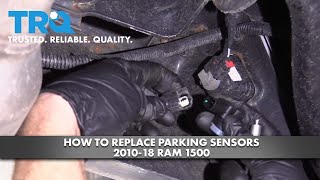
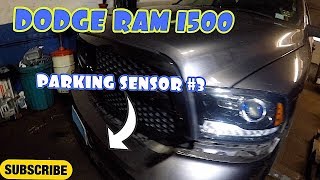
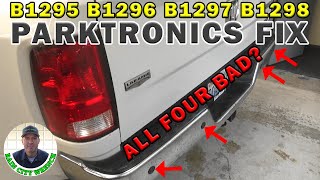
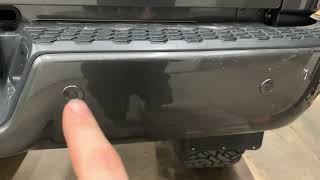
We Have This Part in Stock


The information in this article is provided for general reference and educational purposes only. Vehicle specifications, procedures, and part compatibility can vary by production date, trim level, and region. Always consult your vehicle's factory service manual and verify part numbers before purchasing or performing repairs. Safety-critical components such as airbags, seat belts, and braking systems should be installed by a qualified professional.
- Ram 1500:
- 🎬 Helpful Videos
- 🛍️ Shop This Part
- What's Unique About the 2013-2020 Ram 1500
- Diagnostic Flowchart
- Symptoms You May Notice
- Most Likely Causes
- Rare But Worth Checking
- Diagnosis Steps
- Parts You'll Likely Need
- Related Codes That Often Appear With This One
- Technical Service Bulletins (TSBs) & Recalls
- Platform-Specific Known Issues
- Mechanic-Grade Diagnostic Values
- Scan Tool Commands That Help
- Wiring & Ground Locations
- Real Owner Repair Stories
- When the Usual Fixes Don't Work
- OEM Part Supersession History
- Model Year Variations Within This Range
- 🎟️ Get 5% Off