

B1290 on 2014-2017 Ram 3500: Park Assist Sensor 3 Failure Causes and Fixes
Code B1290 on a 2014-2017 Ram 3500 indicates a fault with Park Assist Sensor #3, which is the inner sensor on the front passenger-side bumper. The most common fix is simply cleaning dirt, snow, or ice off the sensor. If that fails, replacing the sensor is a straightforward DIY job with parts costing $30-$120. In rare cases, a wiring issue or a software glitch requiring a dealer update could be the cause.
- B1290 specifically refers to Park Assist Sensor #3, the inner sensor on the front passenger-side bumper.
- Always start by thoroughly cleaning the sensor. This is the most common fix and costs nothing.
- If cleaning doesn't work, swap the sensor with a neighboring one to confirm if the sensor itself is bad before buying a new part.
- A scanner that can read manufacturer-specific 'B' codes is necessary for accurate diagnosis.
- Be aware that wiring issues or even software glitches can mimic a failed sensor, so a full diagnosis is key before replacing expensive modules.
What's Unique About the 2014-2017 Ram 3500
On Ram trucks, the ParkSense® sensors are mounted on the front and rear bumpers, where they are highly exposed to road debris, mud, snow, and ice, especially on a heavy-duty model like the 3500. This exposure is why manufacturer Technical Service Bulletins explicitly state that the first diagnostic step is to clean the sensor. The code's meaning is very consistent for this platform, but it's critical to correctly identify Sensor #3 on the front bumper, as replacing the wrong one is a common mistake. Additionally, some Ram models have experienced erroneous sensor codes due to software glitches, which can be resolved with a dealer-installed update.
Diagnostic Flowchart
Tap your situation to follow the diagnostic path that matches what you're seeing on this vehicle.
Symptoms You May Notice
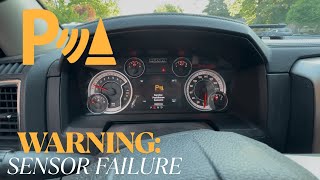
- "Service Park Assist System" or "ParkSense Off" message in the instrument cluster display.
- The amber indicator light on the ParkSense switch will be illuminated.
- The parking sensor system will not produce audible beeps or visual warnings when approaching an obstacle.
- The system may work intermittently before failing completely, sometimes deactivating at speeds above 7-8 mph.
- False alerts or beeping when no obstacle is present, especially in rain, snow, or after a car wash. 🎬 Watch: A quick fix for common Park Sense fault messages.
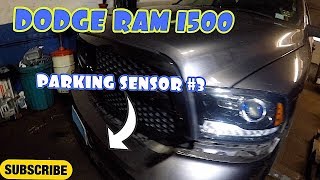
- Replacing the wrong sensor. It is critical to correctly identify Sensor #3 as the inner passenger-side sensor on the front bumper.
- Replacing the Park Assist Module (PAM) before thoroughly testing the sensor and its dedicated wiring circuit.
- Using cheap aftermarket sensors that are not fully compatible, leading to persistent or intermittent issues. Some forum users report issues with non-OEM sensors.
Most Likely Causes
- Obstructed Park Assist Sensor 🔴 High Probability The sensors are located on the bumper, making them highly susceptible to being covered by mud, snow, ice, dirt, or even heavy water spray from a car wash. TSB 9003059 specifically calls this out as the first check.
How to confirm: Visually inspect the face of Sensor #3 (front bumper, inner passenger side) for any physical obstruction. The sensor must be clean to function.
Typical fix: Thoroughly clean the sensor face with a soft cloth, soap, and water. Clear the code and re-test the system.
Est. part cost: $0 - Faulty Park Assist Sensor #3 🟡 Medium Probability Sensors can fail internally over time due to moisture intrusion, vibrations, and thermal cycling. Physical impacts from road debris can also cause damage. The internal electronics are sensitive to the elements.
How to confirm: After cleaning the sensor, if the code persists, swap Sensor #3 with an adjacent sensor (like #4). Clear codes. If the code changes to B1291 (Sensor 4's code), the sensor you moved is confirmed to be faulty. Some owners also report being able to hear a faint 'ticking' or 'clicking' from a working sensor when the system is active.
Typical fix: Replace the faulty park assist sensor. The retainers holding it in the bumper can be brittle, so care should be taken during removal. This is often a plug-and-play repair. 🎬 Watch: Step-by-step guide to replacing Sensor #3 on a Ram.
Est. part cost: $30-$120 - Wiring Harness or Connector Issue ⚪ Low Probability The wiring harness is routed near the front of the vehicle and can be damaged by road debris, impacts, or corrosion from water and road salt. The connectors behind the bumper are a common point for moisture and corrosion.
How to confirm: If the B1290 code remains after swapping the sensor, the problem is in the wiring for that location. Visually inspect the harness and connector for Sensor #3 for chafed wires, corrosion in the pins, or physical damage. Check for continuity and shorts to ground on the signal wire.
Typical fix: Repair the damaged section of the wiring harness or clean/replace the corroded connector. In some cases, the entire front fascia harness may need replacement.
Est. part cost: $5-$250
Rare But Worth Checking
- Faulty Park Assist Module (PAM): This is very uncommon. The module controls the entire system and is typically the last item to be suspected. It is located behind the driver-side kick panel or in the headliner on some models. It should only be considered if all sensors and wiring have been thoroughly tested and confirmed to be good.
- Software Glitch: TSB 08-047-19 and others indicate that on some Ram models, park assist DTCs can be set erroneously. A software update (flash) performed by a dealer may be required to resolve the issue. This is more common on slightly newer models but can't be ruled out.
Diagnosis Steps
- Read the trouble codes with a scanner capable of accessing the Body Control Module (BCM) or Park Assist Module (PAM) to confirm B1290 is present. Note if it appears as B1290-25.
- Locate Park Assist Sensor #3 on the front bumper. It is the inner sensor on the passenger side.
- Visually inspect the sensor for any obstructions like mud, ice, snow, or dirt. Also check for physical damage like cracks.
- Thoroughly clean the sensor's surface with a soft cloth and water. Ensure it is completely clean and dry.
- Clear the diagnostic trouble code and test the ParkSense system by driving near an object at low speed (<7 mph).
- If the code returns, perform a 'sensor swap'. Disconnect and swap Sensor #3 with Sensor #4 (the outer passenger-side sensor). They are identical parts.
- Clear the codes again. Drive the vehicle to trigger the system. If the code changes to B1291 (Sensor 4 fault), the original Sensor #3 is defective and must be replaced.
- If code B1290 returns for the same location even with a known-good sensor, the issue lies in the wiring or connector for the Sensor #3 circuit.
- Carefully inspect the wiring harness leading to the Sensor #3 connector for any signs of physical damage, chafing, or corrosion. Pay close attention to the connector pins for any green or white residue. Repair as needed.
- If wiring appears intact, check the F95 fuse in the under-hood fuse box, which is related to the park assist system. 🎬 See this video to find and check your parking sensor fuse.
- As a final step, check for any available TSBs related to software updates for the Park Assist Module for your specific model year, which may require a dealer visit.
Parts You'll Likely Need
- Park Assist Sensor
(OEM #1EW63TZZAA)— This is the sensor that fails most often after ruling out obstructions. The code B1290 directly points to a failure of this component or its circuit. This part number has many supersessions and is used across many Chrysler, Dodge, and Jeep vehicles.
Trusted brands: Mopar, Bosch, Dorman, Standard Motor Products
OEM price range: $60-$120
Aftermarket price range: $25-$70 - Park Assist Sensor Retainer / Bezel
(OEM #04806229AA (Ring))— The plastic clips that hold the sensor in the bumper can become brittle with age and exposure, often breaking during sensor removal. It's wise to have a replacement on hand.
Related Codes That Often Appear With This One
- B128F — This is the code for the adjacent Sensor #2. Seeing codes for multiple sensors can sometimes point to a shared wiring harness issue or a software problem rather than individual sensor failures.
- B1291 — This is the code for the adjacent Sensor #4. Seeing it with B1290 could indicate a problem affecting the passenger side of the front bumper harness.
- U0159 — This code indicates 'Lost Communication With Park Assist Control Module'. It may appear alongside sensor codes if a major wiring harness issue or a faulty module is causing intermittent communication on the CAN bus.
Technical Service Bulletins (TSBs) & Recalls
- 9003059: Notes that for a B1290-25 code, the first step is to check for and clean any snow, mud, ice, or other obstructions from the sensor face.
- 08-071-14: Confirms B1290-25 as a valid code for 'PTS SENSOR 3 - Signal Shape / Waveform Failure' on 2014 models and suggests a potential software update for the PAM.
- 08-047-19: While for a newer model year (2019), this TSB shows a history of FCA resolving erroneous park assist sensor codes (including B1290) with a software flash, indicating it's a known issue type for the manufacturer.
Platform-Specific Known Issues
- A known issue documented in TSB #9003059 is that obstructions like snow, mud, or ice can cause this specific 'Signal Shape / Waveform Failure' code. The manufacturer's first directive is to clean the sensor before performing any replacements.
- A user on DodgeForum.com with a 2015 Ram experienced the 'Service Park Sense' message appearing only after reaching 7-8 mph in drive, which points to how the system performs self-checks at speed.
- Some owners on HDrams.com have noted that even a fine mist freezing on the sensors can trigger false alerts or system deactivation, highlighting the system's sensitivity.
Mechanic-Grade Diagnostic Values
- Park Assist Sensor Supply Voltage — expected: ~8.4 volts. Failure: No voltage or significantly lower voltage indicates a wiring or PAM issue.
- Park Assist Sensor Resistance — expected: Varies significantly by part; no single definitive value. Forum users report conflicting measurements.. Failure: A reading that is drastically different from the other sensors on the vehicle. One user reported values from 132 kOhms to 194 kOhms on OEM sensors, while aftermarket sensors measured differently. The most reliable test is swapping the suspect sensor with a known good one.
Hidden / Shadow Codes Worth Checking
- B1290-25: The '-25' suffix is a sub-type that specifies a 'Signal Shape / Waveform Failure'. This is more specific than a simple open or short circuit, indicating the signal from the sensor is present but distorted, illogical, or noisy. (see via This extended code is visible on professional-grade scan tools and dealer tools like wiTECH that can read manufacturer-specific body codes.)
Scan Tool Commands That Help
- wiTECH (Dealer Tool): Reprogram PAM — Used to apply software updates as specified by a Technical Service Bulletin (TSB) to fix known glitches that can cause false codes.
- wiTECH (Dealer Tool): Restore Configuration and Align PROXI — This procedure is often required after reprogramming the Park Assist Module (PAM) to ensure the module is correctly configured and communicating with the rest of the vehicle's network.
Wiring & Ground Locations
- Park Assist Sensor Supply Wire — At each park assist sensor connector.. This wire, typically gray and orange, provides the ~8.4V operating voltage to the sensor. A short or open on this wire will cause the sensor to fail.
- Front Bumper Harness Ground — A common ground point for front-end accessories is located on the frame rail or core support behind the front bumper.. A corroded or loose ground for the front bumper harness can cause intermittent or multiple sensor failures, even if the sensors and signal wires are good.
- Park Assist Module (PAM) — On some Ram trucks of this era, the PAM is located in the headliner, requiring removal of the headliner for access.. Knowing the module's difficult-to-access location reinforces the need to exhaust all other diagnostic steps (cleaning, sensor swap, wiring inspection) before suspecting a module failure.
Real Owner Repair Stories
- YouTube channel 'Rain City Wrench' (2012 Ram (rear sensors, but same diagnostic principle)) — Service Park Assist message, codes B1295, B1296, B1297, B1298 (all rear sensors) shorted to ground.
❌ Tried (didn't work) Replacing the Park Assist Module (PAM) was done prior to the video and did not fix the issue.
✅ What actually fixed it After confirming the module and wiring seemed okay, the technician replaced all four rear sensors with aftermarket units, which resolved all codes and restored system function. The conclusion was that all four sensors had failed simultaneously. - YouTube channel 'DIY Car Maintenance' (2021 Ram (rear sensors, but demonstrates a critical wiring failure mode)) — Service Park Assist message with codes for two rear sensors (B1295-11, B1296-11).
❌ Tried (didn't work) Swapping the suspect sensors with known-good sensors from other positions. The fault codes remained for the same locations, proving the sensors were not the problem.
✅ What actually fixed it A detailed visual inspection of the bumper wiring harness revealed a pinch point where the harness had rubbed through. Peeling back the factory tape revealed three broken wires inside the loom. Repairing the broken wires with solder and heat shrink fixed the issue.
OEM Part Supersession History
Multiple, e.g., 1EW63DX8AA, 1EW63FFBAA, etc.→1EW63TZZAA— Consolidation and color coding. Many of the older part numbers were for specific factory-painted sensors. The primary service part, 1EW63TZZAA, comes unpainted ('Paint As Required').
Heads up: While electrically compatible, using 1EW63TZZAA requires painting to match the vehicle's bumper color. It supersedes a long list of previous numbers.
Helpful Videos
We Have This Part in Stock


The information in this article is provided for general reference and educational purposes only. Vehicle specifications, procedures, and part compatibility can vary by production date, trim level, and region. Always consult your vehicle's factory service manual and verify part numbers before purchasing or performing repairs. Safety-critical components such as airbags, seat belts, and braking systems should be installed by a qualified professional.
- Ram 3500:
- 🎬 Helpful Videos
- 🛍️ Shop This Part
- What's Unique About the 2014-2017 Ram 3500
- Diagnostic Flowchart
- Symptoms You May Notice
- Most Likely Causes
- Rare But Worth Checking
- Diagnosis Steps
- Parts You'll Likely Need
- Related Codes That Often Appear With This One
- Technical Service Bulletins (TSBs) & Recalls
- Platform-Specific Known Issues
- Mechanic-Grade Diagnostic Values
- Hidden / Shadow Codes Worth Checking
- Scan Tool Commands That Help
- Wiring & Ground Locations
- Real Owner Repair Stories
- OEM Part Supersession History
- 🎟️ Get 5% Off