

B1290 on 2014-2017 Ram 2500: Park Assist Sensor 3 Fault Causes and Fixes
Code B1290 on a 2014-2017 Ram 2500 points to a signal failure from Park Assist Sensor #3. The most common fix is simply cleaning the sensor face of any dirt, snow, or ice, which costs nothing. If the code persists, the sensor itself has likely failed and needs replacement, a simple DIY job with parts costing between $30 and $120.
- B1290 specifically identifies a signal problem with Park Assist Sensor #3, which is the inner sensor on the driver's side of the front bumper.
- Always start by thoroughly cleaning the sensor. This is the most common fix and costs nothing.
- If cleaning doesn't work, the sensor itself is the next most likely culprit and is a DIY-friendly replacement.
- Do not replace the expensive Park Assist Module unless you have definitively ruled out the sensor and its wiring.
What's Unique About the 2014-2017 Ram 2500
On Ram trucks, the park assist sensors are located in the bumpers where they are highly exposed to road grime, mud, snow, and ice. As confirmed by a manufacturer Technical Service Bulletin (TSB #9003059), these obstructions are a primary cause of the specific 'Signal Shape / Waveform Failure' associated with code B1290. This makes environmental factors a more common culprit on these trucks compared to issues like module failure. The sensor numbering is clockwise from the driver's side front bumper; Sensor #3 is the inner-left-center sensor.
Diagnostic Flowchart
Tap your situation to follow the diagnostic path that matches what you're seeing on this vehicle.
Symptoms You May Notice
- "Service Park Assist System" message on the instrument cluster.
- The Park Assist System automatically disables itself, and the switch light stays illuminated.
- Park assist system gives false alerts or no alerts at all.
- The light on the Park Assist button may stay illuminated, indicating the system is off.
- Audible chimes or beeps may sound upon starting the vehicle to indicate a system fault.
- Replacing the Park Assist Module first. This is an expensive part and is rarely the cause of a single sensor fault.
- Replacing the wrong sensor. It is crucial to correctly identify which physical sensor corresponds to 'Sensor #3'. For the front bumper, sensors are numbered 1-6 from left (driver) to right (passenger). Sensor #3 is the inner sensor on the driver's side (left-inner), not passenger.
- Assuming a new aftermarket sensor is good. Some owners on RamForum.com have reported issues with aftermarket sensors not working correctly or failing quickly, sometimes requiring a few key cycles to either work or fail again.
Most Likely Causes
- Obstruction on Sensor Face 🔴 High Probability The sensors are located on the bumper, making them susceptible to being covered by snow, ice, mud, road salt, or even heavy rain or car wash spray. A manufacturer TSB specifically calls this out as a primary cause for waveform failures.
How to confirm: Visually inspect the face of Park Assist Sensor #3 for any debris. Clean all sensors with a soft cloth and mild soap and water. Clear the code and see if it returns.
Typical fix: Thoroughly clean the sensor face. Do not use scrapers or high-pressure water jets directly on the sensor, as this can cause damage.
Est. part cost: $0 - Failed Park Assist Sensor 🟡 Medium Probability Sensors can fail internally from age, moisture intrusion, or minor physical impacts that may not be visible. The internal electronics that generate and interpret the ultrasonic signal can degrade over time.
How to confirm: After cleaning, if the code returns for Sensor #3, swap it with an adjacent sensor (e.g., Sensor #2 or #4). Clear the codes. If the fault code changes to follow the sensor (e.g., now shows a fault for Sensor #2, code B128F), the sensor is bad. If the B1290 code remains, the problem is likely in the wiring or module. A DIY method to check if a sensor is active is to put the vehicle in reverse (with parking brake on and wheels chocked), and listen closely or use a phone's video recorder microphone near the sensor for a faint clicking or ticking sound.
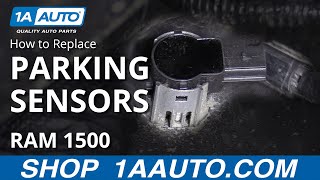
Typical fix: Replace the faulty park assist sensor. They are typically held in by clips and can be accessed from behind the bumper, often without removing it. The replacement is plug-and-play. 🎬 Watch: Step-by-step guide to replacing your front park assist sensor.
Est. part cost: $30-$120 - Wiring or Connector Issue ⚪ Low Probability The wiring harness is located under the vehicle and is exposed to the elements, which can lead to corrosion in the connector or physical damage to the wires from road debris or chafing against the frame or bumper.
How to confirm: Unplug the connector at Sensor #3 and inspect for green or white corrosion, bent pins, or pushed-out terminals. Trace the wiring harness back from the sensor, looking for any chafed, pinched, or broken wires. A user on RamForum.com found bent pins in a connector to be the root cause after a body shop visit.
Typical fix: Clean the connector terminals with electrical contact cleaner and apply dielectric grease to prevent future moisture intrusion. Repair or replace any damaged sections of the wiring harness.
Est. part cost: $5-$50
Rare But Worth Checking
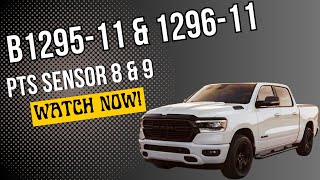
- Faulty Park Assist Module (PAM): This is rare. The module is the last component to suspect. It should only be considered after sensors and wiring have been definitively ruled out. A technician on YouTube noted a coworker had replaced the module for similar codes to no effect, and the problem was ultimately the sensors themselves. 🎬 See how a mechanic diagnoses and replaces a faulty sensor.
Diagnosis Steps
- Read the code with a scanner capable of accessing Body Control Module (BCM) or Park-Tronic System (PTS) faults to confirm B1290-25 is active.
- Locate Park Assist Sensor #3. On the front bumper, sensors are numbered 1-6 from the driver's side to the passenger's side. Sensor #3 is the inner sensor on the driver's side, next to the license plate area.
- Thoroughly clean the face of all park assist sensors with a soft cloth, soap, and water to remove any dirt, ice, or grime.
- Clear the DTCs with the scan tool and test the system by shifting into drive and moving at low speed (<10 mph).
- If the B1290 code returns, inspect the wiring connector at Sensor #3 for corrosion or damage. Check for pushed-out pins or broken wires.
- To confirm a bad sensor, swap Sensor #3 with a neighboring sensor (like #2 or #4). They are identical parts. Clear the codes again. If the fault code moves to B128F (for Sensor #2) or B1291 (for Sensor #4), then the sensor you moved is faulty and needs replacement.
- If the B1290 code persists at the same location after the swap, the issue lies in the wiring harness for that specific sensor location or, rarely, the Park Assist Module itself.
Parts You'll Likely Need
- Park Assist Sensor
(OEM #1EW63TZZAA)— This is the most common part to fail after ruling out obstructions. The sensor's internal electronics can fail over time.
Trusted brands: Mopar, Dorman, Standard Motor Products, Bosch
OEM price range: $50-$150
Aftermarket price range: $30-$80
Related Codes That Often Appear With This One
- B128F, B1291, B1292, etc. — These are codes for other park assist sensors on the same system. Multiple codes may appear if there is a widespread issue like a wiring harness problem, or if multiple sensors are obstructed by a snowbank or thick mud.
Technical Service Bulletins (TSBs) & Recalls
- 9003059: Addresses active or stored DTCs for Park Assist Sensors, including B1290-25, due to Signal Shape / Waveform Failure. The recommended action is to check for and clean obstructions.
- 08-082-20: While for 2019-2020 models, this TSB shows that erroneous waveform failure codes can be set due to software issues, requiring a PAM software update. It lists B1290-25 as one of the potential codes.
Platform-Specific Known Issues
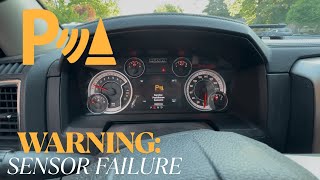
- A Technical Service Bulletin (TSB #9003059) was issued for 2014 models, noting that codes like B1290-25 can be caused by snow, mud, ice, or other obstructions on the sensor face, and the first step should always be to clean the sensors. 🎬 Watch: How to troubleshoot and solve a park assist failure.
- A Ram Body Builder guide confirms the front sensor numbering is 1-6 from left to right, and provides wire color assignments. For Sensor #3, the signal wire is White/Orange.
Mechanic-Grade Diagnostic Values
- Park Assist Sensor Supply Voltage — expected: Approximately 8.0 - 9.0 volts. One technician measured a good circuit at 8.47V.. Failure: A fault may be set if the voltage is greater than 9.2 volts. No voltage would indicate an open in the supply circuit.
Hidden / Shadow Codes Worth Checking
- B1290-25: Signal Shape / Waveform Failure. This is the most common variant and indicates the signal from the sensor is present but distorted or illogical, often due to an obstruction or internal sensor fault. (see via Advanced OBD-II scanner capable of reading manufacturer-specific Body (B) codes (e.g., AlfaOBD, Autel, wiTECH).)
- B1290-92: Performance or Incorrect Operation. This indicates a general performance issue with the sensor or its data communication. (see via Advanced OBD-II scanner capable of reading manufacturer-specific Body (B) codes.)
- B1290-11: Circuit Short to Ground. This points specifically to a wiring issue where the signal wire is shorted to ground. (see via Advanced OBD-II scanner capable of reading manufacturer-specific Body (B) codes.)
- B1290-12: Circuit Short to Battery. This points specifically to a wiring issue where the signal wire is shorted to a power source. (see via Advanced OBD-II scanner capable of reading manufacturer-specific Body (B) codes.)
Scan Tool Commands That Help
- wiTECH (or equivalent): Restore Vehicle Configuration — This function is used to reconfigure the BCM after the Park Assist Module has been physically disconnected, typically to disable the system for a service body or aftermarket bumper. It tells the vehicle the module is no longer present.
- wiTECH (or equivalent): Clear Faults in Park Assist Module (PAM/PTSPAM) — This is a mandatory step after any physical repair (cleaning, sensor replacement, wiring fix). The system may not resume normal function until the stored fault codes are cleared.
Wiring & Ground Locations
- Park Assist Module (PAM) — Located behind the driver's side kick panel.. This is the control unit for the entire system. While rarely the cause of a single sensor fault, its location is necessary for advanced wiring diagnostics, such as checking signal continuity from the sensor connector back to the module.
- Fuse F95 — In the main engine bay fuse box (Power Distribution Center).. This fuse supplies power to the Park Assist system. While a blown fuse would likely cause multiple sensor codes or a communication failure, it is a simple and essential check for any system-wide inoperability.
- Sensor #3 Signal Wire — Pin 2 of the sensor connector. The wire color is typically White with an Orange stripe.. This is the specific wire that carries the signal from sensor #3 to the PAM. It is the primary circuit to test for continuity, shorts to ground, or shorts to power if a sensor swap does not resolve the B1290 code at that location.
Real Owner Repair Stories
- YouTube channel 'Toolbox Tipz' (2013 Ram 1500 Laramie) — Intermittent 'Service Park Assist' message when putting the vehicle in reverse.
❌ Tried (didn't work) Initial diagnosis was unclear due to the intermittent nature of the fault.
✅ What actually fixed it The owner scanned the truck and found codes B1296-12 and B1296-92 for sensor #9. To confirm the sensor was bad, he swapped it with sensor #8. After clearing codes and re-scanning, the fault moved to sensor #8. This confirmed the sensor itself was the problem. Replacing the faulty sensor resolved the issue. - YouTube channel 'Rain City Wrench' (2012 Ram) — Park assist system inoperative with codes for all four rear sensors being shorted to ground (B1295, B1296, B1297, B1298).
❌ Tried (didn't work) A coworker had already replaced the Parktronics control module, which did not fix the problem.
✅ What actually fixed it After verifying power and ground to the sensor harness were good, the technician found it highly unusual for all four sensors to fail at once. Despite the odds, he replaced all four rear sensors. This immediately fixed the problem and all codes cleared.
When the Usual Fixes Don't Work
- In a documented case involving multiple park assist sensor codes, a technician's coworker first replaced the Park Assist Module, assuming a system-wide failure must originate at the controller. This did not resolve the issue. The actual fix was replacing all four of the individual sensors on the harness, which seemed unlikely but was the correct solution. This serves as strong evidence against the common misdiagnosis of prematurely condemning the control module.
OEM Part Supersession History
Multiple older part numbers (e.g., 1ew631auaa, 1ew63dx8aa, etc.)→1EW63TZZAA— Standard part consolidation and revision over many model years and vehicle platforms.
Heads up: The part 1EW63TZZAA is a widely used sensor across many Chrysler/Dodge/Jeep/Ram vehicles, but it must be painted to match the bumper. Applying paint too thickly can impede sensor function and cause a waveform failure code.
Helpful Videos

We Have This Part in Stock


The information in this article is provided for general reference and educational purposes only. Vehicle specifications, procedures, and part compatibility can vary by production date, trim level, and region. Always consult your vehicle's factory service manual and verify part numbers before purchasing or performing repairs. Safety-critical components such as airbags, seat belts, and braking systems should be installed by a qualified professional.
- Ram 2500:
- 🎬 Helpful Videos
- 🛍️ Shop This Part
- What's Unique About the 2014-2017 Ram 2500
- Diagnostic Flowchart
- Symptoms You May Notice
- Most Likely Causes
- Rare But Worth Checking
- Diagnosis Steps
- Parts You'll Likely Need
- Related Codes That Often Appear With This One
- Technical Service Bulletins (TSBs) & Recalls
- Platform-Specific Known Issues
- Mechanic-Grade Diagnostic Values
- Hidden / Shadow Codes Worth Checking
- Scan Tool Commands That Help
- Wiring & Ground Locations
- Real Owner Repair Stories
- When the Usual Fixes Don't Work
- OEM Part Supersession History
- 🎟️ Get 5% Off