

OBD-II Code B1231: Crash Data Stored / Longitudinal Acceleration Threshold Exceeded
The Ultimate Guide to Understanding, Diagnosing, and Fixing B1231
- Code B1231 on Ford and Mazda vehicles indicates the Airbag Control Module (ACM) has permanently locked after detecting a crash event exceeding its g-force threshold.
- You cannot clear B1231 with a standard OBD-II scanner or by disconnecting the 12V battery; the module requires a professional EEPROM data reset.
- The most cost-effective repair is a mail-in ACM reset service, which costs $40 to $100 and avoids the $150+ dealer programming fee required for a new module.
- Driving with an active B1231 code means your vehicle has 0% passive safety protection, as all airbags and seatbelt pretensioners are completely disabled.
- On Honda and Toyota vehicles, B1231 is a false flag for the SRS system; it actually indicates a fault in the A/C evaporator sensor (Honda) or power window anti-jam switch (Toyota).
What Does B1231 Mean?

The trouble code B1231 means your car's Airbag Control Module (ACM), also known as the Restraints Control Module (RCM), recorded a collision or significant impact event. This crash data is stored permanently in the module's non-volatile memory, which is designed to survive a loss of power. As a safety protocol, the module then disables the entire airbag system. This code is considered a 'hard code' and cannot be erased with a standard OBD-II scanner.
Technical definition: On most Ford, Mazda, Jaguar, and Land Rover vehicles, B1231 is defined as "Crash detected, event threshold exceeded" or "Longitudinal Acceleration Threshold Exceeded". This indicates the Supplemental Restraint System (SRS) control module stored crash event data because g-forces surpassed a predefined limit. On other manufacturers, this code number is used for entirely different systems; for example, on most Honda vehicles, B1231 indicates an open in the evaporator temperature sensor circuit for the A/C system, and on many Toyotas, it refers to a Jam Protection Limit Switch Circuit fault in the power window system.
Can I Drive With B1231?

No — Do Not Drive. Mechanically, the vehicle will operate, but it is critically unsafe. A B1231 code means the entire Supplemental Restraint System (SRS) — including all airbags and seatbelt pretensioners — is disabled to prevent accidental deployment. In any subsequent accident, no safety restraints will deploy. Driving with this light on causes an automatic failure of safety inspections in many jurisdictions. The risk is absolute; the system is offline until repaired.
Common Causes

- Vehicle was in a collision (ACM stored crash data) (Very Common) — This is the primary cause. The ACM detects an impact meeting the manufacturer's threshold and logs the event, permanently locking the module. This happens even if airbags did not deploy.
- Incomplete repair after a previous accident (Common) — If the vehicle's body was repaired after an accident but the ACM was not reset and deployed pyrotechnic devices (pretensioners, airbags) were not replaced, this code remains active.
- Severe jolt from road hazard (Rare) — An extremely hard impact from hitting a large pothole, curb, or road debris generates enough force to meet the event threshold. The system registers the sharp deceleration as a crash event, even with no visible body damage.
- Faulty or damaged external crash sensor (Rare) — A fault in an external impact sensor triggers this code without a major collision. This is due to corrosion, wiring damage, internal failure, or a minor impact damaging the sensor itself.
- Water damage to ACM or sensors (Rare) — Water intrusion into the cabin damages the ACM, typically located under the center console 🎬 Watch: How to locate and remove the ACM for reset. or seats. Water also corrodes external impact sensor connectors, leading to system faults.
- Internal failure of the Airbag Control Module (ACM) (Very Rare) — The module fails internally and sets this code without an actual impact event. This points to a corrupted memory chip or internal processing error, sometimes flagged by a separate code like B1342 (ECU is Faulted).
Symptoms

- Airbag warning light is on — A solid or flashing airbag/SRS warning light illuminates on the dashboard. On many Fords, this code is accompanied by a flashing light sequence of 1-9 (LFC 19).
- Airbag system is disabled — The vehicle's airbags, seatbelt pretensioners, and other related safety systems will not function in a collision.
- Code cannot be cleared with a standard scan tool (scan-tool only — no driver-felt sign) — Attempting to erase the code with a generic OBD-II scanner fails, often returning a 'cannot execute routine' message.
- Other SRS codes are present (scan-tool only — no driver-felt sign) — B1231 is often found with codes indicating deployed components, such as B2292 (Seatbelt Pretensioner Fault) or B1193 (Crash Event Storage Full and Locked).
- Inability to communicate with SRS module (scan-tool only — no driver-felt sign) — After storing a hard crash code, the ACM sometimes stops communicating with standard diagnostic tools, appearing offline.
Diagnostic Flowchart
Tap your situation to follow the diagnostic path that matches what you're seeing on this code.
Common Fixes & Costs
- Reset the original Airbag Control Module — Parts: $40-$100 (for mail-in service), Labor: $150-$250 (for removal and reinstallation), ~1.5 hr book time (Professional)
- Replace deployed seatbelt pretensioners — Parts: $150-$400 per seatbelt, Labor: $100-$200, ~1.0 hr book time (Intermediate)
- Replace deployed airbags — Parts: $400-$1,200+ per airbag, Labor: $200-$500+, ~1.5 hr book time (Professional)
- Replace Clockspring — Parts: $75-$300, Labor: $150-$250, ~1.2 hr book time (Intermediate)
- Replace external crash sensor(s) — Parts: $50-$150 per sensor, Labor: $75-$125, ~0.8 hr book time (Intermediate)
- Replace the Airbag Control Module — Parts: $250-$800+ (new OEM), Labor: $150-$300 (including programming), ~2.0 hr book time (Professional)
Used vs. New Parts: Buying Guide
When a used part is worth it: For the Airbag Control Module (ACM), buying a used part almost never makes sense. A used module from a salvage vehicle likely contains crash data from the accident that wrecked the donor car. It will have the same B1231-type fault and will not work.
Donor quality checklist:
- The only 'used' module to consider is your own original module, sent out for a professional reset service.
- Avoid all modules from salvage yards unless they are explicitly certified as 'reset' or 'virgin' by a reputable rebuilder.
- A new module requires expensive VIN programming by a dealer or qualified locksmith to work with your vehicle.
Decision logic:
- If Your original module is not physically damaged (e.g., from flood or impact) → Send your original module for a reset service. This is the cheapest, most reliable option as it retains your car's VIN and programming.
- If Your original module is physically destroyed or missing → Buy a new OEM module and have it professionally programmed. This is the most expensive but only correct option in this scenario.
- If You are considering a used module from a salvage yard → Do not buy it. You will pay for the same problem you already have, plus the added cost of programming a module that is still locked.
Warranty tradeoff: Used Parts (Not Recommended): Typically 30-day warranty, which is useless if it arrives with crash data. Aftermarket New: Very rare for this component. OEM New: 1-year parts warranty typical, but requires programming. Reset Service: Often offer a lifetime warranty on the reset itself.
Worst-case if a used part fails: $200-$500 if a used module is purchased and doesn't work — you lose the cost of the part plus any labor/programming fees attempted.
What Happens If You Wait — Timeline
- Instant (at time of impact/fault): Code B1231 is stored in the ACM's permanent memory. The airbag warning light illuminates, and the entire Supplemental Restraint System (airbags, pretensioners) is immediately disabled by the module as a safety precaution. (MPG impact: 0%% · Added cost: $0)
- First drive after fault: The vehicle is mechanically drivable but has zero passive safety protection. The risk of serious injury or death in any subsequent collision is dramatically increased. (MPG impact: 0%% · Added cost: N/A (Risk is to personal safety, not mechanical))
- At the next scheduled vehicle inspection: The vehicle automatically fails the safety inspection portion in any state that checks the SRS light. This prevents legal registration renewal until the fault is repaired. (MPG impact: 0%% · Added cost: $20-$50 (Cost of failed inspection and re-test fee))
- In the event of a second accident: No airbags or pretensioners will deploy. Beyond the immense safety risk, if it is found the system was knowingly left inoperative, an insurance company investigates for negligent maintenance, potentially impacting personal injury claim payouts and exposing the owner to significant legal liability. (MPG impact: 0%% · Added cost: Potentially thousands to millions in uncovered medical and liability costs.)
Cost of Not Fixing It
- Immediate: Total failure of the Supplemental Restraint System (SRS). No airbags or seatbelt pretensioners will deploy in a future accident, dramatically increasing the risk of serious injury or death. (Added cost: N/A)
- At Next Inspection: Guaranteed failure of any state safety inspection that checks the SRS system. An illuminated airbag light is an automatic fail in most jurisdictions. (Added cost: $20-$50 (for failed inspection fee and re-test))
- Post-Accident: Potential denial of insurance coverage for personal injury claims if it's determined the vehicle's safety systems were knowingly inoperative. This has severe financial and legal ramifications. (Added cost: Potentially thousands to millions in liability)
Diagnosis Steps
- Confirm the Code with an Advanced Scanner
Use a high-quality scanner capable of reading SRS/airbag module codes to confirm B1231 is present. Note the exact definition provided and record any other DTCs. Do not attempt to clear the code.
Tools: Advanced OBD-II Scanner (Beginner) - Full Post-Collision Visual Inspection
Thoroughly inspect the vehicle for signs of past accidents. Beyond obvious bodywork, check the module mounting area (often the center tunnel) for any deformation. Inspect the steering column, knee bolsters, seat mounts, and seatbelt anchor points for damage or stress marks.
Tools: Flashlight, Trim Removal Tools (Intermediate) - Check Seatbelt Pretensioners
Inspect the driver and passenger seatbelt mechanisms. A deployed pretensioner locks the belt, and the buckle area appears compressed or has a visible tear in the stitching. A deployed pretensioner also stores a specific DTC.
Tools: Flashlight (Beginner) - Inspect Other Deployed Components
Check for deployed airbags (steering wheel, dash, seats, curtains). On some Fords, check for a deployed pyrotechnic charge on the steering column. If the driver's airbag deployed, the clockspring must also be replaced.
Tools: Flashlight (Intermediate) - Inspect External Crash Sensors and Mounts
Locate the front impact sensors, typically mounted on or near the radiator support. Check them and their mounting points for physical damage, cracks, or corrosion. A damaged sensor or bracket must be replaced.
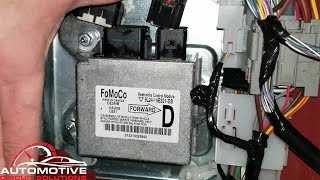
Tools: Flashlight, Socket Set (Intermediate) - Locate the Airbag Control Module (ACM)
The ACM is usually located under the center console, beneath the front seats, or under the dashboard. Access requires removing interior trim panels. On a 2010 Ford Explorer, for example, it is under the center console.
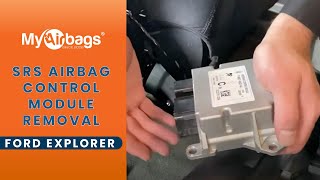
Tools: Socket Set, Trim Removal Tools (Intermediate) - Remove the ACM for Service
CRITICAL: Disconnect the vehicle's battery and wait at least 15-30 minutes for the system's backup power to discharge. Carefully unplug the connectors (these often have locking tabs) and unbolt the module. The module can now be sent for a reset service or replaced.
Tools: Socket Set (Advanced) - Test External Crash Sensor Resistance (Pro Tip)
If no crash occurred, test the sensors. Disconnect the battery. Disconnect the suspect crash sensor connector. Set a multimeter to measure resistance (Ohms). Probe the two pins on the sensor. A good sensor shows a specific resistance value obtained from a factory service manual, typically in the 800-1500 Ohm range. An infinite reading (OL) indicates an open circuit; a near-zero reading indicates a short.
Tools: Digital Multimeter, Factory Service Manual (Advanced) - Verify Wiring Integrity to the ACM (Pro Tip)
With the battery and ACM disconnected, perform a continuity test from the crash sensor connector back to the corresponding pins on the ACM's main harness connector. This identifies breaks (open circuits) in the wiring. Check for shorts by testing for continuity between each wire and a known good ground.
Tools: Digital Multimeter, Vehicle Wiring Diagram (Advanced) - Analyze Live Data PIDs (Pro Tip)
Using an advanced diagnostic scanner, access the live data stream for the Restraints Control Module. Monitor PIDs for front and side impact sensors. Look for inconsistencies. A sensor PID that reads erratically or shows a fixed, out-of-range value indicates a faulty sensor or wiring issue that falsely triggered the B1231 code.
Tools: Advanced OBD-II Scanner with Live Data (Advanced)
When This Code Triggers (Freeze-Frame Conditions)
- Event Data Recorder (EDR) Snapshot: Varies (Code B1231 does not use traditional OBD-II freeze frames. Instead, the Airbag Control Module acts as an Event Data Recorder. When an impact triggers the code, the module permanently stores a snapshot of critical data from the moments just before and during the event.)
- Change in Velocity (Delta-V): Manufacturer-specific threshold (This is the primary trigger. The module records the rapid change in speed (deceleration) during the impact. If this value exceeds the programmed limit for a crash, the B1231 code is stored.)
- Vehicle Speed: Recorded in MPH or KPH (The EDR captures vehicle speed in the 5 seconds leading up to the impact, providing a timeline of the event.)
- Brake & Throttle Position: On/Off & Percentage (The module records whether the brakes were applied and the accelerator pedal position in the moments before the crash.)
- Seatbelt Status: Buckled/Unbuckled (The EDR logs the status of the driver and passenger seatbelt buckles at the time of the event.)
- Deployment Status: Deployed/Not Deployed (The data includes which specific airbags and seatbelt pretensioners were commanded to deploy.)
Related Codes
- B1193 — Known as 'Crash Event Storage Full and Locked', this is another Ford/Mazda code that is functionally identical to B1231. Both confirm the module's memory is locked due to a crash and cannot be cleared with a scan tool. The diagnostic and repair procedure is the same.
- B2290 — This 'Occupant Classification System (OCS) Fault' often appears with B1231. If B1231 is in the main ACM, it's the primary issue. If B1231 is in the OCSM, it means the collision specifically affected the passenger seat weight sensing system, requiring inspection of the seat rails and floor pan for damage before attempting to clear the code.
- B2292 — This code indicates a 'Seatbelt Pretensioner Fault'. B1231 is the master code stating a crash occurred, while B2292 pinpoints a specific component that deployed (the pretensioner). You must replace the pretensioner to fix B2292 AND reset the module to clear B1231.
- Lamp Flash Code (LFC) 19 — This is not an OBD-II code but a visual diagnostic code flashed by the airbag light on many Ford vehicles (1 flash, pause, 9 flashes). It directly corresponds to DTC B1231, indicating 'Crash Data Memory Full'.
Climate & Environmental Factors
- High Humidity / Water Intrusion: Water leaks into the cabin and reaches the Airbag Control Module (ACM), which is often located on the floor under the center console or seats. Moisture leads to corrosion on the circuit board and connectors, causing internal shorts or open circuits. This corrupts the module's memory or causes a complete failure, disabling the SRS system. External crash sensors and their wiring are also susceptible to corrosion from road spray in wet or snowy climates, which causes sensor-specific fault codes or contributes to a general system failure.
How to Talk to a Mechanic About This Code
Say this: "I have an airbag light on and my scanner is showing code B1231, which I know is for stored crash data. I've inspected the vehicle and believe the most cost-effective repair is to remove the module and send it for a reset. I'd like an estimate for the labor to remove and reinstall the airbag control module."
This language shows you understand the problem and the specific solution. It frames the conversation around the most affordable, correct repair (a reset service), preventing a shop from immediately quoting a full, expensive module replacement. It also focuses the request on labor costs, which is the primary service you need from the shop.
Avoid saying:
- My airbag light is on, can you fix it?
- I was in an accident, I need you to look at the airbags.
- Just replace the airbag module.
Questions to ask before authorizing the repair:
- Instead of replacing the module for over $800, can you provide a quote for just the labor to remove and reinstall it if I have it reset by a third-party service?
- Have you confirmed that no other SRS components like seatbelt pretensioners or impact sensors need replacement?
- If you are recommending a replacement module, is that because the original is physically damaged (e.g., by water)?
- Does your quote for a new module include the cost of VIN programming?
Where to Take It: Dealer vs Independent vs Chain
- Dealer:
Not Recommended for the standard repair. Use only as a last resort if a new module must be purchased and programmed.
Best for: Vehicles under warranty (unlikely for this code), Complex cases where the module is physically destroyed and a new, programmed module is the only option.
Downsides: Will almost always recommend replacing the module at a high cost ($800-$1500+) instead of a reset., Highest labor rates. (Typical cost: +100% vs. baseline) - Independent Shop:
Best Fit. An honest independent shop is the ideal partner to perform the labor of removing and reinstalling the module, which you can then send to a specialized reset service yourself to save money.
Best for: Removing and reinstalling the module to be sent for a reset., Diagnosing and replacing any other faulty SRS components (sensors, seatbelts).
Downsides: Some smaller shops refuse to work on airbag systems for liability reasons., Quality varies; ensure they are ASE certified and have experience with SRS systems. (Typical cost: +0% vs. baseline) - Chain Shop:
AVOID. This is a safety-critical system that requires specialized knowledge, which is not the focus of chain shops.
Best for: Not applicable for this type of repair.
Downsides: Technicians generally lack the specialized knowledge for SRS diagnostics beyond reading the code., High pressure to upsell parts means they are very likely to recommend an unnecessary and expensive module replacement. (Typical cost: -10% vs. baseline)
When to Walk Away From the Repair
This is a critical safety issue, not a typical mechanical repair. The 'walk away' decision is less about the car's value and more about safety. If the repair cost is manageable, it should be done. If not, the car should not be driven or sold to an unsuspecting private party.
- Car worth $4000, fix is $500: Fix it. A $500 repair (module reset + labor) is a small price to restore a critical safety system and the car's usability.
- Car worth $2500, fix is $2500: Walk Away. If the total repair cost (including deployed airbags, etc.) approaches or exceeds the car's value, it's economically totaled.
- Car worth $12000, fix is $1800: Fix it. The repair cost is significant but well below the vehicle's value and is essential for safety.
What Scan Tool You Need for This Code
Minimum: A scan tool with the ability to read and clear codes from the SRS (Airbag) module.
A standard $20 OBD-II reader only communicates with the engine and emissions systems. It cannot see the SRS module at all and is completely useless for diagnosing an airbag light. You need a tool that specifically lists SRS/Airbag system compatibility.
Budget: BlueDriver Pro or Autel AutoLink AL619 (~$100) — Reads and identifies the B1231 code from the SRS module, confirming the issue is stored crash data. It also reads other SRS codes (like for a faulty seatbelt) but CANNOT clear the B1231 hard code.
Mid-range: Foxwell NT630 Plus or Autel Diaglink (~$180) — Provides robust SRS diagnostics, reads and clears 'soft' SRS codes, and offers live data from sensors. Some have limited bidirectional controls. These tools still CANNOT clear the B1231 hard code, but are excellent for diagnosing other issues before and after the module is reset.
Professional: Autel MaxiCOM MK808/MK906BT or XTOOL D7 (~$500-1200) — Offers full bidirectional control to test SRS components. Some high-end tools have the ability to reset soft crash data in-vehicle, but still likely fail on the 'hard code' B1231, which requires an EEPROM-level bench reset.
Rent vs buy: Most auto parts stores do NOT rent out scanners with SRS capabilities. For this code, buying a budget SRS-capable scanner is a good investment to confirm the diagnosis and ensure no other faults remain after the repair.
How to Clear the Code After You Fix It
- Replace all deployed components (airbags, pretensioners, etc.).
- Install the reset (or new) Airbag Control Module.
- Reconnect the vehicle's battery.
- Use an advanced SRS-capable scan tool to perform a full system scan.
- Clear any remaining 'soft' fault codes from the SRS system. These may be present from components being disconnected during repair.
- Turn the ignition off, wait 30 seconds, then turn it back on. Verify the airbag light illuminates for a few seconds and then turns off.
Drive cycle: A drive cycle is not applicable for clearing a B1231 code. This is a 'hard code' related to stored crash data. It cannot be cleared by driving or with a standard scan tool. The only way to clear it is to physically remove the crash data from the module's memory via a reset service or to replace the module entirely.
Watch out for:
- Attempting to clear the code with a basic OBD-II scanner will fail.
- Disconnecting the battery will not clear the crash data.
- Failing to replace all deployed components (like seatbelt pretensioners) causes the airbag light to remain on with a different code, even after the module is reset.
- Installing a used module from a salvage yard is risky, as it likely contains crash data and requires VIN programming.
Will This Fail Emissions / State Inspection?
No — by itself this code doesn't fail OBD inspection (but it can keep readiness monitors from setting, which causes a separate fail).
- General Rule: Code B1231 is a safety system fault, not an emissions fault. It will NOT fail a standard OBD-II emissions or 'smog' test. However, the illuminated airbag light WILL fail the separate safety inspection required in many states.
- California: California's Smog Check program primarily focuses on emissions. An airbag light will NOT cause a smog test failure. However, the vehicle is not considered road-safe and you could be held liable in an accident.
- New York: The NYS inspection includes a check of the airbag readiness light. If the light is on, stays on, or does not come on at all during the initial bulb check, the vehicle fails the safety inspection.
- Texas: Officially, the airbag system is not a required component of the Texas vehicle safety inspection. Many independent shops pass a vehicle with the light on. However, some chain service centers or stricter inspectors refuse to pass it on general safety grounds.
Most Commonly Affected Vehicles
- Ford Explorer (2005-2010) — Very common for this code. The ACM is under the center console. On these models, B1231 is also stored in the Occupant Classification System Module (OCSM), requiring inspection of the passenger floorpan and seat rails for damage.
- Ford F-Series Trucks (2004-2014) — Often appears with a blinking airbag light code of '19' (one flash, pause, nine flashes). The cause is frequently a stored crash event, but is sometimes intermittent due to wiring issues.
- Ford Ranger (2001-2011) — Frequently seen after an accident, often accompanied by LFC 19 and DTC B2290 (Occupant Classification System Fault).
- Mazda 3 / 6 / CX-5 (2010-2024) — Mazda shares SRS architecture with Ford. The code definition 'Longitudinal Acceleration Threshold Exceeded' is functionally identical to 'Crash Detected' and requires a module reset.
- Jaguar / Land Rover Various Models (2010-2024) — These brands use the B1231 code to indicate 'Crash Detected' in the Restraints Control Module (RCM), requiring a reset or replacement after an incident.
- Hyundai / Kia Various Models (2010-2024) — While B1231 is not a primary crash code for these makes, other SRS faults like a faulty clock spring or Occupant Classification Sensor illuminate the airbag light and are sometimes misidentified by generic scanners.
- Volvo Various Models (2008-2024) — Some diagnostic tools list B1231 as a potential crash data code for modern Volvo vehicles, requiring a check of the SRS module for stored event data.
- Tata Nexon, Tiago, Tigor (2017-2024) — On these models, B1231 is often defined as a 'Crash Sensor Circuit Fault' and points towards a damaged or corroded front impact sensor or its wiring, rather than stored crash data in the module.
Manufacturer-Specific Notes
- Ford: On many Ford vehicles, the airbag light flashes a two-digit Lamp Fault Code (LFC) before staying solid. B1231 is almost always associated with LFC '19'. No recalls are active for this code, as it indicates the system performed its intended function of locking after a detected crash event.
- Mazda: Like Fords, Mazda vehicles use this as a hard code that cannot be cleared without a module reset. The definition is sometimes listed as 'Longitudinal acceleration threshold exceeded', which causes confusion but means the exact same as 'Crash Detected'.
- Honda: CRITICAL: On most Honda vehicles (Accord, CR-V, etc.), B1231 is NOT an airbag code. It is defined as 'An open in the evaporator temperature sensor circuit' and relates to a fault in the A/C system.
- Toyota: CRITICAL: On many Toyota vehicles (Land Cruiser, Avalon, etc.), B1231 is NOT an airbag code. It is defined as 'Jam Protection Limit Switch Circuit On Driver Door' and indicates a fault in the driver's side power window system.
Real Owner Stories
2010 Ford Explorer after minor front-end collision
Vehicle was in a minor accident. Airbags did not deploy, but seatbelt pretensioners did. Airbag light was on, flashing code 19, and scanner showed B1231.
Outcome: The owner removed the Airbag Control Module (located under the center console) and sent it to a mail-in reset service. After reinstalling the reset module, the B1231 code was gone, and the airbag light turned off after clearing remaining 'soft' codes.
Lesson: Even if airbags don't deploy, the B1231 code is stored. You must replace all deployed components (like pretensioners) AND reset the module. The code cannot be cleared without a professional module reset.
2008 Mazda 3 with a mysterious airbag light
Owner of a Mazda 3 purchased used. The airbag light came on, and a scan revealed code B1231, 'Longitudinal Acceleration Threshold Exceeded'. The owner was confused because they hadn't been in an accident.
Outcome: The owner sent the module to an eBay reset service which successfully cleared the crash data. The light went out, confirming the module had stored data from a previous, undisclosed incident.
Lesson: When buying a used car, an active B1231 code is a major red flag for a past accident. 'Longitudinal Acceleration Threshold Exceeded' is the same as 'Crash Detected' and is a hard, non-erasable code.
2018 Ford F-150 with airbag light on, no accident
The airbag light came on intermittently and then stayed on, flashing code 19. The owner had not been in any accident or hit any major potholes. A scan showed code B1231.
Outcome: Diagnosis found a faulty front impact sensor. Although a crash hadn't occurred, the sensor's internal failure sent an erratic signal to the ACM, which was interpreted as a crash event, logging the B1231 code. The sensor was replaced, and the module had to be sent out for a reset to clear the hard code.
Lesson: In rare cases, a faulty impact sensor or wiring causes the B1231 code without a real impact. However, the repair still requires two steps: replacing the faulty component and resetting the crash data from the module.
How to Prevent This Code From Triggering
- Inspect and clear cowl and sunroof drains (Annually) — Prevents water from backing up and leaking into the cabin, which floods the floor where the Airbag Control Module is often located, causing corrosion and failure.
- Perform a pre-purchase inspection on used vehicles (Before buying any used car) — A thorough inspection uncovers signs of previous, poorly repaired accident damage. This is the #1 way to avoid inheriting a B1231 code from a previous owner.
- Avoid driving through standing water (During heavy rain/flooding) — As little as six inches of water causes a loss of control, and deeper water floods the vehicle's interior, directly damaging low-mounted electronics like the ACM and its sensors.
- Ensure stable battery voltage (Ongoing) — While not a direct cause of B1231, significant voltage fluctuations from a failing battery or alternator cause unpredictable behavior in sensitive electronics, including the SRS module. A healthy electrical system prevents ancillary faults.
Frequently Asked Questions
Can I reset the B1231 code by disconnecting the battery?
No. The B1231 code is stored in non-volatile memory (EEPROM) designed to retain data even with a complete loss of power. Disconnecting the battery will not clear it; the module must be professionally reset.
My airbags didn't deploy, so why do I have this code?
The system records an impact event when g-forces exceed a certain threshold, even if it's not severe enough to warrant airbag deployment. The code is set as a safety measure to ensure the entire SRS system is inspected and verified as fully functional before being re-enabled.
What does airbag light flash code 19 mean on my Ford?
Flash code 19 (one flash, pause, nine flashes) is the visual equivalent of the stored OBD-II code B1231. It means the Restraint Control Module has recorded a crash event and its memory is full.
Why does my scanner show B1231 on my Honda or Toyota, but the airbag light isn't on?
On Honda vehicles, B1231 refers to a fault in the A/C system's evaporator sensor. On Toyota vehicles, it refers to a fault in the driver's side power window anti-jam switch. If you have one of these vehicles, the code is completely unrelated to the airbag system.
What's the difference between 'Longitudinal Acceleration Threshold Exceeded' and 'Crash Detected'?
They mean the exact same thing. 'Longitudinal Acceleration Threshold Exceeded' is the technical trigger indicating the forward/backward g-forces of an impact crossed a pre-set limit. 'Crash Detected' is the plain-language result confirming the module is locked.
Is it safe to buy a used Airbag Control Module?
It is highly risky. A used module from a salvage yard likely contains crash data from the donor vehicle's accident. It also requires expensive programming at a dealership to match your car's specific VIN and options.
Will my car pass a safety inspection with code B1231?
No. An active airbag warning light and a critical fault code like B1231 causes the vehicle to fail any safety inspection that checks the SRS system.
Can a severe pothole or curb strike trigger code B1231?
Yes, though it is rare. The module triggers based on exceeding a g-force threshold. An exceptionally violent, sharp impact from a road hazard is interpreted by the module as a crash event, locking the system even without visible body damage.
Key Takeaways
- Code B1231 on Ford and Mazda vehicles indicates the Airbag Control Module (ACM) has permanently locked after detecting a crash event exceeding its g-force threshold.
- You cannot clear B1231 with a standard OBD-II scanner or by disconnecting the 12V battery; the module requires a professional EEPROM data reset.
- The most cost-effective repair is a mail-in ACM reset service, which costs $40 to $100 and avoids the $150+ dealer programming fee required for a new module.
- Driving with an active B1231 code means your vehicle has 0% passive safety protection, as all airbags and seatbelt pretensioners are completely disabled.
- On Honda and Toyota vehicles, B1231 is a false flag for the SRS system; it actually indicates a fault in the A/C evaporator sensor (Honda) or power window anti-jam switch (Toyota).
Helpful Videos

The information in this article is provided for general reference and educational purposes only. Vehicle specifications, procedures, and part compatibility can vary by production date, trim level, and region. Always consult your vehicle's factory service manual and verify part numbers before purchasing or performing repairs. Safety-critical components such as airbags, seat belts, and braking systems should be installed by a qualified professional.
- 🎬 Helpful Videos
- What Does B1231 Mean?
- Can I Drive With B1231?
- Common Causes
- Symptoms
- Diagnostic Flowchart
- Common Fixes & Costs
- Used vs. New Parts: Buying Guide
- What Happens If You Wait — Timeline
- Cost of Not Fixing It
- Diagnosis Steps
- When This Code Triggers (Freeze-Frame Conditions)
- Related Codes
- Climate & Environmental Factors
- How to Talk to a Mechanic About This Code
- Where to Take It: Dealer vs Independent vs Chain
- When to Walk Away From the Repair
- What Scan Tool You Need for This Code
- How to Clear the Code After You Fix It
- Will This Fail Emissions / State Inspection?
- Most Commonly Affected Vehicles
- Manufacturer-Specific Notes
- Real Owner Stories
- 2010 Ford Explorer after minor front-end collision
- 2008 Mazda 3 with a mysterious airbag light
- 2018 Ford F-150 with airbag light on, no accident
- How to Prevent This Code From Triggering
- Frequently Asked Questions
- Can I reset the B1231 code by disconnecting the battery?
- My airbags didn't deploy, so why do I have this code?
- What does airbag light flash code 19 mean on my Ford?
- Why does my scanner show B1231 on my Honda or Toyota, but the airbag light isn't on?
- What's the difference between 'Longitudinal Acceleration Threshold Exceeded' and 'Crash Detected'?
- Is it safe to buy a used Airbag Control Module?
- Will my car pass a safety inspection with code B1231?
- Can a severe pothole or curb strike trigger code B1231?
- Key Takeaways
- 🎟️ Get 5% Off