

B1192 on 2013-2014 Honda Accord: Causes and Fixes for the 'Check Charging System' Message
On a 2013-2014 Honda Accord, code B1192 with a 'Check Charging System' message is most often caused by a faulty battery sensor on the negative battery terminal. Replacing this sensor is a common, DIY-friendly fix, with the part costing around $80-$130.
- Code B1192 on a 2013-2014 Accord almost always points to an issue with the battery sensor on the negative terminal, not the alternator.
- The primary symptom is the 'Check Charging System' message on the dashboard.
- Before replacing the sensor, check the 7.5A BMS fuse in the under-hood fuse box, as this is a simple and cheap potential fix.
- Replacing the battery sensor is a very easy DIY job that requires only a 10mm socket and about 15 minutes.
- Use the genuine Honda part (38920-T2A-A04 or a superseding number) as this issue was subject to a recall and OEM part quality is important.
What's Unique About the 2013-2014 Honda ACCORD

This issue was common enough on the 9th generation Accord (and other Hondas of the era) that Honda issued Technical Service Bulletins (TSBs) to investigate the problem. The TSBs specifically mention customer complaints of the 'Check Charging System' message and DTC B1192, indicating a known issue with the battery sensor or its related components on these vehicles. Furthermore, a safety recall (NHTSA Campaign 17V423000, TSB 17-057) was issued for the 2013-2016 Accord to address battery management sensors that were not properly sealed against moisture, which could lead to failure.
Diagnostic Flowchart

Tap your situation to follow the diagnostic path that matches what you're seeing on this vehicle.
Symptoms You May Notice

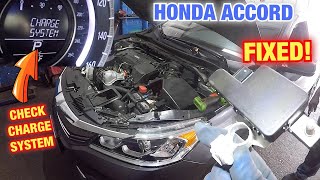
- "Check Charging System" message displayed on the instrument panel.
- Battery warning light may illuminate.
- Intermittent starting problems.
- Incorrect battery voltage readings or fluctuations.
- Replacing the alternator. While the message says 'Check Charging System', the alternator is often working correctly. The problem is that the system can't get the correct information from the battery sensor to control the alternator properly.
- Replacing the battery. A weak battery can cause many electrical issues, but it's not typically the direct cause of a B1192 communication code. However, it's always wise to test the battery to ensure it's healthy.
Most Likely Causes

- Faulty Battery Sensor 🔴 High Probability The original sensors on these models were subject to a recall for insufficient moisture protection, leading to corrosion and failure.
How to confirm: After checking fuses and connections, replacing the sensor is the most common diagnostic step. The issue is often resolved immediately after replacement.
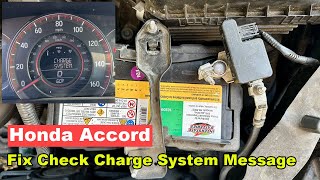
Typical fix: Replace the battery sensor located on the negative battery terminal. This is a simple unbolt/re-bolt procedure. 🎬 Watch: A quick walkthrough of the battery sensor replacement.
Est. part cost: $80-$130 - Blown Fuse for the Battery Management System (BMS) 🟡 Medium Probability
How to confirm: Check the fuses in the under-hood fuse box. Specifically, look for a 7.5A fuse (often labeled BMS) that provides power to the sensor circuit.
Typical fix: Replace the blown fuse. If the fuse blows again, there is a short circuit in the wiring that needs to be diagnosed.
Est. part cost: $1-$5 - Loose or Corroded Battery Terminals/Sensor Connector ⚪ Low Probability
How to confirm: Visually inspect the negative battery terminal where the sensor is mounted. Check for any white or green corrosion. Ensure the sensor's electrical connector is plugged in securely.
Typical fix: Clean the battery terminals and sensor connection points with a wire brush. Ensure all connections are tight.
Est. part cost: $0-$10
Rare But Worth Checking
- Damaged Wiring Harness: The communication wire between the sensor and the Gauge Control Module could be broken or shorted. This usually requires more in-depth diagnostics with a multimeter to check for continuity.
- Faulty Gauge Control Module (Instrument Cluster): It is extremely rare for the instrument cluster itself to be the cause of this specific communication error.
Diagnosis Steps
- Verify the "Check Charging System" message is present.
- Check the under-hood fuse box for a blown fuse related to the Battery Management System (BMS), typically a 7.5A fuse.
- Inspect the negative battery terminal. Ensure the terminal clamp and the battery sensor connector are clean, tight, and free of corrosion.
- Disconnect the sensor's electrical connector and reconnect it to ensure a solid connection.
- If fuses and connections are good, the most likely cause is a failed battery sensor.
- Disconnect the negative battery cable (which includes the sensor). Use a 10mm socket to remove the sensor from the terminal and ground cable.
- Install the new sensor, reconnect all cables, and start the vehicle. The message should be gone.
Parts You'll Likely Need
- Battery Sensor
(OEM #38920-T2A-A04)— This is the component that fails most frequently, causing the B1192 code. It is the central point of failure identified in TSBs and owner forums.
Trusted brands: Honda (Genuine)
OEM price range: $88-$128
Aftermarket price range: $60-$100
Related Codes That Often Appear With This One
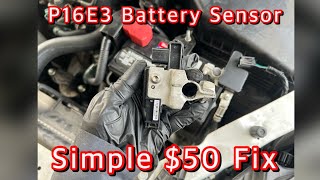
- P16E3 — This code is also related to a communication error between the PCM and the battery sensor, and often appears alongside B1192. 🎬 See how to fix the P16E3 code and charging message.
Technical Service Bulletins (TSBs) & Recalls
- DLR MSG - RFP - (2015-08-24): Investigating B1192 and 'Check Charging System' message on 2013-2014 Accords.
- 17-057 / 17-069: Safety Recall for 2013–16 Accord Battery Management Sensor due to improper sealing against moisture.
Platform-Specific Known Issues
- Honda issued TSBs DLR MSG - RFP - in 2015 to investigate this exact issue, noting they were collecting parts to "fully understand the cause" of the B1192 code and 'Check Charging System' message on 2013-2014 Accords.
- A wider safety recall (TSB 17-057) was issued for 2013-2016 Accords because the Battery Management Sensor case may not be sufficiently sealed, allowing moisture entry and eventual corrosion, which can cause a short and lead to this code.
Mechanic-Grade Diagnostic Values
- LIN Bus (UART) Communication Line Voltage — expected: Toggling between approx. 1V and 11V (1V below battery voltage) when communicating; steady at approx. 12V when at rest.. Failure: No voltage, steady low voltage, or voltage that does not toggle indicates a fault in the sensor or wiring.
- Alternator Charging Voltage at Battery Terminals (Engine Running) — expected: 14.0V to 14.7V. Failure: Below 14.0V may indicate an undercharging condition; above 14.7V indicates overcharging. However, with this code, the voltage is often correct, pointing to the sensor.
- Battery Voltage (Engine Off) — expected: 12.4V to 12.7V. Failure: Below 12.4V indicates a discharged or failing battery.
- Continuity on LIN Bus Wire — expected: Should be continuity (less than 1.0 Ω) between the sensor connector and the gauge module connector.. Failure: No continuity (high resistance) indicates a broken wire.
Scan Tool Commands That Help
- Honda Diagnostic System (HDS): Clear DTCs — This is the first step in the official diagnostic procedure to see if the code returns immediately, which would indicate a hard fault.
- Honda Diagnostic System (HDS): B-CAN System Diagnosis Test Mode A — Used when multiple B-CAN network DTCs are present to perform a system-wide diagnosis.
- Honda Diagnostic System (HDS): Jump SCS Line — A specific diagnostic step mentioned in some Honda troubleshooting procedures to test communication lines.
Wiring & Ground Locations
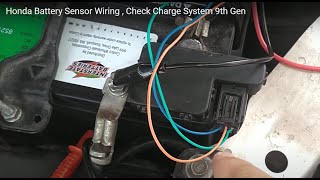
- Battery Sensor 2P/3P Connector — On the battery sensor itself, attached to the negative battery terminal.. This is the connector for the sensor. Pin 2 is the LIN communication wire to the gauge module. Wire colors are Pin 1: Light Blue, Pin 2: Red, Pin 3: Green.
- Gauge Control Module 32P Connector — Behind the instrument cluster in the dashboard.. This connector receives the communication signal from the battery sensor. Pin 23 is the LIN wire from the sensor. A break in the wire between this connector and the sensor causes code B1192. 🎬 Watch: Understanding the battery sensor wiring and communication lines.
- G505 / G506 — G505 is under the right center of the dash; G506 is under the center of the dash.. These are primary ground points for dashboard components, including the Gauge Control Module. A poor ground here can cause various communication errors.
- G102 — Left rear of the engine compartment.. Main engine compartment ground point. While less likely to cause this specific code, a poor ground here can cause widespread electrical issues.
Real Owner Repair Stories
- YouTube user 'Random DIY Videos' (2016 Honda Accord) — 'Check Charge System' error on the dash. Battery would die after 2-3 days. Battery tested bad (low cold cranking amps).
❌ Tried (didn't work) Replacing the battery. The error message immediately returned after battery replacement.
✅ What actually fixed it Replaced the battery sensor on the negative terminal (Part # 38920-T2A-A04). The cost was $52.98 from a Honda dealership. This resolved the warning light. - YouTube user 'Auto User Manual' (2013 Honda Accord EX-L) — 'Check Charge System' warning on the dashboard.
❌ Tried (didn't work) Testing the battery (read a healthy 12.7V engine off)., Testing the alternator (read a healthy 14.25V engine running).
✅ What actually fixed it Replaced the OEM battery sensor (Part # 38920-T2A-A04). The total cost was $81 from a local Honda dealer. The warning light was gone immediately after installation. - YouTube user 'RB The Mechanic' (Honda Accord (9th Gen)) — 'Check Charging System' light stayed on even after the owner had already replaced the battery and alternator.
❌ Tried (didn't work) Replacing the alternator., Replacing the battery.
✅ What actually fixed it The mechanic first unplugged and re-plugged the sensor connector, which made the light go away temporarily, indicating a connection or sensor issue. He then replaced the battery sensor to provide a permanent fix.
When the Usual Fixes Don't Work
- Multiple owner-documented repairs confirm that the B1192 code and 'Check Charging System' message can persist even with a brand new battery and an alternator that tests perfectly, with outputting a steady 14.0V-14.5V. In these cases, the root cause was consistently a failure of the battery sensor itself, which was not providing the correct data to the vehicle's computers. This counters the common assumption that a charging system message must mean the alternator or battery is at fault.
OEM Part Supersession History
38920-T2A-A02, 38920-T2A-A03, 38920-TY2-A01→38920-T2A-A04— Part revision to improve reliability and address manufacturing defects like poor moisture sealing mentioned in recalls.
Helpful Videos
Used OEM Parts in Stock

New Aftermarket Parts Available


The information in this article is provided for general reference and educational purposes only. Vehicle specifications, procedures, and part compatibility can vary by production date, trim level, and region. Always consult your vehicle's factory service manual and verify part numbers before purchasing or performing repairs. Safety-critical components such as airbags, seat belts, and braking systems should be installed by a qualified professional.
- Honda ACCORD:
- 🎬 Helpful Videos
- 🛍️ Shop This Part
- What's Unique About the 2013-2014 Honda ACCORD
- Diagnostic Flowchart
- Symptoms You May Notice
- Most Likely Causes
- Rare But Worth Checking
- Diagnosis Steps
- Parts You'll Likely Need
- Related Codes That Often Appear With This One
- Technical Service Bulletins (TSBs) & Recalls
- Platform-Specific Known Issues
- Mechanic-Grade Diagnostic Values
- Scan Tool Commands That Help
- Wiring & Ground Locations
- Real Owner Repair Stories
- When the Usual Fixes Don't Work
- OEM Part Supersession History
- 🎟️ Get 5% Off