

OBD-II Code B1081: Left Temperature Damper Motor Circuit
What B1081 means, why it triggers, and how to fix it
- Code B1081 indicates a climate control fault on Ford and Mazda, a critical seat belt pretensioner failure on Nissan and Infiniti, or an audio system issue on GM vehicles.
- A repetitive clicking sound from the dashboard when adjusting the temperature confirms a stripped blend door actuator gear, requiring a $25 to $80 replacement part.
- Always remove the actuator and manually rotate the blend door shaft 90 degrees; if it binds, replacing the actuator will not solve the root problem.
- Fixing a binding blend door on affected Ford F-150, Super Duty, and Ranger models requires complete dashboard removal, costing between $1,200 and $2,500 in labor.
What Does B1081 Mean?

Trouble code B1081 most commonly indicates the climate control module detects a fault with the driver's side temperature blend door system. This system uses a small electric actuator motor to move a blend door inside the dashboard, mixing hot and cold air to achieve the selected temperature. When this code appears, the door is physically stuck, the actuator motor has failed, or an electrical problem prevents communication between the control module and the actuator.
Technical definition: The official SAE/ISO definition for code B1081 is highly manufacturer-specific. For Ford, Lincoln, and Mazda, it is defined as 'Left Temperature Damper Motor Circuit Failure', indicating the commanded position of the driver's side temperature blend door does not match its actual position feedback. For Nissan and Infiniti, it indicates 'Right-hand Front Seat Belt Pre-Tensioner Circuit Open'. For some Chevrolet and GM vehicles, it indicates an 'Audio Circuit Output #6' problem.
Can I Drive With B1081?
Yes. You can drive the vehicle if the code relates to the climate control system, as it only affects cabin comfort. However, if the defroster is stuck on cold air, impaired visibility creates a severe safety risk in icy conditions. On Nissan and Infiniti models, B1081 indicates a disabled seat belt pretensioner, meaning the vehicle is unsafe to drive until repaired.
Common Causes

- Failed Temperature Blend Door Actuator (Very Common) — The actuator is a small electric motor with plastic internal gears that strip, crack, or wear out over time. Once stripped, it cannot move the blend door, resulting in a clicking noise and a loss of temperature control.
- Binding or Stuck Blend Door (Very Common) — The blend door or the HVAC housing it resides in warps or becomes obstructed by debris. This prevents the door from moving freely, putting excessive strain on the actuator and causing it to fail. This is a well-documented design flaw in many Ford trucks.
- Failed Seat Belt Pretensioner (Nissan/Infiniti) (Common) — On Nissan and Infiniti vehicles, this code points to an open circuit in the passenger-side seat belt pretensioner. This critical safety component tightens the seatbelt during a collision. The fault is often caused by broken wires in the door harness. 🎬 Watch: How to diagnose Nissan airbag light and pretensioner codes.
- Lost Actuator Calibration / Potentiometer Failure (Common) — The actuator contains an internal potentiometer providing position feedback to the control module. If this sensor fails or the module loses calibration, the actuator attempts to push the door past its physical stops, causing the gears to skip and break.
- Wiring Harness or Connector Issue (Less Common) — The wires leading to the blend door actuator fray, corrode, or disconnect in the driver's footwell area. This results in an open circuit (B1081:13) or a short to ground (B1081:11), interrupting power or command signals.
- HVAC Control Module Software Issue (Less Common) — On specific modern vehicles, notably the 2021 Ford F-150, 🎬 Watch: Troubleshooting Ford Super Duty and F-150 blend door codes. a software glitch within the HVAC control module erroneously triggers this code. The physical components are functional, but the module requires reprogramming by a dealer.
- Failed HVAC Control Module (Rare) — The main climate control module commanding the actuator fails internally. This requires replacing the module after ruling out all wiring and mechanical parts.
Symptoms

- Clicking or Tapping Noise from Dashboard — A repetitive clicking, popping, or grinding sound emits from the driver's side of the dashboard. This noise is most noticeable when starting the vehicle or changing the temperature setting and confirms a stripped actuator gear. 🎬 See this walkthrough on replacing the F-150 blend door actuator.
- Inability to Change Air Temperature — The air from the driver's side vents is stuck on full hot or full cold. Adjusting the temperature controls has no effect on the output temperature.
- Poor Defroster Performance — If the blend door is stuck providing cold or lukewarm air, the defroster cannot clear the windshield of condensation, fog, or ice, creating a serious safety hazard.
- Airbag Warning Light is On (Nissan/Infiniti) — On Nissan and Infiniti models, the primary symptom is the illumination of the SRS/airbag warning light on the instrument cluster, indicating a fault in the safety restraint system.
- Incorrect or Inconsistent Temperature — The air temperature from the vents does not match the setting on the climate controls, or it fluctuates randomly between hot and cold during a drive.
Diagnostic Flowchart
Tap your situation to follow the diagnostic path that matches what you're seeing on this code.
Common Fixes & Costs
- Replace Temperature Blend Door Actuator — Parts: $25-$80, Labor: $100-$250, ~1.5 hr book time (DIY)
- Lubricate Blend Door and Replace Cams (per TSB 23-2115) — Parts: $50-$150, Labor: $1200-$2500, ~8.0 hr book time (Professional)
- Replace HVAC Air Distribution Housing — Parts: $1000-$1200, Labor: $1500-$2500, ~8.0 hr book time (Professional)
- Repair Seat Belt Pretensioner Circuit (Nissan/Infiniti) — Parts: $60-$150, Labor: $150-$300, ~1.5 hr book time (Professional)
- HVAC Module Reprogramming — Parts: $0, Labor: $100-$200, ~0.5 hr book time (Professional)
Used vs. New Parts: Buying Guide
When a used part is worth it: Given the low cost of a new aftermarket blend door actuator ($25-$80), buying used never makes sense. The internal plastic gears are a known wear item. A used part only makes sense if replacing the entire HVAC housing from a low-mileage donor vehicle.
Donor-vehicle mileage cap: roughly under 30000 miles for the part to have meaningful remaining life.
Donor quality checklist:
- Verify the part number exactly, as visually similar actuators have different internal logic.
- Avoid parts with physical damage or corrosion on the electrical pins.
- For the Nissan pretensioner, only buy from a reputable source guaranteeing the part is not from a deployed vehicle.
Decision logic:
- If The part is a blend door actuator → Buy a new aftermarket or OEM part. The cost is low and new parts feature improved internal gear material.
- If The part is a seat belt pretensioner → Favor a new OEM part or a professional rebuilding service due to the critical safety function.
- If The required fix is the entire HVAC housing → A used housing from a low-mileage vehicle is a cost-effective option, but carries the risk of having the same design flaw.
Warranty tradeoff: Used parts typically have a 30-90 day warranty. Aftermarket new actuators come with a 1-year to limited lifetime warranty. An OEM part installed by a dealer carries a 1-2 year warranty on parts and labor.
Worst-case if a used part fails: $250 if a used actuator fails after installation, primarily due to the repeated labor cost for diagnosis and replacement.
What Happens If You Wait — Timeline
- 0-2 weeks: Intermittent clicking from the dash on startup or when changing temperature. Temperature control becomes slightly inconsistent. The B1081 code is stored but does not trigger a warning light. (MPG impact: 0%% · Added cost: $0)
- 2 weeks - 3 months: The clicking becomes constant. The driver's side is stuck on either full heat or full cold. The defroster becomes ineffective if stuck on cold, posing a safety risk. (MPG impact: 0%% · Added cost: $0)
- 3-6 months: The actuator motor burns out completely, and the clicking stops. The temperature remains stuck. If the root cause was a binding door, the constant strain strips the gears on a brand-new replacement actuator. (MPG impact: 0%% · Added cost: $80 (Cost of a second replacement actuator))
- 6+ months: No further mechanical damage occurs to the HVAC system. The primary long-term cost is the ongoing safety risk of an inoperable defroster or, for Nissan/Infiniti, a disabled airbag system. (MPG impact: 0%% · Added cost: $1500-$3000 (Eventual repair cost if the entire dash must be removed for a binding door))
Cost of Not Fixing It
- Immediate: Loss of driver-side temperature control. For Nissan/Infiniti, the passenger-side seatbelt pretensioner is disabled, creating a critical safety risk. (Added cost: Negligible)
- 1-3 Months: Inability to use the defroster effectively if stuck on cold, posing a major safety hazard in cold or humid weather. A constantly clicking actuator is a significant annoyance. (Added cost: $0)
- 6+ Months: The primary long-term cost is the ongoing safety risk from an inoperable defroster or a disabled SRS system. (Added cost: Immeasurable cost of injury in an accident where the safety system fails to deploy.)
Diagnosis Steps
- Scan for Codes and Suffixes
Use an OBD-II scanner capable of reading Body (B) codes to confirm B1081 is present. Pay close attention to suffixes (e.g., :07, :11, :13, :49), as they provide critical information about the fault type (mechanical, electrical, internal).
Tools: OBD-II Scanner (Body code capable) (Beginner) - Listen for the 'Click of Death'
With the engine on, cycle the driver's temperature control from its coldest to its hottest setting and back. Listen carefully for a rhythmic clicking or tapping sound from the driver's side dashboard. This sound confirms a failed actuator with stripped gears.
Tools: None (Beginner) - Access and Visually Inspect the Actuator
The driver's side temperature blend door actuator is in the driver's footwell, high up against the center console. Remove the lower trim panel. Visually inspect the actuator while an assistant changes the temperature to see if it attempts to move or jumps.
Tools: Flashlight, Basic hand tools (screwdriver, socket set) (Intermediate) - PRO TIP: Test the Blend Door Manually
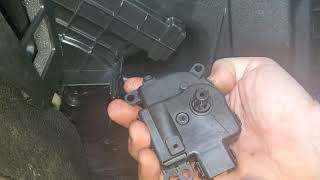
Unplug and remove the screws holding the actuator. With the actuator removed, turn the white plastic shaft it connects to by hand. The shaft must rotate smoothly approximately 90 degrees. If it is stiff or binds, the problem is the door inside the HVAC case. A new actuator will fail again if this is the case.
Tools: Screwdriver or small socket set (T20/T25 Torx, or 8mm socket) (Intermediate) - Attempt an HVAC System Reset/Recalibration
Pull the fuse for the HVAC module for several minutes, then reinstall. Alternatively, initiate a recalibration using a capable scan tool like FORScan, which forces the system to relearn door positions.
Tools: Fuse puller or pliers, Bi-directional Scan Tool (optional) (Beginner) - PRO TIP: Test Seat Belt Pretensioner Resistance (Nissan/Infiniti)
For a B1081 code on a Nissan, access the yellow pretensioner connector. Disconnect the battery and wait several minutes. Disconnect the pretensioner and use a multimeter to measure the resistance across its two pins. A healthy pretensioner reads 2.0 to 3.0 ohms. An 'OL' reading confirms an open circuit.
Tools: Multimeter, Basic hand tools (Advanced) - PRO TIP: Use a Scan Tool to Monitor PIDs
For Ford vehicles, use a tool like FORScan to monitor the 'LEFT_BLEND_ACT_FDBK' PID. Command the temperature from cold to hot. The value must change smoothly from 0% to 100%. If the value gets stuck or jumps erratically, it confirms a mechanical or actuator feedback fault.
Tools: Bi-directional Scan Tool (e.g., FORScan) (Advanced) - PRO TIP: Check for Voltage at the Connector (Ford)
Using a multimeter, check the actuator's electrical connector with the key on. You must find battery voltage (approx. 12V) between the power and ground pins. The signal wire voltage must vary smoothly as the temperature knob is turned, from 0.6V to 7.4V.
Tools: Multimeter, Vehicle-specific wiring diagram (Advanced) - Check Wiring for Shorts/Opens
If you have code B1081:11 (Short to Ground) or B1081:13 (Open Circuit), use a multimeter set to resistance to check the suspect wire. For an open circuit, check for continuity from end-to-end. For a short, check for continuity between the signal wire and a known good ground.
Tools: Multimeter, Vehicle-specific wiring diagram (Advanced)
When This Code Triggers (Freeze-Frame Conditions)
- Ignition Status: ON (The fault is detected when the ignition is on, either during startup self-test or when a temperature change is commanded.)
- Commanded Actuator Position: 0-100% (Code sets when the module commands the actuator to a new position.)
- Actual Actuator Position (Feedback): No change or erratic value (The fault logs when the feedback position PID does not match the commanded position within a specified time, indicating a mechanical jam or electrical failure.)
- Time Since Ignition On: 0-30 seconds (HVAC modules perform a self-test and calibration of all actuators immediately after a cold start, triggering the code.)
Related Codes
- B1082 — This code is for the passenger side (Right) Temperature Damper Motor. It is common to see both B1081 and B1082 together if there is a software issue or a design flaw affecting the entire HVAC unit.
- B1081:07 — Indicates a 'Mechanical Failure'. The module commanded the actuator to move, but the feedback sensor's position did not change. This confirms the part is physically stuck, jammed, or broken.
- B1081:11 — Indicates a 'Circuit Short to Ground'. A wire in the actuator's circuit is touching the vehicle's metal chassis, causing lower than expected voltage.
- B1081:13 — Indicates a 'Circuit Open'. This points to a break in the wiring, a loose connector, or a completely burned-out internal motor winding.
Climate & Environmental Factors
- Extreme Temperatures (Hot or Cold): Extreme cold makes plastic components like actuator gears and the HVAC housing brittle and susceptible to cracking. Extreme heat from sun loading on the dashboard warps the plastic HVAC housing over time, leading to the blend door binding.
- High Humidity: High humidity accelerates corrosion on electrical connectors and pins if moisture intrudes, leading to intermittent electrical faults.
How to Talk to a Mechanic About This Code
Say this: "I have a B1081 code and symptoms pointing to the blend door. I need a diagnosis to determine if it's the actuator or a binding door. Please have the tech manually check the door's range of motion after removing the actuator before quoting a repair."
This shows you understand the two primary failure modes and prevents a shop from replacing the cheap actuator without diagnosing the more expensive root cause.
Avoid saying:
- 'My A/C is broken, can you fix it?'
- 'I hear a clicking in my dash.'
- 'Just replace the blend door actuator.'
Questions to ask before authorizing the repair:
- Did you test the blend door's movement by hand with the actuator removed? Was it smooth or stiff?
- If it's a Ford, are you aware of TSB 23-2115 for this issue?
- If it's a 2021 F-150, have you ruled out the software issue from TSB SSM 49712?
- If it's a Nissan, what was the resistance reading across the seat belt pretensioner pins?
Where to Take It: Dealer vs Independent vs Chain
- Dealer:
Best for: Vehicles under warranty or with an Extended Service Plan., Known TSB-related repairs requiring dashboard removal., Software-related fixes requiring module reprogramming.
Downsides: Highest labor rates, typically 1.5-2x more than independent shops., Defaults to the most expensive TSB fix without exploring simpler options first. (Typical cost: +50% vs. baseline) - Independent Shop:
Best for a simple actuator swap. For complex diagnostics or dash-out repairs, a dealer or a highly-rated specialist is safer. For the Nissan SRS fault, a shop specializing in electrical work is ideal.
Best for: Confirmed simple actuator replacement on an out-of-warranty vehicle., Diagnosing the actuator vs. binding door issue., Repairing the pretensioner wiring on a Nissan/Infiniti.
Downsides: Quality and diagnostic skill vary greatly., Lacks the specific tools or desire to perform a full dashboard removal. (Typical cost: +0% vs. baseline) - Chain Shop:
AVOID for this repair. The diagnostic process is too complex and the potential for a costly misdiagnosis is very high.
Best for: Getting the code read for free.
Downsides: High pressure to upsell., Very likely to misdiagnose a binding door and simply replace the actuator, leading to a repeat failure. (Typical cost: -10% vs. baseline)
When to Walk Away From the Repair
If the estimated repair cost exceeds 40-50% of the car's private-party value, sell the car as-is or trade it in.
- Car worth $8000, fix is $3700: Walk away. The repair cost is nearly 50% of the vehicle's value for a non-critical system. Sell as a 'mechanic's special' disclosing the issue.
- Car worth $25000, fix is $450: Fix it. This is a minor cost relative to the car's value.
- Car worth $6000, fix is $600: Fix it, especially if it's the Nissan SRS fault. The cost is low relative to the car's value and it resolves a critical safety issue.
What Scan Tool You Need for This Code
Minimum: A scanner that reads manufacturer-specific Body (B) codes. A basic engine-only (P-code) reader will not see code B1081.
A cheap $20 scanner shows 'No Codes Found' because it only accesses the engine control unit, not the Body Control Module or HVAC module where B1081 is stored.
Budget: BlueDriver Pro or FORScan with Adapter (~$100) — Reads and clears Body codes like B1081. Displays live data PIDs for actuator commanded vs. actual position, which is crucial for diagnosis.
Mid-range: Foxwell NT510 Elite (~$150) — Provides all functions of the budget pick and adds bi-directional control. This allows you to command an HVAC recalibration directly from the tool.
Professional: Autel MaxiCOM MK808 (~$500) — Offers full OEM-level diagnostics. Runs guided component tests, actuator calibrations, and accesses detailed manufacturer-specific information.
Rent vs buy: Most auto parts store loaner tools are basic engine code readers and will NOT work for this code. Buying a capable scanner like a BlueDriver or a Foxwell is a worthwhile investment.
How to Clear the Code After You Fix It
- Reconnect any disconnected components.
- Use an OBD-II scan tool to clear the B-code from the HVAC or Body Control Module.
- Perform an HVAC module reset/recalibration by pulling the specific HVAC/FCIM fuse for several minutes or by using a scan tool function.
- Turn the key to 'ON' (without starting the engine) and wait 1-2 minutes for the system to cycle through its new learned positions.
Drive cycle (~5 minutes): A specific drive cycle is not required. After clearing the code and performing the reset, start the vehicle and test the full range of the temperature controls from max cold to max hot, verifying correct operation.
Readiness monitors affected: None
Watch out for:
- Clearing the code without performing a recalibration causes the actuator to behave erratically or the code to return.
- If the code is for a Nissan/Infiniti seatbelt pretensioner, the SRS module stores the fault until cleared with a capable scanner. Disconnecting the battery will not clear it.
Will This Fail Emissions / State Inspection?
No — by itself this code doesn't fail OBD inspection (but it can keep readiness monitors from setting, which causes a separate fail).
- California: A B1081 code for an HVAC fault will not cause a smog check failure. If the code is for a Nissan/Infiniti airbag system, the illuminated airbag light does not fail the smog check, but indicates a serious safety issue.
- New York: For an HVAC fault, B1081 will not cause an inspection failure. For the Nissan/Infiniti airbag variant, the state inspection notes the illuminated airbag warning light as an advisory, but it does not automatically fail the safety inspection.
- Texas: The Texas safety inspection checks for an illuminated airbag warning light. An active SRS light due to the B1081 code on a Nissan/Infiniti results in a safety inspection failure. An HVAC-related B1081 code will not.
Most Commonly Affected Vehicles
- Ford F-150 (2015-2020) — Extremely common failure caused by a failed actuator or a binding door. Addressed in TSB 23-2115, requiring dashboard removal to replace cams and lubricate the door.
- Ford F-250 / F-350 Super Duty (2017-2022) — Highly prone to both actuator failure and a binding blend door. The official fix is outlined in TSB 23-2115, a labor-intensive job.
- Ford Ranger (2019-2020) — A known design flaw where the HVAC housing warps, causing the blend door to bind. TSB SSM 51313 recommends replacing the entire housing, an expensive repair.
- Ford F-150 (2021) — Early production models (built Sept 2020 - Jan 2021) have a software issue (TSB SSM 49712) that falsely triggers B1081, requiring a dealer to reprogram the HVAC module.
- Nissan / Infiniti Titan, X-Trail, Altima (2004-2018) — B1081 indicates 'Right-hand Front Seat Belt Pre-Tensioner Circuit Open'. This is a safety system fault, not a climate control issue, and illuminates the airbag warning light.
- Mazda Various with Full-Auto A/C (2006-2018) — This code indicates 'Driver-side air mix actuator motor lock'. The diagnostic procedure involves checking the actuator, linkage, and wiring.
- Chevrolet / GM Malibu, Equinox (2008-2020) — B1081 indicates 'Audio Circuit Output #6' is having a range or performance issue. Symptoms include no sound from specific speakers.
Manufacturer-Specific Notes

- Ford: Ford has issued multiple TSBs, including TSB 23-2115 (F-150/Super Duty) and TSB SSM 51313 (Ranger). Repairs are covered if the vehicle is under the New Vehicle Limited Warranty or an Extended Service Plan.
- Nissan / Infiniti: B1081 does not relate to climate control. It indicates an 'Open Circuit' in the right-hand front seat belt pretensioner, a critical SRS fault that illuminates the airbag light.
- Chevrolet / GM: B1081 points to a fault in 'Audio Circuit Output #6', resulting in no sound from certain speakers.
Real Owner Stories
2018 Ford F-150 Lariat with Dual-Zone Climate
The passenger side was stuck on maximum heat, while the driver's side worked correctly. A clicking noise was present.
What they tried:
- Replaced the passenger side blend door actuator.
Outcome: Replacing the actuator did not fix the problem. A mechanic diagnosed the blend door itself was physically stuck inside the HVAC housing. The dealer quoted over 10 hours of labor ($3,700) to remove the dashboard and repair the door.
Lesson: A new actuator failing to fix the issue is a classic sign of a binding blend door. Before replacing the actuator, remove the old one and try to move the door's linkage by hand. If it is stiff, the actuator is not the root cause.
2017 Ford F-150 at 40k miles
The owner noticed weak heat performance and found a stored B1081 code indicating a mechanical failure. Visually confirmed the actuator only rotated about 30 degrees instead of its full range.
What they tried:
- Considered a DIY replacement.
- Before replacement, the actuator started working correctly on its own the next day.
Outcome: The intermittent failure pointed towards the blend door binding, not a completely failed actuator. The door gets stuck, the actuator gives up and sets a code, but works again on the next startup if the door frees itself.
Lesson: An intermittent B1081 code that fixes itself indicates a binding blend door. The problem is temporarily resolved but guaranteed to return.
Ford Fusion with multiple HVAC codes
After a service at a local shop, the heat stopped working in the winter.
What they tried:
- Ran the EATC self-test and pulled the codes.
Outcome: The investigation revealed the blend door actuator was simply unplugged. Plugging it back in resolved all codes and restored normal operation.
Lesson: If a B1081 code appears immediately after a vehicle is serviced, check that the actuator's electrical connector is securely seated before assuming the part has failed.
How to Prevent This Code From Triggering
- Run the HVAC system regularly through all settings. (Weekly) — Regularly moving the blend doors from full hot to full cold prevents the plastic gears and pivots from seizing up due to inactivity.
- Avoid extreme, rapid temperature changes. (Daily habit) — Slamming the temperature control from max cold to max hot puts sudden stress on the actuator gears. Gradual adjustments reduce wear over the long term.
- Keep the dashboard and vent area clear of debris. (As needed) — Small items like coins, pens, or leaves fall into the defrost vents and migrate into the HVAC case, physically jamming the blend door mechanism.
- Change the cabin air filter. (Every 12,000-15,000 miles) — A clogged cabin air filter restricts airflow, forcing the HVAC system to work harder and increasing the likelihood of debris entering the HVAC case.
Frequently Asked Questions
Can I just ignore code B1081?
If it is a climate control issue, you can ignore it, but you lose temperature control and potentially your defroster. If it is a Nissan or Infiniti seatbelt code, you must not ignore it because a critical safety system is disabled.
I hear a clicking noise in my dash. Is that B1081?
Yes, a repetitive clicking or tapping sound from the dashboard when starting the car or changing the temperature is the definitive symptom of a stripped blend door actuator gear.
I replaced the blend door actuator, but the clicking came back. What now?
The blend door itself is binding inside the HVAC housing, causing the new actuator to fail under the strain. This requires a labor-intensive dashboard removal to lubricate or replace the HVAC case.
What's the biggest mistake when fixing a B1081 code?
The biggest mistake is replacing the blend door actuator without manually testing the blend door's movement. If the door is stiff, the new actuator will fail again quickly.
Why is the repair so expensive if the part is cheap?
While the actuator costs under $80, fixing a binding blend door requires a technician to remove the entire dashboard. This 5-to-8-hour job costs thousands in labor.
My scanner shows B1081 on my Nissan, but my A/C works fine. Why?
On Nissan and Infiniti vehicles, B1081 indicates an open circuit in the passenger-side seat belt pretensioner, not a climate control issue. Your airbag warning light will be illuminated.
What is a blend door actuator recalibration?
Recalibration forces the HVAC module to relearn the full range of motion for the blend doors. It fixes temporary glitches or lost position memory, but it cannot fix a physically broken gear or a binding door.
Key Takeaways
- Code B1081 indicates a climate control fault on Ford and Mazda, a critical seat belt pretensioner failure on Nissan and Infiniti, or an audio system issue on GM vehicles.
- A repetitive clicking sound from the dashboard when adjusting the temperature confirms a stripped blend door actuator gear, requiring a $25 to $80 replacement part.
- Always remove the actuator and manually rotate the blend door shaft 90 degrees; if it binds, replacing the actuator will not solve the root problem.
- Fixing a binding blend door on affected Ford F-150, Super Duty, and Ranger models requires complete dashboard removal, costing between $1,200 and $2,500 in labor.
Helpful Videos

The information in this article is provided for general reference and educational purposes only. Vehicle specifications, procedures, and part compatibility can vary by production date, trim level, and region. Always consult your vehicle's factory service manual and verify part numbers before purchasing or performing repairs. Safety-critical components such as airbags, seat belts, and braking systems should be installed by a qualified professional.
- 🎬 Helpful Videos
- What Does B1081 Mean?
- Can I Drive With B1081?
- Common Causes
- Symptoms
- Diagnostic Flowchart
- Common Fixes & Costs
- Used vs. New Parts: Buying Guide
- What Happens If You Wait — Timeline
- Cost of Not Fixing It
- Diagnosis Steps
- When This Code Triggers (Freeze-Frame Conditions)
- Related Codes
- Climate & Environmental Factors
- How to Talk to a Mechanic About This Code
- Where to Take It: Dealer vs Independent vs Chain
- When to Walk Away From the Repair
- What Scan Tool You Need for This Code
- How to Clear the Code After You Fix It
- Will This Fail Emissions / State Inspection?
- Most Commonly Affected Vehicles
- Manufacturer-Specific Notes
- Real Owner Stories
- 2018 Ford F-150 Lariat with Dual-Zone Climate
- 2017 Ford F-150 at 40k miles
- Ford Fusion with multiple HVAC codes
- How to Prevent This Code From Triggering
- Frequently Asked Questions
- Can I just ignore code B1081?
- I hear a clicking noise in my dash. Is that B1081?
- I replaced the blend door actuator, but the clicking came back. What now?
- What's the biggest mistake when fixing a B1081 code?
- Why is the repair so expensive if the part is cheap?
- My scanner shows B1081 on my Nissan, but my A/C works fine. Why?
- What is a blend door actuator recalibration?
- Key Takeaways
- 🎟️ Get 5% Off