

Ultimate Guide to OBD-II Code B1054: Driver Airbag Circuit Fault
The Most Comprehensive B1054 Resource: Why It Happens, Pro-Level Diagnosis, and Definitive Fixes
- Code B1054 disables the entire SRS system, meaning no airbags will deploy in a crash.
- A failed clock spring causes over 90% of B1054 codes; a simultaneously dead horn or broken steering wheel buttons confirms this diagnosis.
- Never replace the $250+ airbag module without first using a 2.0-3.3 ohm resistor test to definitively isolate the fault to the clock spring.
- Always disconnect the negative battery terminal and wait 15 minutes before touching any yellow SRS connectors to prevent accidental airbag deployment.
- You must use an SRS-capable OBD-II scanner to clear the B1054 code from the module's memory after repair, as the light will not turn off automatically.
What Does B1054 Mean?

Code B1054 indicates the SRS control module detected an open circuit or high resistance in the driver's side airbag circuit. This circuit comprises the steering wheel airbag module, the clock spring (spiral cable), and the connecting wiring. Upon detecting this fault, the computer illuminates the airbag warning light and deactivates the entire airbag system to prevent unintended deployment.
Technical definition: The official SAE/OBD-II definition for code B1054 is "Driver Air Bag Module, Open." This indicates that the Supplemental Restraint System (SRS) control module registered a resistance value in the driver's frontal airbag squib (stage 1) circuit that is higher than the manufacturer's specified threshold, interpreting it as an open circuit.
Can I Drive With B1054?
No — Do Not Drive. No. While the vehicle operates mechanically, the B1054 code disables the entire Supplemental Restraint System (SRS). In a collision, the driver's airbag, passenger airbags, and seatbelt pretensioners will not deploy, dramatically increasing the risk of severe injury or death. Furthermore, an active airbag light guarantees a failed safety inspection in most states.
Common Causes

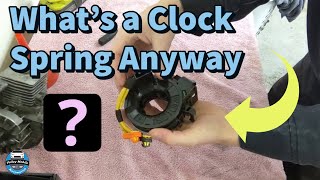
- Faulty Clock Spring (Spiral Cable) (Very Common) — The clock spring is a coiled ribbon of wires within the steering column that maintains electrical contact for the airbag, horn, and steering wheel controls while the wheel turns. Due to constant mechanical stress from steering, these delicate internal wires fracture over time, causing an open circuit. This is the most common cause of a B1054 code by a significant margin.
- Loose or Corroded Connectors (Common) — The SRS system uses distinctive yellow connectors. Key connection points—at the base of the steering column, under the driver's seat, and at the SRS module itself—loosen or accumulate moisture, leading to corrosion and high resistance.
- Low Battery Voltage / Recent Battery Disconnection (Common) — The SRS module is highly sensitive to voltage fluctuations. A dying car battery, a recent jump-start, or disconnecting the battery for service causes a temporary voltage drop, triggering a 'ghost' B1054 code in the system's memory even without a hardware fault.
- Damaged Wiring Harness (Less Common) — Wires in the steering column or dashboard leading to the SRS module pinch, chafe, or sever. This damage occurs during unrelated repairs (e.g., stereo installation, ignition switch replacement) or from age-related vibration.
- Faulty Driver's Airbag Module (Squib) (Less Common) — The internal detonator (squib) within the airbag module fails, creating an open circuit. While often mistakenly replaced first, this is far less common than a clock spring failure.
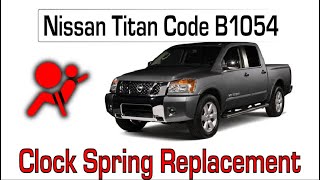
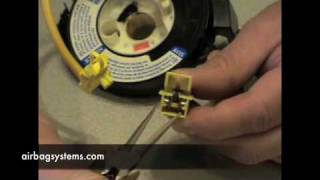
- Previous Incorrect Repair or Installation (Less Common) — If a clock spring is replaced incorrectly (e.g., not properly centered before installing the steering wheel), it breaks immediately upon turning the wheel lock-to-lock. 🎬 Watch: Step-by-step guide to replacing a clock spring correctly. Using poor-quality aftermarket parts also leads to persistent codes.
- Failed SRS Airbag Control Module (Rare) — The central computer for the airbag system fails internally. This typically occurs in vehicles with significant water damage, major electrical surges, or after a collision where crash data was not properly cleared.
- Poor SRS Module Ground Connection (Rare) — The SRS control module relies on a clean, tight ground connection to the vehicle chassis. A loose or corroded ground strap introduces high resistance, causing intermittent SRS codes including B1054.
Symptoms

- Solid or Flashing Airbag Warning Light — The primary indicator. The light on the instrument cluster confirms the SRS system detected a fault and is inactive.
- Horn Inoperative — Because the horn's electrical circuit passes through the clock spring, a non-functional horn strongly points directly to a failed clock spring.
- Steering Wheel-Mounted Controls Fail — Buttons for cruise control, radio volume, or phone functions stop working, as their wiring bundles with the airbag and horn circuits in the clock spring.
- Intermittent Airbag Light — In the early stages of a clock spring failure, the airbag light illuminates only during turns and turns off when driving straight as the broken wire makes and breaks contact.
- Scraping or Grinding Noise When Turning Steering Wheel — A physical clicking, rubbing, or grinding noise corresponding with steering wheel rotation indicates the internal clock spring has mechanically broken and is binding.
Diagnostic Flowchart
Tap your situation to follow the diagnostic path that matches what you're seeing on this code.
Common Fixes & Costs
- Replace Clock Spring (Spiral Cable)
— Parts: $30-$350, Labor: $150-$300, ~1.5 hr book time
(Intermediate)
: OEM B5567-CB66A (Alt: Dorman 525-034)
: OEM 93490-3X040 (Alt: Dorman 525-455)
: OEM FR3Z-14A664-A (Alt: Dorman 525-204)
: OEM 68050845AB (Alt: Dorman 525-130) - Clean or Re-seat SRS Connectors — Parts: $0-$15, Labor: $50-$150, ~0.5 hr book time (DIY)
- Replace Driver's Airbag Module — Parts: $250-$1200, Labor: $75-$150, ~1 hr book time (Professional)
- Repair Damaged Wiring Harness — Parts: $5-$25, Labor: $150-$400, ~2 hr book time (Professional)
- Replace/Reset SRS Control Module — Parts: $50-$1500, Labor: $100-$300, ~1.5 hr book time (Professional)
Used vs. New Parts: Buying Guide
When a used part is worth it: A used OEM clock spring from a low-mileage, accident-free donor vehicle is a cost-effective alternative to a new OEM part, especially for older vehicles.
Donor-vehicle mileage cap: roughly under 80000 miles for the part to have meaningful remaining life.
Donor quality checklist:
- Verify donor vehicle was not involved in a front-end collision.
- Match the part number exactly, including all suffixes.
- Ensure the used clock spring is 'centered' and locked for shipping to prevent damage.
Decision logic:
- If Vehicle is newer and under warranty or recall → Use new OEM parts from the dealer to ensure coverage.
- If Budget is the primary concern and the vehicle is older → A used OEM part from a reputable salvage yard is often better than a cheap aftermarket part of unknown quality.
- If The goal is maximum reliability and peace of mind → Buy a new OEM or high-quality aftermarket part from a reputable brand like Dorman or Standard Motor Products.
Warranty tradeoff: Used parts typically have a 30-90 day warranty. New aftermarket parts carry a 1-year to limited lifetime warranty. New OEM parts have a 1-year/12,000-mile warranty.
Worst-case if a used part fails: $150-$300 if a used or cheap new part fails shortly after installation, requiring repeat labor costs.
What Happens If You Wait — Timeline
- Immediately: The B1054 code sets, the airbag warning light illuminates, and the entire SRS system disables as a fail-safe. (MPG impact: 0%% · Added cost: $0, but the immediate safety risk is extreme.)
- 1-4 weeks: An intermittent fault (light on only during turns) becomes a 'hard' fault where the light stays on permanently as the internal clock spring wire breaks completely. (MPG impact: 0%% · Added cost: $0)
- 1-3 months: Other functions routed through the clock spring fail. The horn becomes intermittent or stops working entirely, and steering wheel controls fail. (MPG impact: 0%% · Added cost: Potential cost of an accident due to a non-functional horn.)
- At next state inspection: The vehicle fails mandatory safety inspections due to the illuminated airbag light, resulting in fines and inability to legally operate the vehicle. (MPG impact: 0%% · Added cost: $150-$400 in inspection/re-inspection fees and potential fines, on top of the eventual repair cost.)
Cost of Not Fixing It
- Immediately: Complete deactivation of the Supplemental Restraint System (SRS). No airbags deploy in a collision, dramatically increasing the risk of serious injury or death. (Added cost: N/A)
- During next state inspection: Guaranteed failure of safety inspections in many states. The vehicle becomes illegal to operate on public roads until repaired. (Added cost: Cost of re-inspection and potential fines.)
- Long-term (6+ months): Ignoring the light masks new, more severe SRS issues. A subsequent fault in another part of the system will not trigger a new warning.
Diagnosis Steps

- Confirm Active Codes with an SRS-Capable Scanner
Use an OBD-II scanner capable of reading SRS/airbag codes; generic engine readers will not work. Confirm B1054 is present and check for B1049, which often appears alongside it and confirms a clock spring failure.
Tools: SRS-capable OBD-II Scanner (Beginner) - Perform a Quick Functional Check
Test the horn and all steering wheel-mounted buttons. If any are non-functional, the clock spring is almost certainly the culprit.
Tools: None (Beginner) - Attempt to Clear the Code
If a low battery event recently occurred, use your scanner to clear the code. If it does not return after a few drive cycles, the issue was a temporary voltage glitch. If it returns immediately, a hard fault exists.
Tools: SRS-capable OBD-II Scanner (Beginner) - Visually Inspect Connectors
CRITICAL SAFETY WARNING: Disconnect the negative battery terminal and wait 15 minutes for backup capacitors to discharge. Inspect the yellow connectors at the base of the steering column and the SRS control module for looseness or green/white corrosion. Unplugging and firmly replugging them resolves poor connections.
Tools: Wrench, Flashlight (Intermediate) - Perform a Resistor Test (Pro Tip)
This definitive test isolates the fault. After disconnecting the battery and waiting 15 minutes, remove the driver's airbag. Insert a 2.0 to 3.3-ohm resistor into the vehicle-side harness connector (NOT the airbag). Reconnect the battery and clear codes. If B1054 disappears, the fault is in the clock spring or wiring. If it returns, the issue is the airbag module or SRS control module.
Tools: Trim removal tools, Socket set, 2.0-3.3 Ohm Resistor (Advanced) - Analyze Live SRS Data (Pro Tip)
Use an advanced scan tool to view live data from the SRS module. Look for 'Driver Airbag Resistance' or 'Squib 1 Resistance'. A normal reading is 1.5 to 3.5 ohms. A reading of 'OL', 'Open', or >10 ohms confirms an open circuit.
Tools: Advanced SRS Scan Tool (Advanced) - Test Clock Spring Continuity with a Multimeter
With the steering wheel and clock spring removed, use a multimeter set to Ohms. Check for continuity (<1 ohm) through each airbag circuit wire. Slowly rotate the clock spring lock-to-lock; any jump to infinite resistance ('OL') indicates a broken internal wire.
Tools: Multimeter, Socket set, Service Manual (Advanced) - Inspect SRS Module and Grounding Point
Locate the SRS control module (often under the center console). Inspect its connectors for damage or corrosion. Trace its ground wire to the chassis and ensure the connection is clean, rust-free, and tight.
Tools: Socket set, Trim removal tools (Professional)
When This Code Triggers (Freeze-Frame Conditions)
- System Voltage: 13.5-14.5V (Normal operating voltage; code sets on startup if voltage drops significantly.)
- Ignition Status: ON (The SRS module performs a self-test every time the ignition turns on.)
- Vehicle Speed: Variable (The fault detects at any speed, but intermittent faults often reveal during turns.)
- Steering Angle: Variable (For intermittent clock spring failures, the code sets when the steering wheel turns, breaking the internal wire's connection.)
Related Codes
- B1049 — Functionally a sibling code to B1054. It means 'Driver Air Bag Module, Open, #2'. Modern airbags use a two-stage deployment system. A single clock spring failure typically breaks both circuits, causing B1049 and B1054 to appear simultaneously.
- B0001 — The generic SAE equivalent of B1054, defined as 'Driver Frontal Stage 1 Deployment Control Circuit'. Manufacturers like GM and Ford use B0001 while Nissan uses B1054. The meaning and diagnostics are identical.
- B0074 — Code for 'Passenger Seat Occupant Classification Sensor Circuit A'. B1054 relates to the DRIVER'S side steering column components, while B0074 requires diagnosing the passenger seat sensor mat.
- P1564 — A Nissan-specific code for 'ASCD (Cruise Control) Steering Switch'. Seeing this alongside B1054/B1049 strongly confirms a failed clock spring, as cruise control signals are also lost.
Climate & Environmental Factors
- High Humidity / Moisture: Moisture penetrates SRS connectors or the control module, leading to corrosion. This increases circuit resistance and triggers a B1054 code.
- Extreme Cold: Cold temperatures cause metal contacts within SRS connectors to contract, creating a loose connection and an intermittent open circuit.
- Dusty Environments: Fine dust works into the clock spring assembly (especially on Jeep Wranglers), compromising internal electrical circuits and causing high resistance.
How to Talk to a Mechanic About This Code
Say this: "I have an airbag light on and my scanner shows code B1054. My horn and steering wheel buttons have also stopped working. I'd like to schedule a diagnostic focused on testing the clock spring first."
This signals you have done your research and identified the most probable cause. It directs the technician to the most efficient diagnostic path, preventing them from starting with less likely, expensive assumptions like a faulty airbag module.
Avoid saying:
- 'My airbag light is on, can you just fix it?'
- 'I think I need a new airbag.'
- 'Just do whatever it takes to turn the light off.'
Questions to ask before authorizing the repair:
- How did you confirm the clock spring was the point of failure? Did you perform a continuity or resistor test?
- Are there any other related SRS codes present in the system?
- Is the replacement part an OEM or aftermarket part, and what is the warranty?
Where to Take It: Dealer vs Independent vs Chain
- Dealer:
Best for: Vehicles under a known recall or warranty extension for the clock spring., Complex cases where prior repairs failed., Owners who prioritize guaranteed OEM parts.
Downsides: Highest labor rates, often 1.5-2x more than an independent shop., Less willing to install customer-supplied or used parts. (Typical cost: +75% vs. baseline) - Independent Shop:
Best overall fit for most out-of-warranty scenarios. A clock spring replacement is a common repair that any competent independent technician performs safely and effectively.
Best for: Most out-of-warranty vehicles., Straightforward clock spring replacements., Cost-conscious owners seeking a balance of expertise and value.
Downsides: Shop quality and experience with SRS systems varies widely., May lack the latest manufacturer-specific diagnostic software for very new models. (Typical cost: +0% vs. baseline) - Chain Shop:
AVOID. The safety-critical nature of the airbag system requires expertise not typically found at high-volume chain shops.
Best for: Not recommended for this repair.
Downsides: Technician skill level is highly variable., High pressure to upsell services., Lack of specific expertise in diagnosing safety-critical SRS components. (Typical cost: -10% vs. baseline)
When to Walk Away From the Repair
If the total estimated repair cost for the B1054 fault exceeds 40-50% of your car's current private-party market value, consider selling or trading in the vehicle as-is.
- Car worth $3500, fix is $550: Fix it. The repair cost is well below the threshold and restores a critical safety feature, preserving the vehicle's value.
- Car worth $4500, fix is $1400: Borderline. The fault is likely more than just a clock spring (e.g., airbag module). Get a second opinion before authorizing.
- Car worth $2500, fix is $1200: Walk away. The repair cost is nearly 50% of the car's value. It is not economically sensible to invest this much into an older, lower-value vehicle.
What Scan Tool You Need for This Code

Minimum: A scanner that specifically reads and clears codes from the Supplemental Restraint System (SRS) / Airbag module.
A standard $20 engine code reader only communicates with the Engine Control Unit (ECU) and is completely blind to the separate SRS computer module. You will see 'No Codes Found' while the airbag light remains on.
Budget: Autel AutoLink AL619 (~$70) — Reads and clears engine, ABS, and SRS (airbag) codes on most major vehicle makes. It successfully identifies the B1054 code and allows you to clear it after the repair.
Mid-range: BlueDriver Pro (~$120) — Connects to your smartphone via Bluetooth. It reads and clears SRS codes, provides access to a database of verified fixes, and displays live data for airbag circuit resistance on supported models.
Professional: Autel MaxiCOM MK808 / MK808BT (~$450-600) — A full-featured diagnostic tablet providing dealership-level access to all vehicle modules. It offers robust live data graphing to monitor airbag squib resistance and performs system-specific functions.
Rent vs buy: Buy. Free 'loan-a-tool' scanners from auto parts stores are almost always basic engine code readers that cannot access SRS modules.
How to Clear the Code After You Fix It
- Reconnect battery
- Use an SRS-capable OBD-II scan tool to erase the B1054 code.
- For some manufacturers (e.g., Nissan), a manual key-cycle procedure clears the light.
- Perform a system functional check (verify airbag light goes off after start-up self-test).
Drive cycle (~15 minutes): SRS codes do not require a complex drive cycle. After clearing the code, a simple cold start, idle, and short drive with several steering wheel turns confirms the fix. The airbag light should turn off after the initial self-check.
Readiness monitors affected: None. SRS system status does not directly affect emissions readiness monitors.
Watch out for:
- Using a generic OBD-II scanner that cannot access the SRS module.
- Not clearing the code after the repair; the light stays on even if the fault is fixed.
- Assuming a cheap aftermarket clock spring is functional out of the box when it may be defective.
Will This Fail Emissions / State Inspection?
Yes — this code typically fails an OBD-II emissions inspection.
- California: An illuminated airbag warning light causes an inspection failure. The Bureau of Automotive Repair requires all safety systems to be functional.
- New York: An illuminated airbag warning light causes a vehicle to fail the annual safety inspection.
- Texas: An airbag warning light is NOT an item on the Texas state inspection checklist and will not cause a failure.
- North Carolina: An illuminated airbag warning light will not cause a vehicle to fail the annual safety inspection.
Most Commonly Affected Vehicles
- Nissan Rogue, Xterra, Frontier, Titan, Qashqai, Sentra, Versa (2002-2020) — Extremely common across the Nissan lineup, almost always caused by clock spring failure and frequently accompanied by code B1049.
- Hyundai / Kia Elantra, Sonata, Optima, i40 (2011-2018) — A known weak point, clock spring failure is prevalent. Hyundai extended the warranty to 15 years/unlimited miles for this part on some 2011-2013 Elantra models.
- Ford Mustang, F-150 (2010-2020) — Common on S550 Mustangs (2015+) and F-150s. While the clock spring is a primary suspect, some Mustang cases trace to faulty wiring in the overhead console.
- Chevrolet / GMC Silverado, Sierra, S-10, C/K 1500 (1998-2007) — On these specific GM trucks, B1054 refers to a fault in the circuit for the passenger airbag ON/OFF indicator switch, not the driver's airbag module itself.
- Dodge / Chrysler / Jeep Grand Caravan, Town & Country, Wrangler (JK) (2008-2018) — The clock spring is a very frequent failure item. Symptoms almost always include loss of steering wheel controls and the ESC/traction control light illuminating.
- Subaru Impreza, Forester, Outback (2008-2016) — Often caused by clock spring failure. On some models, this code triggers from a fault in the passenger occupant detection system.
- Toyota Corolla, Camry, RAV4 (2007-2014) — Known as a 'spiral cable' failure in Toyota terminology. The failure often presents intermittently at first, with the light only appearing during turns.
- Chevrolet Cruze, Aveo, Lacetti (2005-2015) — On these global platforms, B1054 points to faults in the passenger airbag cutoff switch circuit or the driver's side circuit.
Manufacturer-Specific Notes
- Nissan/Infiniti: B1054 is almost a guaranteed clock spring failure. Some models have a manual reset procedure: turn ignition ON, wait for the airbag light to turn off and start blinking, then turn OFF. Repeat 3-4 times to clear the light.
- General Motors (Chevrolet, GMC, Buick): Many GM vehicles feature a 'self-healing' SRS system. If the fault is repaired, the airbag light often turns off after a few ignition cycles without requiring a scan tool.
- Hyundai/Kia: Hyundai issued a warranty extension (Campaign TXXC) covering the clock spring for 15 years/unlimited mileage for certain 2011-2013 Elantra models due to high failure rates.
- Dodge/Chrysler/Jeep: Multiple recalls exist for clock spring failures, including NHTSA recalls S40 (16V-288) and S33 (16V-290) for 2007-2016 Jeep Wranglers due to dust intrusion.
Real Owner Stories
2009 Nissan Rogue with ~150k miles
Airbag warning light was on, and the horn did not work. A scan revealed codes B1054 and B1049.
Outcome: The clock spring was replaced. After installation, the codes were cleared, the airbag light went off, and the horn function was restored.
Lesson: If the horn and/or steering wheel controls fail at the same time as the airbag light comes on, the clock spring is the almost certain cause.
2012 Hyundai Elantra with intermittent airbag light
The airbag light illuminated only when the steering wheel was turned sharply, then went off after driving straight.
Outcome: The dealer confirmed a failing clock spring. The repair was covered under an extended warranty (15 years/unlimited miles) that Hyundai issued for this specific part.
Lesson: An intermittent airbag light that appears only during turns is a classic symptom of a clock spring wire beginning to break. Always check with a dealer for warranty extensions.
2006 Chevrolet Silverado with B1054
The airbag light was on, and a scan showed code B1054.
Outcome: The front impact sensor was replaced, not the clock spring. After replacing the sensor and clearing the codes, the airbag light was resolved.
Lesson: Always verify the specific meaning of a code for your exact make, model, and year. Some manufacturers use B1054 for other components like impact sensors.
DIY Repair Gone Wrong
A car owner attempted to replace a faulty clock spring to save money but did not take proper precautions.
Outcome: The new clock spring was not centered correctly. On the first full turn of the steering wheel, the internal ribbon cable snapped, immediately breaking the brand-new part.
Lesson: When replacing a clock spring, it is absolutely critical to ensure it is centered and locked according to the manufacturer's instructions before reinstalling the steering wheel.
How to Prevent This Code From Triggering
- Maintain stable battery voltage (Ongoing) — The SRS module is sensitive to low voltage. A healthy battery prevents glitches that set 'ghost' codes.
- Apply dielectric grease to accessible SRS connectors (During other repairs) — Applying dielectric grease to the seals of SRS connectors prevents moisture intrusion and corrosion. Do not pack the pins themselves.
- Exercise caution during steering column repairs (When performing related service) — When the steering wheel or linkage is removed, the clock spring easily over-rotates and destroys itself. Always secure the steering wheel with tape.
- Follow proper SRS safety procedures (Any time working near SRS components) — Always disconnect the negative battery terminal and wait 15 minutes for capacitors to discharge before unplugging yellow SRS connectors.
Frequently Asked Questions
Is it safe to drive with code B1054?
No. The vehicle will drive, but the entire airbag system is disabled. In a crash, no airbags will deploy, and seatbelt pretensioners may not activate, creating a significant safety risk.
I replaced the clock spring but the B1054 light is still on. What's next?
First, clear the code with an SRS-capable scan tool, as it rarely resets automatically. If it returns immediately, verify the new clock spring was centered correctly during installation and check all connector seating. Finally, perform a resistor test to rule out a faulty airbag module.
My horn and steering wheel buttons work perfectly. Can it still be the clock spring?
Yes. The clock spring contains multiple separate wire circuits. It is possible for only the airbag circuit to break while the others remain intact.
What is the most common misdiagnosis for B1054?
The most frequent and expensive mistake is replacing the driver's airbag module without first testing the clock spring. The clock spring is a wear-and-tear part that fails at a much higher rate than the solid-state airbag module. Always diagnose thoroughly before replacing the airbag.
Why did my airbag light turn on right after my battery died or was replaced?
Low system voltage during a battery failure or replacement causes a communication glitch in the sensitive SRS module, storing a 'ghost' code. Try clearing the code with a proper scan tool first. If it does not return, no repair is needed.
Can I use a used airbag or clock spring from a junkyard?
Using a used clock spring is acceptable if sourced reputably, though it remains a wear item. However, using a used airbag module is highly discouraged unless from a certified recycler with a known, accident-free history. New OEM parts are always the safest bet for the airbag module itself.
What does it mean if the code is 'past' or 'history' instead of 'current'?
A 'past' or 'history' code indicates the fault was detected previously but is not currently active, often due to an intermittent connection or past low-voltage event. If the light remains on, the system is failing its self-test and the fault requires active diagnosis.
Key Takeaways
- Code B1054 disables the entire SRS system, meaning no airbags will deploy in a crash.
- A failed clock spring causes over 90% of B1054 codes; a simultaneously dead horn or broken steering wheel buttons confirms this diagnosis.
- Never replace the $250+ airbag module without first using a 2.0-3.3 ohm resistor test to definitively isolate the fault to the clock spring.
- Always disconnect the negative battery terminal and wait 15 minutes before touching any yellow SRS connectors to prevent accidental airbag deployment.
- You must use an SRS-capable OBD-II scanner to clear the B1054 code from the module's memory after repair, as the light will not turn off automatically.
Helpful Videos


The information in this article is provided for general reference and educational purposes only. Vehicle specifications, procedures, and part compatibility can vary by production date, trim level, and region. Always consult your vehicle's factory service manual and verify part numbers before purchasing or performing repairs. Safety-critical components such as airbags, seat belts, and braking systems should be installed by a qualified professional.
- 🎬 Helpful Videos
- What Does B1054 Mean?
- Can I Drive With B1054?
- Common Causes
- Symptoms
- Diagnostic Flowchart
- Common Fixes & Costs
- Used vs. New Parts: Buying Guide
- What Happens If You Wait — Timeline
- Cost of Not Fixing It
- Diagnosis Steps
- When This Code Triggers (Freeze-Frame Conditions)
- Related Codes
- Climate & Environmental Factors
- How to Talk to a Mechanic About This Code
- Where to Take It: Dealer vs Independent vs Chain
- When to Walk Away From the Repair
- What Scan Tool You Need for This Code
- How to Clear the Code After You Fix It
- Will This Fail Emissions / State Inspection?
- Most Commonly Affected Vehicles
- Manufacturer-Specific Notes
- Real Owner Stories
- 2009 Nissan Rogue with ~150k miles
- 2012 Hyundai Elantra with intermittent airbag light
- 2006 Chevrolet Silverado with B1054
- DIY Repair Gone Wrong
- How to Prevent This Code From Triggering
- Frequently Asked Questions
- Is it safe to drive with code B1054?
- I replaced the clock spring but the B1054 light is still on. What's next?
- My horn and steering wheel buttons work perfectly. Can it still be the clock spring?
- What is the most common misdiagnosis for B1054?
- Why did my airbag light turn on right after my battery died or was replaced?
- Can I use a used airbag or clock spring from a junkyard?
- What does it mean if the code is 'past' or 'history' instead of 'current'?
- Key Takeaways
- 🎟️ Get 5% Off