

OBD-II Code B1036: Comprehensive Guide to Airbag, Sensor & Circuit Faults
What B1036 means, why it triggers, and how to fix it on your specific vehicle
- Code B1036 disables your vehicle's airbags, increasing fatality risk in a crash, and requires immediate repair.
- A failed clockspring is the leading cause of B1036, confirmed if your horn and steering wheel buttons fail simultaneously with the airbag light.
- Diagnosis requires an advanced OBD-II scanner capable of reading Body (B) codes; a standard $20 engine code reader cannot communicate with the SRS module.
- Never touch airbag components without first disconnecting the negative battery terminal and waiting 15 minutes for the backup capacitors to fully discharge.
What Does B1036 Mean?

The B1036 code means the Restraints Control Module (RCM) or Supplemental Restraint System (SRS) module detects an electrical fault in a related circuit. It usually indicates an open circuit (broken wire) or a short to voltage in a safety component like an airbag, crash sensor, or clockspring. On some vehicles (Ford, Suzuki), it refers to non-safety items like a heated seat or audio system. This fault disables the affected system until repaired.
Technical definition: The SAE/ISO definition for B1036 is highly manufacturer-specific. Common definitions include 'Driver/Left Front Airbag Deployment Squib Circuit Open', 'Discriminating Sensor Open or Short to Voltage' (GM), 'Right Front Seat Heater Element Circuit Short To Battery or Open' (Ford), or 'IG1 Power Supply Circuit Malfunction' (Honda). An advanced scanner is required to read the exact definition and suffix codes (e.g., B1036:15).
Can I Drive With B1036?
No — Do Not Drive. No. An illuminated airbag warning light means the Supplemental Restraint System (SRS) is disabled. In a crash, your airbags will not deploy. Driving without airbags significantly increases fatality risk in severe frontal collisions. Limit driving strictly to reaching a repair shop.
Common Causes

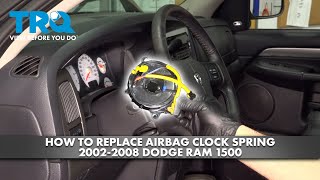
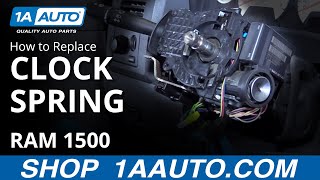
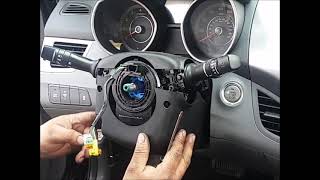
- Faulty Clockspring (Very Common) — The clockspring is a rotary electrical connector in the steering column. Its internal ribbon cables break from the stress of repeated turning, causing an open circuit. This is a leading cause on Ram, Hyundai, and Kia vehicles. 🎬 Watch: Step-by-step clockspring replacement for Dodge Ram trucks.
- Damaged Wiring or Loose Connectors (Common) — Wiring harnesses for SRS components route under seats, through door jambs, and in the front bumper. They suffer damage from corrosion, chafing, or stretching. Yellow connectors under front seats are frequently kicked loose.
- Failed Front Crash/Discriminating Sensor (Common) — On GM and Nissan vehicles, this code points to a front impact sensor on the radiator support or front bumper. Exposure to road salt and moisture causes internal corrosion and failure.
- Failed Passenger Seat Heater Circuit (Ford) (Common) — On 2015-2020 Ford F-150s, an undersized ground pin in the Seat Control Module (SCME) connector overheats, melts the housing, and creates an open circuit. It also indicates a broken wire inside the seat heater element pad.
- Low Vehicle/System Voltage (Less Common) — A weak battery causes voltage drops during startup. The sensitive SRS module interprets this as a fault, setting a B1036 code. It indicates an underlying battery or charging system issue.
- Defective Airbag Module or Occupant Sensor (Less Common) — The internal wiring of an airbag squib (initiator) can fail, creating an open circuit. Alternatively, liquid spills damage the Occupant Detection System (ODS) weight sensors in the passenger seat cushion.
- Faulty Restraints Control Module (RCM/SRS) (Rare) — The main control module monitoring the airbag system fails internally. Consider this only after exhausting all wiring and component tests.
Symptoms

- Airbag Warning Light On — The light remains illuminated as long as the electrical fault is present, indicating the airbag system is disabled. Often accompanied by a 'Service Airbag' message.
- Horn, Cruise, or Steering Wheel Controls Inoperative — If the clockspring fails, the electrical connection to the horn and steering wheel buttons breaks simultaneously with the airbag circuit.
- Passenger Heated/Cooled Seat Not Working — For specific Ford models where B1036 relates to the seat system, the passenger climate seat functions fail.
- Intermittent Airbag Light — The airbag light flickers when hitting bumps or turning the steering wheel, pointing to a chafed wire or a failing clockspring making and breaking contact.
Diagnostic Flowchart
Tap your situation to follow the diagnostic path that matches what you're seeing on this code.
Common Fixes & Costs
- Replace Clockspring — Parts: $80-$300, Labor: $150-$300, ~1.5 hr book time (Intermediate)
- Replace Front Impact/Discriminating Sensor — Parts: $120-$260, Labor: $100-$200, ~1.0 hr book time (DIY)
- Repair Wiring or Connector (e.g., SCME connector) — Parts: $10-$70, Labor: $150-$400, ~2.0 hr book time (Intermediate)
- Replace Seat Heater Element/Pad — Parts: $100-$250, Labor: $210-$310, ~2.5 hr book time (Advanced)
- Replace Airbag Control Module (SRS/RCM) — Parts: $400-$1200, Labor: $150-$350, ~1.5 hr book time (Professional)
Used vs. New Parts: Buying Guide
When a used part is worth it: For non-airbag components like seat heater elements on older vehicles, a used part from a reputable recycler is cost-effective. For safety-critical components like airbag modules or sensors, buy new OEM parts exclusively.
Donor-vehicle mileage cap: roughly under 100000 miles for the part to have meaningful remaining life.
Donor quality checklist:
- Verify the part number matches exactly.
- For clocksprings, ensure the donor vehicle avoided frontal collisions and the part is centered and locked.
- Avoid parts with corrosion, cut wires, or damaged connectors.
- Purchase airbag modules only from certified recyclers guaranteeing non-deployment.
Decision logic:
- If The part is an airbag, crash sensor, or control module → Buy new OEM. The safety risk of a malfunctioning used part is too high.
- If The part is a clockspring or seat heater and the vehicle is >10 years old → A used OEM part from a low-mileage, non-crashed donor is acceptable. New aftermarket is also viable.
- If A recall or warranty extension exists (e.g., Hyundai/Kia clockspring) → Always use the dealer for a free OEM replacement.
Warranty tradeoff: Used parts have a 30-90 day warranty covering only the part. New aftermarket parts carry 1-year to lifetime warranties. New OEM parts have a 1-2 year warranty honored by dealers.
Worst-case if a used part fails: $300-$800 if a used part fails, covering repeat labor and a replacement part.
What Happens If You Wait — Timeline
- Immediately: Airbag warning light illuminates. The SRS is disabled as a fail-safe. Airbags will not deploy in a collision. (MPG impact: 0%% · Added cost: $0 (Safety risk is the primary cost))
- 1-3 months: Intermittent faults become permanent, making diagnosis harder as the triggering event is no longer obvious. (MPG impact: 0%% · Added cost: $0 - $50)
- 3-12 months: A corroded sensor pin breaks off inside the connector, or a chafed wire shorts to ground, damaging the SRS control module. (MPG impact: 0%% · Added cost: $200 - $1,500)
- 12+ months: Guaranteed safety inspection failure. Insurance claims face denial due to willful neglect of a safety system. Resale value plummets. (MPG impact: 0%% · Added cost: Potential legal liability and thousands in diminished vehicle value.)
Cost of Not Fixing It
- Immediately: The airbag system is disabled. Airbags will not deploy in a crash, significantly increasing the risk of serious injury or fatality. (Added cost: N/A (Safety Risk))
- 1-6 months: An intermittent wiring issue worsens over time, escalating a minor connector repair into a full harness replacement. (Added cost: $200-$1000)
- 6+ months: Continued driving with a safety defect guarantees failure during state safety inspections, leading to fines or registration denial. (Added cost: Potential fines and diminished vehicle value.)
Diagnosis Steps

- Read the Full Manufacturer-Specific DTC
Use an advanced OBD-II scanner capable of reading Body (B) codes and communicating with the SRS module. Record the full code and its manufacturer-specific definition (e.g., 'Ford B1036-15'). This dictates the entire diagnostic path.
Tools: Advanced OBD-II Scanner (with SRS capability) (Beginner) - Test Related Functions
Check if the horn and steering wheel-mounted controls work. If they are inoperative alongside the airbag light, a faulty clockspring is the definitive cause.
Tools: None (Beginner) - SAFETY FIRST: Disconnect the Battery and Wait
Before touching any SRS components, disconnect the negative battery terminal and wait 15 minutes. This allows backup power capacitors to discharge, preventing accidental airbag deployment.
Tools: Wrench Set (Beginner) - Perform a Thorough Visual Inspection
Inspect the relevant area based on the code definition. Look for damaged yellow wiring harnesses under seats, in the steering column, and near the front bumper. For Ford seat heater faults, inspect the SCME module connector under the passenger seat for burnt pins.
Tools: Flashlight (Beginner) - Inspect and Reseat Connectors
Unplug and inspect the primary connectors for the identified component. Look for bent, corroded, or backed-out pins. Re-seat the connector firmly to ensure a solid connection.
Tools: None (Intermediate) - Test Component Resistance
Measure the resistance of the suspected component. A GM discriminating sensor should read under 1050 ohms. A reading of 'OL' (Open Loop) indicates a broken internal wire, confirming the component requires replacement.
Tools: Digital Multimeter, Vehicle-specific wiring diagram (Advanced) - Check for Voltage and Ground at the Connector
Determine if the problem is the component or the wiring. Back-probe the connector to verify it receives 12V from the module when activated. No voltage points to a wiring or module issue.
Tools: Digital Multimeter, Back-probe kit, Vehicle-specific wiring diagram (Advanced) - Isolate the Fault with a Resistor
Substitute the component with a 2.0-2.5 ohm SRS test resistor. Reconnect the battery and clear codes. If the code stays away, the component is faulty. If it returns, the fault is in the wiring harness.
Tools: SRS Test Resistor Set, Advanced OBD-II Scanner (Professional)
When This Code Triggers (Freeze-Frame Conditions)
- System State: Key-On Self-Test (The SRS module performs a 6-second self-check at ignition. A fault detected during this check causes the light to remain on immediately.)
- Component Monitored: Continuous (The control module continuously monitors resistance and voltage of critical circuits. An open or short circuit detected during operation sets the code instantly.)
- Vehicle Voltage: 9-16 Volts (The SRS module monitors its power supply. A code triggers if system voltage drops too low during engine cranking or spikes due to a charging fault.)
- Dynamic Event: Varies (Intermittent faults trigger under specific conditions: turning the steering wheel (stressing the clockspring) or hitting a bump (jarring a loose connector).)
Related Codes
- B1037 — A companion code indicating a fault in the same circuit but of a different type (e.g., 'Circuit Short to Ground' instead of 'Circuit Open'). Diagnosed together.
- B0001 — A generic SAE code for a 'Driver Frontal Stage 1 Deployment Control' fault. If present with B1036, it points strongly to the driver's airbag circuit (clockspring or squib).
- B1034 — Specific to Ford, indicating a fault with the DRIVER's seat heater element. Seeing B1034 and B1036 simultaneously means both seat heaters failed or the shared control module is faulty.
Climate & Environmental Factors
- Road Salt / Humidity: Front crash sensors mounted low on the radiator support (GM/Nissan) fail primarily due to winter road salt. Salt and water penetrate the housing, causing internal corrosion and triggering the fault.
- Temperature Fluctuation: Thermal expansion in failing sensors or corroded connectors causes electrical connections to become unstable, leading to intermittent airbag lights during warmer weather.
How to Talk to a Mechanic About This Code
Say this: "I have an airbag warning light on in my [Year, Make, Model]. I scanned it and it shows code B1036. I know this code varies by manufacturer, so I'd like to schedule a diagnostic appointment. I've also noticed [mention secondary symptoms like 'the horn isn't working']."
This provides the mechanic with the specific code and crucial secondary symptoms, focusing their efforts and reducing diagnostic time.
Avoid saying:
- 'My airbag light is on, can you fix it?' (Too vague)
- 'Just replace the part for the B1036 code.' (Leads to replacing good parts if wiring is the issue)
- 'I'm not sure what's wrong, just do whatever it takes.' (Invites unnecessary repairs)
Questions to ask before authorizing the repair:
- What does code B1036 mean for my specific vehicle?
- Did you test the component itself, or just the circuit?
- Is the issue a bad wire or connector that can be repaired instead of replacing the whole component?
- Is the replacement part new OEM, aftermarket, or used?
Where to Take It: Dealer vs Independent vs Chain
- Dealer:
Recommended. The safety-critical nature of the SRS system and high variability of B1036 make the dealer's specialized knowledge advantageous.
Best for: Vehicles under warranty or with a potential recall/warranty extension., Complex, manufacturer-specific faults., Repairs requiring proprietary software for programming a new control module.
Downsides: Highest labor rates., Inclined to replace entire assemblies rather than repair individual wires. (Typical cost: +50% vs. baseline) - Independent Shop:
Good alternative. A reputable independent shop with electrical and SRS experience is excellent for straightforward B1036 causes.
Best for: Out-of-warranty vehicles with well-known failures (e.g., Ram clockspring)., Owners seeking lower labor costs.
Downsides: Quality varies; ensure the shop is ASE certified with SRS diagnostic experience., May lack brand-specific diagnostic tools for module programming. (Typical cost: +0% vs. baseline) - Chain Shop:
Not recommended. Airbag system diagnosis requires specialization beyond the scope of typical chain shops.
Best for: Simple maintenance like oil changes or tires.
Downsides: Technician skill with complex electronics is inconsistent., Business model incentivizes upselling parts over detailed circuit diagnostics. (Typical cost: -10% vs. baseline)
When to Walk Away From the Repair
If the estimated repair cost for the airbag system exceeds 40-50% of your car's private-party value, seriously consider selling or trading in the vehicle.
- Car worth $5000, fix is $2200: Borderline. This repair is 44% of the car's value. Get a second opinion and evaluate overall health.
- Car worth $15000, fix is $800: Fix it. The repair cost is a small fraction of the car's value and restores a critical safety feature.
- Car worth $3000, fix is $1800: Walk away. The repair cost is 60% of the vehicle's value. It is not economically sensible.
What Scan Tool You Need for This Code

Minimum: A scanner that reads and clears Supplemental Restraint System (SRS) / Airbag codes.
A standard $20 OBD-II reader only sees 'P' (powertrain) codes. It cannot communicate with the SRS module to read or clear B-codes like B1036.
Budget: BlueDriver Pro or Foxwell NT301 (~$70-120) — Reads and clears SRS codes, providing the manufacturer definition of B1036 and resetting the light after repair.
Mid-range: Foxwell NT604 Elite or Innova 5610 (~$140-320) — Offers full-system scanning and limited bidirectional controls to test component functionality.
Professional: Autel MaxiCOM MK808 / XTOOL D7 (~$450-700) — Provides full bidirectional control to command modules directly, isolating wiring faults from component failures.
Rent vs buy: Auto parts stores do NOT rent SRS-capable scanners due to liability. Buying a budget scanner pays for itself by avoiding one diagnostic fee.
How to Clear the Code After You Fix It
- Ensure all components are correctly installed and connected.
- Reconnect the negative battery terminal.
- Use an OBD-II scan tool with SRS capabilities to access the airbag module.
- Select the function to clear/erase Diagnostic Trouble Codes (DTCs).
- Cycle the ignition off, then on. The airbag light should illuminate for a 6-second self-test and then turn off permanently.
Drive cycle (~10 minutes): An extensive drive cycle is not required. The SRS system performs a complete self-test at startup. A short drive involving turns in both directions confirms clockspring repairs function correctly under normal operation.
Readiness monitors affected: None. SRS systems do not use emissions readiness monitors.
Watch out for:
- Using a basic engine code reader that cannot communicate with the SRS module.
- Attempting to clear the code without fixing the electrical fault; the code returns immediately.
- Believing disconnecting the battery clears a hard SRS fault code (it does not).
Will This Fail Emissions / State Inspection?
No — by itself this code doesn't fail OBD inspection (but it can keep readiness monitors from setting, which causes a separate fail).
- California: An illuminated airbag light causes failure of the mandatory vehicle safety systems inspection required for revived salvage vehicles, preventing registration.
- New York: An illuminated airbag warning light is an advisory item and not official grounds for rejection during the annual safety inspection, though shops strongly recommend repair.
- Texas: An illuminated airbag light does not cause a safety inspection failure. Safety inspections are being eliminated for most non-commercial vehicles in 2025.
- Virginia, Pennsylvania, Vermont: In states with strict annual safety inspections, an illuminated airbag warning light is an automatic failure.
Most Commonly Affected Vehicles
- Ford F-150 (2015-2020) — Extremely prone to B1036:15 for a failed passenger seat heater element, caused by a burnt ground pin in the SCME connector under the passenger seat.
- Chevrolet / GMC Blazer, S-10, Jimmy (1998-2005) — Commonly sets B1036 for a corroded front discriminating sensor. Diagnosis involves checking resistance across the sensor terminals (<1050 ohms).
- Honda Accord, Civic (2008-2012) — Indicates an 'IG1 Power Supply Circuit Malfunction' related to the gauge control module or under-dash fuse box, not an airbag sensor. Check the 7.5A fuse.
- Ram 1500, 2500 (2009-2018) — Widely known for clockspring failures triggering airbag circuit codes. Symptoms include the airbag light plus an inoperative horn and steering wheel controls.
- Nissan Pathfinder, Frontier, Xterra (2005-2009) — Front crash zone sensors corrode due to road salt exposure. This was subject to a voluntary safety recall in 'Salt Belt' states.
- Hyundai / Kia Elantra, Sonata, Sorento (2011-2014) — Subject to a warranty extension (Campaign TXXC/TXXA) for the clockspring assembly to 15 years/unlimited mileage. Dealers replace it for free.
- Subaru Outback, Legacy (2005-2009) — Points to a failure in the Occupant Detection System (ODS) in the passenger seat. Recalibration with a dealer tool is required after replacement.
Manufacturer-Specific Notes
- Ford: Uses B1036 to indicate a fault in the passenger seat heater element circuit, not the airbag system. Suffixes specify 'Short to Battery or Open' (:15) or 'Short to Ground' (:11).
- General Motors (Chevrolet/GMC): Defines B1036 as 'Discriminating Sensor Open or Short to Voltage,' pointing to front crash sensors near the radiator.
- Honda: Defines B1036 as an 'IG1 Power Supply Circuit Malfunction' related to the gauge cluster and under-dash fuse box, completely unrelated to airbags.
- Nissan: Issued multiple recalls and warranty extensions for sensors triggering airbag faults, specifically targeting front crash sensor corrosion in 'Salt Belt' states.
Real Owner Stories
2017 Ford F-150 XLT at 75K miles
Passenger heated seat stopped working, triggering code B1036:15. The control light illuminated but produced no heat.
What they tried:
- Checked fuses, which were all good.
- Visually inspected the Seat Control Module (SCME) connector under the passenger seat.
Outcome: Discovered the ground pin on the main SCME connector was burnt and melted the plastic housing. Repaired by purchasing a new connector pigtail and moving the ground wire to an unused pin location. Total cost was under $50 for parts.
Lesson: On modern F-150s, B1036 points to the passenger seat heater. Always inspect the SCME connector under the passenger seat for the common burnt ground pin before replacing the expensive heating element.
2012 Ram 1500 at 110K miles
Airbag light came on suddenly. The horn, cruise control, and radio volume buttons on the steering wheel stopped working.
What they tried:
- Tried disconnecting the battery to reset the light, which failed.
- Used an advanced scanner to pull code B1036, indicating an open circuit in the driver's airbag squib.
Outcome: The combination of symptoms confirmed a clockspring failure. Replaced the clockspring with an OEM Mopar part in 2 hours, immediately solving the issue.
Lesson: If the airbag light appears alongside failed steering wheel electrical functions, the clockspring is the definitive cause. This saves diagnostic time and prevents unnecessary part replacements.
1998 Chevy S-10 Blazer at 150K miles
Intermittent airbag light flickered when hitting bumps. A mechanic pulled code B1036 for the right front discriminating sensor.
What they tried:
- Cleaned connectors for both front impact sensors with electrical contact cleaner, but the light returned.
- Considered replacing the $260 sensor.
Outcome: Thoroughly inspected the wiring harness and found a chafed wire making intermittent contact with the frame. Repairing the wire with solder and heat shrink permanently fixed the problem without replacing the sensor.
Lesson: For intermittent 'open circuit' codes on exposed components, suspect the wiring first. Wiggling the harness while observing the light pinpoints wire breaks and saves money.
2011 Hyundai Elantra at 95K miles
Airbag light illuminated. Horn and steering wheel controls stopped functioning.
What they tried:
- Received a $450 quote from an independent mechanic for a failed clockspring.
Outcome: Discovered a Hyundai warranty extension for the clockspring to 15 years/unlimited miles. A dealer confirmed the diagnosis and replaced the clockspring for free.
Lesson: Always check for active warranty extensions before paying for a clockspring repair on a Hyundai or Kia. Many failures from the early 2010s are covered.
How to Prevent This Code From Triggering
- Apply Dielectric Grease to Sensor Connectors (Every 3-5 years) — Applying non-conductive dielectric grease to front crash sensor connectors blocks moisture and road salt, preventing corrosion.
- Be Mindful of Under-Seat Wiring (Daily habit) — Avoid storing loose items under front seats that snag or disconnect yellow SRS wiring harnesses.
- Avoid Aggressive Steering to Full Lock (Daily habit) — Forcefully turning the steering wheel to its absolute limit stresses the internal ribbon cable, accelerating clockspring wear.
- Maintain Vehicle Battery Health (Annually) — A fully charged battery prevents low-voltage situations during startup that trigger spurious SRS fault codes.
- Proactively Modify the SCME Ground (F-150s) (Once) — Adding a redundant ground wire to an adjacent empty pin slot distributes the electrical load, preventing the undersized pin from melting the connector.
Frequently Asked Questions
Can I reset the airbag light myself by disconnecting the battery?
No. Disconnecting the battery will not reset a hard fault in the SRS module. The airbag system stores fault codes in non-volatile memory, meaning they persist even without power. The light reappears instantly until you repair the underlying electrical fault.
What is a common misdiagnosis for code B1036?
On GM vehicles, mechanics often mistakenly replace the front crash sensor without testing the wiring. The actual fault is frequently a broken or corroded wire right at the connector pigtail. Always test the wiring for continuity and resistance before buying expensive parts.
My horn and radio buttons stopped working when the airbag light came on. Are these related?
Yes, this is a definitive symptom of a failed clockspring. The clockspring is the common electrical link for all steering wheel components. When its internal ribbon cable breaks, the airbag, horn, and radio controls lose connection simultaneously.
Is it safe to work on my own airbag system?
It is extremely dangerous if you ignore proper safety procedures. You must disconnect the negative battery terminal and wait 15-30 minutes for the backup capacitors to discharge before touching SRS components. Failure to do so causes accidental deployment and serious injury.
Will a B1036 code cause my car to fail a safety inspection?
Yes. In virtually all regions with vehicle safety inspections, an illuminated airbag warning light is an automatic failure. The vehicle is legally considered unsafe to operate.
Can a low battery or a bad ground cause the B1036 code?
Yes. The SRS module is highly sensitive to voltage drops during engine cranking, which it logs as a fault. A poor ground connection for the SRS module itself also causes unpredictable codes, including B1036.
The code says 'Circuit Open.' What does that mean?
An 'open' circuit means there is a physical break in the electrical path, preventing electricity from reaching the component. This is caused by a broken wire, disconnected plug, corroded terminal, or an internal component failure like a snapped clockspring cable.
Key Takeaways
- Code B1036 disables your vehicle's airbags, increasing fatality risk in a crash, and requires immediate repair.
- A failed clockspring is the leading cause of B1036, confirmed if your horn and steering wheel buttons fail simultaneously with the airbag light.
- Diagnosis requires an advanced OBD-II scanner capable of reading Body (B) codes; a standard $20 engine code reader cannot communicate with the SRS module.
- Never touch airbag components without first disconnecting the negative battery terminal and waiting 15 minutes for the backup capacitors to fully discharge.
Helpful Videos


The information in this article is provided for general reference and educational purposes only. Vehicle specifications, procedures, and part compatibility can vary by production date, trim level, and region. Always consult your vehicle's factory service manual and verify part numbers before purchasing or performing repairs. Safety-critical components such as airbags, seat belts, and braking systems should be installed by a qualified professional.
- 🎬 Helpful Videos
- What Does B1036 Mean?
- Can I Drive With B1036?
- Common Causes
- Symptoms
- Diagnostic Flowchart
- Common Fixes & Costs
- Used vs. New Parts: Buying Guide
- What Happens If You Wait — Timeline
- Cost of Not Fixing It
- Diagnosis Steps
- When This Code Triggers (Freeze-Frame Conditions)
- Related Codes
- Climate & Environmental Factors
- How to Talk to a Mechanic About This Code
- Where to Take It: Dealer vs Independent vs Chain
- When to Walk Away From the Repair
- What Scan Tool You Need for This Code
- How to Clear the Code After You Fix It
- Will This Fail Emissions / State Inspection?
- Most Commonly Affected Vehicles
- Manufacturer-Specific Notes
- Real Owner Stories
- 2017 Ford F-150 XLT at 75K miles
- 2012 Ram 1500 at 110K miles
- 1998 Chevy S-10 Blazer at 150K miles
- 2011 Hyundai Elantra at 95K miles
- How to Prevent This Code From Triggering
- Frequently Asked Questions
- Can I reset the airbag light myself by disconnecting the battery?
- What is a common misdiagnosis for code B1036?
- My horn and radio buttons stopped working when the airbag light came on. Are these related?
- Is it safe to work on my own airbag system?
- Will a B1036 code cause my car to fail a safety inspection?
- Can a low battery or a bad ground cause the B1036 code?
- The code says 'Circuit Open.' What does that mean?
- Key Takeaways
- 🎟️ Get 5% Off