

B1000 on 2008-2015 Audi A4: Airbag Igniter Fault Causes and Fixes
On a 2008-2015 Audi A4, code B1000 (often with a suffix like 1B or 11) almost always points to a faulty clock spring in the steering column, causing high resistance in the driver's airbag circuit. Expect to pay $400-$600 for a new OEM clock spring, with DIY replacement being moderately difficult for experienced individuals. The new module requires coding to the vehicle after installation.
- B1000 on an Audi A4 is not a generic code; it almost always specifies a fault in the driver's airbag igniter circuit, with B10001B 'Resistance Too High' being the most common variant.
- The most common cause is a failed clock spring within the steering column control module, which will also likely disable the horn and steering wheel buttons.
- This is a critical safety issue. The driver's airbag will not deploy in a crash while this fault is active.
- Replacement is complex: due to the risk of accidental airbag deployment and the need for electronic coding and calibration, this repair is best left to professional technicians or highly experienced DIYers with VAG-specific scan tools.
- Always use a VAG-specific scan tool to get the full fault code (e.g., B10001B) for an accurate diagnosis.
What's Unique About the 2008-2015 Audi A4
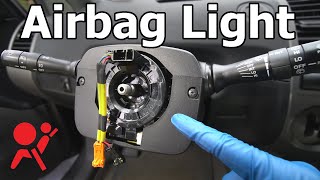
Unlike many vehicles where B1000 can mean a generic ECU failure, on the B8 Audi A4 and related VAG platforms, it's a very specific code pointing to the airbag igniter circuit. The most common failure point is not the airbag or the control module, but the 'clock spring' (also called a squib or slip ring) in the steering column control module (J527). This part contains thin ribbon cables that break from the stress of the steering wheel turning over many years, causing the 'Resistance Too High' fault that is so common on these models. The clock spring is integrated with the steering angle sensor and control stalks, making it a complex module.
Symptoms You May Notice
- Solid airbag warning light on the instrument cluster.
- Horn may stop working.
- Steering wheel-mounted buttons (for radio, phone, etc.) may become inoperative.
- Stability Control (ESC/ESP) or other system warning lights may appear, as the clock spring assembly contains the steering angle sensor (G85).
- Replacing the driver's airbag module when the fault is in the clock spring.
- Replacing the Airbag Control Module when the fault is in the wiring or clock spring.
Most Likely Causes
- Faulty Clock Spring (Squib) 🔴 High Probability The clock spring is part of the Steering Column Control Module (J527) and contains flexible ribbon cables that allow the steering wheel to turn. Over time, these cables fatigue and break from millions of rotations, causing an open circuit or high resistance.
How to confirm: Scan the airbag module (Address 15 on VCDS). If code B10001B ('Resistance Too High') is present, 🎬 Watch this step-by-step B10001B diagnosis and repair tutorial. and other functions like the horn or steering wheel controls are also failing, the clock spring is the most likely culprit. A technician can also measure resistance through the clock spring's pins, which will show an open circuit (infinite resistance) if it has failed. A good circuit should have very low resistance, under 1 ohm.
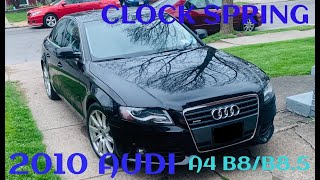
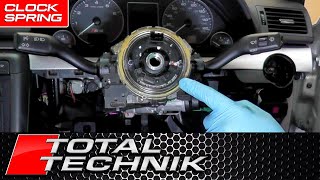
Typical fix: Replace the clock spring/steering column control module assembly located behind the steering wheel. 🎬 See this Audi B8 clock spring replacement walkthrough. The new module must be coded to the car, and the steering angle sensor (G85) must be calibrated.
Est. part cost: $400-$600 - Wiring or Connector Issue 🟡 Medium Probability The yellow airbag connectors, particularly under the driver's seat or at the base of the steering column, can become loose or corroded over time, increasing resistance in the circuit. Aggressively moving the seats can sometimes dislodge the under-seat connector.
How to confirm: Visually inspect all accessible airbag wiring and connectors for damage, corrosion, or looseness. Disconnect and reconnect the main connectors (with the battery disconnected) to ensure a solid connection. A loose connector under the driver's seat is a known, though less common, cause.
Typical fix: Clean, repair, or securely re-seat the faulty connector or wiring section.
Est. part cost: $0-$50
Rare But Worth Checking
- Faulty Driver's Airbag Igniter: While rare, the igniter inside the airbag module itself can fail. This is less common than a clock spring or wiring issue. Diagnosis involves swapping with a known-good airbag, which is a job for a professional.
- Airbag Control Module Failure: It is very rare for the control module (J234) to be the cause of this specific code. Water intrusion is a possible cause if the module is located in an area prone to leaks. All other possibilities should be exhausted before condemning the module.
Diagnosis Steps
- SAFETY FIRST: Disconnect the vehicle's battery and wait at least 15-30 minutes before working on any airbag components to allow capacitors to discharge.
- Scan the Airbag Control Module (Address 15 on VCDS) for specific fault codes. Note the full code, including the suffix (e.g., B10001B).
- If B10001B ('Resistance Too High') is present, check for function of the horn and steering wheel controls. If they are also inoperative, the clock spring is highly suspect.
- Inspect the yellow airbag connectors at the base of the steering column and under the driver's seat. Look for any signs of damage or loose connections.
- If connectors look good, the next logical step is to replace the clock spring/Steering Column Control Module (J527).
- After installing the new part, it must be coded using a VAG-specific scan tool. The original coding from the old module should be read and transferred to the new one.
- Perform the Steering Angle Sensor (G85) calibration. This typically involves turning the wheel full lock to the left, then full lock to the right, and then driving straight for a short distance. Specific procedures may be required via the scan tool.
- After repair and coding, reconnect the battery, clear all fault codes, and verify the airbag light does not return and all steering wheel functions are restored.
Parts You'll Likely Need
- Steering Wheel Clock Spring / Squib / Steering Column Control Module
(OEM #8K0953568F, 8K0953568M, 8K0953568Q (Part number varies by vehicle options like cruise control, lane assist, etc. Must verify by VIN or by reading the number off the original part).)— This is the most common failure point for the B10001B 'Resistance Too High' fault code on this platform.
Trusted brands: Genuine Audi, Kostal (OEM)
OEM price range: $400-$600
Aftermarket price range: $150-$300
Related Codes That Often Appear With This One
- U021200 — This code indicates 'Lost Communication with Steering Column Control Module'. Since the clock spring carries data for the steering wheel controls as well as the airbag, a faulty clock spring will often set both codes simultaneously.
- 00588 — This is an older VAG fault code for 'Airbag Igniter: Driver Side (N95) - Resistance too High'. It is functionally the same as B10001B and points to the same clock spring failure.
Platform-Specific Known Issues
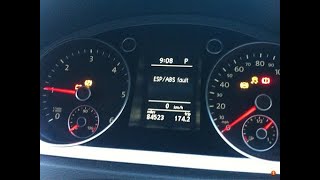
- Coding and Calibration Required: This is not a plug-and-play part. The new steering column control module (which houses the clock spring) must be coded to the vehicle's specific options using a tool like VCDS or ODIS. Failure to code it will result in multiple warning lights (Airbag, ESP, ABS, EPC) and non-functional steering wheel controls. The steering angle sensor (G85) also requires calibration 🎬 Watch how to calibrate the steering angle sensor. after installation.
Mechanic-Grade Diagnostic Values
- Driver's Airbag Igniter (N95) Circuit Resistance — expected: 2.5 - 3.0 Ohms. A technician on a forum measured a known good circuit at 3.0 Ohms. Another measured a good used clock spring at 0.4 Ohms and a faulty one at 0.6-0.7 Ohms, but the key is a stable, low reading.. Failure: Resistance Too High (B10001B / 00588): An open circuit (infinite resistance) indicates a broken wire, most often in the clock spring. Resistance Too Low (B100012 / 00588): A reading near 0.3 Ohms or less indicates a short circuit.
- Continuity Check Across Clock Spring — expected: A continuous tone or a resistance reading of less than 1.0 Ohm for each pin through the clock spring.. Failure: No tone or infinite resistance (OL) on the multimeter indicates a break in the internal ribbon cable.
Scan Tool Commands That Help
- VCDS (VAG-COM): Steering Wheel (16) -> Coding — This is required after replacing the Steering Column Control Module (J527), which houses the clock spring. The coding from the old module must be read and transferred to the new one to ensure all vehicle options (MFSW, Cruise, etc.) are recognized. If the original coding is lost, a new code must be built based on the vehicle's equipment.
- VCDS (VAG-COM): ABS Brakes (03) -> Security Access (16) -> Enter 40168 -> Basic Settings (04) -> Group 060 -> Go! — This is the G85 Steering Angle Sensor calibration procedure. It must be performed after replacing the clock spring assembly to teach the system the straight-ahead position. An uncalibrated sensor will cause ESP/ABS warning lights.
- VCDS (VAG-COM): Steering Limit Stop Adaptation — After the basic G85 calibration, this procedure sets the physical limits. It involves starting the engine, turning the steering wheel fully to the left stop, holding for a few seconds, turning fully to the right stop, holding, and then returning to center. This often extinguishes the steering warning light.
Real Owner Repair Stories
- AudiWorld Forums user 'shazoo' (Audi A5 Sportback (B8 platform)) — Airbag light on, steering wheel controls not working.
❌ Tried (didn't work) Clearing codes with a scan tool; the codes returned immediately.
✅ What actually fixed it The user diagnosed fault codes B100101 (Driver AirBag igniter 2 electrical malfunction) and 00588 (Resistance too high), which both pointed to a faulty clock spring. The final fix was replacing the clock spring assembly. A technician in the same thread confirmed this is the standard fix, stating they always check resistance through the clock spring and it's 'always' the cause for this code, and they have 'yet to ever replace a bag for the problem'. - NHTSA ODI #11471720 (Volkswagen Golf - VAG Platform Cross-Reference) — An owner reported an "Airbag" notification on the dash. A mechanic scanned the Air Bag Control Module and found code B1000 "Igniter for Driver's Air Bag, Resistance Too Large," which the owner understood to be a defective air bag clock spring.
OEM Part Supersession History
8K0953568G→8K0953568M— Part revision and consolidation. 'G' was a common part for the B8.0 generation (pre-facelift), and 'M' became the standard replacement for B8.0 and B8.5 cars with a full set of features (MFSW, cruise).
Heads up: Part number 8K0953568Q is also available but its compatibility is debated. Audi's official stance is that 'Q' is not a valid replacement for a 'G' or 'M' equipped car, even though some aftermarket sellers claim it works for cars without ACC or Side Assist. Sticking to the G -> M supersession is the safest path.
Model Year Variations Within This Range
- 2013-2015 (B8.5 Facelift): The B8.5 models switched from hydraulic to electromechanical power steering. While the clock spring failure mode is the same, this change in the steering system architecture is a key differentiator between B8.0 and B8.5 models. Part numbers for the clock spring also evolved, with 'M' becoming the common service part for the B8.5 era.
Documented NHTSA Reports
While B1000 is often associated with the clock spring on Audi platforms, reports from other manufacturers show it can represent broader electronic control unit (ECU) malfunctions. For instance, NHTSA ODI #11660121 describes B1000-00 as an Electronic Control Unit fault where the ECU may need to be replaced, updated, or reprogrammed. Similarly, NHTSA ODI #11687675 lists B1000 as an ECM fault alongside other communication codes like U0100 and U0140. In some cases, such as NHTSA ODI #11105156, B1000 was identified as an ECU malfunction in the passenger presence system, potentially linked to bad ground conditions at the battery negative to the engine and frame. Another report, NHTSA ODI #11307397, notes the B1000 air bag service light appearing while driving even without a passenger in the seat.
Diagnostic Flowchart
Other Known Issues on This Vehicle
Issues unrelated to this code that are worth knowing about as an owner of this generation:
- Excessive Oil Consumption (2.0T EA888 Gen 2) 🔴 High — Extremely common on 2009-2012 models. Can start as early as 30k-50k miles, often consuming >1 quart per 1,000 miles. Caused by defective piston rings. (Ref: Subject of a class-action lawsuit. TSB 2027731 outlines a multi-stage repair, culminating in piston/ring replacement.)
- Timing Chain Tensioner Failure (2.0T EA888) 🔴 High — Common on pre-update engines (roughly pre-2013). Failure of the plastic tensioner can cause the chain to jump, leading to catastrophic engine damage. Often preceded by a startup rattle. (Ref: Subject of a class-action lawsuit which extended warranties for some owners. An updated tensioner part is the fix.)
- Water Pump / Thermostat Failure 🟠 Medium — Considered a routine wear-and-tear item, often failing between 40k-80k miles. The original pumps have plastic housings that crack or leak. (Ref: No recall, but many owners proactively replace the plastic pump with an aftermarket all-aluminum version during service.)
- Carbon Buildup on Intake Valves (2.0T) 🟠 Medium — Inherent to direct-injection engines. Causes rough idle, misfires, and reduced performance. Typically requires manual cleaning (walnut blasting) every 60k-100k miles.
- Multitronic CVT Transmission Failure (FWD Models) 🔴 High — Front-wheel-drive models equipped with the CVT are known for jerky behavior, slipping, and eventual failure, often around 100k miles. Quattro models with Tiptronic or S-Tronic are more reliable.
Used vs. New Parts: Buying Guide for This Vehicle
When a used part is the smart pick: A used OEM clock spring can be a cost-effective option IF it is sourced from a reputable seller who can verify the donor car was not in an accident and the part is confirmed to be in good working order. However, since the clock spring is a known wear item, this is a significant risk.
Donor-vehicle mileage cap: roughly under 60000 miles for the part to have meaningful remaining life.
What to inspect on the donor part:
- Verify the donor vehicle's VIN to ensure it was not involved in a frontal collision, which could damage airbag components.
- Ensure the part number EXACTLY matches the required part or its official supersession (e.g., 8K0953568M for 8K0953568G).
- Check that the used part comes with the transport lock/clip in place to prevent it from spinning and breaking the internal ribbon before installation.
- Ask the seller for the coding of the module if possible, as this will simplify installation.
OEM-only on this vehicle (don't cheap out):
- Steering Column Control Module (Clock Spring). While aftermarket parts exist, forums are filled with stories of them requiring different coding, failing prematurely, or having buttons that don't work correctly. Given its critical role in the airbag system, a Genuine Audi or OEM (Kostal) part is highly recommended for safety and compatibility.
Aftermarket brands forum-validated for this vehicle:
- Kostal (This is the Original Equipment Manufacturer for Audi, so it is equivalent to Genuine but may be available for less cost).
Brands owners have reported issues with on this vehicle:
- Unbranded, low-cost parts from eBay or Amazon. While tempting, these often lead to coding issues, non-functional buttons, and early failure. A user on an Audizine forum had to use a specific, non-standard code (000016) to get an ECS Tuning branded part to work, highlighting the potential for complication.
Real Owner Stories
Aggregated from forums and TSBs cited above. Mileages and costs reflect what owners reported in those sources.
2009-2012 Audi A4 B8
Symptoms: Airbag light came on and the user ended up with more warning lights like EPC and traction control after attempting a DIY replacement.
What fixed it: The repair required not just replacing the clock spring but also performing the necessary coding and calibration that was initially skipped.
Source hint: Reddit r/Audi: A user describes replacing the clock spring themselves but ending up with more warning lights (EPC, traction control) because they did not perform the necessary coding and calibration
Audi A4 B8
Symptoms: ESP disabled light stayed ON after replacing the steering column switch assembly and clock spring.
What fixed it: The user had to use VCDS to perform specific coding for the aftermarket version of the clock spring and calibrate the G85 sensor.
Source hint: Audizine Forums: A user provides the specific coding needed when replacing an OEM clock spring with an aftermarket version, along with the procedure for calibrating the G85 sensor using VCDS.
Audi A4 B8
Symptoms: Airbag warning light with a 'Resistance Too High' fault code.
What fixed it: Replacement of the clock spring followed by coding the new part and calibrating the steering angle sensor.
Source hint: AudiWorld Forums: Multiple threads confirm that B1000 with 'Resistance Too High' is almost always a failed clock spring.
Related OBD-II Codes
Frequently Asked Questions
My 2010 Audi A4 has a solid airbag light and the horn doesn't work. Is this related to the B1000 code?
Can I just swap in a new Steering Column Control Module (J527) myself?
Is there a TSB for the airbag light caused by the driver's seat wiring?
What is the estimated cost to fix the B1000 'Resistance Too High' fault on an Audi A4?
Does the B1000 code affect the Stability Control (ESC/ESP) system?
How do I calibrate the G85 sensor after replacing the clock spring?
Helpful Videos

We Have This Part in Stock



The information in this article is provided for general reference and educational purposes only. Vehicle specifications, procedures, and part compatibility can vary by production date, trim level, and region. Always consult your vehicle's factory service manual and verify part numbers before purchasing or performing repairs. Safety-critical components such as airbags, seat belts, and braking systems should be installed by a qualified professional.
- Audi A4:
- 🎬 Helpful Videos
- 🛍️ Shop This Part
- What's Unique About the 2008-2015 Audi A4
- Symptoms You May Notice
- Most Likely Causes
- Rare But Worth Checking
- Diagnosis Steps
- Parts You'll Likely Need
- Related Codes That Often Appear With This One
- Platform-Specific Known Issues
- Mechanic-Grade Diagnostic Values
- Scan Tool Commands That Help
- Real Owner Repair Stories
- OEM Part Supersession History
- Model Year Variations Within This Range
- Documented NHTSA Reports
- Diagnostic Flowchart
- Other Known Issues on This Vehicle
- Used vs. New Parts: Buying Guide for This Vehicle
- Real Owner Stories
- 2009-2012 Audi A4 B8
- Audi A4 B8
- Audi A4 B8
- Related OBD-II Codes
- Frequently Asked Questions
- 🎟️ Get 5% Off