

OBD-II Code B1000: Comprehensive Guide to ECU Internal Failure
What B1000 means, which modules are affected, and how to diagnose and fix it like a pro.
- B1000 indicates a catastrophic internal failure within a specific control module, requiring a professional OBD-II scan to identify the exact unit (e.g., Airbag, BCM, or OnStar).
- Driving with a B1000 code in the Airbag Control Module (SDM/SRS) completely disables the airbag system, creating an immediate, critical safety risk.
- Water intrusion causes over 50% of B1000 codes in floor-mounted modules, particularly the Airbag Control Module on 2007-2014 GM trucks.
- Disconnecting the obsolete 2G/3G OnStar module (VCIM) on 2000-2015 GM vehicles permanently fixes the B1000 code and parasitic battery drain for $0.
- Replacing a faulty module costs between $350 and $1,700 and strictly requires professional VIN-specific programming to function.
What Does B1000 Mean?

B1000 means a specific electronic control module in your car failed its internal self-test. The module reports a catastrophic problem with its own memory, internal circuits, or processor. This is not a code for an external sensor or wire, but for the module itself. The module diagnosed itself as faulty, logging a 'checksum malfunction' or 'internal write malfunction'.
Technical definition: The official SAE/OBD-II definition for B1000 is 'Manufacturer Controlled DTC.' Its specific meaning changes depending on the vehicle manufacturer and which module sets the code. Common definitions include 'ECU Malfunction,' 'Airbag ECU Malfunction,' or 'Control Unit Internal Fault.' A professional scan tool is required to identify the faulting module and reveals a specific symptom byte (e.g., B1000:39) for detailed diagnosis.
Can I Drive With B1000?
Yes, But With Caution. The vehicle drives, but critical safety systems like airbags are disabled. Driving with an active B1000 code in the airbag module means the airbags will not deploy in an accident. In rare cases, a severely corroded airbag module short circuits, causing an unexpected deployment of seatbelt pretensioners or airbags. Diagnose the issue immediately to avoid severe safety risks or cascading electrical problems.
Common Causes

- Water Intrusion and Corrosion (Very Common) — Many control modules sit on the vehicle floor (e.g., under seats). Water leaks from clogged drains, door seals, or windshields seeps in and corrodes the module's casing and internal circuit board, causing a guaranteed failure.
- Low Battery Voltage or Bad Grounds (Very Common) — A weak battery, poor ground connections, a faulty alternator, or incorrect jump-starting causes voltage drops or spikes. This corrupts a module's memory or damages sensitive internal electronics, triggering a B1000 code.
- Obsolete OnStar Module (GM Vehicles) (Common) — On 2000-2015 GM vehicles, the analog (2G/3G) OnStar module (VCIM) is no longer supported by cellular networks. The module sets a B1000 code because it cannot connect, a fact documented in GM Technical Service Bulletins. 🎬 Watch: A quick breakdown of B1000 on GMC vehicles
- Stored Crash Data in Airbag Module (Common) — If the vehicle was in an accident, the Airbag Control Module (SDM) stores 'crash data,' even if airbags did not deploy. This locks the module and sets a permanent B1000 code requiring specialized reset services.
- Internal Hardware Degradation (Common) — The electronic control module fails due to age, extreme heat, or internal component breakdown. This frequently affects the Airbag Control Module (SDM/SRS) or Body Control Module (BCM).
- Software Corruption or Failed Programming (Less Common) — A failed software update, data corruption, or incorrect VIN programming during a recent module replacement causes the firmware to become unreadable, leading it to report an internal fault.
Symptoms

- Airbag Warning Light is On — If the B1000 code is stored in the Airbag Control Module (SDM/SRS), the airbag light illuminates, and the entire airbag system is disabled as a fail-safe.
- 'Phone Unavailable' Message (GM Vehicles) — On GM vehicles, this audio message plays through the speakers and accompanies a B1000 code when the obsolete OnStar module is the cause.
- Erratic or Non-Functioning Electronics — If the Body Control Module (BCM) fails, you experience random issues like power locks cycling, interior lights failing, gauges acting erratically, 🎬 Watch: Understanding Body Control Module failures and symptoms or the radio clock resetting.
- No-Start Condition — If the fault is in the Electronic Ignition Switch (EIS) or Powertrain Control Module 🎬 See how internal faults affect Mercedes-Benz control units (PCM), the vehicle does not start because the key is not recognized or the engine start sequence is unauthorized.
- Parasitic Battery Drain (also visible on scanner) — A faulty module fails to enter 'sleep mode' when the vehicle is off, causing a continuous power draw that drains the battery overnight.
Diagnostic Flowchart
Tap your situation to follow the diagnostic path that matches what you're seeing on this code.
Common Fixes & Costs
- Replace the Faulty Control Module
— Parts: $200-$1,200, Labor: $150-$500, ~2.5 hr book time
(Professional)
Chevrolet Silverado (2014-2016): OEM 13592880, 13594402 (Alt: Dorman (e.g., 590-285 for related sensors))
Ford F-150 (2011-2014): OEM AL3Z-15604-C, DC3R-14B476-BC, DL3Z-15604-B (Alt: Cardone, BSE (BCM13848M))
Toyota Corolla (2009-2013): OEM 89170-02A70, 89170-12A20 (Alt: Dorman) - Disconnect Obsolete OnStar (VCIM) Module — Parts: $0, Labor: $0-$150, ~0.8 hr book time (DIY)
- Replace the Car Battery and/or Ground Cables — Parts: $90-$300, Labor: $20-$100, ~0.5 hr book time (DIY)
- Reset Stored Crash Data from Airbag Module — Parts: $0, Labor: $150-$350, ~1.5 hr book time (Professional)
- Reprogram or Re-flash the Control Module — Parts: $0, Labor: $100-$350, ~1 hr book time (Professional)
- Repair Damaged Wiring or Connectors — Parts: $10-$100, Labor: $100-$700, ~2 hr book time (Intermediate)
Used vs. New Parts: Buying Guide
When a used part is worth it: A used module is a budget-friendly option for older vehicles, but only if you find an independent shop with the tools to reprogram a used module. Dealers refuse to program customer-supplied used parts. It is strictly prohibited for safety-critical airbag modules due to unknown history.
Donor-vehicle mileage cap: roughly under 100000 miles for the part to have meaningful remaining life.
Donor quality checklist:
- Match the OEM part number exactly. Do not rely on visual appearance.
- Verify the donor vehicle was not scrapped due to flood, fire, or a major collision.
- Ask for a warranty (typically 30-90 days) and confirm the return policy if the module cannot be programmed.
- Check connectors for any signs of green/white corrosion or bent pins.
Decision logic:
- If The part is an Airbag Control Module (SDM/SRS) → Buy new OEM or use a professional reset service on your original module. A used module has an unknown history and is a major safety risk.
- If The part requires VIN programming (most BCMs, SDMs, etc.) → Buy new and have it programmed by a dealer/qualified shop, UNLESS you confirmed a local shop programs used units.
- If The part is for an obsolete system (e.g., old OnStar module) → Do not buy a replacement. Disconnect the original faulty module.
Warranty tradeoff: Used parts typically have a 30-90 day functional warranty. New aftermarket parts offer a 1-year to limited lifetime warranty. New OEM parts carry a 1-2 year warranty when installed by a dealer.
Worst-case if a used part fails: $300-$1000. This represents the cost of repeat labor for installation and programming, plus the cost of a second (new) module when the used one is faulty or non-programmable.
What Happens If You Wait — Timeline
- Immediate: Code B1000 is set in a module. If it's the airbag module (SRS/SDM), the airbag warning light illuminates instantly, and the entire airbag system is disabled as a fail-safe. (MPG impact: 0%% · Added cost: $0 (but immediate, critical loss of safety function).)
- 1-4 Weeks: If the faulty module is the BCM or another unit with a parasitic draw, the battery begins to drain overnight. The owner notices slow engine cranking in the morning or needs occasional jump-starts. (MPG impact: 0%% · Added cost: $50-$150 (in wasted time, jump-start services, or incorrect diagnosis).)
- 1-3 Months: The constant drain-and-recharge cycle caused by the parasitic draw damages the battery's internal plates (sulfation), permanently reducing its ability to hold a charge. The alternator is also under increased stress. The battery now requires replacement. (MPG impact: 0%% · Added cost: $200-$450 (Cost of a new battery and labor).)
- 3+ Months: If the cause is water intrusion, the corrosion spreads from the module's housing to its electrical connector and the vehicle's wiring harness. This leads to cascading electrical failures (stalling, no-start) and makes the final repair significantly more complex and expensive, requiring wiring harness repair. (MPG impact: 0%% · Added cost: $700-$2,500+ (Cost of new module, plus diagnostic time and labor to repair corroded wiring).)
Cost of Not Fixing It
- Immediate: If the B1000 code is in the airbag module (SDM/SRS), the entire airbag system is disabled. In an accident, airbags will not deploy, drastically increasing the risk of serious injury or death. (Added cost: N/A (Safety Risk))
- 0-3 Months: If the fault is in the BCM or another module causing a parasitic draw, the battery repeatedly drains. This leads to premature battery failure and stress on the alternator. (Added cost: $200-$800 (Cost of a new battery and potentially a new alternator).)
- 3+ Months: Continued driving with a faulty module leads to cascading electrical issues, unpredictable behavior (stalling, lights failing), or a no-start condition. A water-damaged module corrodes surrounding wiring, increasing repair costs. (Added cost: $500-$2000+ (Cost of additional diagnostics, wiring repair, and towing).)
- Ongoing (If OnStar Module): If the B1000 is confirmed to be only from an obsolete OnStar module and no safety lights are on, there is no significant cost or safety risk. The only consequence is the non-functional OnStar system. (Added cost: $0)
Diagnosis Steps
- Perform a Full Vehicle Scan
Use a professional-grade scan tool to read manufacturer-specific codes (B-codes, U-codes) from ALL modules. A basic engine code reader is useless here. Identify EXACTLY which module (e.g., SRS, BCM, VCIM) stores the B1000 code.
Tools: Professional OBD-II Scan Tool (Intermediate) - Research Manufacturer TSBs
Search for the B1000 code alongside your vehicle's make, model, and year. For GM vehicles, the cause is often a known OnStar issue (TSB PIC3278G). Manufacturer-specific context prevents wasted diagnostic time.
Tools: Internet Access (Beginner) - Check Battery and Ground Connections
Ensure the battery is fully charged (12.4V - 12.6V) and terminals are tight. Inspect and clean the main chassis and engine ground straps. Perform a voltage drop test on the ground cable while cranking; the reading must be below 200mV.
Tools: Multimeter, Socket Set, Wire Brush (Beginner) - Attempt a Hard Reset
If the code appeared after a battery change or jump-start, a hard reset clears temporary glitches. Disconnect both battery terminals and hold the clamps together for 60 seconds (away from the battery) to drain residual power, then reconnect.
Tools: Socket Set (Beginner) - Visually Inspect the Faulty Module
Locate the module identified in Step 1. Disconnect the battery, unplug the module, and inspect it for water damage, green/white corrosion, or burnt pins. Swollen sealant gel on the bottom of an airbag module guarantees water intrusion.
Tools: Basic Hand Tools (Intermediate) - Verify Power and Ground at the Module
Using a wiring diagram, use a multimeter to confirm the module receives correct battery voltage (12.0V+) on its power wires and has a solid ground connection. A ground connection must have less than 0.5 ohms of resistance to the chassis.
Tools: Multimeter, Vehicle-Specific Wiring Diagram (Advanced) - [Pro Tip] Perform a Parasitic Draw Test
If the battery dies overnight, the faulty module is the cause. With the vehicle off and modules asleep (wait 60 mins), connect a multimeter in series with the negative battery cable. Normal draw is under 50mA. If higher, pull fuses one by one to isolate the circuit.
Tools: Multimeter with 10A setting, Fuse Puller (Advanced) - [Pro Tip] Check CAN Bus Network Resistance
A failing module disrupts network communication. With the battery disconnected, measure resistance between Pin 6 (CAN High) and Pin 14 (CAN Low) of the OBD-II port. A healthy network reads 60 Ohms. 120 Ohms indicates a missing terminating resistor or broken wiring.
Tools: Multimeter (Advanced)
When This Code Triggers (Freeze-Frame Conditions)
- System Voltage: 9.5V - 11.5V (During engine crank, or immediately after a jump-start or battery replacement. Low voltage corrupts a module's memory during its power-on self-test.)
- Ignition Status: Key-On, Engine-Off (KOEO) (The fault is detected during the initial power-on self-test sequence before the engine starts.)
- Module Uptime: < 1 second (The internal checksum or RAM test fails instantly upon the module receiving power, indicating a hardware or firmware-level fault.)
- Vehicle Speed: 0 mph (The self-test that triggers B1000 runs when the vehicle is stationary as part of its startup checks.)
Related Codes
- U-codes (e.g., U0100, U1500) — U-codes indicate a loss of communication. A module setting a B1000 has an internal fault and stops communicating on the CAN bus. Other modules set U-codes because they cannot hear from the faulty module. The B1000 code identifies the *source* of the communication breakdown.
- B1001 — B1001 means 'Option Configuration Error.' B1000 points to a hardware/memory failure *inside* the module, while B1001 indicates a software problem where the module's programming doesn't match the vehicle's equipment (e.g., a new BCM not programmed for the car's specific VIN).
- P060x (e.g., P0601, P0606) — These are powertrain codes for internal errors in the Engine Control Module (ECM) or Powertrain Control Module (PCM). P-codes are for the engine/transmission controller, while B-codes are for body electronics controllers. Seeing both indicates a widespread voltage issue affecting multiple modules.
- B1325 — On GM vehicles, B1325 indicates 'Device Power Circuit Malfunction' or low system voltage. It appears alongside a B1000 because the underlying cause (a weak battery, bad ground, or failing alternator) starves modules of voltage, causing one to corrupt its memory and log a B1000.
Climate & Environmental Factors
- High Humidity & Rain: High humidity accelerates corrosion on circuit boards and connectors, especially in coastal areas. It causes moisture to penetrate module housings, leading to short circuits and internal failures that trigger a B1000 code.
- Extreme Cold: Cold weather significantly reduces a battery's cranking power. The resulting low voltage during engine start corrupts a module's memory or causes it to fail its internal self-test, logging a B1000 code.
- Extreme Heat: Sustained high temperatures accelerate the degradation of electronic components within a control module, leading to premature failure. Heat also worsens existing issues like micro-fractures on a circuit board.
How to Talk to a Mechanic About This Code
Say this: "I have a B1000 code and I need a diagnostic. My scan tool shows the code is in the [Airbag/BCM/OnStar] module. The symptoms are [airbag light is on / battery is draining / etc.]. I need you to confirm the faulty module and provide a quote for replacement and programming."
This shows you've done initial research and guides the mechanic directly to the problem area. It specifies the symptoms and correctly identifies that module programming is required, preventing them from starting from scratch or suggesting unnecessary diagnostics.
Avoid saying:
- 'My check engine light is on.' (The B1000 rarely triggers the check engine light; this is inaccurate.)
- 'My car has an electrical problem.' (This is too vague and invites a costly, open-ended diagnostic process.)
- 'I think I need a new computer.' (Don't diagnose it for them; describe the specific code and symptom.)
Questions to ask before authorizing the repair:
- Can you confirm which specific module is setting the B1000 code?
- Does the replacement module require programming to my vehicle's VIN, and is that included in the quote?
- What is the warranty on both the part and the labor for this repair?
- If the fault is the airbag module, are you replacing it with a new OEM part or a used one? Can you show me the old part after the repair?
Where to Take It: Dealer vs Independent vs Chain
- Dealer:
Recommended if the vehicle is new, under warranty, or if you cannot find a qualified independent shop with module programming capabilities. They are the most reliable, albeit most expensive, option for this specific repair.
Best for: Vehicles under warranty., Complex programming for newer or German vehicles (Mercedes, BMW)., When manufacturer-specific software or tools are absolutely required and unavailable elsewhere.
Downsides: Highest labor rates, often 1.5-2x more than independent shops., Refuses to install customer-supplied or used parts., Defaults to replacing an entire assembly when a smaller component or reset is the true need. (Typical cost: +50% vs. baseline) - Independent Shop:
Best fit, but with a major caveat: you must confirm they have and use a professional, bidirectional scan tool (like Autel, Launch, or Snap-on) with the ability to program new modules for your specific vehicle make. Ask them directly before booking.
Best for: Out-of-warranty vehicles where cost is a major factor., Diagnosing common B1000 causes like water intrusion or bad grounds., Shops that specialize in your vehicle's brand (e.g., a Honda specialist).
Downsides: Not all independent shops have the expensive, up-to-date scan tools required for module programming. You MUST verify this capability beforehand., Quality and expertise vary widely; vetting the shop through reviews and certifications (like ASE) is critical. (Typical cost: +0% vs. baseline) - Chain Shop:
AVOID. A B1000 code requires advanced diagnostic capabilities that are far beyond the scope of a typical chain repair shop. They are very likely to misdiagnose the issue or be unable to complete the repair.
Best for: Simple, high-volume jobs like oil changes, tires, and brake pads.
Downsides: Technicians are pressured to meet sales quotas, leading to upsells., Almost never have the specialized diagnostic equipment or training for module-level diagnostics and programming., High risk of misdiagnosis, leading to unnecessary parts replacement. (Typical cost: -10% vs. baseline)
When to Walk Away From the Repair
If the total estimated repair cost for the B1000 code (and any other known issues) exceeds 50% of your car's private-party value, you should strongly consider not fixing it. For older, high-mileage cars (>150,000 miles), a stricter 40% threshold is more appropriate.
- Car worth $4000, fix is $2200: Walk away. The repair cost is 55% of the vehicle's value, which is too high for an older car. The risk of other age-related failures is significant.
- Car worth $12000, fix is $1800: Fix it. The repair cost is only 15% of the car's value, which is well below the threshold. This is a sound investment to keep a valuable car safe and functional.
- Car worth $2500, fix is $1500: Walk away. At 60% of the car's value, this is a poor investment. You are putting $1500 into an asset that is still only worth around $2500 and is likely to have other problems soon.
What Scan Tool You Need for This Code

Minimum: A scanner that reads manufacturer-specific codes (B-codes, C-codes, U-codes) from ALL vehicle systems, including the SRS (Airbag) and BCM (Body Control Module).
A basic $20-$50 code reader only shows engine (P-codes) and emissions data. It cannot see the B1000 code because it doesn't exist in the engine computer. Using a basic reader is a waste of time; you will not be able to identify which module is faulty, which is the mandatory first step in any B1000 diagnosis.
Budget: BlueDriver Pro Scan Tool (~$100) — Connects to your smartphone via Bluetooth. It reads and clears codes from all modules, including Airbag (SRS), BCM, and ABS on most GM, Ford, Chrysler, and Toyota/Lexus vehicles. This is enough to complete the crucial first step: identifying the faulty module.
Mid-range: Foxwell NT510 Elite (~$180) — A powerful handheld scanner that comes with one free manufacturer-specific software package (e.g., GM, Ford). It provides deep, dealer-level diagnostics for all modules and offers some bidirectional controls (active tests) to help verify if a component is working, which is a step beyond just reading codes.
Professional: Autel MaxiCOM MK808S / MK808BT (~$450-600) — This is an entry-level professional tablet scanner. It offers full-system diagnostics and bidirectional controls, but most importantly, it includes many service and maintenance functions, including the ability to perform basic module coding and programming needed after a BCM or SRS module is replaced. This is the minimum tool required to actually complete the repair yourself.
Rent vs buy: Rentals from auto parts stores are typically basic engine code readers and will NOT work for this code. If this is a one-time diagnosis, your best bet is to pay a shop for a 1-hour diagnostic fee. Buy a scanner only if you plan to do your own diagnostics and repairs regularly.
How to Clear the Code After You Fix It
- Reconnect the battery (negative terminal last).
- Use a professional-grade scan tool to perform a 'Clear All DTCs' command from all modules.
- Turn the ignition off, then on again, and wait 60 seconds to see if the B1000 code returns immediately.
- If the code stays off, perform a drive cycle to allow vehicle emissions monitors to become 'Ready'.
Drive cycle (~20 minutes): B1000 is a self-test code; it either clears or it doesn't. However, a general drive cycle resets other system monitors after the battery disconnect. A typical cycle includes: a cold start, 5 minutes of idling, 10 minutes of mixed city/suburban driving, and 5 minutes of steady highway speed driving.
Readiness monitors affected: Evaporative System (EVAP), Catalyst (CAT), Oxygen (O2) Sensor, Oxygen Sensor Heater
Before emissions retest: drive at least 50 miles to fully set monitors.
Watch out for:
- The B1000 code is a 'hard fault' and returns instantly upon clearing if the faulty module is not replaced or repaired.
- Disconnecting the battery clears the code temporarily but resets all emissions readiness monitors, guaranteeing an emissions test failure until a full drive cycle is completed.
- Using a basic engine-only code reader cannot clear a B-code from a body or airbag module.
Will This Fail Emissions / State Inspection?
Yes — this code typically fails an OBD-II emissions inspection.
- California: An illuminated airbag light alone does NOT cause a smog check failure. However, if the repair involved disconnecting the battery, the OBD-II readiness monitors reset. You must complete a drive cycle to set the monitors to 'Ready' before the test.
- New York: NYS inspection includes a check of the airbag warning lamp. While an illuminated airbag light is an advisory, the vehicle fails the OBD-II emissions scan if a Check Engine Light is also on. Reset readiness monitors from a battery disconnect also cause a failure.
- Texas: An airbag light is not part of the safety inspection criteria and does not cause a failure. However, the emissions inspection requires that no more than one readiness monitor is 'Not Ready'. A battery disconnect requires a drive cycle before re-inspection.
Most Commonly Affected Vehicles
- Chevrolet / GMC Silverado, Sierra, Tahoe, Suburban (2007-2014) — The Airbag Control Module (SDM) sits on the floor under the driver's seat, making it extremely prone to water damage from cabin leaks. GM issued a Special Coverage Program (09184B) for some 2007-2009 models. For 2015+ models, the SDM relocated to the center console.
- General Motors (Many Models) HHR, Malibu, S10, Corvette, Avalanche (2002-2015) — These models commonly set a B1000 due to an internal fault in the obsolete 2G/3G OnStar (VCIM) module, often accompanied by a U1500 code and a 'Phone Unavailable' message.
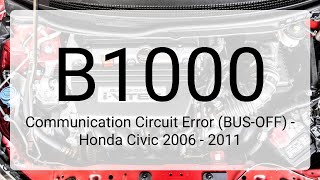
- Honda Civic, Accord (2006-2011) — B1000 often means 'Communication Bus Line Error' or 'BUS-OFF'. The fault is often the network itself, caused by a faulty Multiplex Integrated Control Unit (MICU), which is part of the under-dash fuse box.
- Ford Focus, Fusion, F-150 (2000-2015) — B1000 points to an internal fault in the Restraint Control Module (RCM) or Body Control Module (BCM). It is triggered by low voltage during engine cranking, and is sometimes a temporary glitch that clears after a hard reset.
- Subaru Outback, Legacy, WRX, Forester (2015-2024) — B1000 specifically means 'Airbag ECU Malfunction'. It frequently indicates that crash data is stored in the module after an impact, requiring a specialized reset or replacement of the Airbag Control Module.
- Mercedes-Benz Various (2000-2015) — B1000 points to an internal fault in a Signal Acquisition Module (SAM) or the Electronic Ignition Switch (EZS), commonly caused by water intrusion or voltage issues. A faulty EZS is a security part and must be replaced by a qualified professional.
- Toyota Tundra, Corolla, Prizm (2000-2015) — This code almost always means 'Center Airbag Sensor Assembly Malfunction'. If B1000 appears alone without other codes, Toyota's official repair procedure is to replace the main airbag computer.
- Chrysler / Dodge / Jeep Town & Country, Grand Caravan, Various (2005-2016) — A B1000 code points to a fault within the HVAC (A/C Heater) control module, indicating a switch is stuck or the module has an internal performance error.
Manufacturer-Specific Notes

- General Motors (Chevrolet, GMC, Buick, Cadillac): B1000 is frequently caused by an obsolete OnStar module (VCIM) per TSB PIC3278G, or a water-damaged Airbag Module (SDM) placed on the vehicle floor under the driver's seat (common on 2007-2014 trucks/SUVs).
- Ford: B1000 is defined as an 'ECU Malfunction' and relates to the Restraint Control Module (airbags) or the Body Control Module. It is triggered by low voltage during cranking and is sometimes a clearable glitch.
- Mercedes-Benz: This code points to an internal fault in a Signal Acquisition Module (SAM) or the Electronic Ignition Switch (EZS/EIS), often due to water damage or voltage irregularities. The EZS is a theft-relevant part and requires specialized tools for replacement.
- Toyota/Lexus: B1000 is very specific and almost always means 'Center Airbag Sensor Assembly Malfunction,' pointing directly to a failed main airbag computer.
- Honda: B1000 often indicates a 'Communication Bus Line Error' (BUS-OFF), pointing to a fault in the wiring network or the Multi-plex Integrated Control Unit (MICU), which is part of the under-dash fuse box.
- Subaru: The code B1000 is a direct pointer to an 'AIRBAG ECU MALFUNCTION'. This is the result of stored crash data from an impact, which requires a specialized service to clear or module replacement.
- Chrysler/Dodge/Jeep: A B1000 code relates to the HVAC (climate control) system, indicating a stuck button or an internal performance failure of the control head itself.
Real Owner Stories
2007 Chevy Silverado with 155K miles - Airbag Light On
The airbag light came on and stayed on. A scan with a professional tool revealed code B1000 stored in the Sensing and Diagnostic Module (SDM).
Outcome: Upon removing the driver's seat, the owner found the carpet underneath was damp. The SDM itself had white, chalky corrosion on its aluminum case and the gel sealant on the bottom was bubbled, a clear sign of water intrusion. The owner replaced the SDM with a used one (matching part number) for $75 and the light stayed off.
Lesson: On 2007-2014 GM trucks, a B1000 in the airbag system is almost always caused by water damage to the module under the driver's seat. Always perform a physical inspection for corrosion before buying a new part.
2004 GM vehicle with 120K miles - 'Phone Unavailable' Message
Immediately after replacing a dead battery, the B1000 code appeared along with a constant 'Phone Unavailable' audio message.
Outcome: The owner performed a 'hard reset' by disconnecting the negative battery terminal for 30 minutes. After reconnecting, the OnStar module (VCIM) reset itself correctly, and both the code and the audio message were gone.
Lesson: A low-voltage event, like a battery change or jump-start, corrupts a module's memory and sets a false B1000. Before attempting expensive repairs, try a hard reset to see if the glitch clears itself.
2013 Chevy Malibu - Misdiagnosis and Parasitic Drain
The car's battery died if left sitting for more than a day. The B1000 code was present, along with a 'Phone Unavailable' message.
Outcome: Based on forum research, the owner realized the symptoms pointed to the OnStar module (VCIM). As the 2G/3G service is obsolete, the owner chose to simply disconnect the VCIM, located behind the glove box. This stopped the parasitic drain and cleared the B1000 code, solving the problem for $0.
Lesson: Don't assume a parasitic drain is from the BCM. On many GM vehicles, a failing OnStar module is the true cause. Disconnecting the obsolete module is a common and effective no-cost fix.
Lexus with high mileage - Intermittent Airbag Light
The airbag light came on intermittently, with a B1000 code stored. The issue became more frequent over time.
Outcome: A mechanic found that the electrical connector pins for the airbag module harness had become loose over time, causing a poor connection. The mechanic carefully expanded the pins inside the connector to ensure a tighter fit. This resolved the issue permanently without replacing any parts.
Lesson: An internal fault code doesn't always mean the module itself is bad. A poor connection at the module's main harness mimics an internal failure. Checking connector pin tension is a valid diagnostic step before condemning the module.
How to Prevent This Code From Triggering
- Regularly Clean Sunroof and Cowl Drains (Twice a year (Spring and Fall)) — Debris like leaves and pine needles clog drain tubes, causing rainwater to overflow into the cabin and onto floor-mounted control modules (like the airbag SDM), leading to corrosion and guaranteed failure.
- Maintain a Healthy Battery (Every oil change) — Modules are sensitive to low voltage. A weak battery provides insufficient voltage during engine crank, which corrupts a module's memory and triggers a false B1000 code. Test your battery regularly and replace it every 3-5 years.
- Inspect Door and Window Seals (Annually) — Dried out, cracked, or damaged rubber seals allow water to seep into the vehicle, wetting carpets and damaging electronics. A simple visual inspection or 'dollar bill test' (checking for tension on a closed door) spots a bad seal.
- Use a Surge Protector When Jump-Starting (As needed) — Improper jump-starting creates voltage spikes far exceeding a module's tolerance, causing instant damage. A quality surge protector or voltage regulator stabilizes the current and protects sensitive electronics like the BCM and SRS module.
Frequently Asked Questions
Can I just clear the B1000 code?
You can try, especially if it appeared after a jump-start or battery replacement. However, because B1000 indicates an internal hardware or memory fault, the code almost always returns immediately. It is a 'hard fault' that requires fixing the root cause.
If my airbag light is on with a B1000 code, are my airbags safe?
No. When the B1000 code is active in the airbag system (SDM/SRS), the system is disabled as a safety precaution. Your airbags will not deploy in a crash until the fault is repaired.
Can a bad ground or weak battery cause a B1000 code?
Yes. Control modules are highly sensitive to voltage drops. A weak battery, failing alternator, or corroded ground connection causes voltage drops that corrupt a module's memory, triggering a B1000 code.
What does a symptom byte like B1000-39 or B1000-3B mean?
A symptom byte is a two-character suffix providing a specific diagnosis, like B1000-39 for 'Internal Electronic Failure'. Reading these requires a professional-grade scan tool. It confirms the fault is definitively inside the module.
My mechanic replaced a module, but the B1000 is still there. What went wrong?
This happens for three main reasons. The mechanic misdiagnosed the faulty module, the replacement module was not programmed correctly to your VIN, or the root cause is an unfixed wiring issue.
What's the difference between replacing a module and 'resetting' it?
Replacement installs a new physical unit. Reprogramming updates the module's software to fix corruption. For airbags, a 'reset' is a specialized $50-$150 mail-in service that clears stored crash data from a locked module after an accident.
Can I replace a control module myself?
No. Most replacement modules require professional programming to your car's Vehicle Identification Number (VIN) to function. Without this programming, the car will not start or critical safety systems remain disabled.
My mechanic says the B1000 is from my OnStar. Do I need to fix it?
If the fault is confirmed to be only the OnStar module and no safety lights are on, you can ignore it. The only consequence is non-functional OnStar services. Unplugging the obsolete module clears the code and stops 'Phone Unavailable' messages for free.
Key Takeaways
- B1000 indicates a catastrophic internal failure within a specific control module, requiring a professional OBD-II scan to identify the exact unit (e.g., Airbag, BCM, or OnStar).
- Driving with a B1000 code in the Airbag Control Module (SDM/SRS) completely disables the airbag system, creating an immediate, critical safety risk.
- Water intrusion causes over 50% of B1000 codes in floor-mounted modules, particularly the Airbag Control Module on 2007-2014 GM trucks.
- Disconnecting the obsolete 2G/3G OnStar module (VCIM) on 2000-2015 GM vehicles permanently fixes the B1000 code and parasitic battery drain for $0.
- Replacing a faulty module costs between $350 and $1,700 and strictly requires professional VIN-specific programming to function.
Helpful Videos

The information in this article is provided for general reference and educational purposes only. Vehicle specifications, procedures, and part compatibility can vary by production date, trim level, and region. Always consult your vehicle's factory service manual and verify part numbers before purchasing or performing repairs. Safety-critical components such as airbags, seat belts, and braking systems should be installed by a qualified professional.
- 🎬 Helpful Videos
- What Does B1000 Mean?
- Can I Drive With B1000?
- Common Causes
- Symptoms
- Diagnostic Flowchart
- Common Fixes & Costs
- Used vs. New Parts: Buying Guide
- What Happens If You Wait — Timeline
- Cost of Not Fixing It
- Diagnosis Steps
- When This Code Triggers (Freeze-Frame Conditions)
- Related Codes
- Climate & Environmental Factors
- How to Talk to a Mechanic About This Code
- Where to Take It: Dealer vs Independent vs Chain
- When to Walk Away From the Repair
- What Scan Tool You Need for This Code
- How to Clear the Code After You Fix It
- Will This Fail Emissions / State Inspection?
- Most Commonly Affected Vehicles
- Manufacturer-Specific Notes
- Real Owner Stories
- 2007 Chevy Silverado with 155K miles - Airbag Light On
- 2004 GM vehicle with 120K miles - 'Phone Unavailable' Message
- 2013 Chevy Malibu - Misdiagnosis and Parasitic Drain
- Lexus with high mileage - Intermittent Airbag Light
- How to Prevent This Code From Triggering
- Frequently Asked Questions
- Can I just clear the B1000 code?
- If my airbag light is on with a B1000 code, are my airbags safe?
- Can a bad ground or weak battery cause a B1000 code?
- What does a symptom byte like B1000-39 or B1000-3B mean?
- My mechanic replaced a module, but the B1000 is still there. What went wrong?
- What's the difference between replacing a module and 'resetting' it?
- Can I replace a control module myself?
- My mechanic says the B1000 is from my OnStar. Do I need to fix it?
- Key Takeaways
- 🎟️ Get 5% Off