

OBD-II Code B0126: A Comprehensive Guide to Driver Monitoring Camera and Seat Belt Buckle Faults
What B0126 means, why it triggers, and how to fix it for good
- Code B0126 disables critical safety systems, shutting down either your advanced driver-assist systems (ADAS) or your airbag deployment capabilities.
- On 2023 and newer GM and Cadillac vehicles, B0126 almost always indicates a Driver Monitoring Camera fault requiring a dealer software update or replacement.
- For Toyota, Lexus, Honda, and Nissan models, this code points to a driver's seat belt buckle switch failure, often fixed by cleaning the under-seat connector.
- Never replace expensive camera or airbag modules without first spending 15 minutes checking for chafed wiring or performing a $150 diagnostic wiggle test.
What Does B0126 Mean?

Code B0126 is a Body Diagnostic Trouble Code (DTC) indicating a fault in a key safety system. On modern General Motors (GM) and Cadillac vehicles, it signifies a fault with the Driver Monitoring Camera (DMC), disabling Advanced Driver-Assistance Systems (ADAS) like Super Cruise. On Toyota, Lexus, Nissan, and Honda models, this code points to an electrical malfunction in the driver's side ('LH') seat belt buckle switch circuit, disabling the airbag system.
Technical definition: The SAE/ISO definition for B0126 is manufacturer-specific. The Body Control Module (BCM) or Supplemental Restraint System (SRS) detects an abnormal signal, loss of communication, or internal failure. Common definitions include 'Driver Monitoring Camera' or 'Seat Belt Buckle Switch LH Circuit Malfunction'. On modern GM vehicles, the code often includes a symptom byte, such as B0126-82, identifying an 'Internal Electronic Failure' of the camera module.
Can I Drive With B0126?
Yes, But With Caution. Yes, the vehicle's primary controls operate normally, but critical safety systems are compromised. If the fault relates to the seat belt switch, the SRS module suppresses the driver's airbag in a crash, significantly increasing injury risk. If the fault is with the Driver Monitoring Camera, advanced safety features like automatic emergency braking and Super Cruise are disabled. Diagnose and repair this code promptly to restore full safety system functionality.
Common Causes

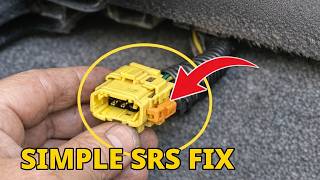
- Faulty Wiring or Damaged Connector (Very Common) — Wires under the driver's seat chafe, break, or stretch from seat movement. Connectors become loose, suffer pin corrosion, or get contaminated with dirt or spilled liquids. 🎬 See how to fix a contaminated under-seat SRS connector This is the most frequent culprit for seat belt buckle faults.
- Failed Driver Monitoring Camera (DMC) (Common) — The camera module fails due to internal electronic faults, a failed image sensor, or physical damage. This is a known, widespread issue on newer GM vehicles built on the Ultium platform.
- Software or Calibration Issue (Common) — The control module requires a software update to fix bugs causing false codes. This is the primary fix for the DMC fault on GM vehicles. On other vehicles, calibration data corrupts after a battery replacement.
- Failed Seat Belt Buckle Switch (Common) — The internal switch mechanism within the buckle assembly wears out from thousands of cycles. Debris or liquid intrusion causes it to short out or stick, providing an incorrect signal to the SRS module.
- Obstructed Camera Lens (Less Common) — The steering column or A-pillar lens is blocked by phone mounts, toll tags, stickers, or a thick layer of dust, preventing it from tracking the driver's face and eyes.
- Water Intrusion (Less Common) — A leaking windshield seal or sunroof drain allows water to drip onto the camera or under-seat connectors, causing an immediate short circuit.
- Faulty Control Module (Rare) — The Airbag Control Module (SRS) or Body Control Module (BCM) fails. This is an expensive, uncommon cause considered only after exhausting all other diagnostic avenues.
Symptoms

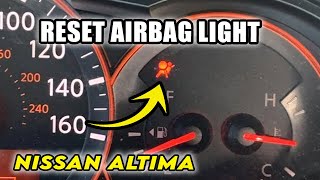
- Airbag or SRS Warning Light On — A red airbag or yellow 'SERVICE SRS' light remains illuminated on the instrument cluster.
- Driver-Assist Features Disabled — Systems like GM's Super Cruise, Ford's BlueCruise, lane-keep assist, adaptive cruise control, and driver attention alerts are unavailable.
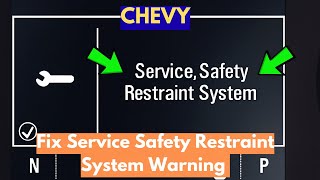
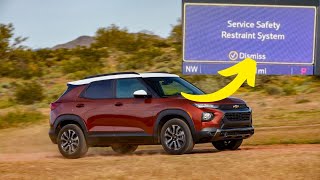
- 'Service Safety System' or 'Camera Fault' Message — A specific text warning appears on the driver information center (DIC) or the main infotainment screen. 🎬 Watch: Troubleshooting the Service Safety Restraint System warning in Chevys
- Seat Belt Warning Light/Chime Malfunction — The chime or dash light stays on even when buckled, or fails to activate when unbuckled.
Diagnostic Flowchart

Tap your situation to follow the diagnostic path that matches what you're seeing on this code.
Common Fixes & Costs
- Software Update / Module Reprogramming — Parts: $0, Labor: $150-$300, ~1.0 hr book time (Professional)
- Repairing Damaged Wiring or Cleaning Connector — Parts: $5-$25, Labor: $150-$400 (diagnostic time), ~1.5 hr book time (Intermediate)
- Replacing the Seat Belt Buckle Assembly
— Parts: $120-$300, Labor: $100-$250, ~1.0 hr book time
(DIY)
Toyota Sienna (2005-2015): OEM 73240-AE020-B0, 73240-08030-B1 (Alt: Dorman, SMP)
Nissan Altima (2013-2018): OEM 86843-9HU8B (Alt: Various) - Replacing the Driver Monitoring Camera
— Parts: $200-$500, Labor: $300-$600 (includes mandatory calibration), ~2.5 hr book time
(Professional)
Chevrolet Silverado/Traverse (2024+): OEM 86517920, 84721338 (Alt: OEM only)
Cadillac Lyriq (2023+): OEM 13554496, 87833315 (Alt: OEM only) - Replacing the Airbag Control Module — Parts: $300-$700, Labor: $150-$250, ~1.5 hr book time (Professional)
Used vs. New Parts: Buying Guide
When a used part is worth it: For a seat belt buckle, a used OEM part from a low-mileage vehicle not involved in a collision is a cost-effective option. For a Driver Monitoring Camera, favor new OEM parts due to calibration requirements.
Donor-vehicle mileage cap: roughly under 80000 miles for the part to have meaningful remaining life.
Donor quality checklist:
- Verify the donor vehicle was not in an accident; seat belts are single-use items in a crash.
- Match the part number exactly. For buckles, ensure the color and connector match.
- For ADAS cameras, check for visible damage to the lens or housing.
Decision logic:
- If The part is a seat belt buckle and the vehicle is over 10 years old → A warrantied used part is a reasonable choice to save money.
- If The part is an ADAS camera → Buy a new OEM part due to the high risk of used part failure and mandatory calibration costs.
- If The part is safety-critical and the cost difference is less than $100 → Buy new for the longer warranty and peace of mind.
Warranty tradeoff: Used parts from salvage yards typically offer a 30-90 day warranty. New aftermarket parts have a 1-year to limited lifetime warranty. New OEM parts carry the manufacturer's 12-month/12,000-mile warranty.
Worst-case if a used part fails: $300-$600 if a used part fails after installation, primarily due to repeated diagnostic and labor costs.
What Happens If You Wait — Timeline
- Immediate (0 days): Code is set, and the SRS/Airbag warning light illuminates. The associated safety system (Airbags or ADAS) is immediately disabled by the control module as a fail-safe. (MPG impact: 0%% · Added cost: $0 (Safety risk is the primary 'cost'))
- 1-3 months: The vehicle continues to operate with a disabled safety system. An intermittent wiring fault degrades further due to vibration, becoming a permanent open/short circuit. (MPG impact: 0%% · Added cost: $0-$150 (Potential increase in diagnostic labor))
- 3-12 months: The vehicle automatically fails its annual state safety inspection in jurisdictions that check for an active airbag light, preventing legal registration renewal. (MPG impact: 0%% · Added cost: $50-$200 (Cost of failed inspection fees and fines))
- 12+ months: The primary consequence remains the severe safety risk. No cascading mechanical damage occurs, but the eventual repair is unavoidable for safety and legal operation. (MPG impact: 0%% · Added cost: Full cost of the eventual repair ($150 - $900+))
Cost of Not Fixing It
- Immediate: The driver's airbag suppresses in a crash, drastically increasing injury risk. All associated ADAS features (Super Cruise, auto-braking) are disabled. (Added cost: N/A (Safety Risk))
- 1-6 months: An intermittent wiring fault worsens into a permanent open or short circuit, requiring more extensive wire harness repair. (Added cost: $0 - $200)
- 6+ months: The vehicle fails any state safety inspection where an active SRS light is an automatic failure. (Added cost: Failed inspection fees + eventual repair cost)
Diagnosis Steps
- Scan for Codes and Identify the System
Use a high-quality OBD-II scanner that reads Body (B) codes. Confirm if B0126 refers to the Driver Monitoring Camera or the Seat Belt Buckle Switch for your specific make and model. Note any symptom bytes (e.g., -82) and related codes (e.g., U0140).
Tools: Advanced OBD-II Scanner (Beginner) - Check for Technical Service Bulletins (TSBs)
For the DMC version on GM vehicles, check for TSBs like PIC6556H. These bulletins instruct dealers to perform a software update as the first step before replacing any hardware.
Tools: Access to OEM service data (Professional) - Perform a Thorough Visual Inspection
For a DMC fault, inspect the camera lens for obstructions or damage. For a seat belt fault, inspect the buckle for debris and check the wiring harness under the driver's seat for pinched wires, disconnected plugs, or liquid spills.
Tools: Flashlight, Mirror (Beginner) - Inspect and Clean the Primary Connector
Disconnect the main electrical connector for the suspect component. Examine the pins for green/white corrosion, moisture, or bent pins. Clean both sides with electrical contact cleaner and reseat it firmly.
Tools: Trim removal tools, Socket set, Electrical contact cleaner (Intermediate) - Perform a 'Wiggle Test' for Intermittent Faults
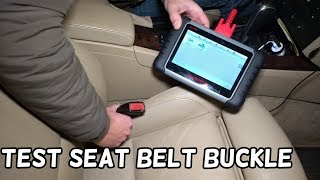
With the system's live data visible on a scan tool, carefully wiggle the wiring harness leading to the component, especially under the seat. A change in live data or the return of the code pinpoints the location of a wire break.
Tools: Advanced OBD-II Scanner (Advanced) - Test the Seat Belt Switch and Circuit
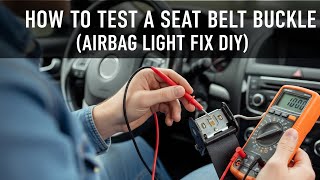
Disconnect the buckle connector and use a multimeter on the resistance (Ohms) setting. The resistance between the two switch pins must change based on state (e.g., 100-500 Ω when buckled, OL when unbuckled). If the switch tests good, measure the resistance of the harness wires back to the SRS module to check for an open circuit.
Tools: Digital Multimeter, Wiring diagram, Socket set (Advanced) - Check for Power and Ground (DMC)
Using a wiring diagram, backprobe the DMC's connector. Verify it receives the correct power (5V or 12V reference) and has a solid ground connection (less than 1.0 Ω resistance to chassis).
Tools: Digital Multimeter, Wiring diagram, Backprobe kit (Advanced) - Perform Bidirectional Control and Calibration
Use a professional scan tool to command the camera on and view its live feed. If a camera or SRS module is replaced, perform the mandatory calibration or 'relearn' procedure to pair the new component to the vehicle.
Tools: Professional scan tool (Professional)
When This Code Triggers (Freeze-Frame Conditions)
- Fault Status: Present / Current (The code logs as soon as the module's self-test fails, typically at ignition on.)
- Ignition Cycles Since Fault: 0 (Indicates the fault was detected on the current ignition cycle.)
- Module Voltage: 11.5V - 14.5V (The fault occurred during normal vehicle operating voltage. A value outside this range indicates a charging system or battery issue.)
- Component State: Varies (For a seat belt fault, the data shows 'Buckled' or 'Unbuckled' status. For a camera fault, it shows 'Initialization Failed' or 'No Communication'.)
Related Codes
- B0127 — The direct counterpart to B0126 for the passenger side ('RH' - Right Hand). Indicates a 'Seat Belt Buckle Switch RH' fault.
- B0126-82 (GM) — The '-82' symptom byte signifies an 'Internal Electronic Failure' detected within the Driver Monitoring Camera itself, requiring replacement.
- B1DD0-57 (GM) — Frequently set in conjunction with B0126-82 on newer GM vehicles. Points to a 'Driver Monitoring Camera internal electronic failure'.
- U0140 — Means 'Loss of Communication with Body Control Module (BCM)'. If present alongside B0126, the root cause is a broader network issue or faulty BCM, not the individual component.
Climate & Environmental Factors
- High Humidity: Moisture accelerates corrosion of electrical connectors and printed circuit boards (PCBs). This is a primary cause of intermittent faults in under-seat connectors for seat belt buckles.
- Extreme Cold: Low temperatures make plastic wire insulation and connectors brittle, increasing the risk of cracking. Cold also temporarily changes resistance values within a circuit, triggering false codes.
- Water Intrusion: Direct water leaks from clogged sunroof drains or faulty windshield seals saturate connectors and modules, causing immediate short circuits.
- Physical Obstruction (Ice/Snow): A layer of ice or frost on the windshield in the camera's view causes temporary DMC faults until the obstruction clears.
How to Talk to a Mechanic About This Code
Say this: "I have a [Your Vehicle Year and Make] with an airbag/SRS light on and the code is B0126. On my car, this points to the [Driver Monitoring Camera/driver's seat belt buckle circuit]. I would like to schedule a diagnostic appointment to confirm the fault. Please start by checking [the TSB for a software update/the wiring and connector under the driver's seat] before quoting a full component replacement."
This signals to the shop that you are an informed consumer. It directs the technician to the most likely and cost-effective starting point, preventing them from immediately quoting an expensive part replacement.
Avoid saying:
- 'My airbag light is on, can you just turn it off?'
- 'Just fix whatever is wrong with the safety system.'
- 'I read online it's just a sensor, so just replace that.'
Questions to ask before authorizing the repair:
- For a seat belt fault: Did you test the continuity of the wires from the buckle to the SRS module, and did you check the resistance of the switch itself?
- For a camera fault: Did you confirm if a software update is available per the manufacturer's TSB? Is the cost of calibration included in the replacement quote?
- Can you provide me with the specific fault code, including any symptom bytes (like -82)?
- What is the warranty on this specific repair, including both parts and labor?
Where to Take It: Dealer vs Independent vs Chain
- Dealer:
The best and often only choice for a Driver Monitoring Camera (DMC) fault, especially if the vehicle is under warranty. Recommended for any repair that requires ADAS calibration.
Best for: Vehicles under warranty (especially 2023+ GM models with the camera fault)., Repairs requiring manufacturer-specific software updates (DMC issue)., Repairs requiring ADAS calibration after component replacement.
Downsides: Highest labor rates., May be less willing to perform a simple wiring repair and more likely to recommend a full component replacement. (Typical cost: +40% vs. baseline) - Independent Shop:
The best choice for the seat belt buckle version of this code on an out-of-warranty vehicle. A good independent shop saves significant money by repairing wiring instead of replacing parts.
Best for: Out-of-warranty vehicles with the seat belt buckle fault., Diagnosing and repairing wiring or connector issues., Owners who have a trusted relationship with a local mechanic with strong diagnostic skills.
Downsides: May not have the expensive tools required for ADAS camera calibration., Quality varies greatly; look for ASE certification and good reviews on SRS or electrical work. (Typical cost: +0% vs. baseline) - Chain Shop:
AVOID. This code involves critical safety systems (airbags and ADAS) that require a level of expertise not typically found at chain shops.
Best for: Tires, oil changes, and brakes.
Downsides: Technicians lack specialized training for complex SRS and ADAS diagnostics., High pressure to upsell leads to incorrect and expensive recommendations., Not equipped for ADAS calibration or module programming. (Typical cost: -10% vs. baseline)
When to Walk Away From the Repair
If the estimated repair cost exceeds 50% of the car's private-party value, evaluate your options. Because B0126 involves a non-negotiable safety system, the decision is 'fix it' or 'sell it'.
- Car worth $4000, fix is $450: Fix it. This is a relatively low-cost repair that restores a critical safety function and makes the car sellable and safe to drive.
- Car worth $12000, fix is $900: Fix it. The repair cost is well below the threshold and is necessary for the vehicle's safe operation.
- Car worth $3500, fix is $2200: Walk away. The repair cost is over 60% of the car's value. It's not financially sound to invest this much into an older vehicle for a single repair.
What Scan Tool You Need for This Code
Minimum: A scanner that reads and clears Body (B) and SRS/Airbag codes. A basic engine-only (P-code) scanner is not sufficient.
A standard $20 OBD-II reader only communicates with the Engine Control Unit (ECU). Code B0126 is stored in the Body Control Module (BCM) or Supplemental Restraint System (SRS) module, which basic scanners cannot access.
Budget: Autel MaxiLink ML629 (~$90) — Reads and clears codes from the Engine, Transmission, ABS, and SRS modules. It retrieves the B0126 code, clears it after repair, and shows live data for a 'wiggle test'.
Mid-range: Innova 5610 (~$330) — Provides full system diagnostics, including SRS live data with graphing to monitor the buckle switch status in real-time. Offers bidirectional controls to test components.
Professional: Autel MaxiCOM MK808 / Launch X431 Series (~$450-600) — Offers full bidirectional control, module programming, and the ability to perform the mandatory ADAS camera calibration after replacement.
How to Clear the Code After You Fix It
- Ensure the underlying fault (bad wiring, faulty component) is corrected.
- Reconnect the vehicle's battery if disconnected for the repair.
- Use an SRS-capable OBD-II scan tool to clear the B0126 code from the SRS or BCM module.
- Cycle the ignition off, then on, and verify the SRS/Airbag warning light performs its self-check and turns off.
Drive cycle (~10 minutes): A complex drive cycle is not required. After clearing the code, a short test drive of 5-10 minutes confirms the fix. The system performs a self-test upon every startup; if the light stays off, the repair is successful.
Readiness monitors affected: Not applicable. B-codes do not affect engine emissions readiness monitors.
Watch out for:
- Clearing the code without fixing the root cause results in the code returning immediately.
- Using a basic OBD-II scanner that only reads powertrain (P) codes cannot see or clear body (B) codes.
- Forgetting to perform a mandatory calibration after replacing a Driver Monitoring Camera prevents the code from clearing.
Will This Fail Emissions / State Inspection?
Yes — this code typically fails an OBD-II emissions inspection.
- California: An illuminated airbag light does NOT cause a failure of the emissions-only SMOG check, but the vehicle is considered unsafe.
- New York: An illuminated airbag warning lamp is an automatic failure during the annual safety inspection.
- Texas: An illuminated airbag light is NOT checked during the Texas safety inspection and does not cause a failure.
- Pennsylvania: A vehicle passes the regular annual safety inspection with an airbag light, but fails the 'enhanced' safety inspection required for reconstructed or salvaged vehicles.
Most Commonly Affected Vehicles
- Chevrolet Silverado EV, Traverse, Equinox EV, Blazer EV (2024-2026) — Highly susceptible to the Driver Monitoring Camera fault. TSB PIC6556H addresses this, requiring a software update or camera replacement under warranty.
- Cadillac Lyriq, CT5, Escalade (2023-2026) — Sharing the GM Ultium platform, these models experience the B0126 Driver Monitoring Camera fault. Repair follows GM's software-first diagnostic approach.
- Toyota Sienna, Highlander, Land Cruiser (2005-2015) — The code consistently means 'Seat Belt Buckle Switch LH Circuit Malfunction'. Caused by chafed wiring under the driver's seat or a failed internal buckle switch.
- Lexus RX series, IS series (2008-2016) — Logs B0126 for a fault in the driver's seat belt buckle circuit. Diagnostics focus on under-seat wiring and switch continuity.
- Nissan Altima, Maxima, Murano (2013-2018) — Frequently experience the seat belt buckle fault caused by a dirty or loose connector under the seat.
- Subaru Outback, Forester, Ascent (2019-2025) — Models with the DriverFocus system log B0126 for the Driver Monitoring Camera.
- Honda / Acura Accord, Civic, CR-V, MDX (2008-2017) — Uses B0126 to indicate a fault with the driver's seat belt buckle switch. Diagnostics focus on the switch and its wiring harness.
Manufacturer-Specific Notes
- General Motors: On 2023+ vehicles with ADAS, B0126 almost exclusively means a Driver Monitoring Camera fault. TSB PIC6556H mandates a software-first approach; dealers must apply updates before replacing the camera.
- Toyota/Lexus: B0126 is consistently defined as 'Seat Belt Buckle Switch LH Circuit Malfunction'. The repair is often covered under Toyota's 'Restraint Systems Warranty,' which is 60 months or 60,000 miles.
- Fiat/Chrysler/Jeep: B0126 appears with a '-54' suffix, meaning 'Calibration Missing'. The Occupant Restraint Controller (ORC) lost its programming and requires recalibration with a professional scan tool.
- Honda/Acura: B0126 points to the driver's seat belt buckle switch. The fault is traced to a failed switch within the buckle assembly or the connector under the driver's seat.
Real Owner Stories
2024 Chevrolet Silverado EV with 5K miles
Brand new truck. 'Service Safety System' message appeared on the dash, and Super Cruise became unavailable. Code B0126-82 was stored.
What they tried:
- Owner checked for camera obstructions and reset the infotainment system, but the code returned on the next startup.
Outcome: Dealer service was required. Per TSB PIC6556H, the technician first attempted a software reprogram of the Image Processing Control Module. When that failed, the Driver Monitoring Camera was replaced and calibrated. The repair was covered under the bumper-to-bumper warranty.
Lesson: On new GM vehicles, B0126 is a known issue with the Driver Monitoring Camera. It is a warranty repair that requires a dealer visit for software updates and potential hardware replacement.
2013 Nissan Altima at 110K miles
Airbag light came on intermittently, usually after adjusting the driver's seat. Code was B0126 for the seat belt buckle switch.
What they tried:
- A mechanic quoted $450 to replace the seat belt buckle assembly.
- Owner decided to inspect it themselves first. They found the yellow connector under the driver's seat was slightly loose.
Outcome: Owner disconnected the battery, unplugged the connector, cleaned it with electrical contact cleaner, and reseated it firmly until it clicked. The airbag light went off and stayed off. Total cost was under $10.
Lesson: For the seat belt buckle variant of B0126, always perform a thorough inspection of the under-seat wiring and connectors before replacing parts. An intermittent light is a classic symptom of a loose connection.
2008 Toyota Sienna at 150K miles
Persistent airbag light. A basic scanner pulled code B0126, pointing to the driver's seat belt buckle switch.
What they tried:
- Owner replaced the driver's seat belt buckle assembly with a new OEM part. The code was cleared but returned immediately.
Outcome: The owner took it to a shop specializing in electrical diagnostics. The technician tested the wiring from the buckle connector to the main SRS module and found an open circuit (broken wire) deep inside the harness where it passed over a sharp metal seat bracket. The wire was repaired, and the code was resolved. The buckle replacement was unnecessary.
Lesson: Don't assume the component is bad just because the code points to it. A continuity test with a multimeter is essential to confirm the entire circuit's integrity before replacing expensive parts.
How to Prevent This Code From Triggering
- Periodically clean the Driver Monitoring Camera lens (Every 3-6 months) — Dust, smudges, and grime obstruct the camera's view, preventing it from tracking the driver's eyes. Use a clean microfiber cloth; avoid harsh chemicals that scratch the lens.
- Secure under-seat wiring (Once, or after any under-seat work) — Use zip ties to gently secure the seat belt and airbag wiring harness away from sharp seat brackets or moving tracks. This prevents wires from stretching or chafing when the seat is adjusted.
- Avoid spilling liquids on or around the seat belt buckle (Daily habit) — Sugary drinks and coffee get inside the buckle mechanism, causing the internal switch to become sticky or short-circuit.
- Maintain battery and charging system health (Annually) — Low voltage (below 12.0V) during startup causes memory and calibration data in sensitive modules like the SRS and BCM to corrupt, leading to false codes.
Frequently Asked Questions
My dealer quoted a huge repair bill. Could it be something simple?
Absolutely. There are numerous documented cases where owners were quoted thousands for a new airbag module or camera system, only for a second-opinion mechanic to find the issue was a corroded or loose connector under the seat. Always start with the simplest and most common causes—wiring and connectors—before authorizing a major component replacement.
The airbag light turns on and off randomly. What does that signify?
An intermittent warning light is a classic sign of a poor electrical connection. The most common cause is a wire under the driver's seat that gets tugged or flexed when the seat is adjusted. A 'wiggle test' while monitoring live scanner data is the best way to find this type of fault.
Can I just clear the B0126 code myself?
You can clear the code with a scanner, but if the underlying electrical or hardware fault remains, the code returns immediately. Clearing the code does not solve the problem and leaves critical safety systems disabled.
Is a B0126 repair covered under warranty?
If the vehicle is within its bumper-to-bumper warranty period, the repair is covered. For the known GM camera issue, a specific Technical Service Bulletin (TSB) mandates a warranty repair. Federal regulations also often mandate longer 60-month/60,000-mile warranties for safety restraint systems like seat belts.
Will my airbags still deploy with code B0126 active?
Assume they will NOT deploy correctly. If the code is for the seat belt buckle, the system cannot confirm if the driver is buckled and suppresses the airbag to prevent injury. This is a serious safety risk that requires immediate attention.
Why did this code appear right after my battery was replaced?
Low voltage conditions during a battery failure or replacement corrupt the calibration memory in sensitive control modules like the SRS or BCM. Simply clearing the code after the new battery is fully charged often resolves it. If not, the module requires a professional 'relearn' procedure.
Can I replace a Driver Monitoring Camera myself?
While physically swapping the camera is possible for a skilled DIYer, it is not recommended. The new camera requires precise calibration to the vehicle using specialized, dealer-level software and tools. Without this calibration, the system remains offline and the code persists.
What does the '-82' after my B0126 code mean?
On a GM vehicle, the '-82' symptom byte means the control module detected an 'Internal Electronic Failure' inside the Driver Monitoring Camera. This strongly indicates the camera itself failed and requires replacement, rather than a wiring or software issue.
Key Takeaways
- Code B0126 disables critical safety systems, shutting down either your advanced driver-assist systems (ADAS) or your airbag deployment capabilities.
- On 2023 and newer GM and Cadillac vehicles, B0126 almost always indicates a Driver Monitoring Camera fault requiring a dealer software update or replacement.
- For Toyota, Lexus, Honda, and Nissan models, this code points to a driver's seat belt buckle switch failure, often fixed by cleaning the under-seat connector.
- Never replace expensive camera or airbag modules without first spending 15 minutes checking for chafed wiring or performing a $150 diagnostic wiggle test.
Helpful Videos

The information in this article is provided for general reference and educational purposes only. Vehicle specifications, procedures, and part compatibility can vary by production date, trim level, and region. Always consult your vehicle's factory service manual and verify part numbers before purchasing or performing repairs. Safety-critical components such as airbags, seat belts, and braking systems should be installed by a qualified professional.
- 🎬 Helpful Videos
- What Does B0126 Mean?
- Can I Drive With B0126?
- Common Causes
- Symptoms
- Diagnostic Flowchart
- Common Fixes & Costs
- Used vs. New Parts: Buying Guide
- What Happens If You Wait — Timeline
- Cost of Not Fixing It
- Diagnosis Steps
- When This Code Triggers (Freeze-Frame Conditions)
- Related Codes
- Climate & Environmental Factors
- How to Talk to a Mechanic About This Code
- Where to Take It: Dealer vs Independent vs Chain
- When to Walk Away From the Repair
- What Scan Tool You Need for This Code
- How to Clear the Code After You Fix It
- Will This Fail Emissions / State Inspection?
- Most Commonly Affected Vehicles
- Manufacturer-Specific Notes
- Real Owner Stories
- 2024 Chevrolet Silverado EV with 5K miles
- 2013 Nissan Altima at 110K miles
- 2008 Toyota Sienna at 150K miles
- How to Prevent This Code From Triggering
- Frequently Asked Questions
- My dealer quoted a huge repair bill. Could it be something simple?
- The airbag light turns on and off randomly. What does that signify?
- Can I just clear the B0126 code myself?
- Is a B0126 repair covered under warranty?
- Will my airbags still deploy with code B0126 active?
- Why did this code appear right after my battery was replaced?
- Can I replace a Driver Monitoring Camera myself?
- What does the '-82' after my B0126 code mean?
- Key Takeaways
- 🎟️ Get 5% Off