

OBD-II Code B0111: Side Airbag Fault or Camera Washer Problem
What B0111 means, why it triggers, and how to fix it
- Code B0111 indicates a critical 'Side Airbag Open Circuit' on Toyota, Lexus, and Hyundai vehicles, or a non-urgent 'Camera Washer Circuit' fault on 2018+ Ford and GM models.
- If the airbag warning light illuminates, the vehicle's SRS module instantly disables 100% of the airbags, leaving occupants completely unprotected in a collision.
- For airbag-related B0111 codes, inspect the yellow wiring harness under the front passenger seat first, as damaged or corroded connectors cause the vast majority of these faults.
- Never test airbag circuits with a standard multimeter, as the electrical current triggers accidental deployment; always disconnect the battery for 15 minutes before inspecting SRS wiring.
What Does B0111 Mean?

B0111 has two vastly different meanings depending on the manufacturer. For Toyota, Lexus, and Hyundai, it indicates a critical fault in the right-hand (RH) side airbag circuit. For modern Ford, GM, and Chrysler vehicles, it points to a non-urgent issue with the front camera washer system.
Technical definition: The SAE definition is either "Open in Side Squib (RH) Circuit 🎬 Watch: Troubleshooting the Toyota side squib circuit fault." or "Camera Washer Actuator H Circuit Fault." An "open" signifies a broken electrical circuit or high resistance. The Side Squib is the pyrotechnic igniter inside the passenger seat's side airbag. The Camera Washer Actuator is the electric motor that sprays fluid onto the forward-facing ADAS camera.
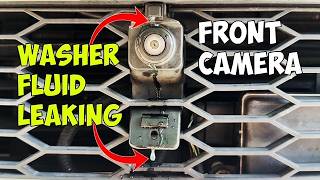
🎬 See how to fix a leaking camera washer for under $20.Can I Drive With B0111?
Yes, But With Caution. You can physically drive the vehicle, but it is highly unsafe. If the airbag warning light is on, the entire Supplemental Restraint System (SRS) is disabled as a fail-safe, meaning zero airbags will deploy in a collision. If the code pertains to the camera washer, critical Advanced Driver-Assistance Systems (ADAS) like Pre-Collision Assist are unavailable, increasing accident risk.
Common Causes

- Damaged or Corroded Under-Seat Connector (Airbag Fault) (Very Common) — The yellow-sheathed wiring and main connector for the side airbag sit under the passenger seat. Items shoved under the seat, passenger feet, or moisture from spilled drinks and wet shoes easily damage or corrode these pins, creating an open circuit.
- Failed Camera Washer Actuator Pump (Camera Fault) (Common) — For vehicles using the camera washer definition, the small electric motor in the washer pump assembly frequently burns out from heavy use or fails due to internal moisture intrusion.
- Faulty Side Airbag Assembly / Squib (Airbag Fault) (Common) — The pyrotechnic igniter (squib) within the side airbag module can fail internally over time. When the SRS module detects this internal break during its self-check, the entire side airbag unit must be replaced.
- Low System Voltage / Weak Battery (Airbag Fault) (Less Common) — The SRS module is highly sensitive to voltage drops. A dying battery or a voltage spike from an improper jump-start causes the module to fail its self-test and store a 'ghost' B0111 code.
- Disconnected Passenger Seat Harness (Airbag Fault) (Less Common) — If the passenger seat was recently removed for cleaning or replaced with an aftermarket seat, the airbag connector is often forgotten, improperly seated, or incompatible with the factory SRS module.
- Damaged Front Wiring Harness (Camera Fault) (Less Common) — Camera washer wiring runs to the front grille, exposing it to road salt, moisture, and debris. This exposure corrodes the actuator's connector or damages the wiring insulation.
- Faulty Clock Spring (Airbag Fault) (Rare) — While a clock spring failure typically sets a driver's side code, a severe internal short in this steering column component sometimes disrupts the entire SRS network, triggering passenger-side codes like B0111.
- Faulty Airbag Control Module (SRS Module) (Rare) — The central airbag control module rarely fails internally. This is the absolute last component to suspect after meticulously testing all wiring, connectors, and the side airbag assembly. 🎬 Watch: Professional guide to diagnosing and repairing SRS systems.
Symptoms

- Illuminated or Blinking Airbag Warning Light — The primary symptom for an airbag fault. The light remains solid or blinks (common on Toyota models) to indicate an active, hard fault in the SRS system.
- Entire Airbag System Disabled — Whenever the airbag warning light illuminates for a circuit fault, the SRS control module disables the entire system. No airbags will deploy in an accident.
- Inoperative Front Camera Washer — For the camera washer definition, the washer for the front-facing ADAS camera fails to spray fluid when activated.
- ADAS Malfunction Messages on Dash — A dirty camera lens resulting from a failed washer triggers dashboard errors like "Front Camera Fault," "Pre-Collision Assist Not Available," or "Lane Keeping System Fault."
Diagnostic Flowchart
Tap your situation to follow the diagnostic path that matches what you're seeing on this code.
Common Fixes & Costs
- Repairing Under-Seat Airbag Wiring/Connector
— Parts: $20-$80, Labor: $150-$300, ~1.5 hr book time
(Intermediate)
: OEM
: OEM - Replacing Camera Washer Actuator/Pump
— Parts: $50-$150, Labor: $100-$200, ~1.0 hr book time
(DIY)
: OEM - Replacing Side Airbag Assembly (Squib)
— Parts: $300-$800, Labor: $300-$450, ~2.5 hr book time
(Professional)
: OEM - Replacing Airbag Control Module (SRS) — Parts: $400-$900, Labor: $200-$400, ~2.0 hr book time (Professional)
DIY vs Professional
- Repairing Under-Seat Airbag Wiring/Connector — Beginner: No
Tools: SRS scanner, wire strippers, crimpers, heat shrink tubing, contact cleaner. - Replacing Camera Washer Actuator/Pump — Beginner: Yes
Tools: Socket set, trim removal tools, pliers. - Replacing Side Airbag Assembly (Squib) — Beginner: No
Tools: Professional scan tool, socket set, torque wrench, hog ring pliers.
Used vs. New Parts: Buying Guide
When a used part is worth it: Buy a used OEM camera washer pump to save money. Never install a used airbag, squib, or SRS control module due to unknown history (flood damage, prior deployments) and extreme safety risks.
Donor-vehicle mileage cap: roughly under 60000 miles for the part to have meaningful remaining life.
Donor quality checklist:
- Verify the donor vehicle was not in a front-end collision for washer pumps.
- Match the part number exactly; washer pumps change connectors year to year.
- For SRS modules, use a professional remanufacturing service rather than a salvage yard pull.
Decision logic:
- If The faulty part is an airbag, squib, or clock spring → Always buy new OEM. The safety risk is never worth the cost savings.
- If The faulty part is the camera washer pump → A used pump from a reputable salvage yard is a viable, budget-friendly option.
- If The faulty part is the SRS Control Module → A professional reset/remanufacturing service is a reliable alternative to a brand-new module.
Warranty tradeoff: Used parts carry a 30-90 day warranty. New aftermarket parts offer 1-year warranties. New OEM parts provide a 12-month/12,000-mile guarantee.
Worst-case if a used part fails: $5000+ if a used airbag fails to deploy in an accident. A used washer pump failure costs roughly $150 in repeat labor.
What Happens If You Wait — Timeline
- Immediate (First Ignition Cycle): The SRS module detects the open circuit, illuminates the warning light, and disables the entire airbag system. Primary safety function is lost instantly. (MPG impact: 0%% · Added cost: $0)
- 1-4 Weeks: The vehicle automatically fails state safety inspections due to the illuminated airbag light, resulting in fines and the inability to renew registration. (MPG impact: 0%% · Added cost: $50-$200)
- 1-6 Months: If caused by a water leak, ongoing moisture exposure corrodes other wiring harnesses and causes mold growth in the carpet padding. (MPG impact: 0%% · Added cost: $500-$2500)
- 6+ Months: The active warning light masks new, unrelated SRS faults. A second component fails, but the driver receives no new warning, leading to complex diagnostics later. (MPG impact: 0%% · Added cost: $150-$400)
Cost of Not Fixing It
- Immediate: For an airbag fault, the entire SRS is disabled. Zero airbags will deploy in a collision, drastically increasing the risk of fatal injury. (Added cost: N/A)
- Immediate: For a camera washer fault, critical ADAS safety features like automatic emergency braking are disabled. (Added cost: N/A)
- Days to Weeks: An illuminated airbag light results in an automatic failure of state safety inspections in most jurisdictions. (Added cost: $50-$200)
- Months: Ignoring the fault masks new problems. If a second SRS component fails, the driver receives no new warning because the light is already on, complicating future diagnostics. (Added cost: $150-$400)
Diagnosis Steps

- Identify Code Definition (Airbag vs. Camera)
Confirm your vehicle's specific definition. Toyota, Lexus, Scion, and Hyundai use the critical airbag definition. Ford, GM, and modern Chrysler vehicles with ADAS use the non-urgent camera washer definition.
Tools: OBD-II Scanner, Internet Access (Beginner) - SAFETY PREP: Disconnect Battery (Airbag Fault)
Before touching any yellow SRS wiring, you MUST disconnect the negative battery terminal and wait exactly 15 minutes. This discharges the SRS module's backup capacitors, preventing accidental airbag deployment.
Tools: 10mm Wrench or Socket (Beginner) - Inspect and Clean Under-Seat Connector (Airbag Fault)
With the battery disconnected, locate the yellow wiring harness under the front passenger seat. Unplug the main connector, inspect for green/white corrosion, spray both ends with electrical contact cleaner, and firmly reconnect it.
Tools: Flashlight, Electrical Contact Cleaner (Beginner) - Check Camera Washer Fuse (Camera Fault)
Locate the fuse for the camera washer system (often labeled "CAMERA_WASH" or "WASHER"). If blown, replace it with the exact same amperage. If it blows again immediately, you have a short circuit in the pump or wiring.
Tools: Owner's Manual, Fuse Puller (Beginner) - Test Camera Washer Actuator Voltage (Camera Fault)
Access the camera washer pump. Have a helper activate the washer switch while you use a multimeter to check for 12V at the pump's connector. If 12V is present but the motor doesn't run, replace the pump.
Tools: Multimeter, Basic Hand Tools (Intermediate) - Monitor Squib Circuit Resistance (Airbag Fault)
Using a professional scan tool, view the live data for "Side Squib RH Circuit Resistance." Normal is 1.5 to 3.5 ohms. While watching the screen, wiggle the under-seat connector. If resistance spikes to 'OL' or above 5 ohms, you have a broken wire or loose pin.
Tools: Professional Bidirectional Scan Tool (Advanced) - Isolate Fault with 2.2-Ohm Resistor (Airbag Fault)
Disconnect the harness from the side airbag squib. Insert a 2.2-ohm resistor into the vehicle-side harness connector. Reconnect the battery and clear codes. If B0111 disappears, the wiring is good and the airbag squib is faulty. If B0111 returns, the wiring harness is broken.
Tools: 2.2 Ohm Resistor or Airbag Simulator Tool, SRS Scan Tool (Professional) - Verify BCM Command (Camera Fault)
Use a bidirectional scan tool to manually command the Body Control Module (BCM) to turn on the camera washer. If the tool says the command was sent but the pump receives no voltage, the BCM has a faulty internal driver.
Tools: Professional Bidirectional Scan Tool, Multimeter (Advanced)
When This Code Triggers (Freeze-Frame Conditions)
- Fault Status: Present / Active (The SRS module performs a self-check at every startup; it detects the open circuit within seconds, logging the fault as 'active'.)
- System Voltage: 11.5V - 14.5V (Captures battery voltage at the moment of the fault. A value below 11V strongly indicates a weak battery caused a 'ghost' code.)
- Ignition Cycle Counter: 1 to 255 (Indicates the exact number of times the vehicle has been started since the fault was first detected.)
Related Codes
- B0116 — The direct counterpart to B0111, indicating an 'Open in Side Squib (LH) Circuit' for the left-hand (driver's) side. Diagnostic procedures are identical.
- B0110 — Indicates a 'Short to Ground in Side Squib (RH) Circuit.' B0111 is a broken wire (open), while B0110 means the wire is improperly touching the vehicle's metal chassis.
- B0112 / B0113 — B0112 is a 'Short to B+' (wire touching a power source), and B0113 means the two squib wires are shorted to each other.
Climate & Environmental Factors
- High Humidity / Rain: Moisture leaking past door seals or spilled drinks wicks into under-seat connectors. This corrodes the pins, increasing resistance and creating the open circuit that triggers B0111.
- Road Salt (Winter Climates): Corrosive salt brine kicks up into the undercarriage and front grille, rapidly accelerating the chemical decay of copper wires and pins in both airbag and camera washer systems.
- Extreme Cold: Plastic wiring insulation becomes brittle and cracks. Residual water in camera washer lines freezes, destroying the pump motor when activated.
How to Talk to a Mechanic About This Code
Say this: "I have an airbag warning light on, and my scanner shows a B0111 code. Based on my vehicle, I believe this is for the passenger side airbag circuit. I'd like you to start by inspecting the wiring and connector under the passenger seat, as I know this is a very common failure point."
This signals you are informed and directs the technician to the most likely cause first, preventing them from immediately suggesting an expensive airbag replacement before checking simple wiring issues.
Avoid saying:
- 'My airbag light is on, can you just reset it?'
- 'Just fix whatever is wrong with the airbag system.'
- 'I have a B0111 code, just replace the passenger airbag.'
Questions to ask before authorizing the repair:
- What were the results of the physical inspection of the under-seat wiring and connector?
- Did you use a scan tool to read the live resistance data for the side squib circuit? What was the exact reading?
- If recommending airbag replacement, did you isolate the fault using a load tool/resistor to prove the wiring harness is good?
Where to Take It: Dealer vs Independent vs Chain
- Dealer:
Recommended only if the vehicle is under warranty or a known TSB exists. Otherwise, an independent shop is more cost-effective.
Best for: Vehicles still under the manufacturer's base or SRS warranty., Complex cases where a Technical Service Bulletin (TSB) applies, requiring specific repair kits., When the fault is confirmed to be the SRS control module, requiring proprietary programming.
Downsides: Highest labor rates., Often recommend replacing an entire seat or harness when a simpler wiring repair suffices. (Typical cost: +50% vs. baseline) - Independent Shop:
Best fit for most B0111 scenarios. An experienced independent technician handles common wiring issues efficiently.
Best for: Out-of-warranty vehicles, especially common models like Toyota Siennas or Lexus RXs., Diagnosing and repairing common under-seat wiring and connector issues., Camera washer-related faults on Ford/GM vehicles.
Downsides: Quality with SRS systems varies. Ensure the shop has ASE-certified technicians. (Typical cost: +0% vs. baseline) - Chain Shop:
AVOID for the airbag-related version of B0111. The risk of improper diagnosis on a safety system is too high.
Best for: Camera washer faults, as it is a straightforward mechanical replacement.
Downsides: Technicians lack specialized training for safe and accurate SRS diagnosis., High pressure to sell parts leads to incorrect recommendations on safety-critical systems. (Typical cost: -10% vs. baseline)
When to Walk Away From the Repair
If the estimated repair cost for the B0111 code exceeds 40-50% of your car's current private-party value, pause and carefully consider your options.
- Car worth $4000, fix is $2000: Walk away. A $2,000 repair for a side airbag assembly on a $4,000 car is not a sound investment.
- Car worth $15000, fix is $250: Fix it. A $250 repair for a common under-seat wiring issue restores a critical safety system affordably.
What Scan Tool You Need for This Code

Minimum: A scanner that explicitly reads and clears Supplemental Restraint System (SRS) / Airbag codes. Basic engine code readers will not work.
A standard $20 OBD-II scanner only accesses the powertrain control module. It cannot see codes from the SRS or BCM modules. You need an SRS-capable tool to even view or clear B0111.
Budget: Autel AutoLink AL619 / Foxwell NT630 Plus (~$90) — Reads and clears engine, ABS, and SRS codes. It allows you to see the B0111 code, get its definition, and clear the light after a repair.
Mid-range: BlueDriver Pro Bluetooth Scanner (~$120) — Connects to your smartphone and provides live data from the SRS module, which is essential for performing a 'wiggle test' to find intermittent wiring faults.
Professional: Autel MaxiCOM MK808 / Foxwell NT710 (~$500) — Offers full bidirectional control. You can command the BCM to activate the washer pump, or read detailed resistance values for the airbag squib circuit.
Rent vs buy: Auto parts stores do NOT rent out SRS-capable scanners due to liability. You must buy a capable scanner or pay for a professional diagnosis.
How to Clear the Code After You Fix It
- Ensure all repairs are complete and connectors are securely locked.
- Reconnect the negative battery terminal.
- Use an SRS-capable OBD-II scan tool to read and clear the B0111 fault code. Standard engine code readers cannot clear SRS codes.
- Cycle the ignition off, then on. Verify the airbag light illuminates for ~6 seconds (self-check) and then turns off permanently.
Drive cycle (~5 minutes): SRS and BCM codes do not require a complex drive cycle. The system performs a full self-test of its circuits immediately upon ignition. A short 5-minute drive confirms the fix is stable over bumps.
Readiness monitors affected: None. Readiness monitors apply only to emissions systems (P-codes).
Watch out for:
- Using a basic $20 OBD-II scanner that lacks SRS module access.
- Assuming disconnecting the battery clears SRS codes; it does not erase permanent module memory.
- Failing to fix the underlying open circuit, causing the code to return instantly upon the next ignition cycle.
Will This Fail Emissions / State Inspection?
No — by itself this code doesn't fail OBD inspection (but it can keep readiness monitors from setting, which causes a separate fail).
- California: An illuminated airbag light fails the safety inspection. Law enforcement can also issue a 'fix-it ticket' for this safety defect.
- New York: The annual safety inspection mandates a functional SRS system. An active airbag light triggers an automatic failure.
- Texas: The SRS warning light must illuminate during the bulb check and then turn off. If it remains on, the vehicle fails the annual safety inspection.
Most Commonly Affected Vehicles
- Toyota Sienna (2004-2009) — Extremely prone to the 'Open in Side Squib Circuit' fault. Toyota issued T-SB-0069-12 providing a specific wire harness repair kit to bypass the faulty floor connector.
- Lexus RX350 / RX330 / RX400h (2004-2009) — Commonly logs B0111 due to under-seat wiring damage. Low battery voltage is also a frequent trigger for ghost codes on these models.
- Toyota 4Runner (2006-2008) — Subject to TSB T-SB-0086-09, which provides updated repair instructions for side squib circuit wiring faults.
- Toyota Corolla (2001-2008) — Factory service manuals trace B0111 directly to the floor wiring harness or the passenger airbag assembly itself.
- Hyundai Sonata / Elantra (2011-2016) — Frequently logs B0111 due to a high-resistance connection in the wiring harness under the passenger seat.
- Ford / General Motors F-150, Edge, Explorer (2018-2024) — On modern models with ADAS, B0111 exclusively means 'Camera Washer Actuator H Circuit Fault'. Replacing the camera module requires a Programmable Module Installation (PMI).
Manufacturer-Specific Notes
- Toyota / Lexus / Scion: B0111 almost exclusively means 'Open in Side Squib (RH) Circuit'. The issue is so prevalent that Toyota created specific wire repair kits and TSBs to guide technicians through a splice repair rather than replacing the entire floor harness.
- Ford / GM / Chrysler: B0111 is repurposed to mean 'Camera Washer Actuator H Circuit Fault'. This is a non-safety-critical fault. Replacing the camera module requires loading 'As-Built' data via a scan tool.
- Hyundai / Kia: Follows the Toyota pattern, with B0111 pointing to an open circuit in the passenger side airbag, almost always caused by the under-seat connector.
Real Owner Stories
2006 Toyota Sienna, ~193K miles
The airbag warning light blinked constantly. A scan showed code B0111, 'Open in Side Squib RH Circuit'.
What they tried:
- Suspected a low battery, but a jump box didn't solve the problem.
- Disconnected the battery, waited 15 minutes, and located the yellow SRS connector under the passenger seat.
- Unplugged the connector, sprayed both sides with zero-residue electrical contact cleaner, and reconnected it firmly.
Outcome: Cleaning the connector and clearing the code permanently turned off the airbag light. The owner saved hundreds of dollars by avoiding the TSB wire harness repair kit.
Lesson: For Toyota/Lexus vehicles, the under-seat connector is the primary culprit. A careful cleaning with contact cleaner often resolves the issue without splicing wires.
2019 Ford F-150 Lariat
Washer fluid leaked near the passenger wheel, and a 'Front Camera Fault' message appeared. A scan revealed code B0111 for the camera washer actuator.
What they tried:
- Found a forum thread discussing a known issue with the front camera washer line leaking on these trucks.
- Received a $700 repair quote from the dealer.
Outcome: The owner took the truck to the dealer armed with the forum information, and the repair was fully covered under the vehicle's base warranty.
Lesson: For modern Fords, B0111 is a camera washer issue. Check for warranty coverage or TSBs before paying out of pocket, as leaking washer lines are a recognized manufacturer defect.
How to Prevent This Code From Triggering
- Keep the area under the front seats completely clear (Always) — Prevents items from snagging, pinching, or disconnecting the delicate yellow SRS wiring harness, which is the #1 cause of the airbag fault.
- Apply dielectric grease to electrical connectors (During any repair or after cleaning) — Dielectric grease seals out moisture and salt, preventing the pin corrosion that leads to high resistance and open circuits.
- Be careful during interior cleaning (Every cleaning) — Aggressively vacuuming or using steam cleaners forces moisture into connectors or physically dislodges them.
- Use high-quality washer fluid (Every fillup) — Using plain water leads to freezing in cold climates, which destroys the camera washer pump and lines.
Frequently Asked Questions
Is it safe to drive with a B0111 code?
No. If the airbag light is on, the entire airbag system is disabled, meaning no airbags will deploy in an accident. If the code is for the camera washer, advanced safety features like automatic emergency braking are disabled, reducing your safety margin.
Why does B0111 have two completely different meanings?
The Society of Automotive Engineers (SAE) standardizes code formats, but manufacturers have discretion in assigning them. As new technologies like ADAS cameras emerged, manufacturers repurposed existing, unused 'B' (Body) codes for these systems, creating dual definitions.
Can I fix the airbag code myself?
Repairing airbag systems is extremely dangerous due to the risk of accidental, potentially fatal deployment. The only safe DIY step is disconnecting the battery and visually inspecting the under-seat wiring for obvious damage. Never use a standard multimeter to test airbag circuits.
What is a squib?
A squib is the small pyrotechnic igniter charge within an airbag module. When the SRS control unit detects a crash, it sends an electrical current to the squib, igniting a chemical propellant that rapidly inflates the airbag. Code B0111 indicates a broken electrical connection to this igniter.
Can a weak battery cause B0111?
Yes. The SRS module is highly sensitive to voltage fluctuations. A weak battery or a recent jump-start causes the module to store temporary 'ghost' codes. Always ensure your battery is fully charged and clear the codes before starting expensive repairs.
What does a blinking airbag light mean?
On many Toyota and Lexus vehicles, a blinking SRS light indicates a current, hard fault detected during the most recent startup self-test. A solid light often indicates a historical fault or a different issue. A blinking light for B0111 confirms the open circuit is actively present.
Will clearing the code fix the problem?
No. Because B0111 indicates a hard electrical fault (an open circuit), the control module detects the problem again on its next self-test, usually within seconds. The light will immediately turn back on until the underlying wiring or component is repaired.
Key Takeaways
- Code B0111 indicates a critical 'Side Airbag Open Circuit' on Toyota, Lexus, and Hyundai vehicles, or a non-urgent 'Camera Washer Circuit' fault on 2018+ Ford and GM models.
- If the airbag warning light illuminates, the vehicle's SRS module instantly disables 100% of the airbags, leaving occupants completely unprotected in a collision.
- For airbag-related B0111 codes, inspect the yellow wiring harness under the front passenger seat first, as damaged or corroded connectors cause the vast majority of these faults.
- Never test airbag circuits with a standard multimeter, as the electrical current triggers accidental deployment; always disconnect the battery for 15 minutes before inspecting SRS wiring.
Helpful Videos

The information in this article is provided for general reference and educational purposes only. Vehicle specifications, procedures, and part compatibility can vary by production date, trim level, and region. Always consult your vehicle's factory service manual and verify part numbers before purchasing or performing repairs. Safety-critical components such as airbags, seat belts, and braking systems should be installed by a qualified professional.
- 🎬 Helpful Videos
- What Does B0111 Mean?
- Can I Drive With B0111?
- Common Causes
- Symptoms
- Diagnostic Flowchart
- Common Fixes & Costs
- DIY vs Professional
- Used vs. New Parts: Buying Guide
- What Happens If You Wait — Timeline
- Cost of Not Fixing It
- Diagnosis Steps
- When This Code Triggers (Freeze-Frame Conditions)
- Related Codes
- Climate & Environmental Factors
- How to Talk to a Mechanic About This Code
- Where to Take It: Dealer vs Independent vs Chain
- When to Walk Away From the Repair
- What Scan Tool You Need for This Code
- How to Clear the Code After You Fix It
- Will This Fail Emissions / State Inspection?
- Most Commonly Affected Vehicles
- Manufacturer-Specific Notes
- Real Owner Stories
- 2006 Toyota Sienna, ~193K miles
- 2019 Ford F-150 Lariat
- How to Prevent This Code From Triggering
- Frequently Asked Questions
- Is it safe to drive with a B0111 code?
- Why does B0111 have two completely different meanings?
- Can I fix the airbag code myself?
- What is a squib?
- Can a weak battery cause B0111?
- What does a blinking airbag light mean?
- Will clearing the code fix the problem?
- Key Takeaways
- 🎟️ Get 5% Off