

OBD-II Code B0103: Front Impact Sensor 2 (Passenger Side) Fault
The Ultimate 2026 Guide to What B0103 Means, Why It Triggers, and How to Fix It
- Code B0103 instantly disables your entire airbag system, making the vehicle unsafe to drive until repaired.
- On 2003-2007 GM and 2005-2015 Nissan vehicles, road salt corrosion destroys the front passenger impact sensor, causing over 80% of B0103 faults.
- Swap the driver (B0100) and passenger (B0103) sensors on GM trucks to definitively test if the sensor is dead; if the code moves, replace the $150 sensor.
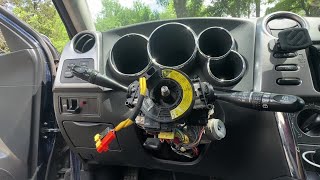
- Toyota and Lexus owners must ignore the front bumper; on these makes, B0103 indicates a failed clock spring in the steering wheel requiring a $300-$500 repair.
- Erase the B0103 code using an SRS-capable OBD-II scanner (costing $80+) after replacing parts, as disconnecting the battery will not reset the airbag module.
What Does B0103 Mean?

Code B0103 means the Sensing and Diagnostic Module (SDM)—the car's main safety computer—has lost communication with or received an invalid signal from the front passenger-side impact sensor ('Sensor 2'). This sensor detects the rapid deceleration of a frontal collision and signals the SDM to deploy the airbags. Because the SDM cannot trust the sensor's input, it disables the entire airbag system to prevent accidental deployment or non-deployment.
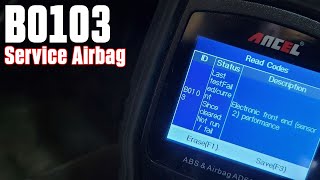
Technical definition: The official SAE/ISO definition is "Electronic Front End Sensor 2 Performance". The SDM sets this code when it fails to receive a valid identification message from the front passenger-side impact sensor within 5 seconds of ignition, loses the continuous status message, or fails to reset the sensor after detecting a fault.
Can I Drive With B0103?

No — Do Not Drive. Driving with code B0103 is extremely unsafe. This code indicates the vehicle's safety computer has disabled the entire Supplemental Restraint System (SRS), including all airbags and seatbelt pretensioners, as a fail-safe. In a collision, the airbags WILL NOT deploy. There is no grace period; the system remains inactive until you repair the fault and clear the code.
Common Causes

- Front Impact Sensor Failure (Very Common) — The sensor is the most frequent failure point. Located at the front of the vehicle, it is highly exposed to moisture, road salt, and physical impact. This exposure causes internal corrosion, swelling, and cracking of the plastic housing, destroying the electronics.
- Corroded or Damaged Connector (Common) — Water and salt intrusion cause the metal pins inside the sensor's electrical connector to develop green or white corrosion. This creates high resistance or an open circuit that the SDM interprets as a complete signal loss.
- Damaged Wiring Harness (Less Common) — Chafing against sharp edges, pinching during previous repairs, rodent damage, or stretching during a minor accident severs or shorts the wiring harness leading to the sensor.
- Previous Accident Damage (Less Common) — A minor front-end collision inflicts latent damage on the sensor, mounting bracket, or wiring. The fault often appears weeks later when corrosion sets into the micro-cracks.
- Incorrect Sensor Installed (Rare) — Using a sensor with the wrong part number or from an incompatible model year causes a communication error. GM sensors require matching two-letter identification codes (like 'MD') for the SDM to recognize them.
- Sensing and Diagnostic Module (SDM) Failure or Water Intrusion (Rare) — Water leaks from bad windshield seals or clogged sunroof drains pool on the floorboards, corroding the SDM. This destroys the module's internal circuitry, triggering B0103 alongside other SRS faults.
- Poor Ground or System Voltage Issues (Rare) — A failing battery, faulty alternator, or corroded chassis ground introduces electrical noise and low voltage conditions. The highly sensitive SRS components misinterpret these anomalies as a sensor circuit fault.
Symptoms

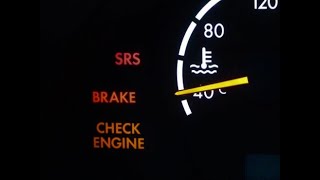
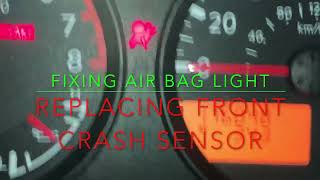
- Airbag Warning Light On — A solid red or amber airbag warning light illuminates on the instrument cluster a few seconds after starting the vehicle and remains on.
- "Service Airbag" Message — The driver information center displays a text warning such as "Service Airbag" or "Service SRS."
- Airbag System Disabled — The entire Supplemental Restraint System (SRS) is inactive and will not deploy in an accident.
- Passenger Airbag 'Off' Light Stays On — The passenger airbag status indicator remains illuminated to show 'OFF', regardless of whether an adult occupies the seat.
- Stored Diagnostic Trouble Code (scan-tool only — no driver-felt sign) — An SRS-capable scan tool reveals B0103 stored in the SDM's memory.
Diagnostic Flowchart

Tap your situation to follow the diagnostic path that matches what you're seeing on this code.
Common Fixes & Costs
- Replace Front Passenger Impact Sensor
— Parts: $70-$250, Labor: $75-$150, ~0.8 hr book time
(DIY)
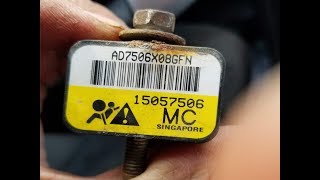
: OEM 15057506 (replaced by 85598001) (Alt: {"brand": "Dorman", "number": "590-200 / 590-200A / 590-202", "price_comparison": "$160-$210"})
: OEM 98581-ZL10B (Alt: {"brand": "Dorman", "number": "590-221", "price_comparison": "$160-$180"}) - Repair or Replace Wiring Connector Pigtail
— Parts: $20-$50, Labor: $150-$300, ~1.5 hr book time
(Intermediate)
: OEM N/A (Alt: {"brand": "Dorman", "number": "645-937", "price_comparison": "$25-$45"}) - Replace Clock Spring (Spiral Cable) - Toyota/Lexus
— Parts: $75-$250, Labor: $150-$300, ~1.5 hr book time
(Intermediate)
: OEM 84306-0E010 (Alt: {"brand": "Dorman", "number": "525-162", "price_comparison": "$80-$150"}) - Repair Damaged Wiring Harness — Parts: $5-$20, Labor: $150-$400, ~2.5 hr book time (Professional)
- Replace Sensing and Diagnostic Module (SDM)
— Parts: $200-$700, Labor: $150-$300, ~2.0 hr book time
(Professional)
: OEM Varies by VIN (Alt: {"brand": "Module Repair Service", "number": "N/A", "price_comparison": "$100-$200 for reset service"})
DIY vs Professional
- Replace Front Impact Sensor — Beginner:
- Replace Clock Spring (Spiral Cable) — Beginner:
- Replace Sensing and Diagnostic Module (SDM) — Beginner:
Used vs. New Parts: Buying Guide
When a used part is worth it: Buying a used front impact sensor is strongly discouraged by safety professionals. Consider it only as an absolute last resort if a new part is unavailable. The $10 junkyard savings is not worth the risk of premature failure on a critical safety component.
Donor-vehicle mileage cap: roughly under 20000 miles for the part to have meaningful remaining life.
Donor quality checklist:
- Verify the donor vehicle was not in a front-end collision.
- Avoid parts from vehicles in 'Salt Belt' regions due to high corrosion risk.
- Inspect the part for a swollen or cracked plastic housing and corroded connector pins.
- Match the OEM part number exactly; visual similarity is insufficient.
Decision logic:
- If The part is a critical safety component like an airbag sensor. → Always buy a new OEM or high-quality aftermarket part.
- If Budget is the absolute primary concern and the vehicle is old. → A used part is a gamble that frequently requires repeating the labor.
- If An aftermarket part (e.g., Dorman) is available. → Research reviews for that specific part number, as quality varies.
Warranty tradeoff: Used junkyard parts offer a 30-day warranty covering only the part. New aftermarket parts offer 1-year to lifetime warranties. New OEM parts guarantee compatibility and quality.
Worst-case if a used part fails: $200-$400 if a used part fails, requiring repeat labor and a new part purchase.
What Happens If You Wait — Timeline
- Immediately (0 seconds): The 'Service Airbag' light illuminates. The SDM logs code B0103 and disables the entire Supplemental Restraint System as a fail-safe. (MPG impact: 0%% · Added cost: $0)
- 0 seconds - Until Repaired: The vehicle remains in a state of zero airbag protection. In any collision requiring airbags, they will not deploy. (MPG impact: 0%% · Added cost: Unquantifiable risk of severe injury or death to occupants.)
- At the next state safety inspection: The vehicle fails the visual safety inspection due to the illuminated airbag warning light, preventing registration renewal. (MPG impact: 0%% · Added cost: $20-$50 in re-inspection fees, plus the mandatory repair cost.)
- At time of vehicle sale: An active airbag light significantly lowers the vehicle's resale or trade-in value, as the buyer assumes the cost and liability of the repair. (MPG impact: 0%% · Added cost: $300-$600 reduction in vehicle value.)
Cost of Not Fixing It
- Immediately: The entire Supplemental Restraint System (SRS) is disabled. In a collision, NONE of the vehicle's airbags or seatbelt pretensioners will deploy. (Added cost: Critical risk of severe injury or death for all occupants.)
- During State Inspection: The vehicle automatically fails its annual safety inspection in states that check the SRS warning light, preventing legal registration renewal. (Added cost: Cost of re-inspection fees plus the mandatory repair cost.)
- Long-Term: There is no progressive mechanical damage. The sole consequence remains the complete failure of the passive safety system. (Added cost: N/A)
Diagnosis Steps
- Confirm the Code with an SRS Scanner
Use an OBD-II scanner capable of reading SRS/Airbag (B-prefix) codes to verify B0103. Basic engine code readers will not work. Note any other codes, especially B0100 (driver-side sensor), to gather diagnostic clues.
Tools: OBD-II Scanner (with SRS/Airbag capability) (Beginner) - Perform a Detailed Visual Inspection
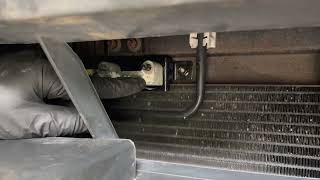
Safely raise the front of the vehicle. Locate the passenger-side front impact sensor (a small plastic box with a yellow connector bolted to the radiator support or frame rail). Look for a cracked or bulging sensor housing and heavy corrosion.
Tools: Jack, jack stands, flashlight (Beginner) - Swap the Front Sensors (GM/Nissan Specific)
On many GM trucks/SUVs and Nissan models, the driver (B0100) and passenger (B0103) sensors are identical. Swap their mounting positions. Reconnect the battery, clear the codes, and start the vehicle. If the code changes to B0100, the sensor is definitively bad. If B0103 returns, the passenger-side wiring is faulty.
Tools: 10mm socket/wrench (Intermediate) - Inspect and Clean the Connector and Wiring
CRITICAL SAFETY STEP: Disconnect the negative battery terminal and wait 30 minutes. Unplug the sensor's yellow connector. Inspect the terminals for green/white corrosion or bent pins. Spray the connector with electrical contact cleaner, scrub with a terminal brush, and apply dielectric grease. Follow the wiring harness back, looking for cuts or chafing.
Tools: Socket set, safety glasses, electrical contact cleaner, terminal cleaning brush, dielectric grease (Intermediate) - Test the Circuit with a Multimeter (GM/Nissan)
With the battery disconnected and sensor unplugged, check for continuity to ground on the ground wire (<1 ohm). Check the signal and voltage supply wires for a short to ground. Reconnect the battery, turn the ignition ON (engine OFF), and probe the connector for the 5V or 12V reference signal from the SDM. Missing voltage points to a wiring or SDM issue.
Tools: Multimeter, vehicle-specific wiring diagram (Advanced) - Test the 'D Squib Circuit' (Toyota/Fiat)
On Toyota/Fiat models where B0103 means 'Short to B+', disconnect the battery and the spiral cable connector at the steering column. Measure the resistance between the two terminals for the driver's airbag on the spiral cable side. A normal reading is 1.5 to 4.0 ohms. An infinite reading (OL) indicates an open circuit in the clock spring.
Tools: Multimeter, vehicle-specific wiring diagram, trim removal tools (Advanced) - Analyze Live Data & Signal with Oscilloscope
Monitor live data PIDs for the front impact sensors using an advanced scan tool. Back-probe the signal wire at the sensor connector with an oscilloscope. A healthy sensor produces a digital square wave when the ignition is on. Proper power and ground with no waveform confirms internal sensor failure.
Tools: Oscilloscope, back-probe pins, advanced scan tool, wiring diagram (Professional)
When This Code Triggers (Freeze-Frame Conditions)
- System Self-Test: Active (The code sets during the initial 5-7 second power-on self-test the SDM runs after turning the ignition to 'ON' or 'RUN'.)
- Ignition Voltage: 10-16 Volts (The fault logs when the SDM powers on and attempts communication. Low battery voltage during startup triggers spurious SRS codes.)
- Vehicle Speed: 0 mph (The check happens at startup before the vehicle moves.)
- Engine RPM: 0 or ~600-800 RPM (The fault logs with the key in the 'ON' position (engine off) or immediately after the engine settles to idle.)
Related Codes
- B0100 — Indicates the identical fault for the driver-side front impact sensor ('Sensor 1'). Swapping the two sensors determines if the sensor or wiring is faulty. If the code changes from B0103 to B0100, the sensor is bad.
- B0102 — Indicates the sensor's signal circuit is shorted to ground. Diagnosed by checking for continuity between the signal wire and chassis ground.
- B0104 — Indicates the sensor's signal circuit is shorted to voltage (B+). Diagnosed by checking for battery voltage on the signal wire.
- B00A0 — On Nissan vehicles, B0103 appears alongside this 'Occupant Detection Sensor Unit' fault. A full scan determines if the front impact sensor is the primary cause.
Climate & Environmental Factors
- Road Salt: This is the single most significant factor for B0103 on GM and Nissan vehicles. The front impact sensor sits behind the bumper, constantly sprayed with salt and water in winter climates. This aggressive corrosion destroys the internal electronics and connector pins.
- High Humidity / Water Intrusion: Moisture accelerates corrosion even without road salt. Water leaks from clogged sunroof drains pool on the floor, damaging the main airbag control module (SDM) and triggering B0103.
How to Talk to a Mechanic About This Code
Say this: "I have an airbag light on and my scanner shows code B0103 for the front passenger impact sensor. My vehicle is a [Year/Make/Model]. I'd like to schedule a diagnostic to confirm if the fault is the sensor itself or the wiring. If it's a GM, please swap the front sensors as a diagnostic step."
This signals you understand the code's meaning and common causes. Mentioning your vehicle's make suggests a specific, efficient diagnostic test, discouraging unnecessary part replacement.
Avoid saying:
- 'My airbag light is on, can you just fix it?'
- 'I'm not sure what's wrong, just do whatever it takes.'
- 'A friend said it might be the sensor, so just replace that.'
Questions to ask before authorizing the repair:
- What was the result of your visual inspection of the sensor and connector?
- Did you test the circuit, or are you recommending a part replacement based only on the code?
- If you are recommending a sensor replacement, is the part a new OEM or a quality aftermarket part with a warranty?
- Does your estimate include clearing the hard fault code from the SRS module after the repair?
- If my car is a Toyota, have you ruled out a clock spring issue, since B0103 points to that on my vehicle?
Where to Take It: Dealer vs Independent vs Chain
- Dealer:
Best for: Vehicles under warranty or with a known recall (e.g., Nissan front sensor recall)., Complex cases on Toyota/Lexus where B0103 means a clock spring issue., Any repair requiring replacement and programming of the main SRS/SDM module.
Downsides: Significantly higher labor rates and parts costs compared to independent shops., Less willing to perform simpler diagnostics like a sensor swap. (Typical cost: +50% vs. baseline) - Independent Shop:
Best fit for the most common cause (GM/Nissan sensor failure). Ensure the shop is ASE-certified and has a scanner that reads and clears SRS codes.
Best for: Common, out-of-warranty repairs like the front impact sensor on a GM or Nissan., Vehicles where cost is a primary concern., Building a long-term relationship with a trusted mechanic.
Downsides: Shop quality and experience with SRS systems vary widely., May lack the expensive, manufacturer-specific software needed for module programming. (Typical cost: +0% vs. baseline) - Chain Shop:
AVOID. The risk of an incorrect or incomplete repair on a critical safety system is too high.
Best for: Simple maintenance like oil changes and tires.
Downsides: Technicians lack specialized training for critical safety systems like airbags., High pressure to upsell leads to misdiagnosis or unnecessary repairs., May not have the correct diagnostic tools for SRS systems. (Typical cost: -10% vs. baseline)
When to Walk Away From the Repair
Because this is a critical safety repair, the decision is less about vehicle value and more about immediate safety. If the repair cost exceeds $2,000 on a car worth less than $5,000, sell the car 'as-is' to a specialized buyer.
- Car worth $4000, fix is $450: Fix it. The cost is a small fraction of the car's value and restores critical safety.
- Car worth $12000, fix is $600: Fix it. This is a routine cost of ownership for a vehicle of this value.
- Car worth $2500, fix is $1800: Walk away. The repair cost approaches the car's total value. Sell as-is with full disclosure to a dealer.
What Scan Tool You Need for This Code
Minimum: An OBD-II scanner that reads and clears Supplemental Restraint System (SRS/Airbag) codes. A basic engine-only code reader will NOT work.
A standard $20 code reader only communicates with the engine control unit. Airbag codes like B0103 are stored in a separate computer, the Sensing and Diagnostic Module (SDM). You need a tool specifically advertised with SRS capabilities.
Budget: Autel AutoLink AL619 (~$80) — Reads and clears codes for Engine, ABS, and SRS systems. It confirms B0103 is the active code and clears it after the repair is complete to turn off the light.
Mid-range: Foxwell NT630 Plus (~$150) — Provides robust ABS and SRS diagnostics, including reading codes, viewing live sensor data, and performing active tests. Offers lifetime free updates.
Professional: Autel MaxiCOM MK808BT (~$550) — Offers full-system diagnostics with advanced features. Provides live data streaming, component testing, and performs programming functions if the SDM needs replacement.
Rent vs buy: Most auto parts stores' free 'loaner tool' programs offer basic engine code readers that CANNOT read SRS codes. Buying a budget SRS scanner is often more economical than paying for a single diagnostic fee at a shop.
How to Clear the Code After You Fix It
- Ensure the new or repaired component is securely connected.
- Reconnect the negative battery terminal.
- Use an OBD-II scan tool with SRS/Airbag capability to access the SRS module.
- Select the function to 'Clear DTCs' or 'Erase Codes'.
- Cycle the ignition off, then on again, and verify the airbag warning light performs its 7-second self-test and turns off permanently.
Drive cycle (~10 minutes): A specific drive cycle is not required. The system performs a self-test every time the ignition turns on. If the repair is successful and the code is cleared, the light stays off. A 10-minute test drive confirms stability.
Readiness monitors affected: None. The B0103 code is part of the SRS system and does not affect engine emissions readiness monitors.
Watch out for:
- Using a basic engine code reader that cannot access the SRS module.
- Forgetting to clear the code after the repair, leaving the light on despite a successful fix.
- Believing that disconnecting the battery clears the code; it will not clear a hard SRS fault.
Will This Fail Emissions / State Inspection?
No — by itself this code doesn't fail OBD inspection (but it can keep readiness monitors from setting, which causes a separate fail).
- California: Will NOT fail. California's Smog Check program tests emissions-related faults. An airbag light does not cause a smog test failure.
- New York: Will NOT fail, but will be noted. The NYS inspection checks the airbag warning light and notes it as an advisement, but it is not grounds for failure.
- Texas: Will NOT fail. The Texas vehicle inspection does not include the SRS system as a pass/fail item.
Most Commonly Affected Vehicles
- Chevrolet Silverado 1500/2500HD, Tahoe, Suburban, Avalanche (2003-2007) — Extremely common failure. The sensors (GM Part #15057506) are highly vulnerable to road salt corrosion, causing the housing to split open.
- GMC Sierra 1500/2500HD, Yukon, Yukon XL (2003-2007) — Identical platform to Chevrolet models suffering the exact same sensor failure. The diagnostic sensor swap is highly effective here.
- Cadillac Escalade, Escalade EXT (2003-2006) — Uses the same SRS components as the GM truck platform and is prone to the identical B0103 fault.
- Nissan Xterra, Frontier, Pathfinder (2005-2015) — The single front center impact sensor mounts low and center, frequently failing from water and debris damage. Subject to recall 08V-690 in 'Salt Belt' states.
- Toyota Tacoma, Sienna (2003-2010) — CRITICAL DISTINCTION: On these models, B0103 indicates a 'Short to B+ in D Squib Circuit', pointing to a fault in the driver's side airbag or clock spring, NOT the front impact sensor.
- Hyundai Sonata, Elantra (2011-2017) — Front impact sensor faults occur on the upper radiator support, though clock spring issues are also common.
- Hummer H2 (2003-2007) — Built on the GM truck platform, using the same front impact sensors and suffering the same high failure rate from corrosion.
- Buick / Pontiac Rendezvous, Aztek, Montana (2002-2007) — GM minivans and SUVs from this era share similar SRS architecture and experience B0103 faults from sensor corrosion.
Manufacturer-Specific Notes
- General Motors (Chevrolet/GMC/Cadillac/Hummer): Exceptionally common on 2003-2007 trucks. The passenger (B0103) and driver (B0100) sensors are identical part numbers, allowing you to swap them to confirm a bad sensor versus a wiring problem.
- Toyota / Lexus: Toyota uses B0103 to indicate a 'Short to B+ in D Squib Circuit'. This points directly to the driver's airbag inflator circuit and clock spring, NOT the front impact sensor. Misdiagnosing this is a costly mistake.
- Nissan: After replacing the faulty front impact sensor, the airbag light sometimes turns off on its own after several drive cycles. However, using a scan tool to clear it immediately is the recommended procedure.
- Fiat: B0103 defines as 'Front Driver Airbag 1st Stage - Circuit Resistance Above Threshold'. Similar to Toyota, this points to a fault in the driver's side airbag circuit, not a passenger-side impact sensor.
Real Owner Stories
2005 GMC Yukon - Easy DIY Sensor Fix
The owner of a 2005 GMC Yukon in a 'Salt Belt' state saw the 'Service Airbag' message at 150,000 miles. A scan confirmed code B0103.
Outcome: They purchased a Dorman 590-200 replacement sensor for $180. After disconnecting the battery, they replaced the sensor in 30 minutes and cleared the code with a borrowed SRS scanner. The light stayed off.
Lesson: On 2003-2007 GM trucks, B0103 is almost always a textbook sensor failure due to corrosion. A quick visual check for a cracked housing confirms the diagnosis.
2014 Toyota Tacoma - Misdiagnosis and Wasted Money
A 2014 Tacoma had an active airbag light after a previous collision. A scan showed codes related to the clock spring circuit.
Outcome: Further diagnosis revealed the main airbag control module (ECU) was faulty from the initial deployment. The original clock spring was fine, making the initial purchase unnecessary.
Lesson: On a Toyota, B0103 points to the driver's airbag circuit, not the front bumper sensor. Don't assume the clock spring is the only cause; the airbag ECU also fails after collisions.
2003 Chevy 2500HD - Both Sensors Fail at Once
The owner of a high-mileage 2003 Duramax had an active airbag light. A scan revealed both B0100 (Driver side) and B0103 (Passenger side) codes active simultaneously.
Outcome: After installing a two-pack of replacement sensors and clearing the codes, the airbag light went out permanently.
Lesson: It is common for both front impact sensors to fail simultaneously from age and corrosion. If both show visible damage, replace them as a pair.
How to Prevent This Code From Triggering
- Apply Dielectric Grease to Connectors (Every 2-3 years or during any front-end service) — Dielectric grease blocks moisture and oxygen from reaching the metal pins, preventing the green/white corrosion that causes high resistance and signal loss.
- Apply a Corrosion Inhibitor Spray/Undercoating (Annually, before winter) — Spraying a wax-based undercoating on the radiator support and sensor brackets creates a physical barrier against road salt, slowing the corrosion that destroys the sensor body.
- Regular Undercarriage Washes (Frequently during winter months in 'Salt Belt' regions) — Washing away road salt and de-icing brines prevents highly corrosive materials from attacking the sensors, connectors, and wiring.
- Clear Cabin and Sunroof Drains (Annually) — Clogged drains cause water to pool on the floorboards, saturating and corroding the main Sensing and Diagnostic Module (SDM) mounted under the seats or center console.
Frequently Asked Questions
Is it safe to drive with code B0103?
No. The B0103 code confirms your entire airbag system is shut down. In a crash, no airbags will deploy, dramatically increasing the risk of serious injury or death.
Can I fix code B0103 myself?
Yes, replacing a bad sensor on a GM or Nissan is a straightforward DIY repair requiring only a 10mm socket. You must disconnect the battery for 30 minutes before starting work to de-energize the system safely.
Will the airbag light go off by itself after I replace the sensor?
Rarely. B0103 is a hard code stored in the airbag control module. You must manually clear it using an OBD-II scanner with SRS capabilities.
How much does it cost to fix code B0103?
A shop charges $150 to $400 to replace a GM or Nissan front sensor. A DIY repair costs $70 to $250 for the part. Toyota clock spring repairs cost $250 to $500 due to complex steering column labor.
What is the difference between B0103 and B0100?
They indicate the exact same problem on opposite sides of the vehicle. B0103 is the passenger-side sensor, and B0100 is the driver-side sensor.
Could a bad clock spring cause a B0103 code?
On GM, Ford, and Nissan, no. On Toyota, Lexus, and Fiat, yes, because B0103 specifically refers to the driver's airbag circuit containing the clock spring.
Will disconnecting the battery clear the B0103 code?
No. Disconnecting the battery is a crucial safety step before repair, but it does not clear stored SRS fault codes. You must erase the code with a compatible scan tool.
My truck only has one front impact sensor, but the code is B0103 'Sensor 2'. Why?
GM software often programs the Sensing and Diagnostic Module (SDM) to use the 'Sensor 2' designation for the passenger side, even if 'Sensor 1' is absent. If you only have one sensor, B0103 refers to that single unit.
Key Takeaways
- Code B0103 instantly disables your entire airbag system, making the vehicle unsafe to drive until repaired.
- On 2003-2007 GM and 2005-2015 Nissan vehicles, road salt corrosion destroys the front passenger impact sensor, causing over 80% of B0103 faults.
- Swap the driver (B0100) and passenger (B0103) sensors on GM trucks to definitively test if the sensor is dead; if the code moves, replace the $150 sensor.
- Toyota and Lexus owners must ignore the front bumper; on these makes, B0103 indicates a failed clock spring in the steering wheel requiring a $300-$500 repair.
- Erase the B0103 code using an SRS-capable OBD-II scanner (costing $80+) after replacing parts, as disconnecting the battery will not reset the airbag module.
Helpful Videos

The information in this article is provided for general reference and educational purposes only. Vehicle specifications, procedures, and part compatibility can vary by production date, trim level, and region. Always consult your vehicle's factory service manual and verify part numbers before purchasing or performing repairs. Safety-critical components such as airbags, seat belts, and braking systems should be installed by a qualified professional.
- 🎬 Helpful Videos
- What Does B0103 Mean?
- Can I Drive With B0103?
- Common Causes
- Symptoms
- Diagnostic Flowchart
- Common Fixes & Costs
- DIY vs Professional
- Used vs. New Parts: Buying Guide
- What Happens If You Wait — Timeline
- Cost of Not Fixing It
- Diagnosis Steps
- When This Code Triggers (Freeze-Frame Conditions)
- Related Codes
- Climate & Environmental Factors
- How to Talk to a Mechanic About This Code
- Where to Take It: Dealer vs Independent vs Chain
- When to Walk Away From the Repair
- What Scan Tool You Need for This Code
- How to Clear the Code After You Fix It
- Will This Fail Emissions / State Inspection?
- Most Commonly Affected Vehicles
- Manufacturer-Specific Notes
- Real Owner Stories
- 2005 GMC Yukon - Easy DIY Sensor Fix
- 2014 Toyota Tacoma - Misdiagnosis and Wasted Money
- 2003 Chevy 2500HD - Both Sensors Fail at Once
- How to Prevent This Code From Triggering
- Frequently Asked Questions
- Is it safe to drive with code B0103?
- Can I fix code B0103 myself?
- Will the airbag light go off by itself after I replace the sensor?
- How much does it cost to fix code B0103?
- What is the difference between B0103 and B0100?
- Could a bad clock spring cause a B0103 code?
- Will disconnecting the battery clear the B0103 code?
- My truck only has one front impact sensor, but the code is B0103 'Sensor 2'. Why?
- Key Takeaways
- 🎟️ Get 5% Off