

OBD-II Code B0084: A Comprehensive Guide for Mechanics and DIYers
Why B0084 is Rarely a Seatbelt Problem and Almost Always a Sensor or Wiring Fault
- Code B0084 rarely indicates a seatbelt issue; on over 80% of affected GM vehicles, it points to a failed right front impact sensor or seat position sensor.
- Swapping the left and right front impact sensors is the definitive diagnostic test; if the code changes to B0083, the sensor is confirmed defective.
- Always disconnect the negative battery terminal and wait 15 minutes before touching any yellow SRS connectors to prevent accidental airbag deployment.
- An active B0084 code completely disables the vehicle's Supplemental Restraint System, meaning zero airbags will deploy in a collision.
What Does B0084 Mean?

The trouble code B0084 signifies that the vehicle's primary safety computer (the SRS or SDM module) has detected a critical electrical fault in a safety circuit. While the generic SAE definition points to the 'Second Row Center Seatbelt Pretensioner', this is highly misleading. On the vast majority of vehicles (especially General Motors), B0084 is a manufacturer-specific code indicating a fault with the right front impact sensor or a seat position sensor. Because of this fault, the SDM disables the entire airbag system.
Technical definition: The official SAE/ISO definition for B0084 is "Second Row Center Seatbelt Load Limiter Deployment Control." However, manufacturers frequently reassign this code. On most GM vehicles, it corresponds to the "Electronic Front End Sensor 2 (Right)" and includes a two-digit symptom byte (like -39 for Internal Electronic Failure or -04 for Open Circuit) that pinpoints the exact electrical failure.
Can I Drive With B0084?
No — Do Not Drive. Driving with an active B0084 code is a severe safety risk. The fault forces the Sensing and Diagnostic Module (SDM) to disable the entire Supplemental Restraint System (SRS) as a fail-safe. In a collision, zero airbags will deploy and the seatbelt pretensioners will not function, dramatically increasing the risk of serious injury or death.
Common Causes

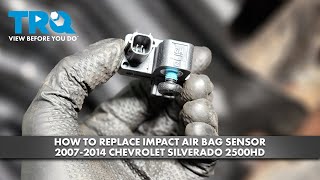
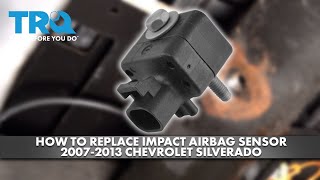
- Cracked or corroded front impact sensor (Very Common) — On GM vehicles, front impact sensors mount low on the radiator support, exposing them to water and road salt. Moisture penetrates the housing, corrodes internal components, and cracks the plastic casing, destroying the electronics. 🎬 Watch: Step-by-step guide to replacing a cracked front impact sensor. Overtightening the mounting bolt also cracks the housing.
- Damaged, broken, or corroded SRS wiring (Very Common) — Wiring harnesses fail from physical stress, rodent damage, or moisture. Wires under seats stretch and break from seat movement, while front sensor connectors suffer pin corrosion from road spray. Internal copper wires often break while the outer insulation remains visually intact.
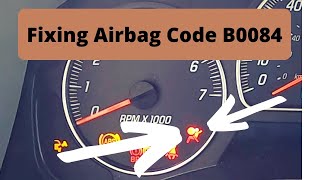
- Faulty seat position sensor (Common) — On specific GM and SAAB models, B0084 indicates a failed driver or passenger seat position sensor. This sensor dictates deployment force based on seat proximity to the dashboard; an electrical failure here triggers the code. 🎬 See how to diagnose and fix a B0084 seat sensor fault.
- Faulty Airbag Control Module (SDM) (Less Common) — The main safety module fails from internal driver faults, voltage spikes, or water intrusion under the vehicle's carpet. This requires complete module replacement and VIN programming.
- Faulty second-row center seatbelt pretensioner (Uncommon) — While this is the generic SAE definition, actual pretensioner failure is rare. The internal pyrotechnic squib degrades over time, pushing electrical resistance outside the required 2-4 ohm range.
Symptoms

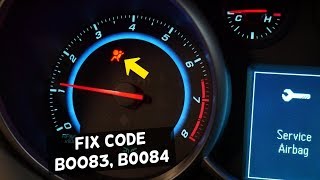
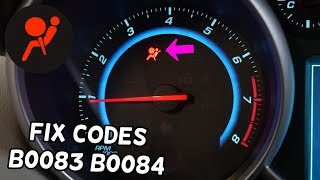
- Airbag or SRS warning light illuminated — The red airbag icon remains lit on the dashboard, often accompanied by a 'Service Airbag' message in the driver information center.
- Audible warning chime on startup — The vehicle sounds a repetitive chime when started to alert the driver to the critical safety system failure.
- Complete disablement of the airbag system (scan-tool only — no driver-felt sign) — The SDM shuts down the entire SRS network. No airbags will deploy and seatbelt pretensioners will not fire in a crash.
Diagnostic Flowchart

Tap your situation to follow the diagnostic path that matches what you're seeing on this code.
Common Fixes & Costs
- Replacing the front impact sensor — Parts: $60-$150, Labor: $75-$150, ~0.5 hr book time (DIY)
- Repairing or replacing the SRS wiring harness/connector — Parts: $30-$80, Labor: $150-$300, ~1.5 hr book time (Intermediate)
- Replacing the seat position sensor — Parts: $100-$250, Labor: $150-$225, ~1.0 hr book time (Intermediate)
- Replacing the Airbag/SRS Control Module (SDM) — Parts: $350-$600, Labor: $250-$400, ~2.0 hr book time (Professional)
Used vs. New Parts: Buying Guide
When a used part is worth it: Buying a used front impact sensor makes sense only if the donor vehicle has low mileage, was not in a front-end collision, and originates from a state that does not use road salt.
Donor-vehicle mileage cap: roughly under 80000 miles for the part to have meaningful remaining life.
Donor quality checklist:
- Verify the donor vehicle's airbags did not deploy.
- Inspect the used sensor housing for hairline cracks or swelling.
- Check the metal connector pins for any trace of green or white corrosion.
Decision logic:
- If The part is a front impact sensor → Buy a new OEM or high-quality aftermarket part. The $60-$100 cost is too low to justify the risk of a used sensor failing from hidden internal corrosion.
- If The part is a wiring pigtail or connector → Always buy new to guarantee a clean, corrosion-free electrical connection.
- If The part is the SDM module → A used module is acceptable to save money, but you must verify the part numbers match exactly and pay a shop to reprogram it to your VIN.
Warranty tradeoff: Used sensors carry a 30-day warranty. New aftermarket sensors (like Dorman) offer a limited lifetime warranty, protecting you against future moisture failures.
Worst-case if a used part fails: 150
What Happens If You Wait — Timeline
- Immediately: The 'Service Airbag' light illuminates. The SDM disables the entire Supplemental Restraint System (SRS) as a fail-safe. (MPG impact: 0%% · Added cost: 0)
- 0-12 months: The vehicle automatically fails state safety inspections, preventing legal registration renewal. The critical safety risk remains constant. (MPG impact: 0%% · Added cost: 150)
- At time of collision: Catastrophic failure of the passive safety system. Zero airbags deploy and seatbelt pretensioners do not activate, resulting in severe injury. (MPG impact: 0%% · Added cost: 0)
Cost of Not Fixing It
- Immediately: The entire Supplemental Restraint System (SRS) is disabled. Zero airbags will deploy and seatbelt pretensioners will not activate in a collision. (Added cost: 0)
- Short-Term (0-6 months): The vehicle will automatically fail mandatory state safety inspections, preventing legal registration renewal. (Added cost: 150)
- Long-Term (6+ months): There is no progressive mechanical damage, but the extreme risk of serious injury or death in an accident remains constant. (Added cost: 0)
Diagnosis Steps
- Read Manufacturer-Specific SRS Codes
Use an SRS-capable OBD-II scanner to read the codes. Record the full code, including the two-digit suffix (e.g., B0084-39). Rely strictly on the manufacturer-specific definition provided by the scanner, which usually points to a front impact sensor or seat sensor.
Tools: SRS-capable OBD-II Scanner (Beginner) - SAFETY FIRST: Disconnect the Battery
Disconnect the negative terminal of the car battery and wait exactly 15 minutes. This discharges the SRS backup power capacitors, preventing accidental airbag deployment while you handle the sensors and wiring.
Tools: 10mm wrench (Beginner) - Perform a Thorough Visual Inspection
Inspect the component identified by the code. For a front impact sensor, check for a cracked plastic housing or green corrosion on the connector pins. For a seat sensor, inspect the yellow wiring harness under the seat for pinched, frayed, or stretched wires.
Tools: Flashlight (Beginner) - PRO TIP: Swap the Front Impact Sensors
If the code points to the right front impact sensor, swap it with the identical left front impact sensor. Reconnect the battery and scan again. If the code changes to B0083 (Left Front Impact Sensor), the sensor is definitively defective. If B0084 remains, the wiring harness is the problem.
Tools: 10mm wrench or socket (Intermediate) - Perform a Harness Wiggle Test
If the fault is intermittent, have a helper watch the live data on a scanner while you gently wiggle the wiring harness leading to the suspect component. If the sensor status changes from 'OK' to 'Fault', you have located the wiring break.
Tools: SRS-capable OBD-II Scanner, Helper (Intermediate) - Check Live Data PIDs
Monitor the live data for 'Front End Sensor 2' or the relevant seat sensor. An erratic signal, or a status locked on 'Invalid', confirms a communication failure between the sensor and the SDM.
Tools: Advanced Bi-Directional Scanner (Advanced) - Test Component Circuit Resistance
With the battery disconnected, measure the resistance across the two pins of the pretensioner or impact sensor. A healthy pyrotechnic squib reads between 2.0 and 3.0 ohms. An infinite reading (OL) means an open circuit; near-zero means a short. Never apply external voltage to SRS circuits.
Tools: Digital Multimeter (Advanced) - Test the Vehicle-Side Harness
Disconnect the sensor and the SDM. Check for continuity on each wire from the sensor connector to the SDM connector (expecting less than 1.0 ohm). Test each wire for a short to ground (expecting infinite resistance).
Tools: Digital Multimeter, Wiring Diagram (Advanced) - Analyze the Sensor Signal with an Oscilloscope
Front impact sensors communicate via a modulated current square wave. Probe the signal wire with a lab scope. A flat line or erratic pattern indicates a failed sensor or crushed wire. Compare the right sensor's waveform to the known-good left sensor.
Tools: Automotive Oscilloscope, Wiring Diagram (Professional)
When This Code Triggers (Freeze-Frame Conditions)
- Ignition Status: ON (The fault is detected during the Power-On Self-Test (POST) immediately after the ignition is turned on.)
- System Voltage: 9-16 Volts (The SDM requires normal operating voltage to run its self-tests and poll the sensors.)
- Component Status: Faulted (The code sets instantly if a sensor fails to respond, sends corrupt data, or reports an internal short/open circuit.)
Related Codes
- B0083 — The direct counterpart to B0084. On GM vehicles, B0083 indicates a fault with the left front impact sensor. Swapping the sensors to see if the code changes is the best diagnostic step.
- B0085 — Refers to the Left Front Side Impact Sensor (usually in the door or B-pillar). Seeing this alongside B0084 indicates a larger system issue, such as a failing SDM or shared ground fault.
- B0081 — Points to a fault in the Passenger Presence System. Because this wiring is often bundled with the seat position sensor, a crushed under-seat harness can trigger both codes simultaneously.
Climate & Environmental Factors
- High Humidity and Road Salt: This is the leading cause of B0084. Front impact sensors are mounted in areas highly exposed to road spray. Saltwater accelerates corrosion, causing the sensor's internals to swell and crack the housing, leading to total failure.
- Extreme Cold: Cold temperatures cause metal electrical contacts to contract, exposing marginal connections. This triggers an intermittent B0084 code on cold mornings that disappears as the engine bay warms up.
- Interior Water Intrusion: Leaks from a clogged sunroof drain or poorly sealed windshield saturate the vehicle's carpet. This destroys the SDM or seat position sensor connectors located on the floorboard.
How to Talk to a Mechanic About This Code
Say this: "I have an airbag light on, and my scanner shows code B0084. I know on my vehicle this points to the right front impact sensor or a seat position sensor, not the second-row seatbelt. I'd like to schedule a diagnostic to confirm if the fault is the sensor itself or the wiring leading to it."
This proves you understand the specific quirks of this code. It directs the technician away from the misleading generic definition and prevents wasted diagnostic time.
Avoid saying:
- 'My airbag light is on, can you just fix it?'
- 'The code says it's a seatbelt problem.'
- 'Just do whatever you think is best.'
Questions to ask before authorizing the repair:
- What specific failure did you find? Was it the sensor, the connector, or a break in the wire?
- If the sensor is bad, can you show me the crack or corrosion on the old part?
- If the wiring needs repair, are you using manufacturer-approved splice connectors?
- Will you provide a written estimate before starting the work?
Where to Take It: Dealer vs Independent vs Chain
- Dealer:
Best for recall-related issues or module programming, but the most expensive route for a simple sensor replacement.
Best for: Vehicles under warranty., Confirmed software issues or recalls (like GM TSB #16007)., SDM module replacements requiring VIN programming.
Downsides: Significantly higher labor rates and parts costs., May default to replacing an entire $800 wiring harness when a $30 pigtail repair is possible. (Typical cost: +50% vs. baseline) - Independent Shop:
The best fit for most B0084 scenarios. An experienced independent technician diagnoses and replaces a faulty sensor far more cost-effectively than a dealer.
Best for: Out-of-warranty vehicles., Common failures like the front impact sensor on GM trucks., Shops that specialize in automotive electrical diagnostics.
Downsides: Quality varies. Vet the shop by checking for ASE electrical certifications., May lack the software to program a new SDM module. (Typical cost: +0% vs. baseline) - Chain Shop:
AVOID for B0084 diagnosis. The risk of misdiagnosis or improper handling of safety-critical SRS components is too high.
Best for: Simple maintenance like oil changes or tires.
Downsides: Technicians lack specialized training for SRS diagnostics., Not equipped for complex wiring repairs or module programming. (Typical cost: -10% vs. baseline)
When to Walk Away From the Repair
Because a B0084 fault renders the car unsafe, it must be fixed. If the repair cost exceeds 40% of the car's value, evaluate your options, but the vehicle cannot be safely driven as-is.
- Car worth $4000, fix is $250: Fix it. This is a low-cost repair for a critical safety system.
- Car worth $4000, fix is $1200: Borderline. A quote this high suggests an SDM module replacement. Get a second opinion to confirm it's not a simpler wiring issue.
- Car worth $2000, fix is $1200: Walk away. The repair cost is approaching the vehicle's total value.
What Scan Tool You Need for This Code
Minimum: A scanner specifically advertised to read and clear Supplemental Restraint System (SRS/Airbag) codes.
A standard $20 OBD-II code reader only checks engine codes. It cannot communicate with the SDM module and will display 'No Codes Found' while your airbag light remains on.
Budget: Autel AutoLink AL619 or Foxwell NT630 Plus (~$70-100) — Reads and clears SRS codes, displays the code definition, and shows live data, which is sufficient for DIY B0084 diagnosis.
Mid-range: Autel MaxiCOM MK808 (~$300-350) — Provides manufacturer-specific code suffixes (-39, -71) and offers bi-directional control to test components.
Professional: Launch X431 Series (~$700-1200) — Offers dealership-level capabilities, including the ability to program a new SDM module to your VIN.
Rent vs buy: Auto parts stores rent basic code readers that CANNOT read SRS codes. Buying a $70 budget-tier SRS scanner is cheaper than paying for a single diagnostic session at a shop.
How to Clear the Code After You Fix It
- Reconnect the negative battery terminal.
- Turn the ignition ON without starting the engine.
- Use an SRS-capable OBD-II scan tool to clear the B0084 code.
- Turn the ignition OFF, then start the engine. Verify the airbag warning light performs its 7-second self-check and turns off permanently.
Drive cycle (~10 minutes): SRS codes do not require a traditional emissions drive cycle. The SDM performs a complete circuit check immediately upon startup. If the light stays off after the initial key-on self-test, the repair is successful.
Readiness monitors affected: Supplemental Restraint System (SRS)
Watch out for:
- Using a basic $20 code reader that cannot access the SRS module to clear the history code.
- Assuming the repair failed because the light didn't turn off instantly; you must cycle the ignition to trigger the self-test.
- Overtightening the new front impact sensor bolt, which cracks the plastic housing and guarantees a repeat failure.
Will This Fail Emissions / State Inspection?
No — by itself this code doesn't fail OBD inspection (but it can keep readiness monitors from setting, which causes a separate fail).
- California: An illuminated airbag warning light is an automatic failure for the state safety inspection. The vehicle cannot be registered until repaired.
- Texas: The airbag warning light is checked during the annual safety inspection. An active light results in an immediate failure.
- New York: The airbag warning lamp is checked during the NYS safety inspection. If lit, it is noted as an advisement but does NOT cause an inspection failure.
Most Commonly Affected Vehicles
- Chevrolet Tahoe / Suburban (2007-2014) — Extremely common for B0084 to indicate a cracked right front impact sensor on the radiator support. Do not overtighten the 10mm mounting bolt on the replacement.
- GMC Yukon / Yukon XL (2007-2014) — Shares the same platform as the Tahoe and suffers identical front impact sensor failures. Swapping the left and right sensors is the definitive diagnostic test.
- Cadillac Escalade (2007-2020) — Prone to front impact sensor corrosion. For 2015-2017 models, check for TSB #16007 regarding an SDM software glitch that requires dealership reprogramming.
- Chevrolet Silverado (2007-2021) — B0084 consistently refers to the right front impact sensor. The harness is routed low, making it highly susceptible to road salt corrosion and rodent damage.
- GMC Sierra (2007-2021) — Mechanically identical to the Silverado. Always inspect the wiring connector for green corrosion before installing a new sensor.
- Chevrolet Cruze (2011-2016) — B0084 reliably points to a fault with the right front impact sensor on the upper radiator support. Ensure the connector's red safety clip is fully engaged.
- Chevrolet Impala (2014-2020) — Known for internal wire breaks in the SRS harness where it passes through the firewall. The copper snaps while the outer insulation looks perfect.
- GMC Envoy (2002-2009) — B0084 is frequently triggered by a broken wire in the harness under the driver's or passenger's seat, related to the seat position sensor.
- SAAB 9-5 (2006-2009) — B0084 specifically defines a fault in the driver's seat position sensor circuit, which disables the dual-stage airbag deployment.
Manufacturer-Specific Notes
- General Motors (Chevy/GMC/Cadillac): The generic OBD-II definition for B0084 is dangerously misleading. The code almost always points to the right front impact sensor or a seat position sensor, never the second-row seatbelt.
- General Motors (Chevy/GMC/Cadillac): Front impact sensors on 2007-2014 trucks are highly prone to failure from moisture intrusion. Even brand new sensors will fail prematurely if the mounting bolt is overtightened, which cracks the housing.
- General Motors (Varies by Model): On certain sedans, B0084 points to the driver's side seat position sensor, while B0083 points to the passenger side—the exact opposite of the impact sensor logic.
- General Motors: Recall 16V651 (GM #16007): A software defect in the SDM prevents frontal airbags from deploying. This affects 2014-2017 Silverado, Sierra, Tahoe, Yukon, and Escalade models and requires a dealer reflash.
Real Owner Stories
2007 Chevy Tahoe with B0084-39
The airbag light illuminated. A scan with an Autel MK808 revealed code B0084-39, indicating 'Right Front Impact Sensor Internal Electronic Failure'.
What they tried:
- Located the right front impact sensor on the radiator support.
- Purchased a Dorman 590-203 replacement sensor for $65.
Outcome: After disconnecting the battery and waiting 15 minutes, the owner replaced the sensor using a 10mm wrench. The battery was reconnected, and the airbag light turned off immediately.
Lesson: For a B0084-39 code on a 2007-2014 GM SUV, the front impact sensor is the culprit and is a highly accessible, low-cost DIY replacement.
2005 GMC Envoy with B0084
The airbag light appeared. A basic scanner defined B0084 as 'Second Row Center Seatbelt'. The owner knew this was misleading for their specific vehicle.
What they tried:
- Removed the driver's seat (held by four 18mm bolts) to inspect the yellow wiring harness underneath.
- While manipulating the harness, a broken wire popped out from the seat position sensor connector.
Outcome: The owner spliced the broken wire using an approved connector. After reinstalling the seat, the airbag light went out.
Lesson: On older GM SUVs, B0084 points to the driver's seat position sensor circuit. Constant seat movement stretches and breaks wires hidden within the insulation.
2018 Chevy Impala with B0084-04
Code B0084-04 indicated an open circuit in the front impact sensor wiring.
What they tried:
- Replaced the front impact sensor, but the code remained.
- Traced the wiring harness from the bumper to the firewall.
- Performed a tug test on the wires passing through the firewall grommet.
Outcome: The tug test revealed an internal wire break at the firewall pass-through. The copper wire had snapped from vibration, but the outer insulation was intact. Repairing the wire resolved the code.
Lesson: If a new sensor doesn't fix the code, perform a physical tug test on the wiring harness at stress points and firewall pass-throughs to find hidden breaks.
Chevy Tahoe Misdiagnosis
The owner had a B0084 code and assumed it was the right front impact sensor based on internet forums.
What they tried:
- Swapped the left and right front impact sensors, but the B0084 code remained.
- Replaced the right front impact sensor with a new part, but the code still would not clear.
Outcome: The owner discovered their specific trim level used different code logic. B0084 actually pointed to the driver's side seat position sensor. Repairing a crushed wire under the seat fixed the issue.
Lesson: If swapping the front impact sensors does not change the code to B0083, stop replacing parts. The fault is either in the wiring harness or refers to a seat position sensor.
How to Prevent This Code From Triggering
- Apply dielectric grease to sensor connectors (When replacing a sensor) — A layer of dielectric grease on the connector seal blocks moisture and road salt from reaching the metal pins, preventing the corrosion that causes sensor failure.
- Wash the radiator support area (Annually, especially after winter) — Removing salt and grime buildup prevents the plastic sensor housings from swelling and cracking.
- Secure under-seat wiring with zip ties (Once, or after interior work) — Ensures the yellow SRS wiring harness is not pinched by the seat tracks or stretched when the seat is moved, preventing wire breaks.
- Clear sunroof drains (Annually) — Prevents water from overflowing into the cabin, saturating the carpet, and destroying the SDM module located on the floorboard.
Frequently Asked Questions
My scanner says B0084 is a 'Second Row Seatbelt' fault, but my truck doesn't have a second row. What's wrong?
The generic code definition is incorrect for most vehicles. On GM trucks and SUVs, B0084 refers to the right front impact sensor. You must use a scanner with manufacturer-specific definitions to avoid misdiagnosis.
What does the '-39' or '-71' suffix on my B0084 code mean?
The two-digit suffix provides specific failure details. For example, B0084-39 indicates an 'Internal Electronic Failure' of the sensor, while B0084-71 means 'Invalid Serial Data Received' due to wiring issues. This symptom byte is critical for accurate diagnosis.
Can I fix a B0084 code myself?
Yes, replacing a front impact sensor is a straightforward DIY repair. You must disconnect the battery and wait 15 minutes before touching any yellow SRS connectors to ensure safety. Module replacements or complex wiring repairs require professional service.
Will the airbag light go off by itself if I fix the problem?
On many GM vehicles, the SRS module performs a self-check at startup and turns off the light if the fault is fixed. However, the code remains stored in the module's history. Use an SRS-capable scanner to clear the code permanently.
What is the difference between B0083 and B0084?
On GM vehicles, B0084 refers to a right-side component fault, while B0083 refers to the identical left-side component. Swapping the left and right front impact sensors is a proven diagnostic trick. If the code changes from B0084 to B0083, the sensor is defective.
Why is the connector for the airbag system always yellow?
The bright yellow color is a universal safety standard for all Supplemental Restraint System (SRS) wiring. It warns technicians to disconnect the battery and let the system discharge before servicing to prevent accidental airbag deployment.
What does the front impact sensor actually do?
Front impact sensors are accelerometers that detect the rapid deceleration of a frontal collision. They send this data to the main airbag control module (SDM). The SDM uses this data to determine if the crash severity warrants deploying airbags and pretensioners.
Key Takeaways
- Code B0084 rarely indicates a seatbelt issue; on over 80% of affected GM vehicles, it points to a failed right front impact sensor or seat position sensor.
- Swapping the left and right front impact sensors is the definitive diagnostic test; if the code changes to B0083, the sensor is confirmed defective.
- Always disconnect the negative battery terminal and wait 15 minutes before touching any yellow SRS connectors to prevent accidental airbag deployment.
- An active B0084 code completely disables the vehicle's Supplemental Restraint System, meaning zero airbags will deploy in a collision.
Helpful Videos

The information in this article is provided for general reference and educational purposes only. Vehicle specifications, procedures, and part compatibility can vary by production date, trim level, and region. Always consult your vehicle's factory service manual and verify part numbers before purchasing or performing repairs. Safety-critical components such as airbags, seat belts, and braking systems should be installed by a qualified professional.
- 🎬 Helpful Videos
- What Does B0084 Mean?
- Can I Drive With B0084?
- Common Causes
- Symptoms
- Diagnostic Flowchart
- Common Fixes & Costs
- Used vs. New Parts: Buying Guide
- What Happens If You Wait — Timeline
- Cost of Not Fixing It
- Diagnosis Steps
- When This Code Triggers (Freeze-Frame Conditions)
- Related Codes
- Climate & Environmental Factors
- How to Talk to a Mechanic About This Code
- Where to Take It: Dealer vs Independent vs Chain
- When to Walk Away From the Repair
- What Scan Tool You Need for This Code
- How to Clear the Code After You Fix It
- Will This Fail Emissions / State Inspection?
- Most Commonly Affected Vehicles
- Manufacturer-Specific Notes
- Real Owner Stories
- 2007 Chevy Tahoe with B0084-39
- 2005 GMC Envoy with B0084
- 2018 Chevy Impala with B0084-04
- Chevy Tahoe Misdiagnosis
- How to Prevent This Code From Triggering
- Frequently Asked Questions
- My scanner says B0084 is a 'Second Row Seatbelt' fault, but my truck doesn't have a second row. What's wrong?
- What does the '-39' or '-71' suffix on my B0084 code mean?
- Can I fix a B0084 code myself?
- Will the airbag light go off by itself if I fix the problem?
- What is the difference between B0083 and B0084?
- Why is the connector for the airbag system always yellow?
- What does the front impact sensor actually do?
- Key Takeaways
- 🎟️ Get 5% Off