

OBD-II Code B0070: Driver Seatbelt Pretensioner Circuit Fault
What B0070 means, why it triggers, and how to fix it
- Code B0070 disables the driver's seatbelt pretensioner, preventing it from tightening during a crash and significantly increasing injury risk.
- Over 70% of B0070 codes stem from a loose or damaged yellow electrical connector under the driver's seat.
- Driving with an active B0070 code guarantees an automatic failure during state safety inspections.
- Repair costs range from $0 for a DIY connector reseat to $700+ for a new OEM pretensioner assembly installed at a dealership.
What Does B0070 Mean?

Code B0070 indicates the Restraint Control Module (RCM) detected a fault in the driver's seatbelt pretensioner circuit. The pretensioner uses a small explosive charge to instantly tighten the seatbelt during a crash. This code means the device is disabled and will not deploy.
Technical definition: The SAE/OBD-II definition is "Driver Seatbelt Pretensioner 'A' Deployment Control." The SRS module has detected an electrical fault—such as an open circuit, a short, or out-of-spec resistance—in the driver's primary seatbelt pretensioner deployment loop.
Can I Drive With B0070?
Yes, But With Caution. You can physically drive the vehicle, but the driver's seatbelt pretensioner and airbag system are disabled. This drastically increases injury risk in a crash. An active SRS code also guarantees an automatic safety inspection failure in states that require them. Address this immediately.
Common Causes

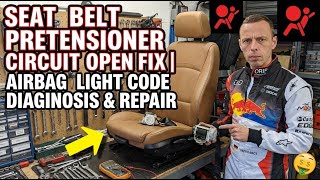
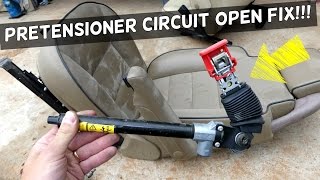
- Faulty or loose wiring/connectors under the driver's seat (Very Common) — The wiring harness under the driver's seat is frequently moved and easily snagged. Loose, corroded, or damaged pins in the yellow SRS connector are the most frequent cause 🎬 Watch: How to diagnose and repair an open pretensioner circuit. of the B0070 code. This includes damage from water ingress or spilled liquids.
- Deployed or failed driver's seatbelt pretensioner (Common) — If the vehicle was in a collision, the pretensioner fired and created an open circuit. Even without an accident, the internal pyrotechnic charge (squib) can fail from age, causing its resistance to go out of specification.
- Faulty Supplemental Restraint System (SRS) control module (Less Common) — The control module that monitors and fires the safety systems can fail internally, setting the code even when the wiring and pretensioner are perfectly healthy.
- Incorrect or faulty replacement parts (Uncommon) — If the seatbelt assembly was recently replaced, the new part could be faulty, a bad used part, or the incorrect part number for the specific VIN, causing an immediate B0070 code.
- Poor ground or loss of power to the SRS module (Rare) — The SRS module requires a stable power supply. A compromised ground strap or intermittent power loss causes the module to set various fault codes, including B0070.
Symptoms

- Airbag or SRS warning light is on — The primary symptom. The light stays illuminated on the dashboard as soon as the fault is detected.
- Seatbelt warning light is on — Some vehicles illuminate a specific seatbelt pretensioner warning light alongside the main airbag light.
- Airbag system disabled message — The vehicle's information display shows a message indicating the safety restraint system requires service.
- Seatbelt is locked or won't retract — If the pretensioner deployed due to an impact, the seatbelt locks tight and becomes unusable.
- Intermittent warning light — The light turns on and off, often correlating with seat movement or extreme interior temperature changes that cause a loose connector to temporarily lose contact.
Diagnostic Flowchart

Tap your situation to follow the diagnostic path that matches what you're seeing on this code.
Common Fixes & Costs
- Secure or Clean Under-Seat Connector — Parts: $0-$10, Labor: $50-$150, ~0.5 hr book time (DIY)
- Replace or Rebuild Driver's Seatbelt Pretensioner Assembly — Parts: $100-$500, Labor: $100-$200, ~1.2 hr book time (Intermediate)
- Repair Damaged Wiring Harness — Parts: $10-$50, Labor: $150-$300, ~1.5 hr book time (Intermediate)
- Replace or Reset SRS Airbag Module — Parts: $50-$1200, Labor: $100-$300, ~1.0 hr book time (Professional)
Used vs. New Parts: Buying Guide
When a used part is worth it: Used seatbelt pretensioners are NEVER recommended. They are single-use pyrotechnic devices. A used part may have hidden damage or be from a flood vehicle. The only cost-effective alternative to new OEM is having your original unit professionally rebuilt.
Donor quality checklist:
- Never buy a used pretensioner from a junkyard or online seller.
- Verify that any rebuilding service uses OEM components and offers a lifetime warranty.
- Ensure the part number matches exactly; these parts are VIN-specific.
Decision logic:
- If Pretensioner has deployed or is electrically faulty → Buy a new OEM part from a dealer.
- If Budget is a primary concern and the pretensioner has deployed → Use a mail-in rebuilding service for your original unit. This is safer than buying a random used part.
- If The SRS module requires replacement → A used module is an option, but it MUST be professionally reprogrammed with your car's VIN to function.
Warranty tradeoff: Used/Junkyard Pretensioners: No warranty, extreme safety risk. Rebuilding Service: Typically offer a lifetime warranty on the repair. OEM New: 12-month/12,000-mile warranty.
Worst-case if a used part fails: $500-$1000+ if a faulty used part is installed, requiring repeat labor plus the cost of a proper new part. The ultimate cost is failure to protect you in an accident.
What Happens If You Wait — Timeline
- Immediately (0 seconds): The SRS module detects the electrical fault during its key-on self-test. The airbag light illuminates, and the driver's seatbelt pretensioner is disabled. (MPG impact: 0%% · Added cost: $0 (Safety risk is the immediate cost))
- Ongoing: The vehicle operates normally, but a critical safety system is deactivated. The primary risk is a significantly increased chance of severe injury in a collision. (MPG impact: 0%% · Added cost: N/A (Unquantifiable personal safety risk))
- At next state safety inspection: The vehicle automatically fails the safety inspection due to the illuminated SRS warning light. It cannot be legally registered until repaired. (MPG impact: 0%% · Added cost: $20-$50 (Failed inspection fee), plus mandatory repair costs.)
- At time of sale: An active SRS light drastically reduces resale value. Dealers subtract the full estimated cost of a professional repair from any trade-in offer. (MPG impact: 0%% · Added cost: $500-$1000+ (Diminished vehicle value))
Cost of Not Fixing It
- Immediate: The driver's seatbelt pretensioner is disabled. In a collision, the seatbelt will not tighten, drastically increasing the risk of serious injury or death. (Added cost: N/A (Safety Risk))
- Next Vehicle Inspection: The vehicle automatically fails its safety inspection due to the illuminated SRS warning light. (Added cost: $20-$50 (Re-inspection fee))
- Long-Term: Ignoring the fault drastically reduces the vehicle's resale value and makes it difficult to sell privately. (Added cost: $500-$1000 (Diminished vehicle value))
Diagnosis Steps
- Read SRS Fault Codes and Suffix
Use an SRS-capable OBD-II scanner to confirm B0070. Pay close attention to manufacturer-specific suffixes like '-13' (Open/High Resistance) or '-1A' (Short/Low Resistance), which immediately isolate the nature of the electrical fault.
Tools: SRS-capable OBD-II Scanner (Beginner) - Visually Inspect and Wiggle Test Under Seat
Locate the yellow SRS connector under the driver's seat. With the ignition on (engine off), gently wiggle the connector and wiring harness. If the airbag light flickers or turns off, you have confirmed a loose connection.
Tools: Flashlight (Beginner) - Disconnect Battery and Reseat the Connector
Disconnect the negative battery terminal and wait 15 minutes for the SRS backup power to discharge. Unplug the yellow connector, inspect the pins for corrosion, and reconnect it firmly until it clicks. Reconnect the battery and clear the codes.
Tools: Socket wrench (Intermediate) - Check Live Data with a Scan Tool
Use a bi-directional scan tool to view live data PIDs from the SRS module. Monitor the 'Driver Pretensioner Resistance' value (typically 2.0-3.0 ohms). Wiggle the harness; any jump to OL (Over Limit) or 0 ohms confirms a wiring fault without risking accidental deployment.
Tools: Advanced Bi-Directional Scan Tool (Advanced) - Measure Pretensioner Squib Resistance
DANGER: Proceed only if experienced. Disconnect the battery, wait 15 minutes, and unplug the pretensioner. Use a multimeter to measure resistance across the pretensioner pins. A healthy squib reads 2.0-3.0 ohms. Infinite (OL) means it failed or deployed; near 0 means a short.
Tools: High-Quality Multimeter, Service Manual, Non-conductive pick set (Advanced) - Test the Wiring Harness
With the battery disconnected and both the SRS module and pretensioner unplugged, test the harness for continuity (less than 1.0 ohm) and shorts to ground (infinite/OL) between the two connectors. This isolates a wiring problem from a component failure.
Tools: Multimeter, Service manual with wiring diagrams (Advanced)
When This Code Triggers (Freeze-Frame Conditions)
- Fault Status: Active/Current (The fault is detected during the initial Key On Self-Test performed by the SRS module.)
- System Voltage: 11.5V - 14.5V (The code typically sets with normal operating voltage; a value below 10V indicates a battery issue.)
- Ignition Cycles Since Fault: 0 (For an active fault, this counter remains at zero, indicating detection on the current startup.)
- Crash Event Status: No Crash Detected (If the code stems from a wiring failure rather than a deployment, freeze frame data shows no recorded crash event.)
Related Codes
- B0071 — Indicates a fault in the passenger's seatbelt pretensioner. If B0070 and B0071 appear together, it suggests a systemic problem like a faulty SRS module or shared ground.
- B007E — Indicates a fault in the 'C' pretensioner circuit on vehicles with dual-pretensioner systems (like Ford). B0070 is the buckle, B007E is the retractor.
- B0079 — Points to the driver's seatbelt outer lap tensioner. Diagnosis requires testing this specific individual circuit.
- B1193 — Indicates 'Crash Data Stored'. If a pretensioner deploys, both codes appear. You must replace the pretensioner to fix B0070, then professionally reset the SRS module to clear B1193.
Climate & Environmental Factors
- High Temperatures: Hot interiors cause metal contacts in loose connectors to expand and break the electrical connection, triggering the code.
- High Humidity / Water Ingress: Moisture from spills or leaks corrodes under-seat connectors, increasing circuit resistance and triggering the fault.
- Cold Temperatures: Extreme cold causes wires and plastic connectors to contract, making already loose connections intermittent.
How to Talk to a Mechanic About This Code
Say this: "I have an airbag light on, and my scanner shows code B0070 for the driver's seatbelt pretensioner. Since the most common cause is the wiring under the seat, please start by inspecting the connector and harness for damage or loose connections before quoting a full pretensioner replacement."
This directs the technician to the most likely and cheapest fix first, preventing them from immediately assuming the most expensive part (the pretensioner assembly) has failed.
Avoid saying:
- 'My airbag light is on, can you fix it?' (Too vague; invites a high quote for full system replacement.)
- 'Just replace the seatbelt.' (Assumes the most expensive part is the problem.)
- 'I heard you can just put a resistor in it.' (Signals you want a dangerous shortcut, which reputable shops refuse.)
Questions to ask before authorizing the repair:
- Did you perform a 'wiggle test' on the under-seat connector and wiring? Did the resistance value change?
- If recommending a pretensioner replacement, what resistance reading did you get from the old part? Was it open-circuit (infinite) or shorted (zero)?
- Is the fault intermittent or present all the time? Did you check for manufacturer-specific sub-codes?
- If the wiring is damaged, will you use OEM-approved crimp connectors for the repair?
- What is the warranty on the parts and labor for this specific repair?
Where to Take It: Dealer vs Independent vs Chain
- Dealer:
A strong option if you suspect a recall or need module programming, but the most expensive for a simple wiring fix.
Best for: Vehicles under warranty., Complex cases involving multiple SRS codes or module programming., Checking for related recalls that result in a free repair.
Downsides: Highest labor rates., Quick to replace the entire pretensioner assembly rather than diagnosing a simpler wiring fault. (Typical cost: +50% vs. baseline) - Independent Shop:
Best overall fit. A good independent shop diagnoses and repairs common wiring causes for significantly less than a dealer.
Best for: Out-of-warranty vehicles where cost is a major factor., Diagnosing common wiring and connector issues that cause B0070.
Downsides: Shop quality varies. Ensure the shop has ASE-certified technicians with airbag system experience. (Typical cost: +0% vs. baseline) - Chain Shop:
AVOID. SRS systems involve pyrotechnic devices and require qualified technicians with specific airbag experience.
Best for: Not recommended for SRS system diagnostics or repairs.
Downsides: Technicians often lack specialized training for airbag systems., Business model focuses on high-volume, simple jobs, not complex electrical diagnostics., High risk of misdiagnosis or refusal to work on safety-critical systems. (Typical cost: -10% vs. baseline)
When to Walk Away From the Repair
If the estimated repair cost exceeds 50% of the car's private-party value, consider selling or trading in the vehicle. For older, high-mileage cars, this threshold drops to 40%.
- Car worth $4000, fix is $2200: Walk away. The repair cost is over 50% of the car's value. Selling a car with a known safety defect carries liability risks.
- Car worth $12000, fix is $800: Fix it. This repair is well below the threshold and restores a critical safety feature, preserving the vehicle's value.
- Car worth $2500, fix is $1500: Walk away. The repair cost is 60% of the car's value. It is not economically sensible to invest this much into an older car.
What Scan Tool You Need for This Code
Minimum: An OBD-II scanner that reads and clears Supplemental Restraint System (SRS/Airbag) codes.
A standard $20 engine code reader cannot communicate with the SRS module. It will not see or clear the B0070 code. You need a tool specifically advertised with SRS/Airbag capabilities.
Budget: Autel AL619 / Foxwell NT301 (with SRS) (~$80) — Reads and clears the B0070 code from the SRS module. Confirms the fault exists but offers limited live data.
Mid-range: BlueDriver Pro / Autel ML629 / Foxwell NT680 Pro (~$120) — Reads and clears SRS codes and provides live data streaming. Crucial for viewing pretensioner circuit resistance in real-time while wiggling wires.
Professional: Autel MaxiCOM MK808 / Foxwell NT809 (~$450-600) — Offers full bidirectional control and OE-level diagnostics. Reads manufacturer-specific sub-codes (e.g., B0070-1A) that immediately identify the electrical fault type.
Rent vs buy: Most auto parts stores do NOT rent out SRS-capable scanners due to liability. If this is a one-time fix, pay a shop a diagnostic fee (~$100-150). For DIYers, a mid-range scanner is a worthwhile investment.
How to Clear the Code After You Fix It
- Ensure the physical repair is complete and connectors are seated.
- Reconnect the negative battery terminal.
- Use an SRS-capable OBD-II scan tool to access the Restraint Control Module.
- Select the function to 'Clear Codes' or 'Erase DTCs'.
Drive cycle (~5 minutes): The SRS system does not require a complex drive cycle. After clearing the code, turn the ignition off, then back on. The SRS module performs a self-test immediately. If the light turns off after a few seconds, the repair was successful.
Readiness monitors affected: None
Watch out for:
- Using a standard engine code reader, which cannot access or clear SRS module codes.
- Failing to fix the underlying electrical fault, causing the code to return immediately.
- Forgetting to clear 'Crash Data' (hard codes) from the SRS module after an accident, which requires specialized professional service.
Will This Fail Emissions / State Inspection?
No — by itself this code doesn't fail OBD inspection (but it can keep readiness monitors from setting, which causes a separate fail).
- California: An airbag light does not fail the emissions (smog) check itself, but fails the comprehensive safety inspection required for revived salvage vehicles.
- New York: An illuminated airbag warning lamp is an advisory item, not a strict cause for rejection of the annual safety inspection, though individual inspectors vary.
- Texas: Texas does not fail vehicles for an illuminated airbag light during its safety inspection.
- Virginia: In states with rigorous annual safety inspections like Virginia, an illuminated airbag light is an automatic failure.
Most Commonly Affected Vehicles
- Ford Mustang (2015-2020) — Often appears with code B007E. A code of B0070:1A indicates a short circuit. Recall #16V875 addresses pretensioner cable corrosion on 2015-2017 models.
- Honda Accord, Civic, Odyssey (2013-2018) — Frequently shows up as B0070-13, indicating an open circuit. Often caused by a deployed pretensioner or a faulty unit.
- Chevrolet / GMC Silverado / Sierra (2007-2014) — Wiring under the driver's seat chafes due to seat movement. Recalls N212330040 and 18156 address pretensioner cable fatigue.
- Jaguar XK / XKR (X150) (2007-2014) — Owners report intermittent codes triggered by hot interior temperatures causing poor connector contact.
- Dodge / Chrysler Grand Caravan / Town & Country (2010-2020) — Code B0070-13 frequently points to an open circuit in the pretensioner squib.
- Volkswagen Golf (MK5), Passat (B5.5), Jetta (2004-2010) — The yellow under-seat connector is highly prone to failure. VAG-equivalent codes are 01217 or 01218.
- Subaru Outback, Impreza, Crosstrek (2008-2018) — Triggered by faults in the seat belt tension sensor or the Occupant Detection System (ODS) module under the seat.
- Hyundai / Kia Sonata, Elantra (2011-2019) — Typically related to standard wiring issues under the seat or a failed pretensioner assembly.
Manufacturer-Specific Notes
- Honda: Uses suffix '-13' (e.g., B0070-13) to specify 'Open or increased resistance', almost always pointing to a failed pretensioner or broken wire.
- Ford: Uses suffix ':1A' to indicate 'resistance below threshold' (a short circuit). Often caused by pretensioner cable corrosion or improperly seated connectors.
- General Motors (Chevy/GMC): The wiring harness under the driver's seat is a known weak point. Constant seat movement causes wires to chafe or break.
- Jaguar: Intermittent B0070 codes are heavily linked to thermal expansion, where hot interiors cause loose connectors to temporarily break contact.
- Volkswagen/Audi: The yellow under-seat connector fails so frequently that independent shops often bypass it entirely by soldering the wires directly.
Real Owner Stories
2015 Ford Mustang EcoBoost - Intermittent Light, Easy Fix
Owner experienced an intermittent airbag light, often appearing after the car sat in the hot sun. Code reader showed B0070.
Outcome: The light went away permanently. Thermal expansion was causing a partially seated connector to lose contact intermittently. Total cost: $0.
Lesson: Always check the simplest solution first. A firm reseat of the under-seat connector saves hundreds in diagnostic fees.
2016 Honda Odyssey - Misdiagnosis and Wasted Money
Airbag light came on with codes B0070, B0072, and B0079.
Outcome: The light remained on because the actual fault was a poor connection at the SRS module. A shop charged $150 to fix the connector, plus the owner wasted money and damaged their wiring.
Lesson: Bypassing safety systems with resistors is extremely dangerous and rarely fixes the underlying problem. Professional diagnosis is cheaper than guessing.
2018 Ford Mustang - Post-Accident Repair Confusion
After a minor accident, the owner replaced the deployed driver's seatbelt pretensioner. The airbag light remained on, showing B0070:1A (Circuit Resistance Below Threshold).
Outcome: A forum user suggested the new connector wasn't perfectly seated, causing internal shorting bars to remain engaged. The owner reconnected the plug with extra force until it fully clicked, clearing the code instantly.
Lesson: After replacing SRS parts, ensure connectors are seated with a firm, positive click. A 'short circuit' code immediately after replacement points to a connector issue.
2017 Toyota Camry with a Puppy Problem
The airbag light came on. A visual inspection revealed the owner's new puppy chewed through the yellow SRS wiring harness under the seat.
Outcome: The repair fixed the code. The owner installed a plastic shield under the seat to prevent future access.
Lesson: Physical damage from pets or stored items is a real-world cause for B0070. Visual inspection is a critical first step.
How to Prevent This Code From Triggering
- Never store items under the front seats (Daily habit) — Objects like water bottles or umbrellas slide and impact delicate SRS connectors, causing physical damage or disconnection.
- Be careful when cleaning or vacuuming (During vehicle cleaning) — Aggressively shoving vacuum wands under the seat snags wires and partially dislodges the yellow SRS connector.
- Secure pets during travel (Every trip with a pet) — Unrestrained pets crawl into footwells and chew on wires. The yellow SRS harness is a common target.
- Periodically check for water intrusion (After heavy rain or car wash) — Leaking door seals allow water to pool on the floor and wick into SRS connectors, causing corrosion and high resistance faults.
- Apply dielectric grease during repairs (When replacing SRS components) — Applying a small amount of dielectric grease to the connector seal (not the pins) prevents future moisture intrusion and corrosion.
Frequently Asked Questions
Can I fix code B0070 myself?
You can safely check and reseat the under-seat connector yourself. However, replacing the pretensioner or SRS module involves handling explosive charges and requires strict safety protocols. Take the vehicle to an ASE-certified shop for component replacement.
Will clearing the code fix the problem?
No. The SRS module runs a self-test on every startup. If the electrical fault persists, the code returns immediately.
Is a deployed seatbelt pretensioner repairable?
You cannot repair a deployed pretensioner yourself. You must replace it with a new OEM unit or send the deployed assembly to a specialized mail-in service for a professional rebuild.
Why is the airbag light on if the car wasn't in a crash?
The most common cause is a poor electrical connection under the driver's seat. Daily seat movement, stored items, or corrosion can loosen the wiring harness, triggering the fault without an impact.
What are common misdiagnosis mistakes for B0070?
The biggest mistake is replacing the expensive pretensioner assembly before testing the wiring circuit. Mechanics also frequently forget to clear the B1193 'Crash Data' hard code from the SRS module after a collision repair.
Can I use a resistor to bypass the pretensioner and turn off the light?
No. Bypassing the pretensioner permanently disables a critical safety device, drastically increasing the risk of severe injury or death in a crash. Reputable shops will refuse this dangerous shortcut.
Will my car pass inspection with code B0070?
No. An illuminated airbag or SRS warning light is an automatic failure in states with mandatory safety inspections.
Can a weak car battery cause the B0070 code?
Yes. A failing battery causes a low-voltage drop during startup (below 10V), triggering spurious SRS fault codes. If clearing the code keeps the light off, low voltage was the culprit.
Key Takeaways
- Code B0070 disables the driver's seatbelt pretensioner, preventing it from tightening during a crash and significantly increasing injury risk.
- Over 70% of B0070 codes stem from a loose or damaged yellow electrical connector under the driver's seat.
- Driving with an active B0070 code guarantees an automatic failure during state safety inspections.
- Repair costs range from $0 for a DIY connector reseat to $700+ for a new OEM pretensioner assembly installed at a dealership.
Helpful Videos

The information in this article is provided for general reference and educational purposes only. Vehicle specifications, procedures, and part compatibility can vary by production date, trim level, and region. Always consult your vehicle's factory service manual and verify part numbers before purchasing or performing repairs. Safety-critical components such as airbags, seat belts, and braking systems should be installed by a qualified professional.
- 🎬 Helpful Videos
- What Does B0070 Mean?
- Can I Drive With B0070?
- Common Causes
- Symptoms
- Diagnostic Flowchart
- Common Fixes & Costs
- Used vs. New Parts: Buying Guide
- What Happens If You Wait — Timeline
- Cost of Not Fixing It
- Diagnosis Steps
- When This Code Triggers (Freeze-Frame Conditions)
- Related Codes
- Climate & Environmental Factors
- How to Talk to a Mechanic About This Code
- Where to Take It: Dealer vs Independent vs Chain
- When to Walk Away From the Repair
- What Scan Tool You Need for This Code
- How to Clear the Code After You Fix It
- Will This Fail Emissions / State Inspection?
- Most Commonly Affected Vehicles
- Manufacturer-Specific Notes
- Real Owner Stories
- 2015 Ford Mustang EcoBoost - Intermittent Light, Easy Fix
- 2016 Honda Odyssey - Misdiagnosis and Wasted Money
- 2018 Ford Mustang - Post-Accident Repair Confusion
- 2017 Toyota Camry with a Puppy Problem
- How to Prevent This Code From Triggering
- Frequently Asked Questions
- Can I fix code B0070 myself?
- Will clearing the code fix the problem?
- Is a deployed seatbelt pretensioner repairable?
- Why is the airbag light on if the car wasn't in a crash?
- What are common misdiagnosis mistakes for B0070?
- Can I use a resistor to bypass the pretensioner and turn off the light?
- Will my car pass inspection with code B0070?
- Can a weak car battery cause the B0070 code?
- Key Takeaways
- 🎟️ Get 5% Off