

OBD-II Code B0050: Driver Seatbelt Sensor Circuit Fault
The Ultimate 2026 Guide to What B0050 Means, Why It Triggers, and How to Fix It
- Code B0050 disables the driver's airbag and entire SRS system, requiring immediate repair to restore crash safety.
- A loose yellow wiring connector under the driver's seat causes 80% of B0050 faults; perform a physical 'wiggle test' before buying parts.
- If the under-seat wiring is intact, replace the driver's seatbelt buckle assembly (typically $250-$500) due to a failed internal microswitch.
- Diagnosis requires an SRS-compatible OBD-II scanner to read the specific 2-digit sub-code (like -13 for Open Circuit) to pinpoint the exact electrical failure.
What Does B0050 Mean?

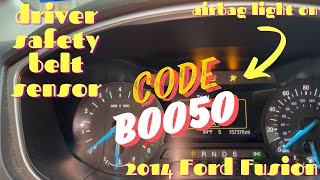
Trouble code B0050 means the Restraint Control Module (RCM) detects a fault in the driver's seatbelt sensor circuit. This sensor tells the computer if the driver's seatbelt is buckled, a critical input for airbag deployment. Due to this fault, the computer disables the airbag system as a safety precaution and illuminates the dashboard airbag warning light.
Technical definition: The SAE/ISO definition for B0050 is "Driver Seatbelt Sensor." It is almost always accompanied by a 2-digit sub-code providing diagnostic direction. Common variants include B0050-13 ("Circuit Open"), B0050-11 ("Circuit Short to Ground"), B0050-12 ("Circuit Short to Battery"), and B0050-2B ("Wires Shorted Together").
Can I Drive With B0050?
Yes, But With Caution. The vehicle drives normally, but the entire Supplemental Restraint System (SRS) is disabled. In an accident, the driver's airbag will not deploy, significantly increasing the risk of severe head, neck, and chest injuries. Limit driving strictly to reaching a repair shop.
Common Causes

- Damaged Wiring or Loose Connector Under Driver's Seat (Very Common) — The wiring harness for the seatbelt buckle runs under the driver's seat and is highly vulnerable. Constant seat movement, stored items, or passenger kicks cause wires to break, the main yellow connector to loosen, or internal pins to corrode and lose tension.
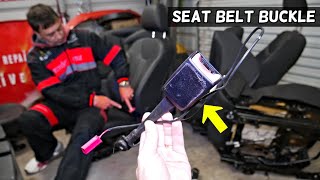
- Faulty Driver's Seatbelt Buckle Assembly (Common) — The sensor detecting a latched belt is an integral microswitch inside the buckle assembly. This switch fails from wear and tear after thousands of cycles or internal corrosion, sending an incorrect signal to the RCM.
- Faulty Seatbelt Pretensioner (Common) — In many vehicles, the buckle switch wiring routes alongside the seatbelt pretensioner wiring. An electrical fault within the pretensioner assembly—the explosive device that tightens the belt in a crash—triggers a B0050 code despite being a separate component.
- Debris or Spilled Liquid in the Buckle (Less Common) — Foreign objects like food crumbs, coins, or spilled liquids enter the seatbelt buckle mechanism. This physically obstructs the switch from making contact or causes electrical shorts across the contacts.
- Incompatible Seat or Component Swap (Rare) — Installing a seat from a different vehicle or trim level causes this code. Even if the seat physically fits, the internal sensor resistance or connector pinout differs, creating a mismatch the RCM flags as a fault.
- Faulty Restraint Control Module (RCM) (Rare) — The RCM suffers an internal hardware failure, such as a burnt driver circuit, preventing it from reading the seatbelt sensor signal. Consider this only after exhausting all wiring and buckle diagnostics.
Symptoms

- Airbag Warning Light is On — The primary symptom. The dashboard light showing a person with an airbag or the letters 'SRS' stays illuminated continuously.
- Seatbelt Warning Light Stays On or Flashes — The seatbelt indicator light on the instrument cluster stays on or flashes even when the seatbelt is securely buckled.
- Continuous or Inoperative Seatbelt Warning Chime — The audible buckle-up chime sounds continuously regardless of belt status, or fails to sound entirely upon startup.
- "Service Airbag System" Message — The driver information center displays a text warning like "Service Airbag System" or "Service Restraint System."
- Seatbelt Status Shows 'Unknown' on Scan Tool (scan-tool only — no driver-felt sign) — Live data on an advanced scan tool shows the driver's seatbelt parameter as '?' or 'Unknown', confirming signal loss.
Diagnostic Flowchart
Tap your situation to follow the diagnostic path that matches what you're seeing on this code.
Common Fixes & Costs
- Secure or Repair Under-Seat Wiring/Connector — Parts: $0-$25, Labor: $150-$300, ~1.5 hr book time (DIY)
- Replace Driver's Seatbelt Buckle Assembly
— Parts: $150-$300, Labor: $100-$200, ~1.2 hr book time
(Intermediate)
Chrysler 200 (2015-2017): OEM
Ford Fusion (2013-2016): OEM
Ford Escape (2013-2016): OEM - Clean Debris from Buckle Mechanism — Parts: $5, Labor: $0-$50, ~0.3 hr book time (DIY)
- Hardwire the Under-Seat Connector — Parts: $10, Labor: $200-$350, ~2.0 hr book time (Advanced)
- Replace Restraint Control Module (RCM) — Parts: $500-$1000, Labor: $150-$300, ~1.8 hr book time (Professional)
Used vs. New Parts: Buying Guide
When a used part is worth it: Never. Using a used part for a safety-critical component like a seatbelt buckle is strictly prohibited by safety standards.
Donor quality checklist:
- Do not use parts from a salvage or junkyard vehicle for any SRS system repair.
- Verify the new part number exactly matches the OEM requirement for your vehicle's VIN.
- Visually identical buckles from different trim levels have different internal resistance and will trigger the code.
Decision logic:
- If The fault requires replacing the seatbelt buckle or pretensioner → Always buy a new, certified OEM part.
- If Budget is the primary concern → Use a certified SRS repair service to rebuild your existing buckle, but a new OEM part remains the safest practice.
Warranty tradeoff: Salvage yard parts carry extreme liability and no reliable warranty. New OEM parts carry a 12-month manufacturer warranty and guarantee federal safety compliance.
Worst-case if a used part fails: $1500+ plus extreme safety risk. A used buckle failing to latch or signal during a collision prevents airbag deployment, leading to severe injury.
What Happens If You Wait — Timeline
- 0-2 months: An intermittent fault begins. The airbag light flickers due to a loose connector pin or partially broken wire. The SRS system is unreliable. (MPG impact: 0%% · Added cost: $0)
- 2-4 months: Vibration degrades the loose connection. The airbag light is on more often than off. The SRS system is disabled most of the time. (MPG impact: 0%% · Added cost: $50 in wasted diagnostic time.)
- 4-6 months: The fault becomes permanent. The airbag light stays on constantly. The loose pin corrodes or the wire breaks completely. (MPG impact: 0%% · Added cost: $150-$300. Repair escalates from a simple wiring fix to mandatory part replacement.)
- 6+ months: The vehicle fails state safety inspections. Continued driving normalizes a critical safety risk. (MPG impact: 0%% · Added cost: Traffic citations and catastrophic risk of injury/death in a collision.)
Cost of Not Fixing It
- Immediate: The driver's airbag and SRS system are disabled. In an accident, there is a significantly increased risk of severe injury or death. (Added cost: N/A (Safety Risk))
- 0-3 months: An intermittent loose connector becomes a permanent 'hard fault' due to vibration or corrosion, requiring part replacement instead of a simple wiring repair. (Added cost: $150-$300)
- 3+ months / Long-Term: Vehicle fails state safety inspections. Continued driving normalizes a critical safety failure, leading to catastrophic liability in a collision. (Added cost: Traffic citations and severe personal injury risk.)
Diagnosis Steps

- Read the Specific SRS Sub-Code
Use an SRS-compatible OBD-II scanner to read the full code, including the two digits after the dash (e.g., B0050-13). This suffix dictates whether you are hunting for an open circuit, a short to ground, or a short to battery.
Tools: OBD-II Scanner (SRS/Body compatible) (Beginner) - Perform a Visual Inspection and "Wiggle Test"
With the ignition on and the airbag light visible, look under the driver's seat for pinched wires, disconnected yellow connectors, or debris. Gently wiggle the main yellow wiring harness. If the airbag light flickers or turns off, you have isolated a loose connection in that harness.
Tools: Flashlight (Beginner) - Secure and Inspect the Main Connector
Disconnect the negative battery terminal and wait 15 minutes to discharge the SRS backup capacitors. Unplug the main yellow connector under the seat, inspect the pins for corrosion or bending, and reconnect it firmly until it clicks. Reconnect the battery, clear codes, and retest.
Tools: Socket set, Flashlight (Beginner) - Test the Buckle Switch Resistance
Disconnect the battery and wait 15 minutes. Unplug the 2-pin connector at the seatbelt buckle. Set a multimeter to Ohms and probe the buckle's pins. It must show infinite resistance (O.L.) when unbuckled, and drop below 5 ohms when latched. If it fails, replace the buckle assembly.
Tools: Multimeter, Basic hand tools (Intermediate) - Monitor Live Data
Access the RCM live data stream using an SRS scan tool. Watch the 'Driver Seat Belt Buckle Switch' parameter while buckling and unbuckling the belt. If the status remains stuck on 'Unbuckled' despite physical latching, the fault lies in the buckle switch or the wiring leading to it.
Tools: OBD-II Scanner (SRS compatible) (Intermediate) - [PRO TIP] Induce an Opposite Fault Code
For a B0050-13 (Open Circuit) code, disconnect the buckle connector and use a fused jumper wire to short the two terminals on the vehicle harness side. Clear codes and re-scan. If the code changes to B0050-11 (Short to Ground), the wiring to the RCM is intact, proving the buckle itself is the culprit.
Tools: OBD-II Scanner (SRS compatible), Fused jumper wire (Advanced) - [ADVANCED] Check Voltage and Ground at Connector
Disconnect the buckle connector and turn the ignition ON. Set a multimeter to DC Volts. One harness pin must show a reference voltage (typically ~5V). Check the other pin for ground (less than 1 ohm resistance to chassis). Missing voltage or ground confirms a wiring break between the seat and the RCM.
Tools: Multimeter, Service manual (Advanced)
When This Code Triggers (Freeze-Frame Conditions)
- Ignition Status: ON (The fault is detected during the RCM's power-on self-test.)
- Vehicle Speed: 0 mph (Code sets immediately after startup, before the vehicle moves.)
- System Voltage: 11.8-14.5V (Occurs during normal battery voltage ranges; rarely caused by voltage spikes.)
- Time Since Ignition On: < 10 seconds (The RCM continuously monitors this circuit and flags the code instantly upon detecting a fault.)
Related Codes
- B0052 — Identical fault but for the passenger's seatbelt sensor. Common to see both if items shoved under the seats disturb both wiring harnesses.
- B0020 — Relates to the driver's side airbag deployment circuit. Triggered by the same faulty under-seat connector that causes B0050, as both circuits route through it.
- B0050-13 — Specific sub-code defining the fault as a 'Circuit Open'. Points directly to a broken wire, loose connector, or failed internal switch.
- B0050-11 — Indicates a 'Circuit Short to Ground'. Diagnosis requires finding a pinched or chafed wire touching the metal seat frame.
- B0050-2B — Indicates 'Wires Shorted Together'. The signal and ground wires within the harness are touching due to worn insulation.
Climate & Environmental Factors
- High Humidity and Winter Moisture: Snow melting on carpets or high ambient humidity penetrates under-seat connectors. This corrodes the pins, alters circuit resistance, and triggers intermittent B0050 faults.
- Extreme Temperature Cycles: Repeated shifts from extreme cold to hot cause plastic connector housings and metal pins to expand and contract. This reduces pin tension, creating a loose connection and an 'Open Circuit' (B0050-13) fault.
How to Talk to a Mechanic About This Code
Say this: "I have an airbag light on, and my scanner shows code B0050. Based on my research, the most common cause is the wiring connector under the driver's seat. Could you please inspect the integrity of that yellow connector before quoting a full buckle replacement?"
Signals you are an informed customer. Directs the technician to the cheapest fix first, preventing them from defaulting to an expensive buckle replacement if the issue is just a loose connection.
Avoid saying:
- 'My airbag light is on, can you fix it?' (Invites a high quote for the most expensive fix.)
- 'I need a new seatbelt.' (You may pay for a part you don't need.)
- 'Just do whatever it takes to turn the light off.' (Gives the shop a blank check.)
Questions to ask before authorizing the repair:
- What was the specific sub-code, for example, B0050-13 for an open circuit?
- Did you perform a 'wiggle test' on the under-seat connector, and what was the result?
- If recommending a buckle replacement, did you test the resistance of the original buckle switch?
- What is the warranty on the parts and labor for this SRS repair?
Where to Take It: Dealer vs Independent vs Chain
- Dealer:
Recommended only if a warranty/recall applies or if independent diagnostics fail.
Best for: Vehicles under warranty or covered by a specific recall., Complex cases requiring Restraint Control Module (RCM) replacement and programming.
Downsides: Highest labor rates., Quick to replace the entire buckle assembly rather than perform a nuanced wiring repair. (Typical cost: +50% vs. baseline) - Independent Shop:
Best fit for most scenarios. An experienced technician easily repairs the common causes of B0050 at a lower cost than a dealer.
Best for: Out-of-warranty vehicles requiring wiring repair or straightforward buckle replacement., Owners seeking cost-effective diagnostics.
Downsides: Some shops refuse SRS work due to liability concerns., Must verify the shop owns an SRS-compatible scan tool. (Typical cost: +0% vs. baseline) - Chain Shop:
AVOID. The risk of misdiagnosis or unnecessary part replacement is high. SRS repairs require specific expertise.
Best for: Not recommended for SRS system diagnostics.
Downsides: Technician skill varies widely., Lacks specific SRS diagnostic tools., Business model pressures technicians toward simple part replacement rather than diagnostics. (Typical cost: -10% vs. baseline)
When to Walk Away From the Repair
If the estimated repair cost exceeds 40-50% of the car's value, evaluate options. However, because B0050 is a critical safety failure, repairing it is almost always necessary to avoid catastrophic liability.
- Car worth $4000, fix is $450: Fix it. The repair cost is low relative to the car's value and essential for safety.
- Car worth $2500, fix is $1200: Walk away. The repair cost is nearly 50% of the car's value.
What Scan Tool You Need for This Code
Minimum: An OBD-II scanner that reads and clears Supplemental Restraint System (SRS/Airbag) codes. Basic engine-only readers cannot see 'B' codes.
A standard $20 scanner cannot communicate with the Restraint Control Module. It shows 'No Codes Found' even with the airbag light on.
Budget: Autel AutoLink AL619 (~$70) — Reads and clears SRS codes. Retrieves the specific B0050 sub-code and views live data essential for diagnosis.
Mid-range: BlueDriver Pro (~$100) — Bluetooth scanner pairing with a smartphone. Reads SRS codes, provides live data graphing, and offers verified repair reports.
Professional: Foxwell NT510 Elite (~$250) — Offers deep, manufacturer-specific diagnostics and bi-directional control to actively test SRS components.
Rent vs buy: Auto parts stores do NOT rent out SRS-capable scanners due to liability. Purchasing a budget-friendly SRS scanner is required for DIY diagnosis.
How to Clear the Code After You Fix It
- Ensure the underlying electrical fault is permanently fixed.
- Reconnect the negative battery terminal.
- Use an SRS-compatible OBD-II scan tool to connect to the Restraint Control Module (RCM).
- Select 'Clear DTCs' or 'Erase Codes'.
- Cycle the ignition off, then back on. Verify the airbag warning light illuminates for a few seconds (self-test) and then turns off permanently.
Drive cycle (~10 minutes): SRS codes do not require a specific drive cycle. The system self-tests upon every ignition cycle. A 10-minute test drive confirms the fix is stable against vibration.
Readiness monitors affected: None
Watch out for:
- Using a basic engine-only OBD-II reader will not clear SRS codes.
- Disconnecting the battery will not clear a B0050 'hard fault' from the RCM's memory.
- If the repair failed, the code reappears immediately on the next ignition cycle.
Will This Fail Emissions / State Inspection?
No — by itself this code doesn't fail OBD inspection (but it can keep readiness monitors from setting, which causes a separate fail).
- California: An airbag light does not fail the emissions SMOG check. However, it is illegal to sell a vehicle to a private party with a known, non-functional SRS system.
- New York: The NYS safety inspection requires the airbag warning light to illuminate during the self-test and then turn off. An active light causes an immediate inspection failure.
- Texas: An illuminated airbag light is not a cause for failure during the standard Texas vehicle safety inspection.
Most Commonly Affected Vehicles
- Chrysler 200 (2015-2017) — FCA issued TSB #9003579 instructing technicians to check for a poorly seated yellow connector under the seat before replacing any parts.
- Ford Fusion (2013-2016) — Frequently caused by a faulty pretensioner assembly or a break in the wiring harness under the seat.
- Ford Escape (2012-2024) — Ford initiated Customer Satisfaction Program 24N08 for 2021-2024 models to replace the driver's side buckle for free if it sets code B0050:13.
- Chevrolet Equinox / GMC Terrain (2010-2017) — Often traced back to a failed internal switch in the buckle assembly or chafed wiring under the seat.
- Dodge Dart (2013-2016) — Shares the Chrysler 200 platform and suffers the exact same loose under-seat connector issue.
- Honda Odyssey (2018-2020) — Subject to recall NHTSA 23V-158. A manufacturing defect prevents proper latching, triggering B0050 sub-codes.
- Ram 1500 / 2500 / 3500 (2010-2018) — Commonly reported after swapping seats between different trim levels due to incompatible buckle sensor resistance.
- Hyundai Elantra (2011-2016) — Most often caused by an internal failure of the seatbelt buckle switch, requiring full assembly replacement.
Manufacturer-Specific Notes
- Ford: Ford relies heavily on sub-codes (:11, :12, :13) to guide diagnostics. For recent models (Escape, Bronco Sport 2021+), Ford extended the warranty on the driver's buckle to 15 years/250k miles for failures causing code B0050:13.
- Chrysler/Dodge/Jeep/Ram: The issue is almost always the large yellow connector under the seat losing connection. Securing the connector tightly with a zip tie after reseating it is the official, permanent fix.
- Honda/Acura: A recall (NHTSA 23V-158) addresses front seat belt buckles that fail to latch correctly due to a manufacturing defect, causing various B0050 sub-codes.
Real Owner Stories
2015 Chrysler 200 with airbag light
Airbag light stayed on. Scan tool showed code B0050-13, 'Driver Seatbelt Sensor - Circuit Open'.
What they tried:
- Suspected a bad buckle.
- Checked the large yellow connector under the driver's seat.
- Found the connector appeared seated but was slightly loose.
Outcome: Disconnected the battery, unplugged and firmly re-plugged the yellow connector until it clicked. Secured it with a zip tie. Cleared codes, and the light stayed off. Total cost: $1.
Lesson: On Chrysler/Dodge vehicles, the under-seat connector is the primary culprit. Always check this free fix before buying a new buckle assembly.
2014 Ford Fusion with intermittent airbag light
Airbag light turned on for a few days, went off for a week, then returned. Code was B0050.
What they tried:
- Ignored the problem initially.
- Performed a visual inspection under the seat.
- Found two wires leading to the buckle ripped from seat movement.
Outcome: Spliced the broken wires using butt connectors and heat shrink tubing. Cleared codes, and the light stayed off permanently.
Lesson: Intermittent lights almost always point to wiring damage. A simple wire repair saves hundreds compared to replacing the entire buckle/pretensioner assembly.
2010 Ram 1500 with B0050 after seat upgrade
Owner swapped basic ST trim seats for Laramie seats. The airbag light immediately illuminated with code B0050.
What they tried:
- Tried bypassing the sensor with jumper wires.
- Verified wiring pinouts matched.
- Reinstalled the original driver's seat, and the code disappeared.
Outcome: Discovered the internal resistance of the buckle sensor differed between trim levels. The RCM detected the mismatch. The fix required sourcing a buckle with the correct OEM part number for the VIN.
Lesson: When swapping seats, 'fits' does not mean 'works'. SRS components are strictly calibrated to the vehicle's original VIN.
How to Prevent This Code From Triggering
- Keep the area under the front seats clear (Daily habit) — Prevents water bottles or umbrellas from snagging and disconnecting the vulnerable SRS wiring harness during seat movement.
- Use caution with liquids in the cabin (Daily habit) — Spilled coffee or soda seeps into the buckle mechanism, shorting out the internal switch contacts.
- Periodically clean the buckle mechanism (Every 6-12 months) — Use compressed air to blow out dust and crumbs that physically obstruct the switch.
- Secure the main under-seat connector (Once, preventively) — Proactively securing the main yellow connector with a zip tie prevents the most common failure point on Chrysler/Dodge vehicles.
- Inspect wiring during interior cleaning (Quarterly) — Spot early signs of wire chafing under the seat before a wire breaks and causes a hard fault.
Frequently Asked Questions
Can I just clear the B0050 code to turn off the airbag light?
You can clear the code, but the RCM re-runs its self-test immediately. The code returns instantly if the underlying electrical problem remains unfixed.
Is it safe to drive with the B0050 code active?
No. While the car drives normally, the airbag system is compromised and will likely not deploy the driver's airbag in a crash, drastically increasing injury risk.
Why is the airbag system connector always yellow?
Automotive safety standards mandate yellow connectors for all SRS components. This serves as a high-visibility warning that technicians are handling a sensitive, explosive system requiring battery disconnection.
Can I replace the seatbelt buckle myself?
Yes, it typically involves unbolting the old buckle and plugging in the new one. You MUST disconnect the negative battery terminal and wait 15 minutes before starting to prevent accidental airbag deployment.
What's the difference between the seatbelt buckle sensor and the pretensioner?
The buckle sensor is a simple switch detecting if the belt is latched. The pretensioner is an explosive device that tightens the belt during a crash; both share wiring but are distinct components.
Can installing a different seat cause a B0050 code?
Yes. If you install a seat from a different trim level or year, the buckle's internal sensor resistance often differs. The RCM detects this mismatch and sets a B0050 code.
Will a used seatbelt buckle from a junkyard work?
It might, but it is never recommended for safety components. A used part's structural or electrical integrity may be compromised from a previous collision.
My seatbelt light works correctly, so why is the airbag light on with a B0050 code?
The dashboard seatbelt reminder light uses a simpler circuit than the Restraint Control Module (RCM). The RCM runs independent, high-precision resistance checks. The basic reminder works even when the RCM detects a slight resistance variance, triggering B0050 and disabling airbags.
Key Takeaways
- Code B0050 disables the driver's airbag and entire SRS system, requiring immediate repair to restore crash safety.
- A loose yellow wiring connector under the driver's seat causes 80% of B0050 faults; perform a physical 'wiggle test' before buying parts.
- If the under-seat wiring is intact, replace the driver's seatbelt buckle assembly (typically $250-$500) due to a failed internal microswitch.
- Diagnosis requires an SRS-compatible OBD-II scanner to read the specific 2-digit sub-code (like -13 for Open Circuit) to pinpoint the exact electrical failure.
Helpful Videos

The information in this article is provided for general reference and educational purposes only. Vehicle specifications, procedures, and part compatibility can vary by production date, trim level, and region. Always consult your vehicle's factory service manual and verify part numbers before purchasing or performing repairs. Safety-critical components such as airbags, seat belts, and braking systems should be installed by a qualified professional.
- 🎬 Helpful Videos
- What Does B0050 Mean?
- Can I Drive With B0050?
- Common Causes
- Symptoms
- Diagnostic Flowchart
- Common Fixes & Costs
- Used vs. New Parts: Buying Guide
- What Happens If You Wait — Timeline
- Cost of Not Fixing It
- Diagnosis Steps
- When This Code Triggers (Freeze-Frame Conditions)
- Related Codes
- Climate & Environmental Factors
- How to Talk to a Mechanic About This Code
- Where to Take It: Dealer vs Independent vs Chain
- When to Walk Away From the Repair
- What Scan Tool You Need for This Code
- How to Clear the Code After You Fix It
- Will This Fail Emissions / State Inspection?
- Most Commonly Affected Vehicles
- Manufacturer-Specific Notes
- Real Owner Stories
- 2015 Chrysler 200 with airbag light
- 2014 Ford Fusion with intermittent airbag light
- 2010 Ram 1500 with B0050 after seat upgrade
- How to Prevent This Code From Triggering
- Frequently Asked Questions
- Can I just clear the B0050 code to turn off the airbag light?
- Is it safe to drive with the B0050 code active?
- Why is the airbag system connector always yellow?
- Can I replace the seatbelt buckle myself?
- What's the difference between the seatbelt buckle sensor and the pretensioner?
- Can installing a different seat cause a B0050 code?
- Will a used seatbelt buckle from a junkyard work?
- My seatbelt light works correctly, so why is the airbag light on with a B0050 code?
- Key Takeaways
- 🎟️ Get 5% Off