

OBD-II Code B0041: Airbag System Fault Guide
The Ultimate Guide to B0041: What It Means, Why It Happens, and How to Fix It
- Code B0041 disables your entire airbag system, meaning zero airbags will deploy in a crash.
- On 1999-2006 GM trucks and SUVs, a broken wire in the yellow harness under the driver's seat causes over 80% of B0041 codes.
- You must use an SRS-capable OBD-II scanner to read and clear this code, as standard $20 engine code readers cannot access airbag modules.
- Perform a free 5-minute 'wiggle test' on the under-seat wiring harness with the ignition on to instantly identify intermittent connection faults.
- Vehicles with an active B0041 code automatically fail mandatory safety inspections in states like Virginia and Pennsylvania.
What Does B0041 Mean?

Code B0041 indicates the vehicle's airbag control module, known as the Sensing and Diagnostic Module (SDM), detected a fault in a specific airbag circuit. It specifically points to an 'open' or high resistance condition in either the "Left/Driver Frontal Deployment Loop (Stage 1)" or the "Third Row Left Frontal Stage 1 Deployment Control." An 'open' means a physical break exists in the circuit, preventing electricity flow. The system logs this fault when it measures resistance higher than the expected range (e.g., greater than 4.8 ohms in GM vehicles), immediately disabling the entire airbag system as a safety precaution.
Technical definition: The official definition for B0041 is "Left/Driver Frontal Deployment Loop (Stage 1) Open" or "Third Row Left Frontal Stage 1 Deployment Control." This signifies the airbag control module (SDM) registered a resistance value in a specific deployment loop above the manufacturer's specified threshold. For example, a GM service manual dictates a B0041 sets if resistance exceeds 4.8 ohms for 500 milliseconds. This fault prevents the module from verifying circuit integrity, forcing a system shutdown.
Can I Drive With B0041?
No — Do Not Drive. Do not drive the vehicle. A B0041 code signifies that the Supplemental Restraint System (SRS), including all airbags and seatbelt pretensioners, is disabled. In a crash, zero airbags will deploy, drastically increasing the risk of serious injury or death. Furthermore, a vehicle with an active airbag warning light automatically fails safety inspections in states like Virginia and Pennsylvania, making it illegal to operate on public roads.
Common Causes


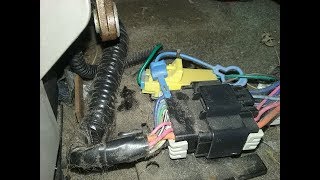
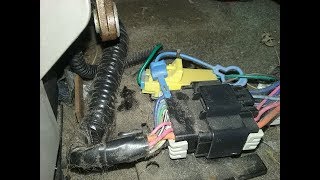
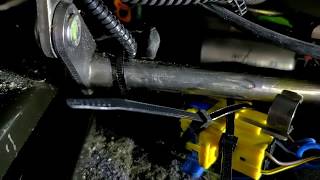
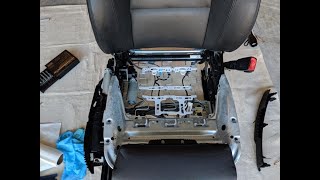
- Damaged Wiring Under Driver's Seat (Very Common) — On millions of vehicles, particularly 1999-2006 GM trucks and SUVs, the wiring harness for the side impact sensor and seat belt pretensioner routes under the driver's seat. Repeated seat movement stretches, chafes, and breaks these wires, creating an open circuit that triggers the B0041 code. 🎬 Watch: How to fix B0041 wiring on 1999-2006 GM trucks.
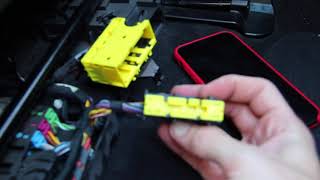
- Loose, Corroded, or Improperly Seated Connector (Common) — Yellow airbag system connectors under the seats or in door panels loosen or corrode over time. Moisture, dirt, vibrations, or failing to fully seat the locking tabs after a repair leads to a poor connection, which the SDM interprets as high resistance. On the C6 Corvette, this is a documented failure covered by a Technical Service Bulletin (TSB). 🎬 See this simple fix for C6 Corvette airbag light issues.
- Defective Airbag Clock Spring (Common) — The clock spring is a rotary connector in the steering column allowing the steering wheel to turn while maintaining electrical contact for the driver's airbag. The thin internal ribbon cable snaps over time, causing an immediate open circuit in the driver's airbag deployment loop.
- Faulty Side Impact Sensor (Common) — The impact sensor, designed to detect collisions and signal the module to deploy airbags, fails internally. These sensors are located in the vehicle's doors or on the seat frame and degrade from moisture or physical impact.
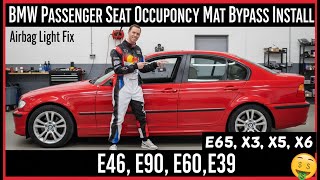
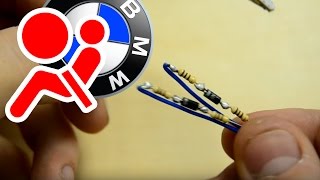
- Failed Passenger Seat Occupancy Sensor Mat (BMW) (Common) — On many BMW models, a sensor mat within the passenger seat detects occupant weight. This mat degrades and cracks, creating a resistance fault that illuminates the airbag light. Owners frequently install a bypass module to resolve this. 🎬 Watch: Step-by-step BMW passenger seat occupancy mat bypass installation.
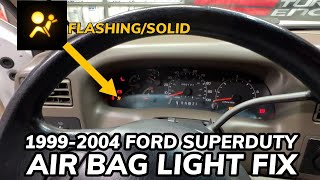
- Burned-Out Indicator Light Bulb (Ford, Honda) (Less Common) — On specific Ford and Honda vehicles, the airbag system's self-check monitors the passenger airbag deactivation indicator light. If this small incandescent bulb burns out, the system registers a high-resistance fault and sets a code, such as flashing code '27' on Ford F-Series trucks.
- Faulty Airbag Control Module (SDM) (Less Common) — The airbag control module itself fails due to internal hardware degradation (cracked solder joints), software corruption, or water intrusion.
- Cracked Solder Joints on Overhead Console (Subaru) (Uncommon) — On 2007-2009 Subaru Outbacks and Legacys, passenger airbag indicator LEDs live in the overhead console. Cracked solder joints on this circuit board interrupt the circuit, forcing the SDM to detect a fault and trigger the airbag light.
Symptoms
- Airbag Warning Light is On — The primary symptom. The dashboard light, showing a person with an airbag or the letters "SRS," remains illuminated permanently after the initial startup self-test.
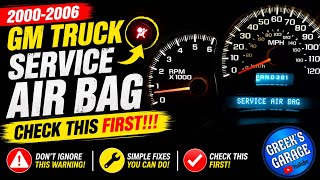
- Message on Driver Information Center (DIC) — General Motors vehicles display a text message such as "Service Air Bag System" on the dashboard information screen.
- Intermittent Warning Light — If caused by a loose wire or failing clock spring, the airbag light turns on and off as the driver's seat moves or the steering wheel turns.
- Flashing Airbag Light Code (Ford) — Ford models flash a two-digit Light Flash Code (LFC) before staying solid. Code '27' (two flashes, pause, seven flashes) specifically points to a fault in the passenger airbag deactivation (PAD) switch circuit.
- Airbag System Disabled (scan-tool only — no driver-felt sign) — An active B0041 code means the entire Supplemental Restraint System is inactive and will not deploy in an accident.
Diagnostic Flowchart
Tap your situation to follow the diagnostic path that matches what you're seeing on this code.
Common Fixes & Costs
- Repair Wiring Under Driver's Seat — Parts: $5-$25, Labor: $150-$250, ~1.5 hr book time (Intermediate)
- Clean and Secure Connectors — Parts: $5-$15, Labor: $100-$200, ~1.0 hr book time (Beginner)
- Replace Airbag Clock Spring — Parts: $100-$250, Labor: $150-$250, ~1.5 hr book time (Intermediate)
- Replace Side Impact Sensor — Parts: $70-$350, Labor: $100-$200, ~1.0 hr book time (Intermediate)
- Replace Airbag Control Module (SDM) — Parts: $500-$1,000, Labor: $150-$300, ~2.0 hr book time (Professional)
Used vs. New Parts: Buying Guide
When a used part is worth it: Buying used SRS components (clock springs, impact sensors) is NEVER recommended due to critical safety functions. The age and history of a used part are unknown, and it fails without warning.
Donor-vehicle mileage cap: roughly under 10000 miles for the part to have meaningful remaining life.
Donor quality checklist:
- Never buy a used airbag inflator or control module from a vehicle with deployed airbags.
- Even low-mileage clock springs are damaged if not centered correctly during previous installation.
- Match part numbers exactly; 'interchangeable' parts lack identical resistance values.
Decision logic:
- If The part is an airbag, clock spring, impact sensor, or control module → Buy new OEM or a high-quality aftermarket part. Cost savings do not justify the safety risk.
- If The vehicle has a known common failure (e.g., C6 Corvette under-seat connector) → Follow the manufacturer's recommended repair (soldering wires) rather than replacing with another connector that fails again.
- If Budget is the absolute primary concern → Buy a reputable aftermarket new part over a used OEM part to ensure a warranty and zero prior wear.
Warranty tradeoff: Used parts from salvage yards carry 30-90 day warranties covering only the part. New OEM and reputable aftermarket parts carry warranties of 1 year or longer.
Worst-case if a used part fails: $1000-7000+. If a faulty used part fails to activate the airbag system in a crash, the cost is measured in severe injury, not dollars.
What Happens If You Wait — Timeline
- Immediately: Code B0041 sets. The airbag warning light illuminates, and the entire Supplemental Restraint System (SRS) disables. Airbags will not deploy in a crash. (MPG impact: 0%% · Added cost: $0)
- First State Inspection: Vehicle automatically fails mandatory safety inspections in states like Virginia and Pennsylvania due to the illuminated airbag light, preventing registration renewal. (MPG impact: 0%% · Added cost: $50-$200 in failed inspection fees and fines.)
- 1-6+ Months: An intermittent chafed wire breaks completely. A corroded connector's pins degrade until the entire pigtail requires replacement rather than a simple cleaning. (MPG impact: 0%% · Added cost: $50-$150 for connector replacement.)
- At Time of Sale/Trade-In: Resale value plummets. An active airbag light is a massive red flag for buyers, suggesting a serious safety defect and expensive repairs. (MPG impact: 0%% · Added cost: $500-$2,500+ reduction in vehicle value.)
- In an Accident: The disabled SRS system fails to deploy, dramatically increasing the risk of serious injury or death. Insurance providers investigate for negligent maintenance. (MPG impact: 0%% · Added cost: Potentially unlimited medical and legal costs.)
Cost of Not Fixing It
- Immediately: Total failure of the Supplemental Restraint System (SRS). Airbags will NOT deploy in a crash. (Added cost: N/A)
- During state inspection: Automatic failure of safety inspection in states like Virginia and Pennsylvania, preventing legal road use. (Added cost: $50-$200 in failed inspection fees and fines.)
- At time of sale or trade-in: Significant reduction in vehicle value. It is illegal to sell a vehicle with an undisclosed safety defect. (Added cost: $500 - $2000+ reduction in vehicle value.)
- In case of an accident: Insurance claim denial or investigation for negligent maintenance. Increased personal liability for passenger injuries. (Added cost: Potentially unlimited legal and medical costs.)
Diagnosis Steps

- Read Fault Codes with an SRS-Capable Scanner
Use an OBD-II scanner that accesses the SRS/airbag module. Standard engine code readers do not work. Confirm B0041 is active and record related codes (e.g., B0065 for a seatbelt pretensioner) to narrow the diagnosis.
Tools: SRS-capable OBD-II Scanner (Beginner) - Perform a Visual Inspection Under the Driver's Seat
Move the driver's seat fully forward and upward. Inspect the yellow wiring harness and connector under the seat. Look for pinched, stretched, or broken wires. Ensure the connector is securely fastened and free of corrosion.
Tools: Flashlight (Beginner) - Perform a 'Wiggle Test'
With the ignition on (engine off), carefully wiggle the yellow harness connectors under the seat and at the base of the steering column. If the airbag light flickers or turns off, you found the exact location of the intermittent open circuit.
Tools: None (Beginner) - Inspect Connectors and Terminals
Disconnect the negative battery terminal and wait 15 minutes for backup power to discharge. Disconnect the suspect connector. Look for corrosion, dirt, or bent pins. Female terminals must feel snug when reconnected to ensure proper pin tension.
Tools: Socket set, Trim removal tools, Flashlight (Intermediate) - Test Circuit Continuity with a Multimeter
CRITICAL: Never probe an airbag inflator or connected airbag circuit with a multimeter; it causes deployment. With the battery disconnected, unplug the harness from both the SDM and the component. Set the multimeter to Ohms and check continuity of the control wires between the disconnected ends. A reading of 'OL' indicates a broken wire. Resistance should be under 1 ohm.
Tools: Digital Multimeter, Vehicle-specific wiring diagram (Advanced) - Check for Shorts to Ground or Power
With components disconnected, test for continuity between each deployment loop wire and a known good chassis ground. The multimeter must read 'OL'. Reconnect the battery (components still disconnected) and check for voltage on the circuit wires. Any continuity to ground or present voltage indicates a short.
Tools: Digital Multimeter, Vehicle-specific wiring diagram (Advanced) - [PRO TIP] Use a Diagnostic Load Tool
Connect a specialized load tool (like GM J-38715-A) to the vehicle's harness in place of the airbag or sensor. The tool mimics a good component's resistance. If clearing the codes keeps B0041 away, the wiring and module are good, proving the component itself is faulty.
Tools: SRS Diagnostic Load Tool, SRS-capable OBD-II Scanner (Professional) - [PRO TIP] Use a Resistor for Diagnosis
Insert a 2.0-3.3 ohm resistor into the harness connector (after disconnecting the component) to simulate a good airbag inflator. If the code clears and stays cleared, the component is confirmed faulty. Using the wrong resistance value causes further issues.
Tools: 2-3 Ohm Resistor, SRS-capable OBD-II Scanner (Professional) - [ADVANCED] Measure Deployment Loop Resistance Values
With the component and battery disconnected, measure the resistance of the component itself. A normal airbag inflator measures between 1.5 and 3.5 ohms. A reading of OL (Open Loop) indicates a faulty component. On GM vehicles, readings above 4.8 ohms set a B0041.
Tools: High-impedance Digital Multimeter, Vehicle-specific service manual (Advanced) - [ADVANCED] Analyze SRS Live Data PIDs
Using a bi-directional scan tool, view the SRS module's live data stream. Look for 'Driver Deployment Loop Resistance'. A healthy circuit displays a steady value (e.g., 2.5 ohms). An active B0041 shows 'High', 'Open', or a value above the threshold (e.g., >5.0 ohms). Wiggling wires while watching this data pinpoints intermittent opens instantly.
Tools: Advanced Bi-Directional Scan Tool (Advanced)
When This Code Triggers (Freeze-Frame Conditions)
- System State: Key-On, Engine Off (The SRS module performs a self-test immediately upon ignition 'ON'. Most faults are detected during this 6-7 second check before the engine starts.)
- Battery Voltage: 11.8V - 12.5V (A fault logs if battery voltage drops during the initial self-test, causing communication errors.)
- Component Resistance: > 4.8 Ohms (The code sets when the measured resistance of a deployment loop exceeds the manufacturer's maximum threshold (e.g., 4.8 ohms for GM).)
- Event: Intermittent Connection (For loose wires, the code sets during driving when a bump or seat adjustment momentarily breaks the circuit.)
Related Codes
- B0040 — The direct counterpart to B0041. B0040 indicates low resistance (a short circuit), whereas B0041 indicates high resistance (an open circuit). GM specifies B0040 for resistance under 1.3 ohms and B0041 for resistance over 4.8 ohms.
- B0045 — Relates to the same circuit but signifies the deployment loop is shorted to ground or has a voltage-out-of-range condition. Diagnosis focuses on finding shorts, not breaks.
- B0065 — Code for the driver's seat belt pretensioner. Because pretensioner wiring routes in the same under-seat harness as the side impact sensor, a damaged harness triggers both B0041 and B0065 simultaneously. Seeing both guarantees an under-seat wiring fault.
- B0013 — Code for the Driver Frontal Deployment Loop Stage 2. Seeing either B0041 or B0013 points to a fault in the driver's airbag assembly, clock spring, or steering column wiring.
Climate & Environmental Factors
- High Humidity / Moisture: Moisture in coastal climates corrodes the pins of airbag system connectors and the SDM circuit board. This corrosion increases resistance, triggering a B0041 code in under-seat and door harnesses.
- Extreme Cold: Cold weather causes electrical wires to contract. This forces an already stressed wire to separate completely, creating an intermittent open circuit that appears only on cold starts.
How to Talk to a Mechanic About This Code
Say this: "I have an airbag light on and my scanner shows a B0041 code, pointing to an open in the driver's side deployment loop. Based on my vehicle, the most common causes are the wiring under the driver's seat or the clock spring. Please start by inspecting those areas."
This signals you are an informed customer. It directs the technician to the cheapest fixes first, preventing them from immediately quoting an expensive airbag module.
Avoid saying:
- 'My airbag light is on, can you fix it?' (Too vague, invites costly diagnostics.)
- 'Just replace whatever is broken.'
- 'I heard it might be the sensor, can you just replace that?' (Never guess at a specific part; guide them to a diagnostic area.)
Questions to ask before authorizing the repair:
- What was the exact resistance reading on the deployment loop circuit?
- Did you perform a 'wiggle test' on the under-seat harness and clock spring connector to check for intermittent connections?
- How did you isolate the failure to this specific part and rule out a wiring or connector issue?
- Is this recommended repair a common issue for my specific model?
- What is the warranty on both the parts and the labor for this repair?
Where to Take It: Dealer vs Independent vs Chain
- Dealer:
Best for: Vehicles under warranty or covered by a specific recall/TSB (like the C6 Corvette)., Complex issues requiring manufacturer-specific software for module programming.
Downsides: Highest labor rates, often 1.5-2x more than independent shops., Dealers replace entire assemblies (e.g., full wiring harnesses) rather than performing targeted wire repairs. (Typical cost: +50% vs. baseline) - Independent Shop:
Best fit for most out-of-warranty vehicles. An experienced independent technician efficiently diagnoses common B0041 causes like wiring or a clock spring at a lower cost than a dealer.
Best for: Out-of-warranty vehicles with well-known issues (like GM under-seat wiring)., Owners looking for cost-effective diagnosis and repair.
Downsides: Shop must own an SRS-capable scan tool. Vet the shop's reviews for electrical diagnostic work. (Typical cost: +0% vs. baseline) - Chain Shop:
AVOID for B0041 diagnosis. This code requires specialized knowledge. The risk of incorrect diagnosis or improper handling of safety components is high.
Best for: Simple maintenance like oil changes or tires.
Downsides: Technician skill for complex electrical diagnosis is highly variable., Lack specialized SRS diagnostic tools and experience., Business model encourages replacing parts rather than performing detailed wiring diagnostics. (Typical cost: -10% vs. baseline)
When to Walk Away From the Repair
If the total estimated repair cost for the airbag system exceeds 40-50% of your car's private-party value, sell the car as-is rather than fixing it.
- Car worth $4000, fix is $2200: Walk away. The repair cost is over 50% of the car's value. It is not economically sensible to proceed.
- Car worth $15000, fix is $1200: Fix it. The repair cost is well under the threshold and restores a critical safety feature.
- Car worth $2500, fix is $400: Fix it. Even on a low-value car, a sub-$500 repair to restore the airbag system is worthwhile for safety and makes the car sellable.
What Scan Tool You Need for This Code

Minimum: An OBD-II scanner that reads and clears Supplemental Restraint System (SRS) / Airbag codes. Basic engine-only code readers do not work for B0041.
A standard $20 scanner only sees 'P' (Powertrain) codes. B0041 is a 'B' (Body) code stored in a separate computer module. Without an SRS-capable scanner, you cannot see the code or clear the light after the repair.
Budget: BlueDriver Pro Bluetooth Scanner (~$99) — Connects to a smartphone app and reads/clears SRS codes for major brands. It provides code definitions and repair reports, making it a powerful tool for DIY diagnosis.
Mid-range: Foxwell NT630 Plus (~$150) — A dedicated handheld unit excelling at ABS and SRS diagnostics. It offers live data graphing for SRS circuits to pinpoint faults without replacing parts.
Professional: Autel MaxiCOM MK808 / MK900-BT (~$500-800) — A professional-level tablet scanner with full bi-directional control. It views manufacturer-specific live data PIDs for resistance and performs system-level tests.
Rent vs buy: Buy. Auto parts stores do not rent out SRS-capable scan tools due to their higher cost and complexity. Purchasing a budget-friendly SRS-capable scanner is the only practical option.
How to Clear the Code After You Fix It
- Ensure the physical fault (e.g., broken wire, faulty sensor) is repaired.
- With the battery disconnected, reconnect all SRS components.
- Reconnect the battery (negative terminal last).
- Turn the ignition to 'ON'. The airbag light illuminates for 6-7 seconds and turns off if the repair succeeded.
- Use an SRS-capable OBD-II scan tool to clear stored 'history' codes from the module's memory.
Drive cycle (~5 minutes): The SRS system does not require a drive cycle. The system self-tests at every key-on. After a successful repair, the light goes out after the initial 6-7 second bulb check.
Readiness monitors affected: None. SRS faults do not affect emissions readiness monitors.
Watch out for:
- Using a standard engine code reader, which cannot access or clear SRS module codes.
- Clearing the code without fixing the physical fault; the code returns immediately on the next key cycle.
- Assuming disconnecting the battery clears a hard fault code from the SRS module's memory; it does not.
Will This Fail Emissions / State Inspection?
No — by itself this code doesn't fail OBD inspection (but it can keep readiness monitors from setting, which causes a separate fail).
- California: An airbag light does NOT cause a failure of the California Smog Check, as it is an emissions-only inspection.
- New York: An illuminated airbag warning light is noted as an advisory on the inspection report but is NOT a cause for inspection failure in New York State.
- Texas: The airbag system is NOT a required inspection item in Texas. A vehicle with an airbag light passes the state safety inspection.
- Virginia / Pennsylvania: In states with comprehensive safety inspections, an illuminated airbag light is a critical safety defect resulting in an automatic inspection failure.
Most Commonly Affected Vehicles
- GMC Yukon / Yukon XL (1999-2006) — Extremely common problem caused by broken wires in the harness under the driver's seat. The wires are too short and break from seat movement.
- Chevrolet Tahoe / Suburban (1999-2006) — Shares the same platform and wiring design as the GMC Yukon, making it highly susceptible to under-seat wiring failures.
- Chevrolet Silverado (1999-2006) — The under-seat wiring design leads to frequent B0041 codes from chafed or broken wires in the main harness connector.
- Cadillac Escalade (1999-2006) — Suffers from the identical, very common issue of damaged wires under the driver's seat.
- Chevrolet Corvette (2005-2013) — The yellow connector under the seat drags on the carpet and pulls apart. GM issued Special Coverage bulletin #15643A for this, requiring dealers to solder the wires directly.
- Ford F-250 / F-350 Super Duty (1999-2004) — Presents as a flashing airbag code '27'. Caused by a burned-out incandescent bulb in the Passenger Airbag Deactivation (PAD) switch.
- BMW 3-Series, 5-Series, X3, X5 (2000-2013) — The passenger seat occupancy sensor mat degrades over time, causing a resistance fault. Inexpensive bypass emulators are a popular DIY solution.
- Honda Pilot, Accord, Civic, Odyssey (2003-2012) — Caused by a failed LED/bulb inside the passenger airbag status indicator assembly on the dashboard.
- Nissan Altima, Xterra, Frontier (2005-2015) — Disconnecting the passenger airbag indicator light in the center console during other repairs triggers this code. Loose connectors under the seats are also common.
- Subaru Outback, Legacy (2007-2009) — Cracked solder joints on the circuit board for the overhead console (housing the passenger airbag indicator LEDs) trigger the airbag light.
Manufacturer-Specific Notes
- General Motors (Chevrolet, GMC, Cadillac): The overwhelming cause of B0041 on 1999-2006 trucks is a broken wire in the yellow harness under the driver's seat. For 2005-2013 Corvettes, GM issued Special Coverage #15643A to solder these wires directly.
- Ford: This fault manifests as Light Flash Code '27' (2 flashes, pause, 7 flashes). This guarantees the bulb inside the passenger airbag deactivation (PAD) switch is burned out.
- Honda / Acura: A code for 'high resistance in the indicator circuit' is caused by the failure of the LED/bulb in the passenger airbag status light assembly on the center dash. The entire switch unit requires replacement.
- BMW: The passenger seat occupancy sensor mat becomes brittle and cracks, creating an open circuit. Third-party 'bypass emulators' plug into the seat connector to mimic a functioning sensor and resolve the code.
Real Owner Stories
2005 Chevrolet Silverado, 140K miles
The 'Service Airbag' message appeared intermittently, then became permanent. The light turned off after adjusting the driver's seat.
What they tried:
- Cleared the code, but it returned immediately.
- Wiggled the large yellow connector under the driver's seat, making the light flicker and confirming the fault location.
Outcome: Owner disconnected the battery and the yellow connector. Found two stretched and broken wires. Repaired the wires using solder and heat-shrink tubing. The airbag light stayed off on the next startup. Total cost: under $10.
Lesson: For GM trucks, a 'wiggle test' is a free diagnostic step that instantly confirms if the fault is in the under-seat harness before buying parts.
2007 Chevrolet Corvette C6, 85K miles
Airbag light stayed on with code B0041 after adjusting the power seat all the way back.
What they tried:
- Found the yellow connector under the driver's seat pulled partially apart from dragging on the carpet.
- Applied dielectric grease and zip-tied the connector, but the light remained on.
Outcome: The owner discovered GM Special Coverage bulletin #15643A. The dealer performed the official fix—removing the connector entirely and soldering the wires directly—for free.
Lesson: Always search for Technical Service Bulletins (TSBs) or Special Coverage warranties. The manufacturer often has a documented fix that a dealer performs for free.
2002 Ford F-250, 180K miles
Airbag light flashed code '2-7' (two flashes, pause, seven flashes) before staying solid, causing an inspection failure.
What they tried:
- A shop quoted $300 to replace the 'Passenger Airbag Deactivation (PAD) module'.
- Owner researched the flash code, pointing to a burned-out indicator bulb.
Outcome: The owner disassembled the PAD switch and soldered in a new 12V 60mA bulb from an electronics store for $2. The airbag light and code cleared permanently.
Lesson: On Ford trucks, a specific flash code like '27' pinpoints a $2 component failure, helping you avoid a $300 module replacement.
2008 BMW 328i (E90), 110K miles
'Passenger Restraint System Malfunction' warning on the iDrive screen. Code pointed to the passenger seat occupancy sensor.
What they tried:
- Dealer quoted $1,200 to replace the sensor mat, requiring full seat upholstery removal.
Outcome: The owner purchased a $40 'seat occupancy sensor bypass emulator' online. They plugged the emulator into the seat harness in place of the mat. After clearing codes, the warning light vanished.
Lesson: A bypass emulator is a cheap alternative for BMW seat mat failures, but it makes the passenger airbag deploy in every crash, regardless of occupancy.
How to Prevent This Code From Triggering
- Secure Under-Seat Wiring Harness (Once) — On GM trucks, the SRS harness has zero slack. Zip-tie the harness and connector to the seat frame to prevent snagging and stretching when the seat moves.
- Limit Extreme Seat Track Movement (Daily habit) — Avoid moving power seats to their absolute forward or backward limits. Repeated stress causes wires in taut harnesses to stretch and break.
- Avoid Placing Heavy/Sharp Objects on Passenger Seat (Daily habit) — On BMWs, placing heavy toolboxes or kneeling on the passenger seat creates pressure points that destroy the delicate internal occupancy sensor grid.
Frequently Asked Questions
Can I reset the airbag light myself?
You can clear the code with an SRS-capable scan tool, but it returns instantly if the root cause remains. The airbag system performs a self-test every time the car starts. Manual reset procedures only work for temporary glitches, not hard faults.
Is it safe to drive with the B0041 code?
No. The vehicle operates mechanically, but the B0041 code confirms the entire airbag and safety restraint system is deactivated. Zero airbags will deploy in an accident, dramatically increasing the risk of severe injury.
Will fixing the broken wire under the seat turn off the airbag light?
Yes. Once the open circuit is repaired, the SDM detects restored circuit integrity during its next startup self-test. The active code clears and the light turns off, though you need a scanner to clear the stored history code.
Why is the airbag wiring harness yellow?
Automakers universally use bright yellow for all SRS wiring, connectors, and loom tubing. This serves as a critical visual warning for technicians to handle these circuits with extreme caution to prevent accidental deployment.
Is it legal to sell a car with the airbag light on?
This depends on local laws, but selling a car with an active airbag light prevents it from passing safety inspections in many states. While a private sale is technically legal with full disclosure, you face liability if an accident occurs. Selling 'as-is' with a signed waiver is the absolute minimum protection required.
My mechanic quoted thousands to fix my airbag light. Is this a scam?
Not necessarily, as replacing an airbag module, clock spring, and sensors easily exceeds $1,500. However, the fault is frequently a simple wiring or connector issue costing under $250 to fix. Always demand a detailed diagnostic breakdown and get a second opinion before approving expensive module replacements.
What is a clock spring and how does it relate to B0041?
A clock spring is a coiled ribbon of wires inside the steering column that maintains electrical connections to the driver's airbag while the wheel turns. If this ribbon breaks, it creates an open circuit, triggering the B0041 code for the driver's deployment loop.
Key Takeaways
- Code B0041 disables your entire airbag system, meaning zero airbags will deploy in a crash.
- On 1999-2006 GM trucks and SUVs, a broken wire in the yellow harness under the driver's seat causes over 80% of B0041 codes.
- You must use an SRS-capable OBD-II scanner to read and clear this code, as standard $20 engine code readers cannot access airbag modules.
- Perform a free 5-minute 'wiggle test' on the under-seat wiring harness with the ignition on to instantly identify intermittent connection faults.
- Vehicles with an active B0041 code automatically fail mandatory safety inspections in states like Virginia and Pennsylvania.
Helpful Videos
![Fixing Airbag Code 27 [Ranger/Explorer/B3000]](https://img.youtube.com/vi/WpUdWnPlXbo/mqdefault.jpg)

The information in this article is provided for general reference and educational purposes only. Vehicle specifications, procedures, and part compatibility can vary by production date, trim level, and region. Always consult your vehicle's factory service manual and verify part numbers before purchasing or performing repairs. Safety-critical components such as airbags, seat belts, and braking systems should be installed by a qualified professional.
- 🎬 Helpful Videos
- What Does B0041 Mean?
- Can I Drive With B0041?
- Common Causes
- Symptoms
- Diagnostic Flowchart
- Common Fixes & Costs
- Used vs. New Parts: Buying Guide
- What Happens If You Wait — Timeline
- Cost of Not Fixing It
- Diagnosis Steps
- When This Code Triggers (Freeze-Frame Conditions)
- Related Codes
- Climate & Environmental Factors
- How to Talk to a Mechanic About This Code
- Where to Take It: Dealer vs Independent vs Chain
- When to Walk Away From the Repair
- What Scan Tool You Need for This Code
- How to Clear the Code After You Fix It
- Will This Fail Emissions / State Inspection?
- Most Commonly Affected Vehicles
- Manufacturer-Specific Notes
- Real Owner Stories
- 2005 Chevrolet Silverado, 140K miles
- 2007 Chevrolet Corvette C6, 85K miles
- 2002 Ford F-250, 180K miles
- 2008 BMW 328i (E90), 110K miles
- How to Prevent This Code From Triggering
- Frequently Asked Questions
- Can I reset the airbag light myself?
- Is it safe to drive with the B0041 code?
- Will fixing the broken wire under the seat turn off the airbag light?
- Why is the airbag wiring harness yellow?
- Is it legal to sell a car with the airbag light on?
- My mechanic quoted thousands to fix my airbag light. Is this a scam?
- What is a clock spring and how does it relate to B0041?
- Key Takeaways
- 🎟️ Get 5% Off