

OBD-II Code B0022: A Comprehensive Guide for Professionals and DIYers
What B0022 means, why it triggers, and how to fix it for good
- Code B0022 disables your entire airbag system, increasing frontal crash fatalities by up to 32% until the fault is repaired.
- Over 80% of B0022 codes on GM vehicles stem from a loose yellow connector or a broken $15 CPA clip under the seat, not a failed airbag component.
- Disconnect the negative battery terminal and wait exactly 15 minutes before touching any yellow SRS wiring to prevent accidental airbag deployment.
- Use a professional scan tool to read the two-digit suffix code (like -04 for open circuit or -0D for high resistance) to pinpoint the exact electrical fault.
- Never use a multimeter directly on airbag component terminals; use a 2.2-ohm SRS load tool to safely test the circuit.
What Does B0022 Mean?

B0022 indicates the vehicle's primary safety computer—the Sensing and Diagnostic Module (SDM)—detected a critical electrical fault in a specific deployment loop. This fault disables the entire airbag system as a non-negotiable safety measure. On General Motors vehicles, it usually points to a seat belt pretensioner circuit. On Ford or Hyundai vehicles, it refers to a side curtain airbag circuit.
Technical definition: The SAE/ISO definition for B0022 varies by manufacturer. For GM, it is 'Passenger Seat Belt Pretensioner Deployment Loop'. For others, it is 'Left Curtain Deployment Control 2'. The code triggers when the airbag module detects incorrect resistance, an open circuit, or a short persisting for 120 to 500 milliseconds. Normal operating resistance for these circuits is strictly between 1.1 and 3.9 ohms.
Can I Drive With B0022?
Yes, But With Caution. You can physically drive the vehicle, but the airbag warning light signifies the entire Supplemental Restraint System (SRS) is disabled. In a crash, no airbags deploy and seat belt pretensioners will not activate. Frontal airbags reduce driver fatalities by 29%; driving with this code active forfeits this critical protection and dramatically increases the risk of serious injury or death.
Common Causes

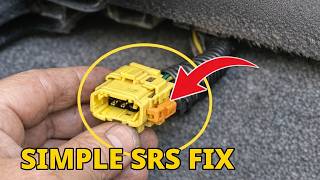
- Loose or Damaged Electrical Connector (Very Common) — The most frequent cause is a poor connection in a yellow SRS wiring harness. On GM vehicles, this is the connector under the driver or passenger seat, or at the base of the B-pillar. Items stored under the seat or aggressive seat movement dislodge it.
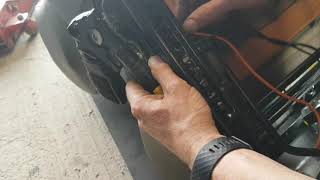
- Broken Connector Position Assurance (CPA) Retainer (Very Common) — This small plastic clip secures the main connector. It is brittle and breaks or falls out, allowing the main connector to vibrate loose. This well-documented issue is covered by GM Technical Service Bulletin #08-09-41-002H. 🎬 Watch: How to fix B0022 on GM and Chevy vehicles.
- Damaged or Chafed Wiring (Common) — Wires in the airbag circuit under seats, along the B-pillar, or in the headliner get pinched, stretched, or rubbed through, causing an open or short circuit.
- Poor Terminal Crimp from Factory (Common) — On 2014-2015 GM SUVs (Traverse, Acadia, Enclave), female terminals within the seat harness connectors lack sufficient factory crimping, causing high resistance. GM TSB PI1357 advises technicians to solder the terminals to fix this.
- Water Intrusion and Corrosion (Less Common) — Spilled drinks or water leaks from sunroof drains seep into under-seat or B-pillar connectors. This corrodes the sensitive gold-plated terminals, causing high resistance.
- Faulty Seat Belt Pretensioner (Less Common) — The pretensioner unit fails internally, causing its electrical resistance to drop out of the 1.1 to 3.9 ohm range. Suspect this only after confirming the wiring is flawless.
- Previous Improper Repair (Rare) — On rebuilt vehicles, a previous attempt to hide a deployed airbag involves cutting wires and soldering in a resistor to fool the SDM. These shoddy repairs fail and trigger the code.
- Faulty Airbag Control Module (SDM) (Rare) — The airbag computer itself fails. This is the absolute last component to suspect after ruling out all wiring, connectors, and pretensioners through proper load testing.
Symptoms

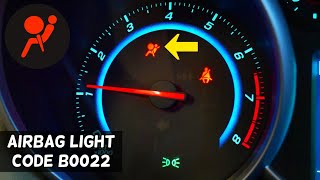
- Airbag Warning Light On (Solid or Flashing) — The airbag or SRS warning light stays illuminated on the dashboard. On some models, it flashes a specific pattern (Lamp Fault Code) before staying solid.
- 'Service Air Bag' Message — The driver information center (DIC) displays a text warning such as 'Service Air Bag'.
- Intermittent Electrical Gremlins — If the Airbag Control Module fails, you experience random warning lights or erratic power accessory behavior due to electronic interference.
- Airbag System Disabled — The presence of code B0022 confirms the entire SRS system is inactive and will not deploy in a collision.
Diagnostic Flowchart
Tap your situation to follow the diagnostic path that matches what you're seeing on this code.
Common Fixes & Costs
- Secure or Repair Under-Seat/B-Pillar Connector — Parts: $0-$20, Labor: $80-$150, ~1 hr book time (DIY)
- Replace Connector Position Assurance (CPA) Retainer — Parts: $5-$20, Labor: $80-$150, ~1 hr book time (DIY)
- Repair Damaged Wiring (Solder or Pigtail) — Parts: $10-$60, Labor: $150-$300, ~2 hr book time (Intermediate)
- Replace Seat Belt Pretensioner Assembly — Parts: $200-$400, Labor: $150-$300, ~2 hr book time (Professional)
- Replace Airbag Control Module (SDM) — Parts: $400-$1200, Labor: $150-$300, ~2.5 hr book time (Professional)
Used vs. New Parts: Buying Guide
When a used part is worth it: Never for pyrotechnic components like pretensioners. For the SDM, used parts only work if a professional verifies the donor vehicle had no crash history and reprograms the VIN.
Donor-vehicle mileage cap: roughly under 50000 miles for the part to have meaningful remaining life.
Donor quality checklist:
- Verify donor vehicle was not in a crash.
- Ensure the part has zero signs of water damage or corrosion.
- The part number must match EXACTLY.
- Avoid parts from flood-prone regions.
Decision logic:
- If The faulty part is a seat belt pretensioner or airbag. → Buy new OEM. The risk of a used pyrotechnic device failing is too high.
- If The faulty part is the Airbag Control Module (SDM). → Buy a new OEM module or use a professional reset service. Used modules require professional VIN programming.
- If The part is a simple connector or plastic trim. → Used is acceptable if in perfect condition.
Warranty tradeoff: Used SRS components carry a 30-day warranty at best. New OEM parts carry a 1-year minimum warranty. GM explicitly warns against using salvaged SRS parts.
Worst-case if a used part fails: $500-$1500 plus the catastrophic risk of a safety component failing during a crash.
What Happens If You Wait — Timeline
- Immediately: Code B0022 sets. The airbag warning light illuminates. The entire SRS system is immediately disabled as a fail-safe. (MPG impact: 0%% · Added cost: $0)
- Persistent: The fault remains active every time the vehicle starts. The system is completely non-functional, posing a significant risk to occupant safety. (MPG impact: 0%% · Added cost: $0)
- During a Collision: No airbags deploy and no seat belt pretensioners activate. Occupants face a dramatically higher risk of severe injury or death. (MPG impact: N/A% · Added cost: Potentially infinite (medical bills, loss of life).)
- At Vehicle Inspection/Resale: The vehicle fails mandatory safety inspections. The airbag light significantly decreases resale value. (MPG impact: 0%% · Added cost: $500 - $2000 in diminished value.)
Cost of Not Fixing It
- Immediately and Persistently: The entire Supplemental Restraint System (SRS) is disabled. NO airbags deploy and seat belt pretensioners will not activate. (Added cost: Non-quantifiable. Frontal airbags reduce driver fatalities by 29%; this protection is completely lost.)
- During a Collision: Occupants rely solely on the standard locking function of the seatbelt, without pretensioners or airbags. (Added cost: Catastrophic medical bills or loss of life.)
- Vehicle Resale or Inspection: The vehicle fails safety inspections and resale value plummets. Selling without disclosure creates legal liability. (Added cost: $500 - $2000 reduction in vehicle value.)
Diagnosis Steps
- Safety First: Disable the SRS System
Disconnect the negative battery terminal and wait exactly 15 minutes before touching any yellow airbag components. This discharges the SDM backup power capacitors, preventing accidental deployment.
Tools: ['10mm Socket or Wrench'] (Beginner) - Read the Full Fault Code with Suffix
Use an SRS-capable scanner to read the crucial two-digit suffix (e.g., B0022-04, B0022-0D). This specifies the exact electrical fault (Open Circuit, High Resistance) required for diagnosis.
Tools: ['SRS-capable OBD-II Scanner'] (Beginner) - Inspect Under-Seat and B-Pillar Connectors
Visually inspect all yellow airbag connectors under the front seats and at the B-pillar base. Look for loose connections, debris, or a broken plastic locking clip (CPA retainer).
Tools: ['Flashlight'] (Beginner) - Secure and Test Connectors
Firmly reconnect any loose connector and ensure the CPA clip clicks. If broken, replace it. Clear the codes and cycle the ignition to see if the fault returns.
Tools: ['SRS-capable OBD-II Scanner'] (Beginner) - Inspect Wiring Harness
Trace the wiring leading to the connector. Look for chafing from seat movement, pinching, corrosion, or electrical tape hiding a past repair.
Tools: ['Flashlight', 'Trim Removal Tools'] (Intermediate) - Wiggle Test with Live Data
With a scan tool displaying live resistance data for the suspect circuit, wiggle the connector and harness. If resistance jumps from ~2.2 ohms to 'OL', you found the intermittent open circuit.
Tools: ['SRS-capable OBD-II Scanner'] (Advanced) - Measure Live Data Resistance Values
View live data for 'Deployment Loop Resistance'. A reading below 1.1 ohms is a Low Resistance fault (-0E). Above 3.9 ohms is a High Resistance fault (-0D). 'OL' or 25.5 ohms is an Open Circuit (-04).
Tools: ['SRS-capable OBD-II Scanner'] (Advanced) - Use a Load Tool for Circuit Testing
Never probe airbag terminals with a multimeter. Disconnect the component and plug a 2.2-ohm SRS load tool into the harness. If the code clears, the vehicle wiring is good and the component is faulty.
Tools: ['SRS Load Tool/Diagnostic Resistor Set'] (Advanced) - Test Circuit Resistance at the SDM
Disconnect the battery, component, and SDM. Use a multimeter to check continuity from the component connector back to the SDM connector. Resistance must be under 5.0 ohms end-to-end.
Tools: ['Digital Multimeter', 'Vehicle-specific Wiring Diagram'] (Advanced)
When This Code Triggers (Freeze-Frame Conditions)
- System Status: Key-On Self-Test (The SRS module performs a self-check every time the ignition turns to 'ON'.)
- Ignition Voltage: 9-16 Volts (The module requires normal operating voltage to run diagnostics.)
- Deployment Loop Resistance: < 1.1 ohms or > 3.9 ohms (The code sets when measured resistance goes outside the acceptable 1.1 to 3.9 ohm range.)
- Fault Duration: 120-500 milliseconds (The out-of-range resistance must persist for a fraction of a second to confirm a hard fault.)
Related Codes
- B0022-XX — The two-digit suffix codes (-01, -02, -04, -0D, -0E) specify the exact electrical fault: Short to Battery, Short to Ground, Open Circuit, High Resistance, or Low Resistance.
- B0015 — The equivalent code for the driver's side seat belt pretensioner. Seeing B0015 and B0022 together points to a systemic issue like a faulty SDM or shared ground.
- B0023 — Refers to a different deployment loop, often on the opposite side of the vehicle or a different component entirely.
- B0029 — Refers to 'Right Curtain Deployment Control 1'. Seeing this alongside B0022 indicates a wiring issue in the roof or a failing airbag control module.
Climate & Environmental Factors
- High Humidity / Water Intrusion: Moisture from spills or sunroof leaks corrodes the gold-plated terminals in SRS connectors, directly causing high resistance faults like B0022-0D.
- Extreme Cold: Cold temperatures make plastic components, especially the CPA retainer clip, brittle and susceptible to breaking. Metal terminals contract, creating intermittent open circuits.
How to Talk to a Mechanic About This Code
Say this: "I have an airbag light on and a B0022 code. Based on my research, this is often a connector or wiring issue on my vehicle. Before replacing any expensive parts, please thoroughly inspect the connectors under the seat and at the B-pillar for looseness, damage, or a broken CPA clip."
This signals you are an informed consumer. It directs the technician to the most common failure points first, preventing them from defaulting to an expensive part replacement.
Avoid saying:
- 'My airbag light is on, can you fix it?'
- 'Just replace the airbag sensor.'
- 'Do whatever you think is best.'
Questions to ask before authorizing the repair:
- Did you find the specific suffix code, like -0D for high resistance or -04 for an open circuit?
- Can you confirm you inspected the connector and wiring harness first?
- If recommending a part replacement, did you use a load tool to rule out the wiring?
- What is the warranty on this specific repair?
Where to Take It: Dealer vs Independent vs Chain
- Dealer:
Best for: Vehicles under warranty or a specific recall., Complex cases requiring SDM replacement and programming., When you want a guaranteed OEM-part-only repair.
Downsides: Highest labor rates., May replace an entire assembly rather than perform a detailed wiring repair. (Typical cost: +50% vs. baseline) - Independent Shop:
Best fit for most situations. A good independent shop diagnoses the common connector fault efficiently, saving you from an unnecessary part replacement.
Best for: Most B0022 cases on out-of-warranty vehicles., Cost-conscious owners looking for a correct diagnosis.
Downsides: Shop quality varies. Vet them by asking if they have ASE-certified technicians comfortable with airbag diagnostics. (Typical cost: +0% vs. baseline) - Chain Shop:
AVOID. This critical safety system repair requires diagnostic expertise not found at high-volume chain shops.
Best for: Simple services like oil changes or tires.
Downsides: Technician skill with complex safety systems is inconsistent., Often lack advanced scan tools needed for SRS diagnostics. (Typical cost: -10% vs. baseline)
When to Walk Away From the Repair
If the estimated repair cost exceeds 50% of the car's private-party value, seriously consider selling the car as-is.
- Car worth $4000, fix is $600: Fix it. The cost is well below the threshold and restores a critical safety feature.
- Car worth $3000, fix is $1500: Borderline. Get a second opinion to confirm no cheaper wiring fix is possible before authorizing.
- Car worth $2500, fix is $1800: Walk away. The repair cost is over 70% of the car's value.
What Scan Tool You Need for This Code

Minimum: A scanner that reads and clears SRS/Airbag 'B' codes. A basic engine-only code reader is useless.
Generic scanners cannot see 'B' codes. You need a tool that accesses the SRS module, reads the two-digit suffix code, and views live resistance data.
Budget: Autel AutoLink AL619 (~$80) — Reads and clears SRS codes. Confirms the B0022 code is present and clears it after repair.
Mid-range: Foxwell NT630 Plus (~$130) — Reads SRS codes and shows live data streams (circuit resistance). The sweet spot for a serious DIYer.
Professional: Autel MaxiCOM MK808 (~$450) — Provides full bidirectional control, comprehensive live data, and manufacturer-specific code details.
Rent vs buy: Auto parts stores read codes for free, but their basic tools often cannot read SRS codes. Buying a mid-range scanner is a worthwhile investment for DIYers.
How to Clear the Code After You Fix It
- Ensure the underlying fault is repaired.
- Reconnect the vehicle battery.
- Use an SRS-capable OBD-II scan tool to access the 'Body' or 'SRS' control module.
- Select 'Clear Codes'. A generic engine code reader will not work.
Drive cycle (~10 minutes): The SRS system does not require a drive cycle. Cycle the ignition off, then on. The airbag light illuminates for 7 seconds for its self-test and turns off.
Readiness monitors affected: None
Before emissions retest: drive at least 100 miles to fully set monitors.
Watch out for:
- Attempting to clear the code without fixing the root cause guarantees it returns instantly.
- Using a basic OBD-II scanner that only reads 'P' (Powertrain) codes.
- Disconnecting the battery clears emissions readiness monitors, requiring a 50-100 mile drive cycle before an emissions test.
Will This Fail Emissions / State Inspection?
No — by itself this code doesn't fail OBD inspection (but it can keep readiness monitors from setting, which causes a separate fail).
- California: An airbag light will NOT fail a California smog check, as it is an emissions-only test.
- New York: An illuminated airbag warning lamp is an 'advisement only' and not official cause for rejection, though individual shops may refuse inspection.
- Texas: An airbag light will NOT fail the Texas state safety inspection.
- Virginia / Pennsylvania: In states with strict safety inspections, an illuminated airbag light causes an automatic failure.
Most Commonly Affected Vehicles
- Chevrolet Malibu (2006-2013) — The fault is almost always the passenger seat belt pretensioner connector at the B-pillar, caused by a failed CPA clip (P/N 88988974).
- GMC / Chevrolet / Cadillac Yukon, Acadia, Terrain, Tahoe, Escalade (2007-2014) — A bad connection in the under-seat harness. GM recall 14V118 advises soldering the wires to bypass the faulty connector.
- Chevrolet Corvette (C6) (2006-2013) — Caused by a loose yellow connector under the power seats snagging on the carpet. GM Special Coverage #15643 extends the warranty for this issue.
- Chevrolet Cruze (2011-2015) — Triggers code B0022-04 (Open Circuit) due to a poor connection at the B-pillar seatbelt retractor.
- Chevrolet Cobalt, Trailblazer, Express (2005-2012) — Points to a bad connection at the passenger seat belt pretensioner connector, covered by TSB #08-09-41-002H.
- Pontiac G6 (2005-2010) — Shares the Malibu platform. Fixed by replacing the CPA clip (P/N 88988974) on the B-pillar connector.
- Ford Fusion, F-150 (2006-2012, 2015-2020) — Caused by wiring issues under the seat. On the F-150, wires break inside the harness right at the connector.
- Hyundai Elantra, Santa Fe (2011-2016, 2024) — Triggered by faults in the side curtain airbag circuits in the A-pillar or headliner. A 2024 Santa Fe recall addresses chafing harnesses.
Manufacturer-Specific Notes

- General Motors: Code B0022 almost always points to a poor electrical connection, not a failed part. GM TSBs identify faulty CPA clips and bad terminal crimps as the primary culprits.
- General Motors (Specific Models): For recalls on 2007-2014 SUVs and 2005-2013 Corvettes, the official repair eliminates the under-seat connector entirely by soldering the wires together.
- Hyundai: Hyundai's official procedure forbids repairing SRS wiring. Damaged harnesses require replacing the entire harness assembly.
- Ford: A flashing airbag light that blinks a 'code 33' or '34' pattern points directly to a seat belt pretensioner circuit fault before staying solid.
Real Owner Stories
2008 Chevy Corvette C6 with 75,000 miles
Airbag light came on intermittently, often after adjusting the power seat. Code B0022 was present.
What they tried:
- Tried clearing the code, but it returned immediately.
- Disconnected the battery, waited 30 minutes, and accessed the yellow connector under the passenger seat.
Outcome: The yellow connector had snagged on the carpet and partially unplugged. The owner re-seated the connector and secured it with a zip tie. The code cleared permanently. Total cost: $0.10.
Lesson: On C6 Corvettes, check the under-seat connectors first. It's a well-documented issue and often a free fix.
2011 Chevy Malibu at 110,000 miles
'Service Air Bag' message appeared with code B0022-0D (High Resistance).
What they tried:
- A mechanic quoted $550 to replace the passenger seat belt pretensioner.
- Owner found GM TSB #08-09-41-002H pointing to a faulty CPA clip.
- Ordered the CPA clip (P/N 88988974) for under $15.
Outcome: Owner removed the B-pillar trim, found the broken clip, replaced it, and cleared the code. The repair cost $15 and took one hour.
Lesson: Don't automatically accept a quote for full part replacement. A high resistance code often points to a connection, not a component failure.
2012 GMC Acadia with intermittent B0022
Airbag light came on randomly. Scan showed B0022 with high resistance.
What they tried:
- Wiggling wires under the driver's seat temporarily turned the light off.
- A mechanic diagnosed a poor terminal crimp inside the connector (GM PI1357).
Outcome: The mechanic cut out the faulty connector and soldered the wires directly, sealing them with heat shrink. The $250 labor cost permanently fixed the issue.
Lesson: For an intermittent fault that reacts to wire movement, the problem is the wiring. Soldering the wires is the official GM fix for this specific issue.
How to Prevent This Code From Triggering
- Avoid storing items under the front seats (Daily habit) — Objects shift during driving and physically dislodge the sensitive SRS connectors under the seat.
- Be mindful when moving power seats (Daily habit) — Slamming the power seat to its extreme limits tugs on the wiring harness, leading to broken wires or loose connections.
- Secure under-seat harnesses with a zip tie (Once, as a proactive measure) — Adding a loose zip tie around the connector and seat frame prevents it from snagging on carpet or separating from vibration.
- Apply dielectric grease to SRS connectors (During any related repair) — Applying dielectric grease to the connector seal keeps moisture out, preventing corrosion that leads to high resistance faults.
- Periodically inspect visible yellow wiring (Every 6 months) — A visual check spots dislodged CPA clips or early signs of chafing before they become hard faults.
Frequently Asked Questions
Can I just clear the B0022 code?
You can clear it with a scanner, but if the electrical fault remains, the SDM detects it during the next startup and the code returns instantly.
A mechanic quoted me for a whole new seat belt assembly. Is that necessary?
Not always. For many GM vehicles, the cause is a bad connection fixed by re-seating a connector or replacing a $15 plastic clip. Insist on a thorough wiring inspection before replacing expensive parts.
Can I use a resistor to bypass the airbag light for code B0022?
Wiring a resistor to bypass the airbag light is an extremely dangerous and illegal practice that permanently disables the safety device. You lose all crash protection from that component. This hazardous shortcut is common on rebuilt salvage vehicles and must be reversed.
Is it safe to work on my own airbag system?
Working on the SRS system is dangerous and causes accidental deployment if done incorrectly. Always disconnect the battery and wait 15 minutes before starting work. If you lack experience or a load tool, take the vehicle to a professional.
Will replacing the seat belt buckle fix code B0022?
No. Code B0022 relates to the seat belt retractor pretensioner in the B-pillar, not the buckle where you latch the belt.
My airbag light is on for the passenger side. Will my driver's airbag still work?
No. When the SDM detects a critical fault like B0022, it disables the entire SRS system. No airbags deploy anywhere in the vehicle.
What are the yellow connectors for?
Yellow wiring and connectors universally identify the high-risk SRS system. They warn technicians to take special precautions, like disconnecting the battery.
Key Takeaways
- Code B0022 disables your entire airbag system, increasing frontal crash fatalities by up to 32% until the fault is repaired.
- Over 80% of B0022 codes on GM vehicles stem from a loose yellow connector or a broken $15 CPA clip under the seat, not a failed airbag component.
- Disconnect the negative battery terminal and wait exactly 15 minutes before touching any yellow SRS wiring to prevent accidental airbag deployment.
- Use a professional scan tool to read the two-digit suffix code (like -04 for open circuit or -0D for high resistance) to pinpoint the exact electrical fault.
- Never use a multimeter directly on airbag component terminals; use a 2.2-ohm SRS load tool to safely test the circuit.
Helpful Videos

The information in this article is provided for general reference and educational purposes only. Vehicle specifications, procedures, and part compatibility can vary by production date, trim level, and region. Always consult your vehicle's factory service manual and verify part numbers before purchasing or performing repairs. Safety-critical components such as airbags, seat belts, and braking systems should be installed by a qualified professional.
- 🎬 Helpful Videos
- What Does B0022 Mean?
- Can I Drive With B0022?
- Common Causes
- Symptoms
- Diagnostic Flowchart
- Common Fixes & Costs
- Used vs. New Parts: Buying Guide
- What Happens If You Wait — Timeline
- Cost of Not Fixing It
- Diagnosis Steps
- When This Code Triggers (Freeze-Frame Conditions)
- Related Codes
- Climate & Environmental Factors
- How to Talk to a Mechanic About This Code
- Where to Take It: Dealer vs Independent vs Chain
- When to Walk Away From the Repair
- What Scan Tool You Need for This Code
- How to Clear the Code After You Fix It
- Will This Fail Emissions / State Inspection?
- Most Commonly Affected Vehicles
- Manufacturer-Specific Notes
- Real Owner Stories
- 2008 Chevy Corvette C6 with 75,000 miles
- 2011 Chevy Malibu at 110,000 miles
- 2012 GMC Acadia with intermittent B0022
- How to Prevent This Code From Triggering
- Frequently Asked Questions
- Can I just clear the B0022 code?
- A mechanic quoted me for a whole new seat belt assembly. Is that necessary?
- Can I use a resistor to bypass the airbag light for code B0022?
- Is it safe to work on my own airbag system?
- Will replacing the seat belt buckle fix code B0022?
- My airbag light is on for the passenger side. Will my driver's airbag still work?
- What are the yellow connectors for?
- Key Takeaways
- 🎟️ Get 5% Off