

Ultimate Guide to OBD-II Code B0013: A Critical Airbag Circuit Fault
What B0013 Means, In-Depth Causes, and Pro-Level Fixes
- Code B0013 completely disables your vehicle's Supplemental Restraint System, guaranteeing zero airbag deployment during a collision.
- Inspect the $10 plastic Connector Position Assurance (CPA) clip before replacing any parts, as a broken clip is the leading cause of this code on GM vehicles.
- Perform a live data resistance test while turning the steering wheel lock-to-lock to definitively diagnose or rule out a $300 clock spring failure.
- Disconnect the negative battery terminal and wait exactly 30 minutes to discharge the backup capacitors before touching any yellow SRS wiring.
- Use an SRS-capable scan tool to read the 2-digit symptom byte (like -0D for high resistance) to pinpoint the exact electrical fault.
What Does B0013 Mean?

B0013 is a Body Diagnostic Trouble Code (DTC) indicating the Sensing and Diagnostic Module (SDM)—the primary airbag computer—detected an electrical fault in a specific airbag deployment circuit. This fault forces the SDM to disable the entire airbag system as a failsafe and illuminate the airbag warning light. The specific circuit varies by manufacturer.
Technical definition: The SAE/ISO standard defines B0013 as "Deployment Control Fault." For General Motors (GM), it translates to "Driver Steering Wheel Airbag Deployment Loop 2 Open/High Resistance." For Chrysler, it points to the "Passenger Knee Bolster Squib Control Circuit Open." An SRS-capable scan tool retrieves a two-digit symptom byte (e.g., -04 for open circuit, -0D for high resistance) providing specific diagnostic data.
Can I Drive With B0013?
no_recommended. While the vehicle operates mechanically, driving with code B0013 is strongly discouraged. The Supplemental Restraint System (SRS) is disabled. In a collision, no airbags will deploy, drastically increasing the risk of severe injury or fatality. There is no risk of mechanical damage, but the safety risk is absolute.
Common Causes


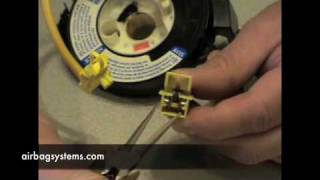
- Broken or Missing Airbag Connector Position Assurance (CPA) Retainer (Very Common) — This is the leading cause, especially on GM vehicles. The CPA is a small plastic clip that locks the main electrical connector onto the airbag module. Brittle plastic breaks over time, causing micro-vibrations that the SDM detects as high resistance. GM issued TSB #08-09-41-002H 🎬 Watch: Diagnosing common GM airbag codes B0012 and B0013. to address this widespread issue.
- Faulty Clock Spring (SIR Coil) (Common) — The clock spring is a coiled ribbon of wires within the steering column maintaining electrical contact for the driver's airbag. Continuous steering wheel rotation fatigues and breaks internal ribbon wires, creating an open circuit or high resistance. 🎬 See this guide on how to test a clock spring.
- Damaged Wiring or Poor Terminal Tension (Common) — Wiring leading to an airbag component gets pinched, chafed, or cut in the steering column or under seats. Female metal terminals inside connectors also lose their grip on male pins, creating poor connections. GM TSB PI1474 addresses poor terminal tension in the steering wheel airbag coil connector for specific Cadillac models.
- Faulty Airbag Module (Inflator) (Less Common) — The chemical inflator's squib or integrated wiring fails internally, pushing electrical resistance outside manufacturer specifications. This requires replacing the entire airbag module.
- Corrosion from Water Ingress (Uncommon) — Cabin moisture from leaks or high ambient humidity corrodes airbag connectors and pins. This corrosion introduces unwanted resistance into sensitive airbag circuits, triggering a fault code.
- Aftermarket Accessory Interference (Uncommon) — Improperly installed aftermarket remote starters, alarms, or unshielded 12V chargers emit Radio Frequency Interference (RFI) that disrupts SRS wiring. Tapping into wires near the airbag harness causes electrical noise or shorts.
- Faulty Sensing and Diagnostic Module (SDM) or Software (Rare) — The central airbag computer (SDM) rarely fails. Software corruption or outdated calibration logic causes the module to misinterpret sensor data. Replace or re-flash the SDM only after rigorously testing all wiring, connectors, and the airbag module.
Symptoms
- Airbag Warning Light Illuminated — The primary symptom. The light remains illuminated continuously as long as the fault is active.
- Airbag System Disabled — The entire SRS is deactivated. No airbags will deploy in an accident, rendering a critical safety feature useless.
- Driver Information Center (DIC) Warning Message — The vehicle's information display shows a specific text warning, such as "Service Airbag System" or "Airbag Fault."
- Horn or Steering Wheel Controls Inoperative — If a broken clock spring causes the fault, other steering wheel-mounted electronic functions, such as the horn or cruise control, fail simultaneously.
Diagnostic Flowchart
Tap your situation to follow the diagnostic path that matches what you're seeing on this code.
Common Fixes & Costs
- Replace Airbag Connector Position Assurance (CPA) Retainer — Parts: $5-$15, Labor: $100-$200, ~1.0 hr book time (Intermediate)
- Replace Clock Spring (SIR Coil) — Parts: $50-$450, Labor: $150-$300, ~1.5 hr book time (Intermediate)
- Repair Damaged Wiring or Replace Connector Pigtail — Parts: $20-$60, Labor: $150-$300, ~2.0 hr book time (Professional)
- Replace Airbag Module (Inflator) — Parts: $400-$1,200, Labor: $100-$300, ~1.0 hr book time (Professional)
- Replace Sensing and Diagnostic Module (SDM) — Parts: $400-$1,200, Labor: $150-$350, ~1.8 hr book time (Professional)
DIY vs Professional
- Replace Airbag Connector Position Assurance (CPA) Retainer — Beginner: Yes, with caution.
Tools: Basic hand tools, trim removal tools. - Replace Clock Spring (SIR Coil) — Beginner: No. Recommended for intermediate to advanced DIYers.
Tools: Socket set, torque wrench, steering wheel puller, trim removal tools. - Repair Damaged Wiring or Replace Connector Pigtail — Beginner: No. Professional recommended.
Tools: Soldering iron, heat shrink tubing, wire strippers, multimeter, airbag circuit test adapters. - Replace Airbag Module (Inflator) — Beginner: No. Professional only.
Tools: Specialized tools for handling explosive components, torque wrench, scan tool.
Used vs. New Parts: Buying Guide
When a used part is worth it: For a clock spring, a used OEM part from a low-mileage vehicle not in a frontal collision is a cost-effective alternative. It is illegal and unsafe to purchase used airbag modules.
Donor-vehicle mileage cap: roughly under 60000 miles for the part to have meaningful remaining life.
Donor quality checklist:
- Verify the donor vehicle part number matches exactly.
- Ensure the donor vehicle was not scrapped due to a frontal impact or airbag deployment.
- Inspect the part for physical damage, corrosion, or previous repair attempts.
Decision logic:
- If The faulty part is an airbag module (inflator). → Always buy new OEM. It is a one-time-use pyrotechnic device and cannot be safely reused.
- If The faulty part is a clock spring and the vehicle is older (>10 years). → A low-mileage used OEM part or new aftermarket part is a viable option.
- If The faulty part is a wiring connector or CPA clip. → Buy new OEM or a high-quality aftermarket pigtail to ensure proper terminal tension.
Warranty tradeoff: Used parts typically have a 30-90 day warranty. Aftermarket new parts offer 1-year to limited lifetime warranties. New OEM parts carry a 12-month/12,000-mile warranty.
Worst-case if a used part fails: $200-$500 if a used clock spring fails prematurely, requiring repeat labor costs.
What Happens If You Wait — Timeline
- Immediate (First Key-On): The SDM detects the electrical fault during its self-test. The airbag warning light illuminates, and the entire airbag system is disabled as a failsafe. (MPG impact: 0%% · Added cost: $0)
- At State Safety Inspection: The vehicle automatically fails mandatory safety inspections in states like NY, VA, and TX due to the illuminated airbag light, preventing legal registration. (MPG impact: 0%% · Added cost: $50-$200 in inspection fees and potential fines.)
- At Time of Resale: The vehicle's resale value is significantly diminished. Dealerships refuse the trade-in or reduce its value by an amount far exceeding the repair cost. (MPG impact: 0%% · Added cost: $1000-$4000+ in lost vehicle value)
Cost of Not Fixing It
- Immediate: Total loss of airbag system functionality. In a collision, no airbags will deploy, dramatically increasing the risk of severe or fatal injury. (Added cost: N/A)
- Ongoing: Failure of mandatory state safety inspections, preventing legal vehicle registration and operation. (Added cost: $50-$200 (towing, re-inspection fees))
- At Resale: Significant reduction in vehicle resale or trade-in value. Dealerships refuse the trade, and private buyers are deterred. (Added cost: $1000-$4000+)
Diagnosis Steps
- Scan for Codes with an SRS-Capable Scanner
Use a scan tool that reads Body (B) codes from the SRS/airbag module. A standard engine code reader will not work. Record the full B0013 code with its symptom byte (e.g., B0013-0D for high resistance).
Tools: SRS-Capable OBD-II Scan Tool (Beginner) - SAFETY: Disable the Airbag System
Disconnect the negative terminal of the car battery. Wait exactly 30 minutes before working on any airbag components. This allows the backup power capacitors within the SDM to fully discharge, preventing accidental deployment. This is a non-negotiable safety step.
Tools: 10mm Wrench (Beginner) - Visually Inspect the Target Connector and CPA Clip
Access the component specified by the code. Carefully inspect the bright yellow airbag connector. Look for the small plastic CPA retainer clip; check if it is broken, loose, or missing. Wiggle the connector to verify it is fully seated.
Tools: Trim removal tools, flashlight (Intermediate) - Live Data Resistance Test (Clock Spring Check)
Reconnect the battery. With an advanced scan tool connected, monitor the live data PID for 'Deployment Loop Resistance'. Slowly turn the steering wheel from lock to lock. The resistance must remain stable (typically 2.1-4.0 ohms). If the reading spikes, drops out, or reads 'Open', the clock spring is faulty.
Tools: Advanced SRS-Capable Scan Tool (Advanced) - Inspect the Wiring Harness
Trace the yellow, sheathed wiring harness from the airbag component back towards the main harness. Look for chafing against metal, pinching, or cuts. Pay close attention to wiring in the steering column and under the front seats.
Tools: Flashlight (Intermediate) - Measure Circuit Resistance with a Multimeter
Disable the system again (Step 2). Disconnect the harness at the SDM and at the airbag component. Using a multimeter and special airbag circuit test adapters, measure the resistance of the deployment loop wires. Compare the reading to the manufacturer's specification. Never probe airbag connectors directly with standard multimeter leads.
Tools: Digital Multimeter, Airbag Circuit Test Adapters (Advanced) - Check for Shorting Bar Function
After disconnecting an airbag connector, test the resistance between the two terminals on the component side. The reading must be infinite (open circuit). A resistance reading indicates the internal shorting bars are not disengaging properly, meaning the connector is faulty.
Tools: Digital Multimeter (Professional) - Isolate the Faulty Component
If resistance is out of spec, isolate the problem by testing the resistance of individual components and sections of wiring separately. Consult a factory service manual for specific connector pinouts and testing procedures.
Tools: Digital Multimeter, Factory Service Manual (Professional)
When This Code Triggers (Freeze-Frame Conditions)
- Ignition Cycle Counter: Varies (e.g., 152) (Indicates the number of times the vehicle has been started since the fault was first detected.)
- Fault Status: Active / Current (Shows that the fault is present at the time of scanning, as opposed to 'History'.)
- System Voltage: 12.0 - 14.5 Volts (Records the vehicle's electrical system voltage when the fault occurred, ruling out low/high voltage as a cause.)
- Deployment Loop Resistance: > 4.4 Ohms or 'OPEN' (A key parameter showing the measured resistance was outside the acceptable range when the code was set.)
Related Codes
- B0012 — Refers to the 'Stage 1' deployment loop. Seeing B0012 and B0013 together strongly suggests a fault common to both circuits, such as the main connector or clock spring.
- B0013-04 — Indicates an 'Open Circuit.' The SDM detected a complete break in the wiring, such as a disconnected connector or a fully broken wire in the clock spring.
- B0013-0D — Indicates 'Resistance Above Threshold.' The most common variant, indicating a poor connection, corrosion, or a broken CPA clip is causing high resistance.
- B0013-0E — Indicates 'Resistance Below Threshold.' The two wires in the deployment loop are shorted together, possibly due to pinched insulation or a faulty shorting bar.
Climate & Environmental Factors
- High Humidity / Water Leaks: High ambient humidity or water ingress from leaks penetrates electrical connectors. This corrodes connector pins, increasing electrical resistance and triggering a B0013-0D (high resistance) fault.
- Extreme Cold: In very cold weather, plastic components like the CPA retainer and wire insulation become brittle and crack. Temperature fluctuations cause electrical connections to contract and loosen, leading to intermittent open circuits.
How to Talk to a Mechanic About This Code
Say this: "I have an airbag light on and my scanner shows code B0013. I understand this is often a connection issue, like the CPA clip or terminal tension noted in manufacturer TSBs. Could you please ensure the technician starts with a connector and wiring inspection before quoting expensive parts like a clock spring or airbag module?"
This signals you are an informed customer. It directs the shop to follow a logical, cost-effective diagnostic path and prevents them from immediately quoting an expensive, unnecessary part replacement.
Avoid saying:
- My airbag light is on, can you fix it?
- Just do whatever it takes to turn the light off.
- I think I need a new clock spring.
Questions to ask before authorizing the repair:
- Did you inspect the airbag connector and the CPA retainer clip? Was it broken or loose?
- What was the resistance reading of the deployment loop? Was it high, low, or open?
- If you are recommending a clock spring or airbag module, how did you rule out a wiring or connection issue?
- Can I see the old part you are replacing?
- What is the warranty on this specific repair, including both parts and labor?
Where to Take It: Dealer vs Independent vs Chain
- Dealer:
A safe, but expensive, choice. They are most familiar with TSBs, which is a major advantage for this specific code.
Best for: Vehicles under warranty, Repairs covered by a specific recall or Technical Service Bulletin (TSB), Complex diagnostics on very new models requiring proprietary software
Downsides: Highest labor rate and part costs., Defaults to replacing entire assemblies rather than smaller components. (Typical cost: +50% vs. baseline) - Independent Shop:
Excellent fit. A reputable independent shop with experience in electrical and safety systems offers the best balance of expertise and value.
Best for: Out-of-warranty vehicles where cost is a factor., Common, well-documented issues like B0013 on GM vehicles., Building a long-term relationship with a trusted mechanic.
Downsides: Quality and expertise vary widely; vetting the shop's reputation and ASE certifications is crucial., Less experience with brand-new models. (Typical cost: +0% vs. baseline) - Chain Shop:
Avoid for this repair. Diagnosing an SRS fault requires specialized knowledge and tools beyond the scope of a typical chain shop.
Best for: Simple, routine maintenance like oil changes, tires, and batteries.
Downsides: Technician skill is highly variable., Not equipped or trained for in-depth electrical or SRS diagnostics., Business model encourages upselling unnecessary services. (Typical cost: -10% vs. baseline)
When to Walk Away From the Repair
If the estimated repair cost exceeds 50% of the car's private-party value, consider selling or trading it in. For a critical safety issue like B0013 that causes inspection failure, the repair is non-negotiable if you plan to keep driving it.
- Car worth $4000, fix is $1800: Walk away. The repair cost is nearly half the vehicle's value. Sell the vehicle 'as-is' with full disclosure or trade it in.
- Car worth $12000, fix is $450: Fix it. This is a relatively low-cost repair that restores a critical safety feature and the vehicle's value.
- Car worth $2500, fix is $350: Fix it, if the rest of the car is sound. This repair is necessary to pass safety inspection and makes the car legally drivable.
What Scan Tool You Need for This Code

Minimum: A scanner that reads and clears Supplemental Restraint System (SRS) / Airbag codes. A basic engine-only code reader will not work.
A standard $20 code reader only communicates with the Powertrain Control Module. It cannot see or clear codes from the SRS module where B0013 is stored.
Budget: Autel AutoLink AL619 / ML629 (~$80) — Reads and clears codes from the Engine, ABS, and SRS modules. It correctly identifies the B0013 code and allows you to clear it after the repair.
Mid-range: BlueDriver Bluetooth Pro or Foxwell NT630 Plus (~$120) — Offers live data streaming. This is critical for B0013, allowing you to monitor deployment loop resistance in real-time as you wiggle wires or turn the steering wheel.
Professional: Autel MaxiCOM MK808 / Foxwell NT809 (~$450-600) — Offers full system diagnostics, bidirectional control, and access to manufacturer-specific data. Provides the deepest level of insight, identical to what a repair shop uses.
Rent vs buy: If this is a one-time repair, AutoZone offers a loaner tool program. Verify their loaner scanner reads SRS codes. If you plan to do your own diagnostics regularly, buying a midrange pick is a worthwhile investment.
How to Clear the Code After You Fix It
- Ensure the physical fault has been properly repaired.
- Reconnect the negative battery terminal.
- Use an SRS-capable OBD-II scan tool to access the Airbag/SRS module.
- Select the option to 'Clear DTCs' or 'Erase Codes'.
Drive cycle: No drive cycle is required. The airbag light turns off immediately after clearing the code if the repair was successful. If the fault exists, the light reappears instantly upon the next key-on self-test.
Readiness monitors affected: Not Applicable
Watch out for:
- Disconnecting the battery will not clear a B0013 code; it requires a scanner to reset.
- A standard engine code reader cannot communicate with the SRS module.
- The code returning immediately indicates a misdiagnosis, such as replacing the clock spring when the connector clip was the real issue.
Will This Fail Emissions / State Inspection?
No — by itself this code doesn't fail OBD inspection (but it can keep readiness monitors from setting, which causes a separate fail).
- General Note: An illuminated airbag light does NOT cause a failure of an emissions test. However, it WILL cause an automatic failure of the mandatory Safety Inspection in many states.
- California: The smog check does not test for airbag faults. However, selling a car with a known safety defect creates liability issues.
- New York: An illuminated airbag warning light is an automatic failure of the annual safety inspection. The vehicle cannot be legally driven until repaired.
- Texas: The airbag warning lamp must illuminate during the bulb check and turn off. If it remains on, the vehicle fails the annual safety inspection.
Most Commonly Affected Vehicles
- Chevrolet Malibu, Impala, Cobalt, Traverse (2006-2014) — Extremely prone to broken CPA retainers (GM P/N 88988974) on the driver's airbag connector, documented in GM TSB #08-09-41-002H.
- GMC Envoy, Acadia (2005-2009) — Covered under GM TSB #08-09-41-002H for faulty CPA clips. On the GMT360 platform, this is one of the most common repairs.
- Saturn Aura, VUE (2007-2010) — Shares platforms with other GM models and is highly susceptible to the same CPA retainer and clock spring failures.
- Cadillac CTS, ATS (2008-2015) — For 2015 models built between Aug 1 and Oct 1, 2014, TSB #PI1474 points to poor terminal tension requiring pigtail P/N 13580115.
- Ford Edge, Fusion (2007-2014) — B0013 relates to issues with connectors under the front seats getting kicked or damaged, or wiring in the steering column.
- Honda Accord, Odyssey, CR-V (2008-2017) — B0013 points to the 'Front Passenger's Knee Airbag Inflator'. Diagnosis focuses on checking for high resistance in the RKA lines.
- Dodge / Chrysler / Jeep Grand Caravan, Town & Country, Wrangler (2008-2016) — B0013 refers to the 'Passenger Knee Bolster Squib Control Circuit'. The cause is frequently a loose connector on the knee airbag module.
- Chevrolet Equinox, Trailblazer (2005-2012) — While the CPA retainer issue is common, internal failures of the driver's airbag module itself are also documented root causes.
Manufacturer-Specific Notes

- General Motors (Chevrolet, GMC, Buick, Cadillac, Saturn): GM vehicles are notorious for this code being caused by a brittle plastic CPA clip (P/N 88988974). Multiple TSBs advise technicians to inspect this clip before replacing expensive parts.
- Dodge / Chrysler / Jeep: B0013 often refers to the 'Passenger Knee Bolster Squib Control Circuit'. The cause is frequently a loose connector on the knee airbag module behind the glove box.
- Honda: B0013 points to the 'Front Passenger's Knee Airbag Inflator'. Diagnostic procedures focus on checking wiring connections between the airbag and the main SRS unit.
- SAAB: Diagnostic procedures for B0012 and B0013 are grouped. A common pro-tip is to rotate the steering wheel lock-to-lock while monitoring resistance to check for a failing clock spring.
Real Owner Stories
2006 Chevy Malibu with B0013-0D
Airbag light stayed on permanently. Horn and steering wheel controls still worked, ruling out a completely failed clock spring.
Outcome: Replaced the CPA clip (GM P/N 88988974) for under $10. Cleared the code with an SRS scanner, and the light stayed off.
Lesson: Inspect simple, cheap parts first. On many GM vehicles, the B0013 code is caused by a sub-$10 CPA clip, not a $300 clock spring.
2011 Chevy Equinox with B0013 High Resistance
Airbag light was on constantly. Scan confirmed B0013, "driver steering wheel airbag deployment loop stage 2 high resistance."
Outcome: Replacing the entire driver's airbag module cleared the code. The fault was internal to the airbag inflator's squib circuit.
Lesson: If a thorough inspection of all external wiring and connectors reveals no issues, the airbag module itself becomes the next likely culprit.
2015 Cadillac CTS with B0013-0D
Airbag light illuminated on a 2015 CTS. Code indicated high resistance in the driver's airbag circuit.
Outcome: The test revealed poor terminal tension. The technician replaced the connector with a new pigtail (GM P/N 13580115), fixing the problem.
Lesson: Manufacturer TSBs are critical. For certain model years, the fault is poor pin fitment requiring a specific pigtail replacement.
Dodge Grand Caravan with B0013
Airbag light appeared. Scan showed code B0013, pointing to the 'Passenger Knee Bolster Squib Control Circuit.'
Outcome: Owner firmly reconnected the electrical connector to the knee bolster airbag. After clearing codes, the light did not return.
Lesson: For Chrysler/Dodge/Jeep, B0013 often relates to the passenger knee airbag. The fix is often ensuring the connector behind the glove box is securely fastened.
How to Prevent This Code From Triggering
- Apply Dielectric Grease to Connectors (During any repair or every 5-7 years) — Applying dielectric grease to electrical connector seals repels moisture and prevents pin corrosion that causes high resistance faults.
- Inspect and Secure Wiring Harnesses (Annually or during other maintenance) — Periodically check that the yellow SRS wiring loom is properly secured and not rubbing against sharp metal edges or moving parts.
- Address Water Leaks Promptly (As needed) — Fix cabin water leaks immediately. Prolonged moisture saturates carpets and corrodes under-seat airbag connectors or the main SDM.
- Avoid Using Unshielded 12V Chargers (Daily habit) — Low-quality phone chargers generate Radio Frequency Interference (RFI) that disrupts the sensitive SRS module, setting false fault codes.
Frequently Asked Questions
Can I just clear the B0013 code to turn the airbag light off?
You can clear the code with an SRS-capable scan tool, but it will return instantly upon the next key cycle if the electrical fault remains. The SDM re-runs its diagnostic test every time the vehicle starts.
Is it safe to work on my own airbag system?
Airbag systems are extremely dangerous and cause fatal injury if deployed accidentally. You MUST disconnect the battery and wait 30 minutes for backup power to discharge before touching any component. If you are uncomfortable with this risk, hire a certified professional.
I replaced the clock spring, but the B0013 code is still there. What now?
This is a common misdiagnosis. Re-inspect the connector at the airbag module for loose pins or a broken CPA clip. On GM vehicles, a broken CPA clip causes this code far more often than a failed clock spring.
What's the difference between high resistance (0D) and an open circuit (04)?
An 'Open Circuit' (04) means a total loss of connection, like a severed wire or unplugged connector. 'High Resistance' (0D) means electricity flows but is impeded by a corroded terminal or loose pin. High resistance points to connection quality, while an open circuit points to a hard break.
Will a basic $20 code reader work for this?
No. Basic OBD-II code readers only communicate with the Powertrain Control Module (PCM). You need an advanced scan tool that accesses the Supplemental Restraint System (SRS) to read and clear B-codes.
My mechanic wants to replace the whole airbag. Is that necessary?
Not usually. The most common causes for B0013 are simple connection or wiring issues. Ask the mechanic to inspect the connector, CPA clip, and test circuit resistance before condemning the expensive airbag module.
Why did my airbag light come on after hitting a pothole?
A sudden jolt from a pothole disturbs loose or failing connections, such as a broken CPA clip or a connector with poor terminal tension. The SDM detects this momentary loss of contact, latches the B0013 code, and illuminates the warning light.
Key Takeaways
- Code B0013 completely disables your vehicle's Supplemental Restraint System, guaranteeing zero airbag deployment during a collision.
- Inspect the $10 plastic Connector Position Assurance (CPA) clip before replacing any parts, as a broken clip is the leading cause of this code on GM vehicles.
- Perform a live data resistance test while turning the steering wheel lock-to-lock to definitively diagnose or rule out a $300 clock spring failure.
- Disconnect the negative battery terminal and wait exactly 30 minutes to discharge the backup capacitors before touching any yellow SRS wiring.
- Use an SRS-capable scan tool to read the 2-digit symptom byte (like -0D for high resistance) to pinpoint the exact electrical fault.
Helpful Videos


The information in this article is provided for general reference and educational purposes only. Vehicle specifications, procedures, and part compatibility can vary by production date, trim level, and region. Always consult your vehicle's factory service manual and verify part numbers before purchasing or performing repairs. Safety-critical components such as airbags, seat belts, and braking systems should be installed by a qualified professional.
- 🎬 Helpful Videos
- What Does B0013 Mean?
- Can I Drive With B0013?
- Common Causes
- Symptoms
- Diagnostic Flowchart
- Common Fixes & Costs
- DIY vs Professional
- Used vs. New Parts: Buying Guide
- What Happens If You Wait — Timeline
- Cost of Not Fixing It
- Diagnosis Steps
- When This Code Triggers (Freeze-Frame Conditions)
- Related Codes
- Climate & Environmental Factors
- How to Talk to a Mechanic About This Code
- Where to Take It: Dealer vs Independent vs Chain
- When to Walk Away From the Repair
- What Scan Tool You Need for This Code
- How to Clear the Code After You Fix It
- Will This Fail Emissions / State Inspection?
- Most Commonly Affected Vehicles
- Manufacturer-Specific Notes
- Real Owner Stories
- 2006 Chevy Malibu with B0013-0D
- 2011 Chevy Equinox with B0013 High Resistance
- 2015 Cadillac CTS with B0013-0D
- Dodge Grand Caravan with B0013
- How to Prevent This Code From Triggering
- Frequently Asked Questions
- Can I just clear the B0013 code to turn the airbag light off?
- Is it safe to work on my own airbag system?
- I replaced the clock spring, but the B0013 code is still there. What now?
- What's the difference between high resistance (0D) and an open circuit (04)?
- Will a basic $20 code reader work for this?
- My mechanic wants to replace the whole airbag. Is that necessary?
- Why did my airbag light come on after hitting a pothole?
- Key Takeaways
- 🎟️ Get 5% Off