

2022-2024 VW Golf Front Knee Assembly: Bearing Failure Symptoms and DCC vs. Standard Knuckle Guide
Your definitive guide to diagnosing front wheel bearing noises, choosing the right used knuckle, and understanding the critical suspension differences for the MK8 Golf, GTI, and Golf R.
- The most critical compatibility check is for DCC (Dynamic Chassis Control); knuckles for DCC and standard suspensions are different and not interchangeable.
- The primary failure is the integrated wheel bearing, which causes a humming/grinding noise that changes with speed and while turning.
- Replacement requires replacing several single-use Torque-to-Yield (TTY) bolts, including the axle bolt, which has a critical torque sequence of 200 Nm + 180°.
- A wheel alignment is mandatory after replacing the knuckle to prevent poor handling and rapid tire wear.
Symptoms of a Failing Front Knee Assembly


For the 2022-2024 Volkswagen Golf family (including GTI and Golf R), failure of the front knee assembly almost always means failure of the integrated wheel bearing and hub unit. The knuckle itself is a robust piece of metal that rarely fails unless subjected to a significant impact from a collision or a very large pothole. A bent knuckle will cause persistent alignment issues and uneven tire wear. However, the rotating wheel bearing is a wear item. Here are the specific symptoms of a bad wheel bearing:
1. Humming, Grinding, or Growling Noise
This is the most common symptom. You will hear a constant humming, grinding, or rumbling sound coming from one of the front wheels. The noise is directly related to vehicle speed — it gets louder and higher in pitch as you accelerate and quieter as you slow down. It is often mistaken for tire noise, but unlike tire noise, it will be present on all road surfaces and will worsen over time. Some owners of MK8 models have reported hearing these speed-dependent noises, confirming wheel bearings as the likely cause.
2. Noise Changes While Turning
A key diagnostic trick is to listen for changes in the noise while turning. When you steer, the vehicle's weight shifts, loading and unloading the wheel bearings. If the noise gets louder when you steer to the left, the bad bearing is likely on the right side (the outside wheel). If it gets louder when steering right, the bad bearing is likely on the left side.
3. Steering Wheel Vibration or Wobble
As the bearing wears and develops excessive play, you may feel a vibration or a slight wobble through the steering wheel. This can be more noticeable at highway speeds. This indicates a more advanced stage of bearing failure.
4. Loose or Vague Steering
A significantly worn wheel bearing can cause a feeling of looseness or 'play' in the steering. The vehicle may feel less responsive to steering inputs or may pull to one side. This happens because the worn bearing allows for unwanted movement in the wheel hub, affecting the suspension geometry.
5. ABS Warning Light
The wheel speed sensor, which is part of the Anti-lock Braking System (ABS), is located at the wheel hub. A failing wheel bearing can create excessive movement or runout, damaging the sensor or disrupting its signal. This can trigger an ABS warning light on your dashboard.
Pro Tip: To confirm a bad wheel bearing, safely raise the front of the vehicle so the wheel is off the ground. Place your hands at the 12 and 6 o'clock positions on the tire and try to rock it back and forth. If you feel any play or clunking, the bearing is bad. You can also spin the wheel by hand and listen for grinding or feel for roughness.
Known Issues, TSBs, and Recalls
As of mid-2024, there are no widespread recalls or Technical Service Bulletins (TSBs) specifically for premature failure of the front knee or wheel bearing assembly on 2022-2024 VW Golf models. Most recalls for this generation have focused on software issues with the rearview camera or infotainment system.
- Deformed Strut Mounts (Recall 23V-443): A very small number of 2023 Golf GTI and Golf R models (59 vehicles total) were recalled for potentially deformed front strut mounts from a supplier issue. While this does not affect the knuckle directly, it is a related front suspension component.
- Front Suspension Noises: Some owners have reported creaking or clunking noises from the front suspension, which dealers have addressed under warranty by lubricating or replacing components like control arm bushings or front struts. These are generally separate from wheel bearing failure noises.
Variant Differences: DCC vs. Standard Suspension

This is the single most important compatibility check when buying a used front knee assembly for an MK8 Golf. Volkswagen's optional Dynamic Chassis Control (DCC) system uses electronically controlled dampers (struts) to adjust ride firmness.
- Standard Suspension Knuckles: Designed for passive, non-electronic struts.
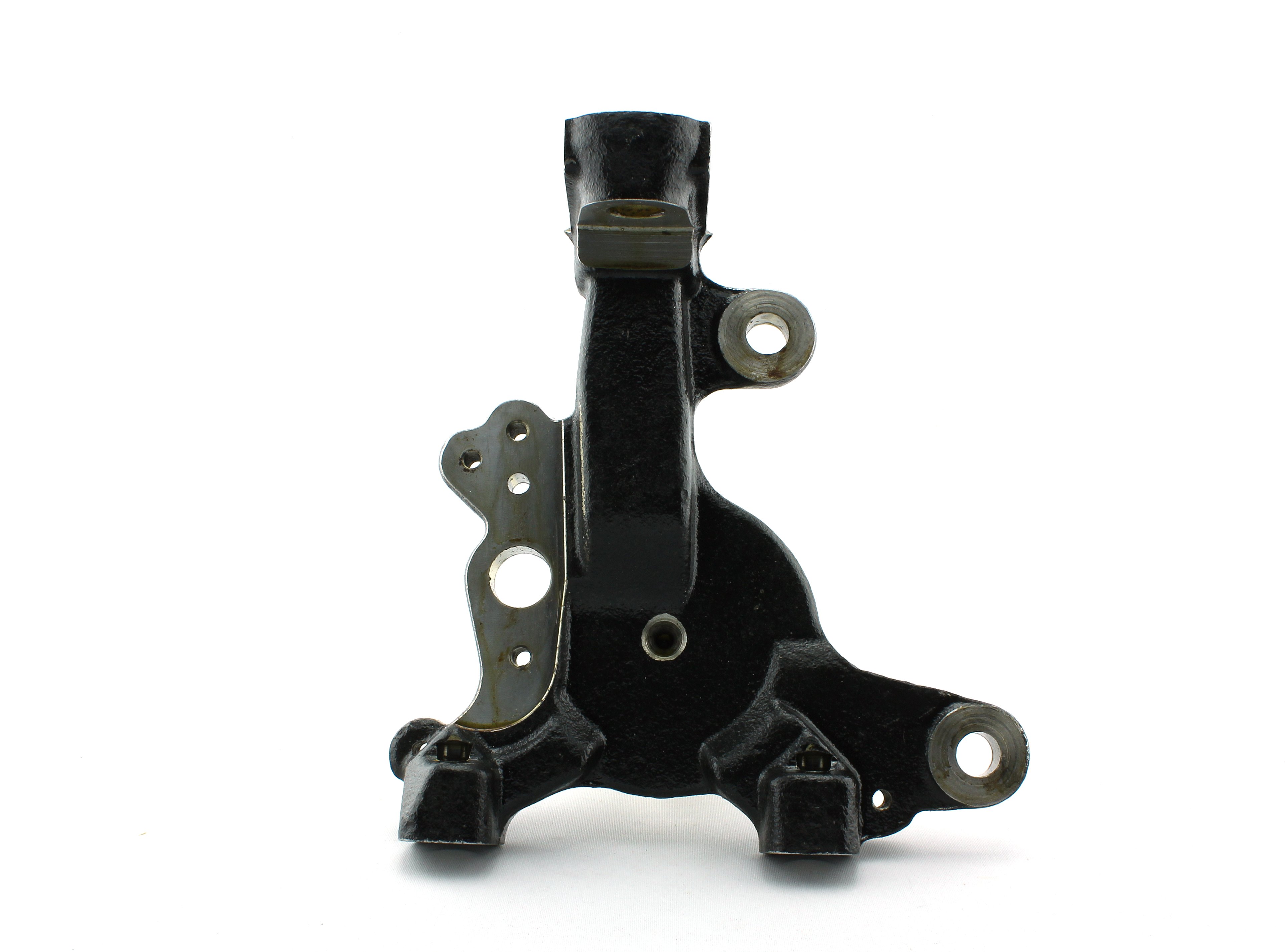
- DCC Suspension Knuckles: These knuckles have an extra mounting bracket to hold the electrical connector for the DCC strut.
The two knuckle types are NOT interchangeable. If you install a standard knuckle on a car with DCC, you will have nowhere to secure the strut's wiring, leading to a dangling connector and a DCC fault warning on the dash. Conversely, a DCC knuckle can physically fit on a standard car, but you will have an unused bracket.
Warning: Before purchasing, you must verify if the vehicle has DCC. You can check the vehicle's original window sticker or look for the "Drive Mode Selection" screen in the infotainment system, which will show a "DCC" or adaptive suspension setting with modes like Comfort and Sport.
Buying a Used Front Knee Assembly
A used OEM knee assembly can be an excellent value, especially since the knuckle itself is very durable. The main concern is the condition of the included wheel bearing. Here’s what to inspect:
- Verify Compatibility: First, confirm if you need a DCC or non-DCC part. Second, confirm the side (Left/Driver or Right/Passenger). Part numbers 5WA407253A (and its revisions) are for the left side, while 5WA407254A (and its revisions) are for the right side.
- Check the Wheel Bearing: This is the most critical inspection. With the assembly on a bench, try to spin the hub by hand. It should rotate smoothly and silently. Any grinding, roughness, or noise means the bearing is bad. Grab the hub and try to wiggle it; there should be zero play or wobble.
- Inspect for Physical Damage: Carefully examine the entire knuckle for any signs of cracks, especially around the mounting points for the strut, ball joint, and tie rod. Check for any bending or deformation from an accident. Look at the threaded holes to ensure they are not stripped.
- Mileage Considerations: Wheel bearing life can range from 80,000 to 120,000 miles, but this can vary. A used assembly from a low-mileage vehicle (under 50,000 miles) is a much safer bet. For higher-mileage units, consider the price; it may be low enough to justify pressing in a new bearing hub assembly before installation.
- OEM vs. Aftermarket: For a component as critical as a steering knuckle, a used OEM part is often superior to a cheap, new aftermarket one. OEM knuckles are made with specific metallurgy and undergo rigorous testing to ensure proper suspension geometry and strength. Aftermarket knuckles may not have the same precision, potentially leading to alignment problems or premature failure.
Cost Breakdown
Replacing the front knee assembly can vary in cost depending on the parts chosen and local labor rates. Note that an alignment is required after this repair, adding $100 - $200 to the total cost.
| Part/Service | Estimated Cost | Notes |
|---|---|---|
| New OEM Knee Assembly | $385 - $590 per side | Part only. Price from VW dealers. |
| Used OEM Knee Assembly | $150 - $250 per side | Part only. Price depends on condition and mileage. |
| New Aftermarket Hub/Bearing Only | $110 - $150 per side | This is just the bolt-in hub/bearing unit, not the knuckle. Labor is slightly less than replacing the whole knuckle. |
| Shop Labor (Full Knuckle Replacement) | $290 - $430 per side | Based on 2-3 hours of labor. |
| Shop Labor (Hub/Bearing Only) | $220 - $325 per side | Slightly less labor as the knuckle stays on the car. |
Replacement Overview and Torque Specs

Replacing the front knee assembly is an advanced DIY job requiring specialized tools. The MK8 Golf uses several torque-to-yield (TTY) bolts, which are single-use and MUST be replaced. An alignment is mandatory after the job is complete.
The basic process involves removing the wheel, brake caliper and rotor, axle nut, and then separating the tie rod end and lower ball joint from the knuckle. Finally, the strut is unbolted and removed from the knuckle.
Special Tools: You will need a tool to spread the knuckle where the strut inserts, a 12-point socket for the axle bolt, and triple-square bits for various fasteners.
Key Torque Specifications (Always use new TTY bolts where specified):
These specs are based on the MK7/MK8 MQB platform but should always be verified with a factory service manual.
- Axle to Hub Bolt (TTY): 200 Nm (148 ft-lb) + 180° turn. The final 180° turn should be done with the wheel on and the vehicle's weight on the suspension.
- Strut to Knuckle Pinch Bolt (TTY): 70 Nm (52 ft-lb) + 90° turn.
- Ball Joint to Knuckle Nut (TTY): 60 Nm (44 ft-lb).
- Ball Joint to Control Arm Nuts (x3, TTY): 40 Nm (30 ft-lb) + 45° turn.
- Brake Caliper Carrier to Knuckle Bolts (TTY): 200 Nm (148 ft-lb).
- Tie Rod End to Knuckle Nut (TTY): ~50 Nm (37 ft-lb).
Frequently Asked Questions
What's the difference between a knee, knuckle, and spindle?
These terms are often used interchangeably. "Steering Knuckle" is the most technically correct term. On front-wheel-drive cars like the Golf, the knuckle has a large hole for the drive axle to pass through and a hub/bearing assembly is bolted to it. A "spindle" typically refers to a solid axle shaft that is part of the knuckle, which the wheel bearings ride on (common in rear-wheel-drive applications). "Knee" is a common slang and cataloging term for the entire assembly.
Do I need a wheel alignment after replacing the front knee?
Yes, absolutely. Replacing the steering knuckle directly affects the camber and toe alignment angles. Driving without an alignment will cause poor handling and rapid, uneven tire wear.
Can I just replace the wheel bearing instead of the whole assembly?
Yes. On the MK8 Golf, the wheel bearing is part of a bolt-on hub assembly. It does not require a hydraulic press. You can unbolt the old hub from the knuckle and bolt on a new one. This is less expensive in parts than a full knee assembly if your knuckle is not damaged. Labor costs are also slightly lower.
How do I know if my 2022-2024 Golf has DCC?
Check the Drive Mode selection screen in the infotainment system. If you have DCC, you will see an option to adjust the suspension firmness, often with a slider or modes labeled Comfort, Normal, and Sport. Standard suspension cars will only have modes that affect steering and throttle, not the suspension itself.
Technical Specifications
OEM Part Numbers: 5WA407253A 5WA407253B 5WA-407-253-A 5WA-407-253-B 5WA407254A 5WA407254B 5WA-407-254-A 5WA-407-254-B 5WA407258A
Housing for bolt-on wheel bearing/hub assembly. Available in two variants: one for standard passive suspension and one with a mounting bracket for the DCC electronic damper connector.
We Have This Part in Stock

The information in this article is provided for general reference and educational purposes only. Vehicle specifications, procedures, and part compatibility can vary by production date, trim level, and region. Always consult your vehicle's factory service manual and verify part numbers before purchasing or performing repairs. Safety-critical components such as airbags, seat belts, and braking systems should be installed by a qualified professional.
- Volkswagen Golf:
- 🛍️ Shop This Part
- Symptoms of a Failing Front Knee Assembly
- 1. Humming, Grinding, or Growling Noise
- 2. Noise Changes While Turning
- 3. Steering Wheel Vibration or Wobble
- 4. Loose or Vague Steering
- 5. ABS Warning Light
- Known Issues, TSBs, and Recalls
- Variant Differences: DCC vs. Standard Suspension
- Buying a Used Front Knee Assembly
- Cost Breakdown
- Replacement Overview and Torque Specs
- Key Torque Specifications (Always use new TTY bolts where specified):
- Frequently Asked Questions
- 🎟️ Get 5% Off