

2006-2010 Solstice & Sky Front Knee Assembly: Diagnosing Noises and FE2 vs. FE3 Suspension Traps
This guide covers the common failure points of the front knee assembly on the Pontiac Solstice and Saturn Sky, with a focus on identifying bad wheel bearings, worn control arms, and critical suspension differences.
- The most critical step is identifying your suspension: FE2 (base, steel arms) or FE3 (GXP/Redline, aluminum arms). Check the RPO code in the glove box. The parts are not interchangeable.
- A humming/grinding noise that changes with speed and turning points to a bad wheel bearing/hub assembly.
- Clunking noises over bumps are typically caused by worn control arm bushings or ball joints.
- When buying a used assembly, prioritize inspecting the condition of the rubber bushings and ball joint boots, and check for any play in the wheel hub.
- A wheel alignment is mandatory after replacing control arms or the steering knuckle.
Symptoms of a Failing Front Knee Assembly

Problems with the front knee assembly typically trace back to one of three components: the wheel bearing, the control arm bushings, or the ball joints. Each has distinct symptoms.
Noises: Humming, Grinding, and Clunking
- Humming or Grinding: A constant humming, growling, or grinding noise that gets louder with vehicle speed is the classic sign of a bad wheel bearing. The noise may change pitch or disappear when you steer left or right. For example, a failing right-side bearing often gets louder when turning left (as it's loaded with the car's weight) and quieter when turning right.
- Clunking or Popping: A clunking, popping, or knocking sound when driving over bumps, accelerating, or braking is usually caused by worn control arm bushings or a bad ball joint. The noise comes from metal-on-metal contact as the worn components allow for excessive movement in the suspension.
- Clicking When Turning: While less common for this part, a clicking noise specifically when turning can sometimes be related to a very worn wheel bearing, though it's more often associated with a failing CV joint on a front-wheel-drive car.
Vibrations and Steering Issues
- Steering Wheel Vibration: A vibration or buzzing felt in the steering wheel that gets worse with speed can be caused by a failing wheel bearing creating an uneven rotation.
- Loose or Wandering Steering: If the car feels unstable, pulls to one side, or requires constant small corrections to drive straight, it often points to worn control arm bushings or ball joints. This looseness compromises the vehicle's alignment.
- Uneven Tire Wear: Worn bushings and ball joints allow the wheel alignment to shift, which can cause rapid and uneven wear on the inner or outer edges of the front tires.
Warning Lights
An ABS warning light on the dashboard can be triggered by a failing wheel bearing. The wheel speed sensor is integrated into the hub assembly. As the bearing wears, the resulting wobble or 'play' in the hub can disrupt the signal from the sensor, causing the ABS computer to log a fault and turn on the light.
Important: While there are several major safety recalls for the 2006-2010 Pontiac Solstice and 2007-2010 Saturn Sky, none of them directly involve the front knee, knuckle, or wheel bearings. The most notable recalls concern the ignition switch, which can shut the engine off while driving, and the passenger-side airbag sensor.
Crucial Compatibility Check: FE2 vs. FE3 Suspension

The single biggest mistake when buying a used front knee assembly for a Solstice or Sky is getting parts from the wrong suspension package. These cars were offered with two main suspension options, and the control arms are different.
You can find your car's suspension code on the Service Parts Identification (RPO) sticker, which is typically located inside the glove box.
- FE2 (RPO Code): This is the standard 'Ride and Handling' suspension found on all base model Pontiac Solstice and Saturn Sky vehicles. These cars use stamped steel upper and lower control arms.
- FE3 (RPO Code): This is the stiffer 'Sport' suspension found on all Pontiac Solstice GXP and Saturn Sky Red Line models. It was also available as an option on some base models. These cars use forged aluminum upper and lower control arms. The aluminum arms are lighter and stronger than their steel counterparts.
While the mounting points and overall geometry are the same, you should not mix and match steel and aluminum components. When inspecting a used part, the difference is visually obvious: the steel arms are black and formed from stamped metal, while the aluminum arms are silver and have the characteristic look of a cast or forged part.
Pro Tip: If you are buying a complete used knee assembly, look at the control arms. If they are silver aluminum, it's from an FE3 (GXP/Redline) car. If they are black stamped steel, it's from an FE2 (base) car.
Buying a Used Front Knee Assembly: What to Look For

A used OEM knee assembly can be an excellent value, as the knuckle itself rarely fails and OEM control arms are high quality. However, the bearings and bushings are wear items. Here’s what to inspect:
- Verify Compatibility: First and foremost, confirm if you need FE2 (steel) or FE3 (aluminum) control arms to match your vehicle.
- Check the Wheel Bearing: Grab the hub flange where the wheel bolts on and try to wiggle it. There should be zero play, wobble, or looseness. Spin the hub by hand. It should turn smoothly and silently. Any grinding, roughness, or noise means the bearing is bad and the hub must be replaced.
- Inspect Bushings and Ball Joints: Look closely at the rubber bushings on the control arms. They should be intact, without major cracks, tearing, or separation from the metal sleeve. Check the rubber boots on the upper and lower ball joints. They should be sealed and free of rips or tears. A torn boot allows grease to escape and dirt to enter, causing rapid joint failure.
- Check for Physical Damage: Inspect the knuckle and control arms for any signs of cracks, bending, or heavy impact damage from an accident. Check for scraped metal, which could indicate the donor car was moved with a forklift, potentially stressing the components.
- Mileage Considerations: Control arm bushings and wheel bearings can last 100,000 miles or more, but this varies greatly with road conditions and driving style. A lower-mileage assembly (e.g., under 80,000 miles) is always preferable, but a thorough physical inspection is more important than mileage alone.
Cost of Replacement
Replacing components of the front knee assembly can vary widely in cost depending on which parts are needed and whether you choose new or used.
| Part | New OEM | New Aftermarket | Used OEM |
|---|---|---|---|
| Wheel Hub Assembly | $450 - $550 | $80 - $200 | $50 - $100 |
| Lower Control Arm (FE3 Aluminum) | ~$300 | $100 - $150 | $70 - $90 |
| Upper Control Arm (FE3 Aluminum) | ~$250 | $90 - $140 | $60 - $80 |
| Complete Used Knee Assembly (Knuckle, Hub, Control Arms) | N/A | N/A | $250 - $450 |
Labor Costs:
- Wheel Hub Replacement: Expect to pay between $100 and $150 in labor for a shop to replace a single wheel hub assembly.
- Control Arm Replacement: Labor for a single control arm is typically 1-2 hours, costing between $120 and $250.
- Wheel Alignment: A four-wheel alignment is required after replacing control arms or the steering knuckle. This typically costs between $80 and $150.
Installation Tips and Torque Specs

Replacing these components is achievable for an experienced DIY mechanic. The wheel hub is a bolt-on unit and does not require a press.
- Safety First: Always use jack stands to securely support the vehicle. Never work under a car supported only by a jack.
- Control Arm Bolts: A critical step when replacing control arms is to only fully tighten the pivot bolts when the suspension is at its normal ride height. Tightening them with the wheel hanging in the air will preload and quickly destroy the new rubber bushings. You can achieve this by placing a jack under the lower control arm to compress the suspension before torquing the bolts.
- Wheel Alignment: You MUST get a professional wheel alignment after replacing any control arms or the steering knuckle to ensure proper handling and prevent tire wear.
Torque Specs Warning: Torque specifications for GM vehicles of this era are notoriously inconsistent across various sources. The axle nut is especially critical as it preloads the wheel bearing. Many bolts also use a torque-plus-angle procedure (e.g., tighten to a specific value, then turn an additional number of degrees). The only truly reliable source for torque specs is the factory service manual for your specific vehicle. The values below are for reference only.
- Wheel Lug Nuts: 100 lb-ft (136 Nm)
- Axle Nut: Often cited in the range of 155-159 lb-ft. VERIFY with a service manual.
- Hub-to-Knuckle Bolts: Varies widely. VERIFY with a service manual.
- Control Arm-to-Frame Bolts: Likely uses a torque-plus-angle method. VERIFY with a service manual.
Frequently Asked Questions (FAQ)
How do I know if I have FE2 or FE3 suspension?
Check the RPO code sticker in your glove box. If you see the code 'FE2', you have the standard suspension with steel control arms. If you see 'FE3', you have the sport suspension with aluminum control arms. Visually, FE2 arms are black stamped steel, and FE3 arms are silver forged aluminum.
Can I just replace the wheel bearing instead of the whole hub?
No, on the Solstice and Sky, the wheel bearing is part of a sealed hub assembly. The entire hub unit, which includes the bearing and ABS sensor, must be replaced as one piece.
Is the left (driver) side knee the same as the right (passenger) side?
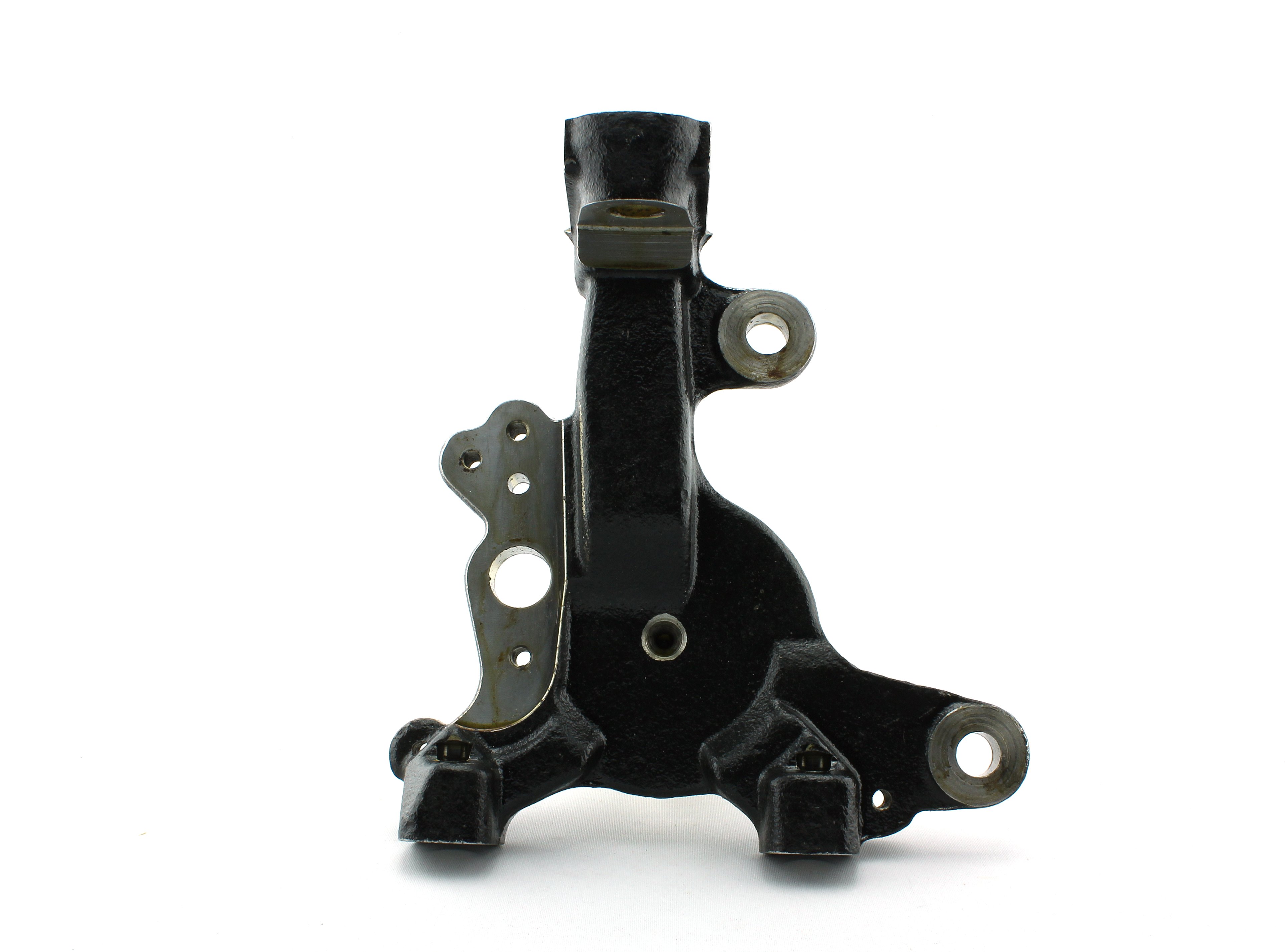
No, the steering knuckles and control arms are side-specific. They are not interchangeable. For example, OEM part number 15262566 is for the right-side knuckle, while 15262567 is for the left.
Do I need an alignment after replacing a wheel hub?
Technically, no. If you are only replacing the bolt-on wheel hub assembly, it should not change your alignment angles. However, an alignment is absolutely mandatory if you replace the steering knuckle or any of the control arms.
Technical Specifications
OEM Part Numbers: 10345966 15262566 10345091 15222274 15222275 15224867 15224868 15262567 15831426 25916181 25916182 25916183 15264325 15264326
Suspension Packages: FE2 (Standard Suspension, Stamped Steel Control Arms), FE3 (Sport Suspension, Forged Aluminum Control Arms). Wheel Hub: Bolt-on unit with integrated ABS sensor.
We Have This Part in Stock


The information in this article is provided for general reference and educational purposes only. Vehicle specifications, procedures, and part compatibility can vary by production date, trim level, and region. Always consult your vehicle's factory service manual and verify part numbers before purchasing or performing repairs. Safety-critical components such as airbags, seat belts, and braking systems should be installed by a qualified professional.
- Pontiac Solstice:
- Saturn Sky:
- 🛍️ Shop This Part
- Symptoms of a Failing Front Knee Assembly
- Noises: Humming, Grinding, and Clunking
- Vibrations and Steering Issues
- Warning Lights
- Crucial Compatibility Check: FE2 vs. FE3 Suspension
- Buying a Used Front Knee Assembly: What to Look For
- Cost of Replacement
- Installation Tips and Torque Specs
- Frequently Asked Questions (FAQ)
- 🎟️ Get 5% Off