

2006-2011 Lexus GS300 & GS350 Front Knuckle: A Guide to RWD vs. AWD Differences
This guide explains the critical differences between RWD and AWD front steering knuckles to help you diagnose noises and buy the correct used part for your 2006 Lexus GS300 or 2007-2011 Lexus GS350.
- The single most critical factor is compatibility: front knuckles for RWD and AWD models are completely different and not interchangeable.
- Symptoms like humming or clunking are usually caused by a failed wheel bearing or ball joint, not the knuckle itself, which is only replaced if bent or cracked.
- A four-wheel alignment is mandatory after replacing a steering knuckle to prevent poor handling and rapid tire wear.
- When replacing the knuckle, it is highly recommended to install a new wheel hub/bearing assembly at the same time for long-term reliability.
Critical Compatibility: RWD vs. AWD and AVS Suspension

Before purchasing a front knee assembly for a 2006 Lexus GS300 or 2007-2011 Lexus GS350, you must verify your vehicle's exact configuration. The wrong part will not fit. The front suspension is almost completely different between Rear-Wheel Drive (RWD) and All-Wheel Drive (AWD) models.
Warning: Knuckles for RWD and AWD models are not interchangeable. They have different shapes, mounting points, and work with different control arms and struts. Installing the wrong one is impossible without changing the entire front suspension.
- Rear-Wheel Drive (RWD): On RWD models, the front knuckle is designed for a wheel that only steers and does not receive power. The strut connects directly to the lower arm.
- All-Wheel Drive (AWD): On AWD models, the knuckle is designed to accommodate a front drive axle (CV axle). The strut sits in a C-shaped lower arm that provides clearance for the axle shaft to pass through to the wheel hub.
- Adaptive Variable Suspension (AVS): AVS was a very rare option on 2008-2011 GS350 models and more common on GS430/460/450h models. It is an electronic system that adjusts shock stiffness. You can identify an AVS-equipped car by a "SPORT/NORM" switch for the suspension on the center console. Knuckles and struts for AVS cars are different to accommodate the electronic actuators. Verify if your car has this system before buying.
Symptoms of a Failing Front Knuckle, Bearing, or Ball Joint

The knuckle itself rarely fails unless it is bent or cracked in a collision or if the brake caliper mounting threads are stripped. Most symptoms come from worn-out components attached to the knuckle.
| Symptom | Likely Cause | Details |
|---|---|---|
| Humming, Growling, or Whining Noise | Wheel Bearing | A noise from the front wheel area that gets louder with vehicle speed. The pitch or volume may change when turning left or right, which loads and unloads the failing bearing. |
| Clunking or Popping Noise | Ball Joints or Control Arm Bushings | A clunking sound is often heard at low speeds when going over bumps, dips, or making tight turns in a parking lot. This indicates excessive play in a ball joint or a worn control arm bushing. |
| Vibration in Steering Wheel | Wheel Bearing or Tire Issue | A constant vibration felt in the steering wheel at highway speeds can be a sign of a failing wheel bearing, though it should be diagnosed to rule out a simple tire imbalance. |
| Scraping or Grinding Noise | Brake Dust Shield or Wheel Bearing | A metallic scraping sound can be caused by a bent brake dust shield rubbing against the brake rotor. A severely failed wheel bearing can also make a grinding noise. |
| Uneven Tire Wear | Bent Knuckle or Worn Suspension | If the knuckle is bent from an impact, it will throw off the alignment and cause rapid, uneven tire wear. Worn control arm bushings are also a common cause of inner tire wear on these models. |
| Steering Wander or Pulling | Worn Bushings or Bent Knuckle | A feeling that the car wanders on the highway or pulls to one side can be caused by worn lower control arm bushings or a bent knuckle affecting alignment. |
Known Issues, Recalls, and TSBs

While there are no recalls specifically for the steering knuckles on these vehicles, owners should be aware of several safety campaigns for the 2006-2011 GS platform.
- Fuel Leak Recalls (Safety Risk): Multiple recalls were issued for potential fuel leaks. One involved a fuel pressure sensor that could loosen over time on 2006-2007 GS300/GS350 models. Another, more widespread recall for 2007-2011 GS350 models, addressed fuel pulsation dampers that could crack and leak fuel. A fuel smell is a serious symptom that should be addressed immediately.
- Accelerator Pedal Recall (AWD only): Some 2006-2007 AWD models were recalled to modify a plastic pad in the driver's floor carpet that could potentially interfere with the accelerator pedal.
- Front Suspension Creak (TSB): For AWD models, Lexus issued a technical service bulletin (TSB) for a creaking noise from the front suspension over uneven surfaces. The fix involves revised front sway bar bushings.
- Lower Control Arm Bushings: A widely discussed issue in owner forums is the premature failure of the front lower control arm bushings, leading to wandering steering and rapid inner tire wear. Upgraded aftermarket bushings are a popular solution.
Buying a Used Front Knee Assembly: What to Inspect

A used OEM steering knuckle is an excellent, cost-effective choice because it is a non-wear item. Unlike aftermarket parts, a used OEM knuckle guarantees perfect factory geometry, provided it isn't damaged.
Pro Tip: The knuckle is just a mounting point. The real wear items are the wheel bearing and ball joints. Plan on replacing the wheel hub/bearing assembly when you install a used knuckle. They are sold as a bolt-on unit.
- Verify Compatibility: This is the most important step. Get the part number or clear photos from the seller and confirm it is for your exact vehicle: 2006 GS300 or 2007-2011 GS350, and either RWD or AWD. They are physically different and will not interchange.
- Check for Accident Damage: Inspect the knuckle carefully for any signs of cracks, particularly around the mounting bosses for the control arms and brake caliper. Look for any indication that it has been bent. A bent knuckle will make the car impossible to align correctly.
- Inspect Caliper Threads: Check the threaded holes where the brake caliper mounts. Ensure they are clean and not stripped or damaged. Cross-threading these bolts can ruin the knuckle.
- Assess Included Components: A used knuckle may come with the wheel hub/bearing and dust shield. Assume you will need to replace the hub/bearing assembly. While it might be usable, its remaining lifespan is unknown. It is far more labor-efficient to install a new hub/bearing onto your used knuckle before installing it on the car.
- Mileage is Not a Major Concern: For the knuckle itself, mileage is irrelevant. It's a solid piece of metal. For any included bearing or ball joint, lower mileage is always better, but replacement of these wear items is recommended regardless.
Cost to Replace a Lexus GS Front Knuckle
The total cost depends heavily on whether you are just replacing the knuckle or also tackling related jobs like control arms at the same time. Labor is the largest variable.
| Part/Service | Estimated Cost | Notes |
|---|---|---|
| New OEM Knuckle | $315 - $490 | Price varies by RWD vs. AWD. |
| New Aftermarket Knuckle (Loaded) | $130 - $250 | Often includes a new wheel hub and bearing pre-installed. |
| Used OEM Knuckle | $125 - $220 | A cost-effective option if inspected carefully for damage. |
| Shop Labor | $250 - $450 | Typically 2-4 hours of labor. Can be higher in rust-prone areas. |
| Wheel Alignment | $100 - $200 | Mandatory after knuckle replacement. |
| Total Professional Replacement | $650 - $1,100+ | Using a new OEM part. Using a used or aftermarket part can lower the total cost. |
Replacement Overview and Torque Specs

Replacing the steering knuckle is an advanced DIY job that requires a good set of tools and mechanical experience. If you are not comfortable disassembling the suspension, this job is best left to a professional. A four-wheel alignment is required after the job is complete.
Warning: The axle nut is a one-time use part and must be replaced. It is torqued to a very high value and then staked (peened) to lock it in place.
Key Steps:
- Raise and support the vehicle and remove the wheel.
- Remove the brake caliper and rotor, and hang the caliper securely to avoid straining the brake line.
- Remove the axle nut (if AWD or RWD). This requires a large socket and a high-torque wrench or breaker bar.
- Disconnect the ABS wheel speed sensor.
- Separate the tie rod end and the upper and lower ball joints from the knuckle using a ball joint separator tool.
- On AWD models, push the CV axle out of the hub.
- Remove the knuckle assembly.
- Transfer the wheel hub/bearing assembly and dust shield to the new knuckle, or install new components.
- Reassemble in reverse order, using new cotter pins for all castle nuts and a new axle nut.
Critical Torque Specifications:
- Front Axle Hub Nut (RWD & AWD): 217 ft-lbf (294 Nm)
- Ball Joint to Knuckle Nuts: 89 ft-lbf
- Tie Rod End Castle Nut: 48-50 ft-lbf
- Brake Caliper Mounting Bolts: ~87 ft-lbf (Varies by source, confirm for your specific caliper)
- Wheel Lug Nuts: 76 ft-lbf (103 Nm)
Frequently Asked Questions (FAQ)
Can I just replace the wheel bearing instead of the whole knuckle?
Yes. The knuckle itself is not a wear item. The wheel bearing is part of a bolt-on hub assembly. If your knuckle is not bent or damaged, you can simply unbolt the old hub assembly and bolt on a new one. If you buy a bare used knuckle, you will need to bolt a new hub assembly to it.
Is a wheel alignment really necessary after replacing a knuckle?
Yes, it is absolutely mandatory. The steering knuckle is the central component that dictates suspension geometry (camber, caster, and toe). Replacing it will alter these angles, leading to poor handling and rapid tire wear if not corrected with a professional four-wheel alignment.
What is the difference between a RWD and AWD front knuckle?
The main difference is that the AWD knuckle has a large splined opening in the center for the CV axle to pass through and power the wheel. The RWD knuckle does not. Their mounting points for control arms and struts are also completely different, making them non-interchangeable.
My mechanic says my knuckle is bent. Is a used one a safe replacement?
A used OEM knuckle is a perfectly safe and economical replacement, provided it comes from a vehicle that was not in a major front-end collision. Inspect it carefully for cracks or signs of stress before installation. Its geometry will be identical to a new OEM part.
Technical Specifications
OEM Part Numbers: 43201-30010 43202-30020 43201-30021 43202-30031 43201-30030 43202-30040 43202-30050
Front Axle Nut Torque (RWD & AWD): 217 ft-lbf (294 Nm)
We Have This Part in Stock

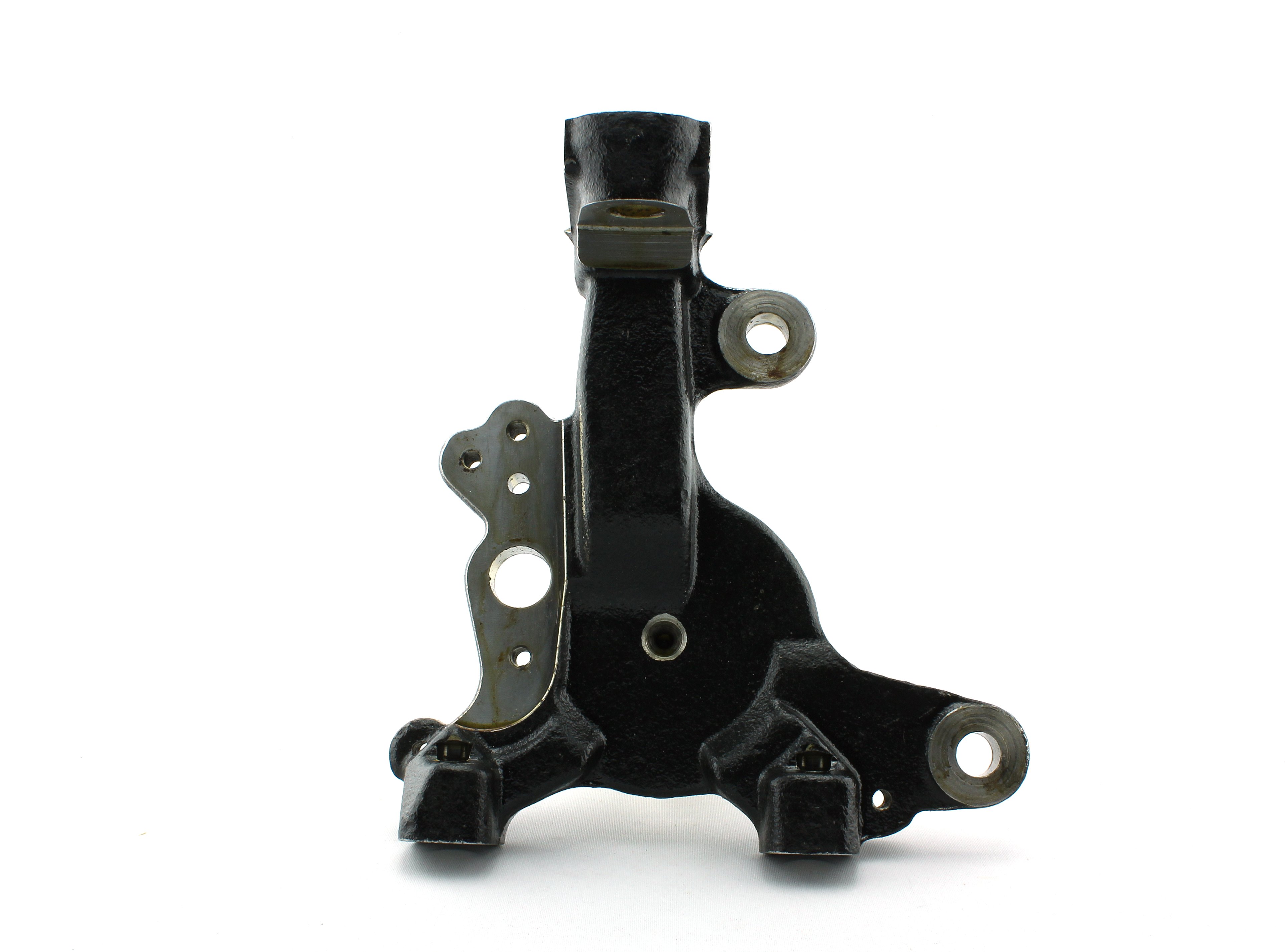

The information in this article is provided for general reference and educational purposes only. Vehicle specifications, procedures, and part compatibility can vary by production date, trim level, and region. Always consult your vehicle's factory service manual and verify part numbers before purchasing or performing repairs. Safety-critical components such as airbags, seat belts, and braking systems should be installed by a qualified professional.
- Lexus GS350:
- Lexus GS300:
- 🛍️ Shop This Part
- Critical Compatibility: RWD vs. AWD and AVS Suspension
- Symptoms of a Failing Front Knuckle, Bearing, or Ball Joint
- Known Issues, Recalls, and TSBs
- Buying a Used Front Knee Assembly: What to Inspect
- Cost to Replace a Lexus GS Front Knuckle
- Replacement Overview and Torque Specs
- Key Steps:
- Critical Torque Specifications:
- Frequently Asked Questions (FAQ)
- 🎟️ Get 5% Off