

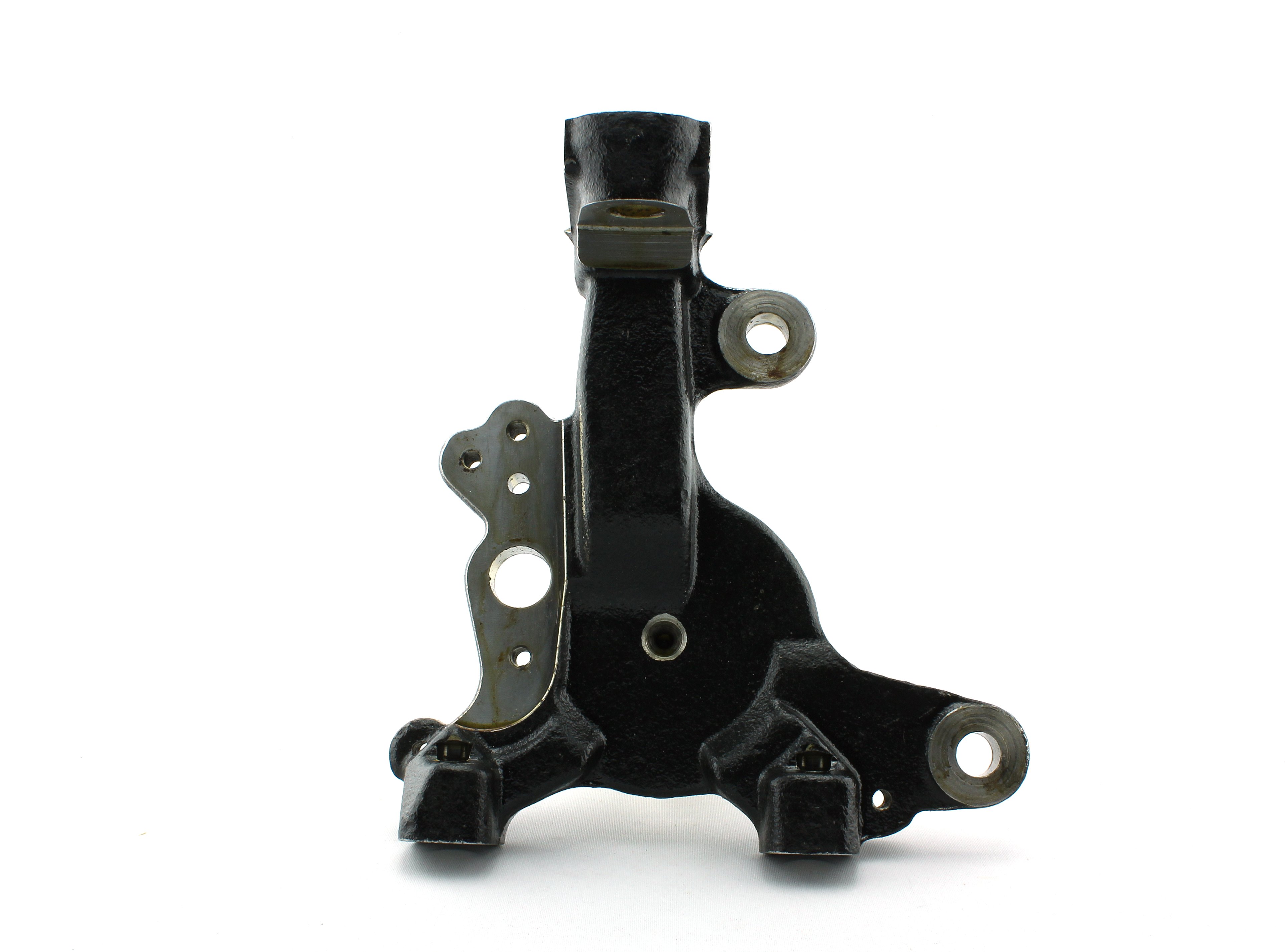
2000-2004 Jaguar S-Type Front Knee Assembly: The Critical VIN M45254 Suspension Split
This guide covers the crucial differences in the front knee/knuckle assembly before and after VIN M45254, common failure noises, and how to buy a good used part.
- The single most critical factor is the VIN split; parts from cars up to VIN M45254 are not compatible with cars from VIN M45255 onward.
- Clunking noises over bumps are a very common symptom, usually pointing to worn lower ball joints or other suspension bushings.
- A grinding or humming noise that changes with road speed is a classic sign of a bad wheel bearing, which is housed in the knuckle.
- When buying a used part, always verify the donor VIN, inspect for cracks, and check the wheel bearing for smoothness and play.
The Critical 2002.5 Suspension Change: VIN M45254

Before purchasing a front knee assembly for a 2000-2004 Jaguar S-Type, you must check the vehicle's VIN. Jaguar significantly redesigned the front suspension starting with the 2003 model year, often referred to as the '2002.5' update. This change occurred at VIN M45255. Parts are not interchangeable across this divide.
- Early Models (2000-2002, up to VIN M45254): These vehicles use a specific knuckle design with corresponding control arms and ball joints. The lower ball joint typically uses a 14mm thread.
- Late Models (2003-2004, from VIN M45255 onward): These models feature a revised knuckle, different control arms, and a different lower ball joint, which often has a 16mm thread.
Warning: Ordering the wrong part is a common and costly mistake. Always verify your vehicle's 17-digit VIN before purchasing a front knee assembly. The 10th digit of the VIN indicates the model year, but the last 6 digits (the serial number) are what you need to compare against the M45254 cutoff.
Symptoms of a Failing Front Knee Assembly

Failure in the knee assembly usually involves the components attached to it, namely the wheel bearing and ball joints. The knuckle itself is a solid piece of metal that typically only fails from collision damage.
Noises and Vibrations
- Clunking or Knocking: A clunking or rattling sound, especially at low speeds over bumps, is a classic sign of a worn lower ball joint. This was a very common issue on early S-Types. Worn sway bar bushings or control arm bushings can also cause similar sounds.
- Grinding, Humming, or Whining: A continuous grinding or humming noise that changes with vehicle speed (but not engine RPM) strongly indicates a failed wheel bearing. The noise may get louder when turning in one direction, which loads the failing bearing.
- Creaking: A creaking sound when going over speed bumps or braking can point to worn front control arm hydro-bushings, as noted in a Jaguar Technical Service Bulletin (TSB #20408).
Steering and Handling Issues
- Vehicle Pulling: A bent knuckle (from hitting a curb or large pothole) or severely worn ball joints can cause the vehicle to pull to one side and make a proper wheel alignment impossible.
- Uneven Tire Wear: Bad ball joints or a bent knuckle can alter the suspension geometry, leading to accelerated wear on the inside or outside edges of the front tires.
- Loose Steering Feel: Excessive play in the ball joints or wheel bearing can translate to a vague or imprecise feeling in the steering wheel.
Known Issues, Recalls, and TSBs

NHTSA Recall 00V-359: Lower Ball Joint Failure Risk
For 2000-2001 S-Type models, Jaguar issued a critical safety recall because the front lower ball joint attaching nuts may not have been tightened correctly at the factory. This could cause the nut to loosen, leading to fatigue and fracture of the ball joint stud, which would result in a separation of the suspension and a loss of vehicle control. The remedy was for dealers to inspect the torque and, if loose, replace the entire vertical link (knuckle) assembly. When buying a used part from this era, be aware of this potential history.
Buying a Used Front Knee Assembly: What to Look For

A used OEM knee assembly is an excellent value, as the factory casting is very robust. The main concerns are the condition of the integrated wear items and ensuring compatibility.
- Confirm the VIN Range: This is the most important step. Get the VIN from the donor vehicle and confirm if it is before or after the M45254 split to ensure it matches your car.
- Inspect for Cracks: Carefully examine the entire knuckle for any hairline cracks, especially around the ball joint mounting points and where the brake caliper bolts on. Any cracks mean the part is unsafe and should be rejected. This is especially important as the part may have come from a vehicle involved in a collision.
- Check the Wheel Bearing: A used knuckle will almost always come with the wheel hub and bearing installed. With the knuckle on the ground, try to spin the hub by hand. It should be smooth and silent. If you feel any roughness, grinding, or hear noise, the bearing is bad and will need to be replaced. Also, try to wiggle the hub side-to-side; there should be zero play.
- Examine Ball Joint Tapers: Look at the tapered holes where the upper control arm, lower ball joint, and tie rod end mount. Ensure they are not damaged, oval-shaped, or cracked.
- Mileage vs. Condition: While lower mileage is generally better, the physical condition is more important. A high-mileage knuckle with a good bearing is a better buy than a low-mileage one with a bad bearing. Expect to replace the wheel bearing on most used units as a matter of course; consider a smooth, tight bearing a bonus.
Cost Comparison for Front Knee/Knuckle Replacement
Prices can vary significantly based on the year of your S-Type and the source of the part. Labor for a complete knuckle replacement is typically less than replacing individual pressed-in components like a wheel bearing or ball joint.
| Part/Service | Estimated Cost | Notes |
|---|---|---|
| New OEM Knuckle | $700 - $850 | Part only. Very expensive, but guarantees perfect fitment. |
| New Aftermarket Knuckle | $160 - $370 | Primarily available for early (2000-2002) models. Fewer options for 2003-2004. |
| Used OEM Knuckle | $100 - $250 | Best value. Price depends on condition and included components (hub/bearing). |
| Shop Labor (Knuckle R&R) | $150 - $250 | Labor to replace the entire assembly. A wheel alignment is required afterward. |
| Shop Labor (Bearing Only) | $260 - $430 | Higher labor cost due to the need to press the old bearing out and new one in. |
| Shop Labor (Ball Joint Only) | $200 - $250 | Reflects the difficulty of pressing the joint on the vehicle. |
Related Parts to Inspect
When the knee assembly is removed, you have easy access to several other suspension components. It's wise to inspect them for wear.
- Upper and Lower Control Arms: Check the bushings for cracks or deterioration and the ball joints for torn boots or excessive play.
- Tie Rod Ends: Check for any play in the joint or torn rubber boots.
- Sway Bar Links and Bushings: These are common sources of noise and are inexpensive to replace.
- ABS Sensor and Wire: Ensure the sensor is not damaged and the wire is not frayed or broken.
Pro Tip: After replacing any major suspension component like the knee assembly or control arms, a four-wheel alignment is not optional—it's mandatory. Skipping it will result in poor handling and rapid, uneven tire wear.
Frequently Asked Questions (FAQ)
Can I just replace the wheel bearing or ball joint instead of the whole knuckle?
Yes, it is possible to replace just the wheel bearing or the lower ball joint, and aftermarket parts are available. However, this requires a hydraulic press and specialized tools, making the labor more intensive and costly than simply swapping the entire used assembly. For many DIY mechanics, replacing the complete knuckle is faster and easier.
How do I know for sure if I have an early or late model S-Type?
Check the last six digits of your VIN. If the number is M45254 or lower, you have the early design. If it is M45255 or higher, you have the later, redesigned suspension.
Is the left (driver side) knuckle the same as the right (passenger side)?
No, they are not interchangeable. Front knee assemblies are side-specific. You must order the correct part for the side of the vehicle you are repairing.
What are the torque specs for installation?
Using correct torque is critical for safety. Key specifications for early models include: Lower ball joint nut to 150 Nm (110 lb-ft), Upper ball joint nut to 90 Nm (66 lb-ft), Hub-to-knuckle bolts to 90 Nm (66 lb-ft), and wheel lug nuts to 128 Nm (94 lb-ft). Always verify specs for your specific year and model.
Technical Specifications
OEM Part Numbers: XW43-2K005-AB XW43-3K186-AC C2C1117 C2C13885 C2C18346 C2C21655 C2C21656 C2C21658 C2C22863 C2C25788 C2C33603 C2Z2279 XR81458 XR81463 XR81534
Bolt Pattern: 5x108mm. Center Bore: 63.4mm. Early models (2000-2002) typically use a 14mm lower ball joint thread. Late models (2003-2004) typically use a 16mm lower ball joint thread.
We Have This Part in Stock

The information in this article is provided for general reference and educational purposes only. Vehicle specifications, procedures, and part compatibility can vary by production date, trim level, and region. Always consult your vehicle's factory service manual and verify part numbers before purchasing or performing repairs. Safety-critical components such as airbags, seat belts, and braking systems should be installed by a qualified professional.
- Jaguar S-Type:
- 🛍️ Shop This Part
- The Critical 2002.5 Suspension Change: VIN M45254
- Symptoms of a Failing Front Knee Assembly
- Noises and Vibrations
- Steering and Handling Issues
- Known Issues, Recalls, and TSBs
- NHTSA Recall 00V-359: Lower Ball Joint Failure Risk
- Buying a Used Front Knee Assembly: What to Look For
- Cost Comparison for Front Knee/Knuckle Replacement
- Related Parts to Inspect
- Frequently Asked Questions (FAQ)
- 🎟️ Get 5% Off