

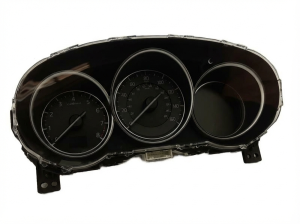
2005-2017 Mazda6 Instrument Cluster: A Guide to Generations, Part Numbers, and Programming
This guide details common failures, complex compatibility across three different generations, and the mandatory programming required for a successful replacement.
- The 2005-2017 range covers three distinct generations (2005-08, 2009-13, 2014-17); parts are NOT interchangeable between them.
- For all 2009-2017 models, a replacement cluster MUST be programmed to the car's immobilizer system, or the engine will not start.
- Compatibility is complex. Always match the OEM part number from your original cluster to ensure the replacement will work with your engine, transmission, and trim level.
- A vehicle's true mileage is stored in the Powertrain Control Module (PCM), not the cluster. A used cluster must be programmed to display the correct, legal mileage.
Critical: The Three Generations of Mazda6 (2005-2017)

The 2005-2017 year range covers three distinct generations of the Mazda6 in the North American market. The instrument clusters are NOT interchangeable between these generations. Installing a cluster from the wrong generation will lead to complete incompatibility. Identifying your vehicle's generation is the first and most important step.
- First Generation (GG1): 2005-2008
- Second Generation (GH): 2009-2013
- Third Generation (GJ/GL): 2014-2017
Symptoms of a Failing Mazda6 Instrument Cluster

A failing instrument cluster can manifest in several ways. These issues can be intermittent at first but typically worsen over time.
- Erratic or Dead Gauges: The speedometer, tachometer, fuel, or temperature gauges may behave erratically, get stuck in one position, or stop working entirely.
- Display Screen Failure: The digital odometer and trip computer display may have dead pixels, become dim, or fail completely.
- Warning Light Malfunctions: Multiple warning lights may illuminate for no reason, or critical lights like the check engine or airbag light may fail to turn on during the initial self-test.
- Total Power Loss: In some cases, the entire cluster may go dark and become completely unresponsive.
- Communication Faults: Since the cluster is a network module, its failure can cause communication issues with other vehicle systems, often logging U-series (network) diagnostic trouble codes (e.g., U0155 - Lost Communication With Instrument Panel Cluster Control Module).
Pro Tip: Before condemning the cluster, always check the related fuses first. Also, a failing battery or alternator can cause a wide range of strange electrical issues, including symptoms that mimic a bad instrument cluster. Ensure your charging system is healthy.
Generation-Specific Details and Compatibility

Compatibility is the biggest challenge when replacing this part. You must match the cluster to your vehicle's generation, engine, transmission, and specific features.
First Generation (2005-2008)
Clusters on these models are the simplest. They are generally plug-and-play, with less complex electronic integration. However, you still need to match the part to your transmission (Automatic vs. Manual) and ensure the gauge face style is the same. The mileage is stored within the cluster itself, so a replacement will show the mileage of the donor vehicle.
Second Generation (2009-2013)
This generation introduced more complexity. Clusters were offered in a standard style and a premium 'blacked out' or 'electroluminescent' style for higher trims. Compatibility depends on:
- Engine: 2.5L I4 vs. 3.7L V6
- Transmission: Automatic vs. Manual
- Gauge Style: Standard vs. Electroluminescent
Warning: All 2009-2013 Mazda6 clusters require programming. The cluster is part of the vehicle's immobilizer system. If you install a used cluster without programming, the car will not start.
Third Generation (2014-2017)
These are the most advanced clusters, often featuring a larger multi-information display. Compatibility is extremely specific and must be matched by part number. Key variables include:
- Transmission: Automatic is most common.
- Display: With or without the multifunction (multi-dot) display.
- Features: Clusters may differ based on trim levels with features like advanced driver-assistance systems (ADAS).
Warning: Like the second generation, these clusters are tied to the immobilizer and absolutely require programming 🎬 See how cloning a cluster can save you money on programming. by a dealer or specialist to function. The car will not start otherwise.
Programming, Immobilizer, and Mileage Correction

For any 2009-2017 Mazda6, you cannot simply swap the instrument cluster. It is a critical anti-theft device.
- Immobilizer Link: The cluster stores your key's transponder information. A replacement cluster has the donor car's key data, so it won't recognize your keys and will prevent the engine from starting. The security light will typically flash rapidly.
- Programming Required: The replacement cluster must be electronically 'introduced' to the car using a process called Programmable Module Installation (PMI). This syncs the cluster with the car's other modules and keys.
- Mileage: The vehicle's true mileage is stored in the Powertrain Control Module (PCM). When a used cluster is installed, it will display the mileage from the donor vehicle. To be legally compliant, the replacement cluster must be programmed to show your vehicle's actual mileage.
Who can program the cluster?
- Mazda Dealership: They have the required proprietary equipment (Mazda IDS) and software. This is the most reliable, albeit often most expensive, option.
- Automotive Locksmith/Specialist: Some advanced locksmiths and automotive electronics repair shops have specialized aftermarket tools (like OBDSTAR or FORScan) that can perform key and module programming for Mazda vehicles. Always confirm they have the specific capability for your year 🎬 Learn how to use FORScan for advanced module and key programming. and model before proceeding.
- Mail-in Services: Several companies offer mail-in programming and mileage correction services. This requires you to remove the cluster and send it to them, along with your original mileage information.
Known Issues, Recalls, and TSBs
While there are no direct recalls for the instrument cluster itself failing, a related recall is important to know about.
- NHTSA Recall 17V-546 (for 2015-2016 models): A wiring harness for the front passenger seat could short-circuit on the seat frame. A symptom of this short-circuit was multiple warning lights illuminating on the instrument cluster. This could be mistaken for a cluster failure, but the root cause is the seat wiring.
- TSB for Infotainment Screen: Mazda has issued Technical Service Bulletins for issues with the separate center infotainment display, such as 'ghost touches' or cracking. This is a different component from the instrument cluster in the driver's dash.
Buying a Used Mazda6 Instrument Cluster
Buying a used OEM cluster is a cost-effective solution, but diligence is required.
- Identify Your Generation First: Determine if you have a Gen 1, 2, or 3 Mazda6.
- Match The Part Number Exactly: The single most important step is to remove your original cluster and find the OEM part number on the sticker. Match this number exactly to the used part you are buying. Part numbers that are only one digit off can mean incompatibility.
- Visually Verify Features: Compare the used cluster to your original. Check the gauge layout, warning light positions, and the type of digital display. For 2009-2013 models, confirm if it's the standard or 'blackout' style.
- Ignore the Mileage: The mileage displayed on the used cluster is irrelevant, as it will need to be corrected during programming for 2009+ models. For 2005-2008 models, be aware the donor mileage will become your car's new displayed mileage.
- Factor in Programming Costs: Remember that for 2009+ models, the purchase price is not the final cost. You must budget for professional programming to make the part work in your car.
Replacement Cost Breakdown
| Part or Service | Estimated Cost |
|---|---|
| New OEM Cluster (Part Only) | $800 - $1,200+ |
| Used OEM Cluster (Part Only) | $75 - $250 |
| Remanufactured Cluster | $150 - $500 |
| Shop Labor (Physical Swap) | 🎬 Watch this video to learn how to remove the cluster yourself.$100 - $200 |
| Dealer/Specialist Programming | $100 - $250 |
Frequently Asked Questions (FAQ)
Will my car's mileage change if I install a used cluster?
Yes. The used cluster will initially show the mileage from the car it came from. For 2009 and newer models, the cluster must be professionally reprogrammed to display your vehicle's true mileage, which is stored in other modules like the PCM. For 2005-2008 models, the cluster's mileage will become the new displayed mileage.
Can I install a cluster from a higher trim level to get more features?
This is generally not recommended. While it may be physically possible within the same generation, differences in wiring and software can cause features not to work or create communication errors with other modules in the car. It is always safest to match your original part number exactly.
Do I really need a dealer to program the cluster?
For 2009+ models, programming is not optional. While a Mazda dealer is the most certain option, a well-equipped automotive locksmith or an electronics specialist may have the necessary tools to perform the programming, often at a lower cost. A general mechanic with a standard OBD-II scanner cannot do this.
Is it hard to replace the instrument cluster myself?
The physical removal and installation of the cluster is relatively easy for a DIYer. It typically involves removing a few trim pieces and several screws, then disconnecting a wiring harness. The difficulty lies in the mandatory electronic programming required after the physical swap for all 2009-2017 models.
Helpful Videos

Technical Specifications
OEM Part Numbers: GAL155446 GAL155447 GAL255447 GEA555471B GEL655471A GJ6A55446 GK2F55471B GLK255471 GLK255471B GLK255471C GLK255471D GLK255471E GLK355471 GLK355471B GLK355471C
Varies significantly by vehicle generation, transmission, engine, and trim level. Part number matching is mandatory.
We Have This Part in Stock





The information in this article is provided for general reference and educational purposes only. Vehicle specifications, procedures, and part compatibility can vary by production date, trim level, and region. Always consult your vehicle's factory service manual and verify part numbers before purchasing or performing repairs. Safety-critical components such as airbags, seat belts, and braking systems should be installed by a qualified professional.
- Mazda Mazda6:
- 🎬 Helpful Videos
- 🛍️ Shop This Part
- Critical: The Three Generations of Mazda6 (2005-2017)
- Symptoms of a Failing Mazda6 Instrument Cluster
- Generation-Specific Details and Compatibility
- First Generation (2005-2008)
- Second Generation (2009-2013)
- Third Generation (2014-2017)
- Programming, Immobilizer, and Mileage Correction
- Known Issues, Recalls, and TSBs
- Buying a Used Mazda6 Instrument Cluster
- Replacement Cost Breakdown
- Frequently Asked Questions (FAQ)
- 🎟️ Get 5% Off