

2015-2021 Tesla Model S & Model X Heater Failure: Your Guide to the PTC Heater
Learn to diagnose the common 'no heat' issue and 'Cabin climate control system requires service' warnings, and understand the replacement options for your Tesla.
- This is a high-voltage component; replacement is extremely dangerous and not recommended for DIYers without proper training and safety equipment.
- Failure is common and typically presents as a 'no heat' condition with a climate system warning on the screen.
- There are two versions: a main front heater (part # 1060432-xx-x) for S/X and a rear auxiliary heater (part # 1035327-xx-x) for the Model X only. Ensure you buy the correct one.
- A used OEM part is a cost-effective solution, but you must inspect the high-voltage connector for damage before purchasing.
Critical Safety Warning: High-Voltage System

Warning: This component is part of the vehicle's high-voltage (HV) system, carrying lethal voltages. Replacement requires specific training, proper personal protective equipment (PPE) like Class 0 (1000V) insulating gloves, and following exact HV disablement procedures. Attempting this repair without proper knowledge can result in severe injury or death. This guide is for informational purposes; professional installation is strongly recommended.
Part Variants: Front vs. Rear Heaters

A common point of confusion for owners is the existence of two different PTC heaters. It is crucial to identify which one you need, as they are not interchangeable.
Front Cabin PTC Heater (The Main Heater)
This is the primary heater for the main cabin in both the 2016-2021 Tesla Model S and 2015-2021 Tesla Model X. It is the component that fails most often and is responsible for the common "no heat" symptom and related dashboard alerts. It is a "Gen 3" design for left-hand-drive (LHD) vehicles only.
- Common Part Numbers: 1060432-00-A, 1060432-00-B, 1060432-00-C, 1060432-00-D, 1060432-00-E
- Location: Inside the main HVAC unit, accessed from both the front trunk (frunk) area and the passenger-side footwell.
Rear Auxiliary PTC Heater (Model X Only)
The Tesla Model X is equipped with a second, smaller PTC heater to provide supplemental heat to the rear of the cabin. This part is specific to the 2016-2020 Tesla Model X and is not used on the Model S.
- Common Part Numbers: 1035327-00-D, 1035327-00-E
- Location: In the rear of the vehicle, accessed by removing the right-hand side trunk trim.
This guide will focus primarily on the Front Cabin PTC Heater, as it is the most common failure point for both models.
Symptoms of a Failing Front PTC Heater

A failing PTC heater usually provides clear symptoms. You may experience one or more of the following:
- No Hot Air: The most obvious symptom is a complete lack of heat from the vents, even when the climate control is set to high.
- Dashboard Alerts: The car will display alerts on the touchscreen, such as "Cabin climate control system requires service" or "Heating and A/C reduced."
- Vehicle May Not Restart: In cases where the heater has an internal short (an isolation fault), you may see a more severe warning like "Vehicle may not restart." This is a safety measure to prevent the high-voltage system from engaging with a potential short circuit.
- Service Mode Faults: Technicians or advanced DIYers can enter the car's 'Service Mode' to find specific fault codes. Common codes for a failed PTC heater include THC_w0220, THC_d0015, or alerts 🎬 Watch: Diagnosing common PTC fault codes and temperature range errors. showing the PTC heater is "MIA" (Missing In Action).
- Blown Fuse: The PTC heater is protected by a 40-amp fuse in the front junction box. A shorted heater will often blow this fuse. If the fuse is blown, simply replacing it without replacing the faulty heater will result in the new fuse blowing immediately.
Diagnosing the Failure

You can perform a basic diagnosis from the driver's seat. If you have no heat and see a climate system alert, the PTC heater is the most likely culprit. You can gain more certainty by accessing the car's Service Mode.
- On the touchscreen, navigate to Controls > Software.
- Press and hold the model name ('Model S' or 'Model X') for several seconds until a password prompt appears.
- Enter "service" as the password.
- In the Service Mode menu, look for an 'Alerts' or 'HVAC' section. A list of active and recent alerts will be displayed, which can confirm a PTC heater fault.
Pro Tip: For advanced users, the definitive test is to check the heater's insulation resistance. After safely disabling the high-voltage system and unplugging the heater, use an insulation tester (megohmmeter) to measure the resistance between the high-voltage pins on the heater and the metal chassis of the car. A reading below 18 megaohms indicates the heater has shorted internally and must be replaced.
Buying a Used Front PTC Heater
Given the high cost of a new unit from Tesla, a used OEM heater from a reputable recycler is a smart, cost-effective option. Here’s what to look for:
- Verify the Part Number: Ensure you are buying a front heater with a part number starting in 1060432-xx-x. Do not buy a 1035327-xx-x part unless you are specifically replacing the rear heater on a Model X.
- Inspect the Connector: The high-voltage connector is the most important area to inspect. Look for any signs of melting, charring, or corrosion on the pins or the plastic housing. A damaged connector is a major red flag.
- Check the Housing: Examine the black plastic case for any cracks, warping, or signs of extreme heat.
- Ask About the Donor Vehicle: If possible, get the mileage and year of the vehicle the part came from. A lower-mileage part is generally preferable, though these heaters can fail at any mileage due to internal component issues.
- Why Used OEM is a Good Choice: The PTC heater must communicate correctly with the vehicle's control modules. A genuine used Tesla part is guaranteed to have the correct software and hardware for seamless integration, an advantage not always found with aftermarket 🎬 Watch: How to use a specialized PTC heater repair kit. repair kits or components.
Replacement Overview & Difficulty
Replacing the front PTC heater is a complex and dangerous job that should not be attempted by inexperienced mechanics.
- Difficulty Rating: 5 out of 5 (Expert level)
- Primary Dangers: Extreme risk of high-voltage shock.
- General Steps: The process involves performing the high-voltage disablement procedure, removing the frunk tub and various under-hood plastics, detaching shock tower braces, and accessing the top of the HVAC unit. Then, from inside the car, the glove box and passenger knee airbag must be removed to access the heater from the side and disconnect its harnesses. The old unit is then removed, the new one is installed, and the entire car is reassembled.
- Post-Installation: In some cases, the vehicle's firmware must be reinstalled via the service menu for the new heater to be recognized and function correctly.
Cost of Replacing a Tesla PTC Heater
| Item | Estimated Cost |
|---|---|
| New OEM (Tesla Service) | $900 - $1,600 (parts & labor) |
| Remanufactured OEM | $400 - $600 + Core Charge |
| Used OEM | $100 - $250 |
| Shop Labor Cost | $400 - $700 |
Frequently Asked Questions (FAQ)
Can I drive my Tesla with a broken PTC heater?
Yes, but with significant limitations. The car is drivable, but you will have no cabin heat or defrost capability, which is unsafe in cold or humid weather due to window fogging. If the failure caused a high-voltage isolation fault, the car may refuse to start until the part is replaced.
Is replacing the PTC heater a DIY job?
For most people, no. Due to the extreme danger of the high-voltage system, this repair should be left to qualified professionals or individuals with extensive experience and training in EV repair. The disassembly process is also very involved.
Will replacing the heater fix the 'Cabin climate control system requires service' alert?
Yes, if the PTC heater is the cause of the fault, replacing it will clear the alert and restore normal function. A firmware reinstall may be needed after the physical replacement.
What's the difference between a PTC heater and a heat pump?
A PTC heater is a simple resistance heater, like a toaster element. It creates heat directly from electricity but is less efficient. A heat pump works like an air conditioner in reverse, moving heat from the outside air into the cabin. It is much more efficient but more complex. Newer Tesla models (approx. 2021+) use a heat pump system instead of a PTC heater.
Helpful Videos

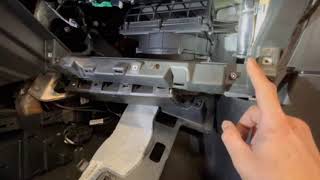
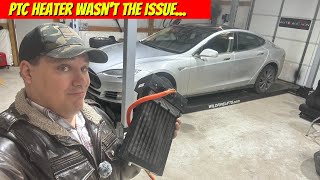

Technical Specifications
OEM Part Numbers: 1060432-00-A 1060432-00-B 1060432-00-C 1060432-00-D 1060432-00-E 1035327-00-D 1035327-00-E
High-voltage Positive Temperature Coefficient (PTC) resistive air heater. Operates on the vehicle's main high-voltage battery pack. Protected by a 40A fuse.
We Have This Part in Stock



The information in this article is provided for general reference and educational purposes only. Vehicle specifications, procedures, and part compatibility can vary by production date, trim level, and region. Always consult your vehicle's factory service manual and verify part numbers before purchasing or performing repairs. Safety-critical components such as airbags, seat belts, and braking systems should be installed by a qualified professional.
- TESLA MODEL X:
- TESLA MODEL S:
- 🎬 Helpful Videos
- 🛍️ Shop This Part
- Critical Safety Warning: High-Voltage System
- Part Variants: Front vs. Rear Heaters
- Front Cabin PTC Heater (The Main Heater)
- Rear Auxiliary PTC Heater (Model X Only)
- Symptoms of a Failing Front PTC Heater
- Diagnosing the Failure
- Buying a Used Front PTC Heater
- Replacement Overview & Difficulty
- Cost of Replacing a Tesla PTC Heater
- Frequently Asked Questions (FAQ)
- 🎟️ Get 5% Off