

2008-2016 Highlander Climate Control: Solving Issues & Finding the Right Part
This guide helps you diagnose common HVAC control problems and navigate the complex front, rear, automatic, and manual unit variations to find the correct replacement.
- You MUST match the part number from your original unit before buying a replacement. Visual similarity is not enough due to numerous variations (front/rear, auto/manual, special features).
- A flashing A/C light is most often caused by a cheap, easy-to-replace A/C relay under the hood, not a faulty control unit. Check this first.
- There are distinct front and rear control units, as well as manual and automatic versions. They are not interchangeable.
- Used OEM units offer significant savings over new dealer parts and are a reliable option if the part number is matched and the unit is inspected for physical damage.
Symptoms of a Failing HVAC Control Unit

When your Highlander's climate control module begins to fail, it can manifest in several ways. While some issues point directly to the control unit, others can be caused by related parts like a blower motor resistor or blend door actuator. Start your diagnosis here.
- Unresponsive Buttons or Knobs: You press a button or turn a knob, and nothing happens. This is a classic sign of internal failure, often due to broken solder joints or worn-out ribbon cables inside the unit, a common issue on earlier models in this generation.
- Flashing A/C Light: The A/C light blinks instead of staying solid, and the system blows warm or ambient air. This is frequently caused by a faulty A/C magnetic clutch relay in the under-hood fuse box 🎬 Watch: How to fix a flashing A/C light and restore cold air., not the control unit itself.
- Incorrect Temperatures: You ask for cold air but get hot, or vice-versa. This can be the control unit, but it's also a primary symptom of a failed blend door actuator.
- Blower Fan Stuck on One Speed or Not Working: If the fan only works on the highest setting or not at all, the problem is most likely the blower motor resistor, not the control head.
- Blank or Flickering Display: The digital screen on automatic climate control units may go dark, become intermittent, or show garbled information.
- Rear Controls Don't Work: On models with rear A/C, the rear control unit may light up but fail to respond to any inputs, resulting in no airflow or temperature change for rear passengers.
Known Issues, Recalls, and TSBs for 2008-2016 Highlander

While this generation of Highlander is reliable, there are a few known issues related to the HVAC system. No major recalls have been issued for the control units themselves.
Common Failure Point: A/C Magnetic Clutch Relay
One of the most frequent causes of a non-working A/C system is a failed Magnetic Clutch Relay (part numbers often include 90987-02027 or 90987-02028). This small, inexpensive relay is located in the under-hood fuse box. When it fails, the A/C compressor clutch won't engage, and the A/C button on the dash will typically flash. Before spending hundreds on a new control unit or compressor, swapping this relay is a critical first diagnostic step.
🎬 Watch: Quick guide to locating the A/C fuse and relay.Technical Service Bulletins (TSBs)
- TSB T-SB-0010-20: Addresses customer complaints about musty or unpleasant odors from the HVAC system. Toyota notes this is a naturally occurring issue and provides a procedure to minimize it, which includes installing a high-performance charcoal cabin air filter (Part No. 87139-50100).
- TSB T-TT-0468-17-Rev: Mentions that the HVAC drain tube can become blocked or clogged, which can lead to water backing up and potentially causing odors or water leaks in the passenger footwell.
Buying a Used HVAC Control: A Step-by-Step Guide

Due to the high cost of new OEM units, a used, recycled control is an excellent value. However, compatibility is extremely tricky. Follow these steps carefully to ensure you get the right part.
Step 1: Identify Your EXACT Control Unit
You must know which system your Highlander has. Visually similar units are NOT interchangeable.
- Front or Rear? Is the failed unit in the main dashboard, or is it the smaller unit on the back of the center console for rear passengers?
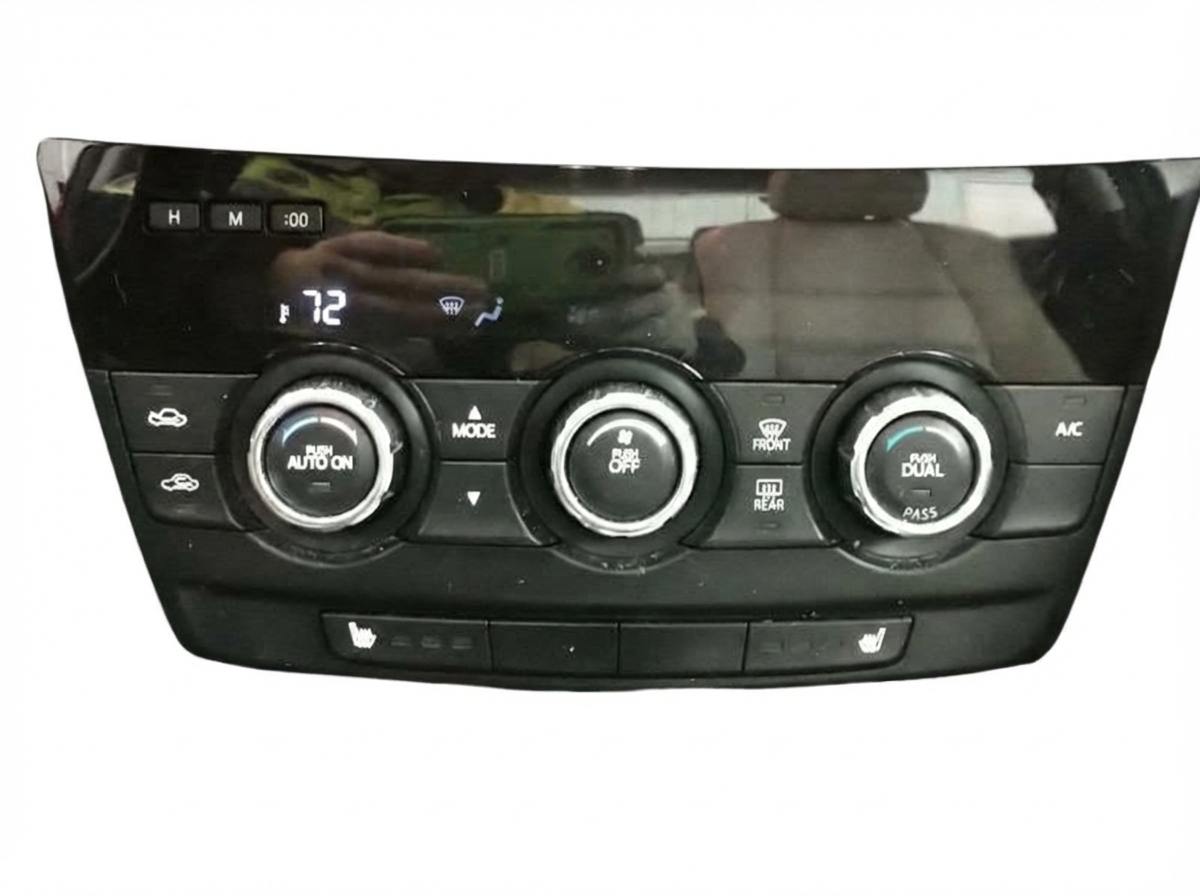
- Automatic or Manual? Does your system have a digital screen with a specific temperature display (e.g., 72°F)? That's Automatic Temperature Control (ATC). If you only have blue and red zones on a dial without a temperature screen, you have Manual controls. A manual unit will not work in a vehicle built for an automatic one, and vice-versa.
- Special Features? Some front manual control units have an extra button for the windshield wiper de-icer (a heating element at the base of the windshield). A unit without this button won't work correctly in a vehicle that has the feature.
Warning: Do not attempt to "upgrade" from a manual to an automatic control unit. The vehicle's wiring harness and system sensors are completely different. It will not work.
Step 2: Match the Part Number
This is the most important rule. The only way to guarantee compatibility is to match the part number on your original unit. You will need to remove the unit to find the number, which is typically on a white sticker on the plastic housing.
Simply providing a VIN to a seller is not enough, as multiple control unit options could exist for the same vehicle. You must physically check the number on your old part 🎬 See this walkthrough on how to remove the unit and fix loose knobs. before ordering a replacement.
Step 3: Physical Inspection Checklist for Used Units
When you receive your used part, inspect it carefully before installation:
- Mounting Tabs: Check all plastic mounting tabs and brackets, especially on front units. They are fragile and can break during removal or shipping.
- Buttons and Knobs: Do all buttons press and return smoothly? Do the knobs turn without excessive wobble?
- Connectors: Look at the electrical connector ports on the back. Ensure no pins are bent, broken, or corroded.
- Screen (ATC Units): Check the screen for any deep scratches, cracks, or signs of delamination.
Cost Comparison: New vs. Used
The price difference between new and used OEM units is significant, making a used part a smart financial choice.
| Part Type | Estimated Cost |
|---|---|
| New OEM | $600 - $1,100+ |
| New Aftermarket | Not commonly available |
| Used OEM | $75 - $200 |
| Remanufactured / Repair Service | $120 - $200 (You send your unit in for repair) |
| Shop Labor for Replacement | $75 - $110 |
Replacement Guide
Replacing the HVAC control unit is a feasible DIY project for those with basic tools and patience.
Front HVAC Control Unit
- Difficulty: 2/5
- Estimated Time: 0.5 - 1 hour
- Tools: 10mm socket with extension, plastic trim removal tools (or a credit card), Phillips head screwdriver.
Simplified Steps:
- Use a trim removal tool to carefully pry off the large silver trim piece surrounding the radio and climate controls. It is held in by clips.
- Once the trim is off, you will see the control unit/radio assembly held in by several 10mm bolts. Remove these bolts.
- Gently pull the entire assembly forward. It will still be attached by wires.
- Carefully disconnect the electrical connectors from the back of the HVAC control unit. The clips can be stiff; press the release tab firmly.
- If necessary, separate the control unit from the radio by removing the side brackets (usually held by Phillips screws).
- Installation is the reverse of removal. Plug in the new unit and test its function before bolting everything back into the dash.
Rear HVAC Control Unit
- Difficulty: 1/5
- Estimated Time: 10 minutes
- Tools: Plastic trim removal tool.
Simplified Steps:
- From the second-row seating area, use a plastic trim tool to carefully pry around the edges of the rear control unit on the back of the center console.
- The unit is held in by clips and will pop out.
- Disconnect the single electrical connector from the back.
- Plug in the new unit, test it, and snap it back into the console.
Frequently Asked Questions (FAQ)
Do I need to program a replacement HVAC control unit?
No, for the 2008-2016 Highlander, the HVAC control units are plug-and-play. No special programming or calibration is required after installation.
My A/C button is flashing but the fan works. Is the control unit bad?
Probably not. A flashing A/C light is the classic symptom of a failed A/C magnetic clutch relay located in the fuse box under the hood. This is a very common, inexpensive part to replace and should be your first check.
Can I upgrade my manual controls to an automatic digital unit?
No, this is not a practical swap. The automatic climate control system uses additional sensors (like cabin temperature sensors and sunload sensors) and a different wiring harness that a manual-equipped vehicle does not have. The automatic unit will not function correctly.
The air blows, but it only comes out of the defrost vents. What's wrong?
This is a common "default" mode for many HVAC systems when they detect a fault. The problem is likely a failed mode door actuator, which is the small motor responsible for directing air to the floor, dash, or defrost vents. While the control unit tells the actuator where to move, the actuator itself is the more common point of failure for this specific symptom.
Helpful Videos
Technical Specifications
OEM Part Numbers: 55900-0E230 55900-0E390 559000E130 559000E190 559000E230 559000E290 559000E390 5590048020 5590048060 5590048290 559000E470
Varies by specific part number. No universal specifications apply.
We Have This Part in Stock





The information in this article is provided for general reference and educational purposes only. Vehicle specifications, procedures, and part compatibility can vary by production date, trim level, and region. Always consult your vehicle's factory service manual and verify part numbers before purchasing or performing repairs. Safety-critical components such as airbags, seat belts, and braking systems should be installed by a qualified professional.
- Toyota Highlander:
- 🎬 Helpful Videos
- 🛍️ Shop This Part
- Symptoms of a Failing HVAC Control Unit
- Known Issues, Recalls, and TSBs for 2008-2016 Highlander
- Common Failure Point: A/C Magnetic Clutch Relay
- Technical Service Bulletins (TSBs)
- Buying a Used HVAC Control: A Step-by-Step Guide
- Step 1: Identify Your EXACT Control Unit
- Step 2: Match the Part Number
- Step 3: Physical Inspection Checklist for Used Units
- Cost Comparison: New vs. Used
- Replacement Guide
- Front HVAC Control Unit
- Rear HVAC Control Unit
- Frequently Asked Questions (FAQ)
- 🎟️ Get 5% Off