

2001-2003 Toyota Prius Hubs: Front vs. Rear, Noises, and Replacement
A complete guide to diagnosing bad wheel hubs on your first-gen Prius and choosing the right used replacement part.
- The front and rear hubs on a 2001-2003 Prius are completely different; the rear is a simple bolt-on assembly, while the front requires a separate bearing and a hydraulic press for installation.
- The primary symptom of failure is a roaring or humming noise that increases with speed and often changes pitch when turning.
- For DIY repair, replacing the rear hub assembly is feasible. Front hub replacement is a complex job best left to a professional shop with a press.
- When buying a used rear hub assembly, spin it by hand to check for smoothness and feel for any play; there should be none.
Front vs. Rear Hubs: A Critical Difference

For the first-generation Toyota Prius (model years 2001-2003), it is essential to understand that the front and rear hubs are not the same and are replaced differently. Misunderstanding this can lead to buying the wrong parts and significant repair delays.
- Rear Hubs: The rear uses a complete, bolt-on unit called a "Hub & Bearing Assembly" (Part No. 42450-47020). This assembly includes the hub, wheel studs, the internal wheel bearing, and the integrated ABS sensor components. Replacement is straightforward for a DIY mechanic with the right tools, as it simply bolts to the rear axle carrier with four bolts.
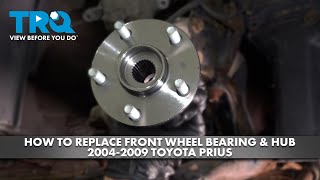
- Front Hubs: The front is more complex. The part you typically buy is the "Hub Sub-Assy" (Part No. 43502-47010 or its successor 43502-12140). This is only the flange that the wheel bolts to. The actual wheel bearing (Part No. 90363-40066) is a separate component. Replacing a front wheel bearing requires removing the entire steering knuckle from the car and using a hydraulic press to push the old bearing out and the new one in. This is generally not considered a simple DIY job. 🎬 See how to replace the hub assembly on a Prius.
Warning: Do not attempt to replace a front wheel bearing on a 2001-2003 Prius without access to a hydraulic press. Attempting to hammer it in will destroy the new bearing.
Symptoms of a Failing Hub or Bearing

A failing wheel bearing gives several distinct audible warnings. Ignoring them can lead to further damage or, in a worst-case scenario, wheel separation.
- Humming or Roaring Noise: The most common symptom is a roaring, humming, or growling sound that starts faint and gets louder over time. The noise is directly related to vehicle speed—the faster you go, the louder it gets.
- Noise Changes When Turning: A key diagnostic trick is to notice if the noise changes pitch or volume when you turn. For example, if the noise gets louder when turning left, it often indicates a bad bearing on the right side of the car, as that side is bearing more weight.
- Clicking or Snapping: In advanced stages of failure, you might hear clicking or popping sounds, especially when turning.
- Vibration: You may feel a vibration in the steering wheel or the floor of the car that gets worse with speed.
- Wheel Play: If you jack the car up so the tire is off the ground, you can check for a bad bearing by grabbing the tire at the top and bottom (12 and 6 o'clock positions) and trying to wiggle it. Any looseness or "play" is a strong sign of a worn-out bearing.
Known Issues, TSBs, and Recalls for 2001-2003 Prius Hubs
Searches of the National Highway Traffic Safety Administration (NHTSA) database and for Technical Service Bulletins (TSBs) did not reveal any specific recalls or widespread, acknowledged defects related to the wheel hubs or bearings for the 2001-2003 Toyota Prius in the North American market. Failure is typically due to normal wear and tear over many miles and years, or from impact damage (hitting curbs or potholes).
Buying a Used 2001-2003 Prius Hub: What to Look For

Buying a used hub can be a great way to save money, especially for the easier-to-install rear assembly. However, you must inspect the part carefully.
Inspecting a Used Rear Hub Assembly
- Spin Test: Hold the assembly firmly and spin the hub flange by hand. It should rotate smoothly and silently. Any grinding, roughness, or catching indicates a bad bearing.
- Check for Play: Try to wiggle the hub flange side-to-side and up-and-down. There should be zero play or looseness.
- Inspect the ABS Sensor Wire: Ensure the ABS sensor wire and its connector are intact, not cut, frayed, or damaged. This is integrated into the assembly.
- Check Wheel Studs: Make sure all four wheel studs are present and their threads are in good condition.
Buying a Used Front Hub Flange
Since the front hub is just a metal flange, there's less to go wrong. Check that it is not bent or warped and that the splines in the center (where the axle goes) and the wheel stud threads are not damaged. Remember, you will still need to buy a new wheel bearing and have it professionally pressed.
Pro Tip: For the front, it is almost always better to buy a new, high-quality bearing and press it into your existing knuckle, using a new or good-condition used hub flange. The labor is the main cost, so don't risk using a questionable used bearing.
Mileage and Lifespan
Wheel bearings on these cars typically last between 85,000 and 150,000 miles, but this can vary widely based on driving conditions. Cars driven on rough roads or in areas with heavy road salt may experience failures sooner. When buying a used rear assembly, one from a lower-mileage vehicle is always preferable.
Replacement Guide Overview

Front Hub & Bearing Replacement (Difficult)
This job is rated as difficult for a DIYer due to the need for a press. The general steps involve removing the wheel, brake caliper, rotor, axle nut, and disconnecting the tie rod and lower ball joint to remove the entire steering knuckle from the car. The knuckle is then taken to a workbench where a hydraulic press is used to push out the old hub and bearing and install the new ones. Because of this complexity, many owners opt to have a professional shop perform this service.
Rear Hub Assembly Replacement (DIY Feasible)
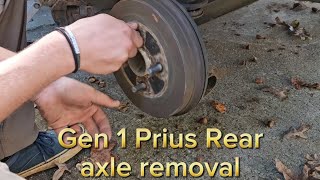
This is a much more straightforward job. After safely jacking up the car and removing the wheel and brake drum, you disconnect the ABS sensor wire. Then, you remove the four bolts holding the hub assembly to the axle carrier from behind the backing plate. In rust-prone areas, the old hub may be seized and require some force with a hammer or punch to break it free. Installation is the reverse of removal.
🎬 Watch this step-by-step Gen 1 Prius rear hub replacement guide.Important Torque Specs
| Part | Torque Spec |
|---|---|
| Rear Hub Assembly-to-Axle Carrier Bolts | 38 ft-lbs |
| Front Axle Nut | 103 ft-lbs (for 2004 model, likely similar) |
| Wheel Lug Nuts | 76 ft-lbs |
Cost Comparison: New vs. Used vs. Aftermarket
| Part | New OEM | New Aftermarket | Used OEM | Shop Labor (per wheel) |
|---|---|---|---|---|
| Rear Hub Assembly | $350 - $550 | $60 - $150 | $40 - $100 | $205 - $300 |
| Front Hub Flange | $125 - $180 | $40 - $80 | $30 - $60 | $250 - $450 (includes pressing) |
| Front Wheel Bearing | ~$60 - $85 | $40 - $70 | Not Recommended |
Prices are estimates and can vary based on supplier and location. Labor for front hub/bearing replacement is higher due to the need for a press.
Frequently Asked Questions (FAQ)
Can I replace just the bearing in the rear hub assembly?
No. The rear hub for the 2001-2003 Prius is a sealed, non-serviceable unit. If the bearing fails, the entire hub and bearing assembly must be replaced.
Do I need a special tool to remove the front axle nut?
Yes, you will likely need a 30mm 12-point socket to remove the front axle nut. You will also need to unstake the nut (bend back a small metal tab) before you can loosen it.
Do I need a wheel alignment after replacing a hub?
If you are only replacing the rear bolt-on hub assembly, an alignment is not typically necessary. However, if you are replacing the front hub and bearing, the process involves removing the steering knuckle. While it's possible to do it without needing an alignment, it is highly recommended to have the alignment checked afterward to prevent premature tire wear.
Should I replace wheel bearings in pairs?
While not strictly required, it is often recommended. Wheel bearings on the same axle experience similar wear. If one has failed due to high mileage, the other may not be far behind. Replacing them in pairs can save you from having to do the same job again in the near future.
Helpful Videos
Technical Specifications
OEM Part Numbers: 42450-47020 4245047020 43502-47010 43502-12140 90363-40066
Rear Hub Assembly Bolts: 38 ft-lbs. Wheel Lug Nuts: 76 ft-lbs. Front Axle Nut: ~103 ft-lbs (30mm 12-point socket required).

The information in this article is provided for general reference and educational purposes only. Vehicle specifications, procedures, and part compatibility can vary by production date, trim level, and region. Always consult your vehicle's factory service manual and verify part numbers before purchasing or performing repairs. Safety-critical components such as airbags, seat belts, and braking systems should be installed by a qualified professional.
- Toyota Prius:
- 🎬 Helpful Videos
- Front vs. Rear Hubs: A Critical Difference
- Symptoms of a Failing Hub or Bearing
- Known Issues, TSBs, and Recalls for 2001-2003 Prius Hubs
- Buying a Used 2001-2003 Prius Hub: What to Look For
- Inspecting a Used Rear Hub Assembly
- Buying a Used Front Hub Flange
- Mileage and Lifespan
- Replacement Guide Overview
- Front Hub & Bearing Replacement (Difficult)
- Rear Hub Assembly Replacement (DIY Feasible)
- Important Torque Specs
- Cost Comparison: New vs. Used vs. Aftermarket
- Frequently Asked Questions (FAQ)
- 🎟️ Get 5% Off