

2011-2019 Explorer & Police Interceptor Hub Assembly: Decoding Noises and Complex Fitment
This guide covers the common failure symptoms and critical compatibility differences for front and rear hub assemblies on the Ford Explorer and its heavy-duty Police Interceptor Utility counterpart.
- Compatibility is extremely complex; fitment depends on drivetrain (AWD/FWD), position (Front/Rear), and package (Police vs. Civilian). Always verify the part number with your VIN.
- A key failure symptom is a humming or roaring noise that gets louder with speed and may change when turning.
- A recall was issued for aftermarket hub HB5Z-1104-C being used incorrectly on the rear of FWD Explorers, which can lead to wheel separation.
- Always use a new axle nut and torque it to the exact specification (184-258 ft-lbs, depending on model) to prevent premature failure and ensure safety.
Symptoms of a Failing Hub Assembly


A failing wheel hub assembly is not just an annoyance; it's a significant safety concern that can lead to loss of vehicle control. The symptoms typically start subtly and worsen over time. Ignoring them can result in the wheel separating from the vehicle.
Noises: Humming, Roaring, Grinding, or Growling
The most common symptom of a bad wheel bearing is a noise that changes with vehicle speed. It often starts as a faint hum and progresses to a louder roar, grind, or growl. This noise is often compared to the sound of an airplane taking off or driving on a rumble strip. A key diagnostic trick is to pay attention to the noise while turning. When you steer, the vehicle's weight shifts. For example, turning left puts more load on the right-side wheels. If the noise gets louder during a left turn, the failing bearing is likely on the right side. If it gets quieter, the bad bearing is likely on the left.
Vibrations
As the bearing wears, it can develop play, leading to a vibration. You may feel this vibration in the steering wheel if the failing hub is in the front, or in the seat and floor if it's in the rear. This can feel similar to an unbalanced tire, but a bearing vibration is often accompanied by the characteristic humming or grinding noise.
ABS or Traction Control Light
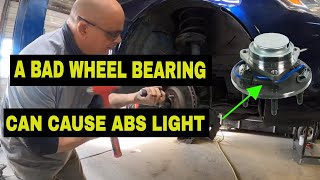
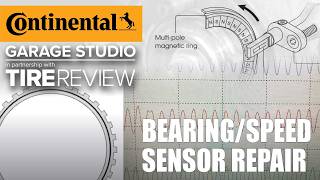
The hub assembly on these vehicles contains a magnetic encoder ring that the wheel speed sensor uses to calculate wheel speed. Corrosion, cracks, or metallic debris can damage this ring, disrupting the signal to the ABS module. This will trigger an ABS or traction control warning light on the dashboard and may log fault codes like C0050 (Right Rear Wheel Speed Sensor Circuit Fault). In many cases, the sensor itself is fine, and the root cause is the failing hub assembly.
🎬 Watch: How a bad wheel bearing triggers an ABS lightWheel Play or Wobble
In advanced stages of failure, the bearing becomes so loose that the wheel itself will wobble. You can check for this by safely jacking the vehicle up so the tire is off the ground and trying to rock the wheel by grabbing it at the top and bottom (12 and 6 o'clock positions). If you feel any looseness, clunking, or play, the hub assembly is severely worn and the vehicle is unsafe to drive.
Critical Compatibility Warning: Part selection for these vehicles is complex. Fitment depends on the axle (front or rear), drivetrain (FWD or AWD), and specific vehicle package (Civilian vs. Police Interceptor). Aftermarket parts often claim to fit all four corners, but OEM parts have critical distinctions. Always verify the correct part number for your specific VIN before purchasing.
Known Issues, TSBs, and Recalls

Aftermarket Hub Recall (NHTSA ID: 17E053)
In 2017, Ford issued a recall for certain aftermarket hub assemblies, including OEM part number HB5Z-1104-C, that were sold with incorrect application information. These hubs were designed for drive axles only but were being sold for use on the rear non-drive axles of Front-Wheel Drive (FWD) Explorers. Installing a drive-axle hub on a non-drive axle results in excessive looseness because there is no axle shaft nut to secure it, which can lead to wheel separation. This highlights the danger of using the wrong part, especially on FWD models.
Related TSBs for Rear Knuckle and Suspension
Ford has issued Technical Service Bulletins (TSBs) like SSM 48876, advising that if the rear wheel knuckle or its bushings require service, the entire knuckle assembly should be replaced with genuine Ford parts. Additionally, recalls like 19S17 were issued for rear suspension toe link fractures, which can cause noises and handling problems that might be mistaken for a bad hub.
Buying a Used Hub Assembly
A low-mileage, used OEM hub assembly can be a reliable and cost-effective alternative to a new aftermarket part, which may not have the same durability as the original. When inspecting a used hub, focus on these key areas:
- Check for Play: Hold the hub flange and try to move it side-to-side against the main body. There should be absolutely no play or looseness.
- Spin the Hub: Rotate the hub by hand. It should spin smoothly and silently. Any grinding, roughness, or catching indicates the internal bearings are damaged.
- Inspect the ABS Encoder Ring: Look at the magnetic ring on the back of the hub. It should be clean, free of cracks, and have no metallic debris stuck to it. Damage to this ring will cause ABS faults.
- Examine the Connectors and Studs: Ensure the ABS sensor connector (if integrated) is not damaged and that all wheel studs are straight and have clean threads.
- Mileage Consideration: Hub bearing failure is often related to mileage and driving conditions. A part from a low-mileage (under 80,000 miles) vehicle is ideal. Police Interceptors often accumulate high engine idle hours but may have lower mileage; however, they are subjected to heavy use, so inspect these parts carefully.
Cost Comparison for Hub Assembly Replacement
| Part Type | Estimated Cost (Part Only) |
|---|---|
| New OEM (Ford/Motorcraft) | $225 - $270 |
| New Aftermarket (Premium) | $90 - $120 |
| Used OEM | $75 - $150 |
| Shop Labor | $160 - $250 per wheel |
Replacement and Installation Tips

Replacing a hub assembly is a feasible DIY job for those with mechanical experience and the right tools. The difficulty is moderate, primarily due to the high torque specs and the potential for the old hub to be seized in the steering knuckle.
🎬 Watch: Step-by-step front hub bearing replacement walkthroughSpecial Tools and Procedures:
- Corrosion: The steel hub often seizes into the aluminum steering knuckle due to galvanic corrosion. Be prepared to use a small sledgehammer or a slide hammer to break it free.
- Cleaning is Crucial: Once the old hub is out, thoroughly clean the bore of the knuckle with a wire brush to remove all rust and corrosion. Apply a thin layer of anti-seize compound before installing the new hub to make future removal easier.
- New Axle Nut: Always use a new axle nut. They are designed for one-time use and stretching to the correct torque. Reusing the old nut can result in it backing off.
- Torque Specs: Correct torque is critical for bearing life. Over or under-tightening the axle nut will destroy a new bearing quickly. While specs can vary slightly by year and model, common values are:
- Hub-to-Knuckle Bolts (18mm): 122 ft-lbs
- Axle Nut (32mm or 1-1/4"): Ranges from 184 ft-lbs to 258 ft-lbs. Police Interceptor models often use the higher specification. Always verify the correct spec for your vehicle.
Pro Tip: A special procedure for the Police Interceptor involves seating the new bearing by tightening the old axle nut to 258 ft-lbs, then removing it and installing the new axle nut to the final torque of 258 ft-lbs. This ensures the hub is fully seated on the axle splines before the final torque is applied.
🎬 See: Front wheel hub replacement on a Police InterceptorFrequently Asked Questions (FAQ)
Will this hub fit my 2016 Explorer XLT?
It might, but you must verify. Part number BB5Z-1104-A, for example, is listed for both civilian Explorers without AWD and for Police Interceptors with steel wheels. The safest approach is to use your vehicle's VIN to confirm the exact OEM part number required before buying.
Is the front hub the same as the rear hub?
Not always. While some aftermarket brands sell a single part for all four corners, Ford has different part numbers for different applications. A hub designed for a drive axle (like the front on a FWD model, or all four on an AWD model) must be used on a drive axle. Using a drive axle hub on a non-drive axle can be extremely dangerous.
If one hub is bad, should I replace them in pairs?
It is highly recommended. Wheel bearings on the same axle experience the same wear and tear. If one has failed due to mileage, the other is likely not far behind. Replacing them in pairs saves you from having to do the same job again in the near future.
Can I reuse my old axle nut?
No. The axle nut is a torque-to-yield fastener, meaning it permanently stretches when tightened to the correct specification. It is designed for single use only. Reusing it creates a significant risk of it backing off, which can lead to catastrophic failure of the hub.
Helpful Videos
Technical Specifications
OEM Part Numbers: BB532C300AC BB532C300AD BB532C300AE BB5Z1104A HB5Z1104A HB5Z1104B HB5Z1104C HUB87 HUB363 HUB364
Axle Nut Torque: 184-258 ft-lbs (model dependent). Hub-to-Knuckle Bolt Torque: 122 ft-lbs. Axle Nut Socket Size: 32mm or 1-1/4 inch. Hub Bolt Socket Size: 18mm.
We Have This Part in Stock



The information in this article is provided for general reference and educational purposes only. Vehicle specifications, procedures, and part compatibility can vary by production date, trim level, and region. Always consult your vehicle's factory service manual and verify part numbers before purchasing or performing repairs. Safety-critical components such as airbags, seat belts, and braking systems should be installed by a qualified professional.
- Ford Explorer:
- Ford Police Interceptor Utility:
- 🎬 Helpful Videos
- 🛍️ Shop This Part
- Symptoms of a Failing Hub Assembly
- Noises: Humming, Roaring, Grinding, or Growling
- Vibrations
- ABS or Traction Control Light
- Wheel Play or Wobble
- Known Issues, TSBs, and Recalls
- Aftermarket Hub Recall (NHTSA ID: 17E053)
- Related TSBs for Rear Knuckle and Suspension
- Buying a Used Hub Assembly
- Cost Comparison for Hub Assembly Replacement
- Replacement and Installation Tips
- Special Tools and Procedures:
- Frequently Asked Questions (FAQ)
- 🎟️ Get 5% Off