

2017-2025 Audi A4, Q5, A6 & More Front Hub Assembly: Noise Diagnosis & Replacement Guide
Diagnose humming, grinding, or clicking noises and understand the critical replacement procedures for the front wheel hub assembly on many modern Audi models.
- A humming or roaring noise that gets louder with speed and changes when turning is the classic sign of a failing hub assembly.
- A low-speed clicking noise when parking may not be a bad bearing, but a known issue addressed by an Audi TSB that requires applying a special grease, not replacement.
- Replacement requires special tools (19mm hex bit, triple square socket) and a very high torque procedure (200 Nm + 180°) for the new, mandatory replacement axle bolt.
- When buying a used OEM hub, prioritize low mileage from the donor vehicle as the best indicator of remaining life.
Symptoms of a Failing Front Hub Assembly


A failing front hub assembly, also known as a wheel bearing, typically gives clear audible warnings. Ignoring these signs can lead to more severe damage or a catastrophic failure where the wheel could seize or detach from the vehicle.
Noises: The Most Common Symptom
- Humming, Roaring, or Growling: This is the classic sign of a worn wheel bearing. The noise is rotational, meaning its pitch and/or volume increases with vehicle speed. It is often described as a sound similar to loud off-road tires.
- How to Pinpoint the Noise: The noise often changes when turning. If you steer to the right, more weight is placed on the left front wheel. If the noise gets louder when turning right, the failing bearing is likely on the left side. Conversely, if the noise increases when turning left, the right-side bearing is the likely culprit. 🎬 Watch: A pro mechanic shows how to pinpoint the noise.
- Grinding or Grating: A more severe grinding or metal-on-metal sound indicates the bearing has significantly deteriorated. This requires immediate attention.
- Clicking or Snapping: A clicking or popping sound, especially when turning, can also point to a very worn bearing. However, this can also be a symptom of a bad CV (Constant Velocity) axle, so a thorough diagnosis is necessary.
Vibrations and Physical Sensations
- Steering Wheel Vibration: A worn bearing can cause excessive play, leading to a vibration or shudder in the steering wheel that intensifies with speed or while turning.
- Pulling to One Side: A failing bearing can create drag, causing the vehicle to pull towards the side of the bad bearing.
- Loose or Sloppy Steering: The steering may feel less precise or responsive due to play in the wheel assembly.
Visual and System Warnings
- ABS or Traction Control Light: The hub assembly contains the sensor ring for the wheel speed sensor. Excessive play from a bad bearing can disrupt the sensor's reading, triggering the ABS or traction control warning lights 🎬 See how a bad bearing triggers ABS and traction lights. on your dashboard.
- Uneven Tire Wear: Over time, the wobble from a bad bearing can cause abnormal tire wear patterns, often on the inside edge of the tire.
Known Issues, TSBs, and Recalls

There are no active safety recalls for this specific part on the listed vehicles. However, Audi has issued Technical Service Bulletins (TSBs) related to front wheel bearing noises that are important for diagnosis.
TSB for Clicking/Clacking Noise When Parking
Audi TSB 40 23 52 (also listed under numbers 2024318/13 and others) addresses a specific condition where a “clicking or clacking noise” is heard when maneuvering or parking at low speeds. According to the bulletin, this is caused by microscopic movements between the wheel bearing and the aluminum wheel bearing housing (steering knuckle).
Pro Tip: This clicking noise does NOT indicate a failed bearing. The official fix is to remove the hub assembly, clean the contact surfaces, and apply a special paste (Part No. G 052109A2) before reinstalling. The TSB explicitly states that replacing the wheel bearing for this specific clicking concern will not be covered under warranty.
TSB for Humming/Booming Noise While Driving
A separate TSB (40 22 45 / 2047920/6) addresses a “buzzing, booming, humming, whistling, or a similar noise from the front end” while the vehicle is moving. This TSB identifies the cause as mechanical damage inside the wheel bearing. The recommended service is to confirm the noise source and replace the affected wheel bearing. Unlike the clicking TSB, this humming noise indicates a genuine part failure.
Diagnosing a Bad Hub Assembly
If you suspect a bad hub assembly, you can perform a couple of simple tests with the vehicle safely lifted and supported on jack stands.
- The Spin Test: With the transmission in neutral, spin the wheel by hand. A good bearing should spin smoothly and quietly. If you feel any roughness, grinding, or hear noise, the bearing is likely bad.
- The Wiggle Test: Grasp the tire at the 12 and 6 o'clock positions and try to wiggle it in and out. Then, repeat the process by grasping the tire at the 3 and 9 o'clock positions. There should be almost no noticeable play or movement. If you can feel the wheel move or hear a clunking sound, the hub assembly is worn and needs replacement. A dial indicator can be used for a precise measurement; play should not exceed .004 inches.
Warning: A noise that sounds like a bad wheel bearing can also be caused by unevenly worn or "cupped" tires. Before replacing the hub, run your hand over the tire's tread. If you feel a saw-tooth or wavy pattern, the noise may be from the tire itself.
Buying a Used Hub Assembly
A recycled OEM hub assembly can be a cost-effective and reliable alternative to a new part, especially when compared to cheap, low-quality aftermarket options. Since this is a sealed, non-serviceable part, here’s what to look for:
- Mileage is Key: The single most important factor for a used hub assembly is the mileage of the donor vehicle. These bearings are designed to last a long time, often over 100,000 miles, but they are a wear item. Always choose a part from the lowest-mileage vehicle available.
- Physical Inspection: When you receive the part, inspect it carefully. Look for any signs of impact damage, cracks, or heavy corrosion on the housing. Check that the threaded holes for the wheel bolts are clean and undamaged.
- Spin It By Hand: Hold the assembly and try to spin the hub flange. It should rotate smoothly with some resistance from the grease inside. It should not feel gritty, loose, or make any noise.
- Check the ABS Ring: Inspect the back of the hub for the magnetic seal that the ABS sensor reads. Ensure it is clean and free from damage or deep scratches, which could interfere with the sensor's operation.
- Why Used OEM is a Good Choice: An original Audi hub assembly is built to a very high standard to handle the performance and weight of the vehicle. A low-mileage used OEM part is often superior in material quality and longevity compared to a brand-new, low-cost aftermarket part.
Replacement Overview & Special Procedures

Replacing this hub assembly is a feasible DIY job for an experienced mechanic with the right tools, as it is a bolt-on unit. However, it requires very high torque values and specific procedures that must be followed for safety.
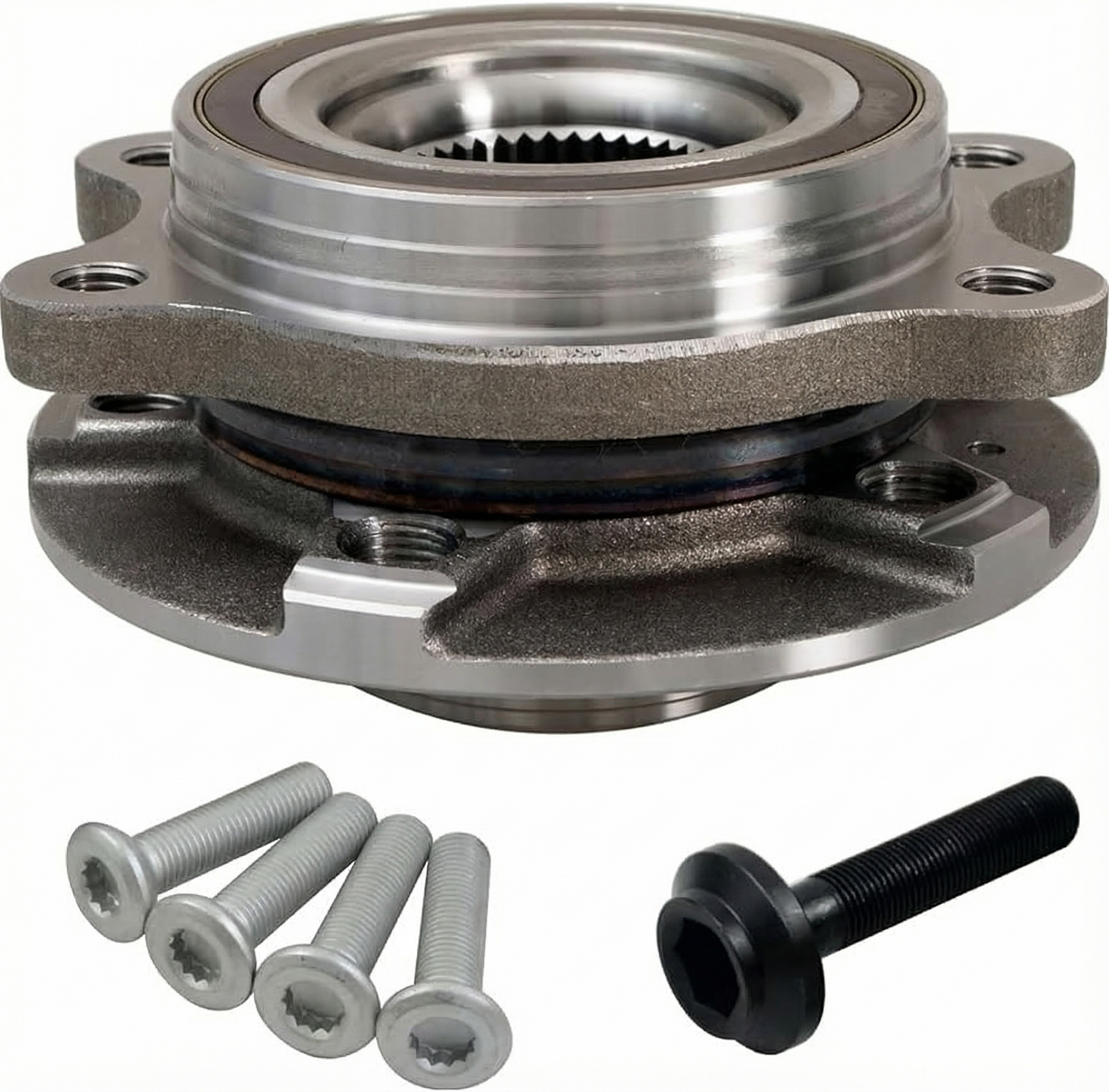
- Key Parts to Replace: The large central axle bolt is a one-time-use, torque-to-yield bolt and MUST be replaced. It is also highly recommended to replace the four smaller bolts that secure the hub assembly to the steering knuckle.
- Special Tools: You will need a 19mm hex (Allen) bit socket for the axle bolt and a 12-point (triple square) socket (typically M12) for the four hub mounting bolts. A heavy-duty, long breaker bar or a high-torque impact wrench is essential.
- Corrosion: The steel bearing housing can corrode and seize into the aluminum steering knuckle, making removal difficult. A slide hammer or careful use of a hammer may be needed to free the old hub.
Torque Specifications
Proper torque is critical for the safety and function of the new hub. These are the most commonly cited specs, but always verify with a current factory service manual for your specific vehicle.
🎬 Watch this full DIY tutorial for replacing the hub assembly.| Fastener | Torque Specification | Notes |
|---|---|---|
| Axle Bolt (19mm Hex) | 200 Nm (147 ft-lbs) + 180° turn | Torque-to-yield. MUST be replaced. Perform final 180° turn with the vehicle's weight on the wheel. |
| Hub Mounting Bolts (Triple Square) | 80 Nm (59 ft-lbs) + 90° turn | Recommended to replace. |
Warning: The 180-degree final turn on the axle bolt requires immense force. Ensure you are using a long, high-quality breaker bar and that the vehicle is securely on the ground with the brakes applied before attempting this step.
Cost of Replacing a Front Hub Assembly
The cost can vary significantly based on the parts you choose and whether you perform the labor yourself.
| Part or Service | Estimated Cost | Notes |
|---|---|---|
| New OEM (Dealer) | $450 - $670 | Part number 8W0407613 from an Audi dealership. |
| New Aftermarket | $80 - $200 | Prices vary by brand (e.g., Febi, SKF, Moog). Quality can also vary. |
| Used OEM | $75 - $175 | Depends on mileage and condition. A good value alternative. |
| Shop Labor | $250 - $400 | Labor for one side. Prices vary by shop rate and location. |
Vehicle Fitment and Part Numbers
This front hub assembly is shared across a wide range of Audi vehicles built on the MLB Evo platform, making it a common replacement part. This guide applies to the front axle of the following North American models:
- 2017-2025 Audi A4 / S4
- 2017-2025 Audi allroad
- 2018-2025 Audi A5 / S5 / RS5
- 2019-2025 Audi A6 / S6
- 2018-2025 Audi Q5 / SQ5
- 2019-2023 Audi e-tron
Known OEM Part Numbers: 8W0407613, 8WD407613
Frequently Asked Questions (FAQ)
Can I drive with a bad wheel bearing?
It is not recommended. While the car may be drivable for a short time after symptoms appear, a failing bearing generates excessive heat and can eventually seize or break apart, leading to a loss of vehicle control or the wheel detaching. It is a serious safety risk that should be addressed immediately.
Do I need to replace hub assemblies in pairs?
No, it is not required. Unlike brakes or shocks, wheel bearings do not need to be replaced in pairs. You only need to replace the one that has failed. However, if the vehicle has high mileage, the other side's bearing may not be far behind.
Is the humming noise from my tires or the wheel bearing?
This can be difficult to distinguish. Tire noise, especially from worn or all-terrain tires, is constant and may not change significantly when turning. A wheel bearing noise will almost always change in volume or pitch when you swerve the car left and right, loading and unloading the bearing.
What is the difference between a wheel hub and a wheel bearing?
On these Audi models, the part is a complete unit called a "hub assembly," which includes the hub (the flange the wheel bolts to) and the sealed, non-serviceable bearing. While some aftermarket companies may sell the hub and bearing as separate pieces that require a press to assemble, the OEM replacement part is a single, bolt-on assembly.
Helpful Videos



Technical Specifications
OEM Part Numbers: 8W0407613 8WD407613
Axle Bolt Torque: 200 Nm (147 ft-lbs) + 180 degrees. Hub Mounting Bolt Torque: 80 Nm (59 ft-lbs) + 90 degrees. Axle bolt requires a 19mm hex bit socket.
We Have This Part in Stock



The information in this article is provided for general reference and educational purposes only. Vehicle specifications, procedures, and part compatibility can vary by production date, trim level, and region. Always consult your vehicle's factory service manual and verify part numbers before purchasing or performing repairs. Safety-critical components such as airbags, seat belts, and braking systems should be installed by a qualified professional.
- Audi A4:
- Audi A6:
- Audi A5:
- Audi Q5:
- Audi SQ5:
- Audi allroad:
- Audi RS5:
- Audi S4:
- Audi S5:
- Audi e-tron:
- Audi Q7:
- Audi Q8:
- Audi Q8 e-tron:
- Audi RS Q8:
- Audi RS4:
- Audi RS6:
- 🎬 Helpful Videos
- 🛍️ Shop This Part
- Symptoms of a Failing Front Hub Assembly
- Noises: The Most Common Symptom
- Vibrations and Physical Sensations
- Visual and System Warnings
- Known Issues, TSBs, and Recalls
- TSB for Clicking/Clacking Noise When Parking
- TSB for Humming/Booming Noise While Driving
- Diagnosing a Bad Hub Assembly
- Buying a Used Hub Assembly
- Replacement Overview & Special Procedures
- Torque Specifications
- Cost of Replacing a Front Hub Assembly
- Vehicle Fitment and Part Numbers
- Frequently Asked Questions (FAQ)
- 🎟️ Get 5% Off