

2008-2018 Audi A4, A5, A6, Q5 & More Hub Assembly Failure: Noises, Warnings, and Replacement Guide
This guide covers the common symptoms, replacement costs, and critical compatibility warnings for the front and rear wheel hub assemblies on many popular Audi models.
- The most common symptom of failure is a humming or roaring noise that gets louder with speed.
- This hub fits the FRONT on all listed models, but only fits the REAR on Quattro (AWD) models.
- Replacement requires special tools like a 19mm hex socket and M12 triple square bit. Always use new, torque-to-yield bolts.
- A used OEM hub assembly is often a more reliable choice than a cheap, new aftermarket part due to superior bearing quality.
Compatibility Warning: Front vs. Rear & Drivetrain

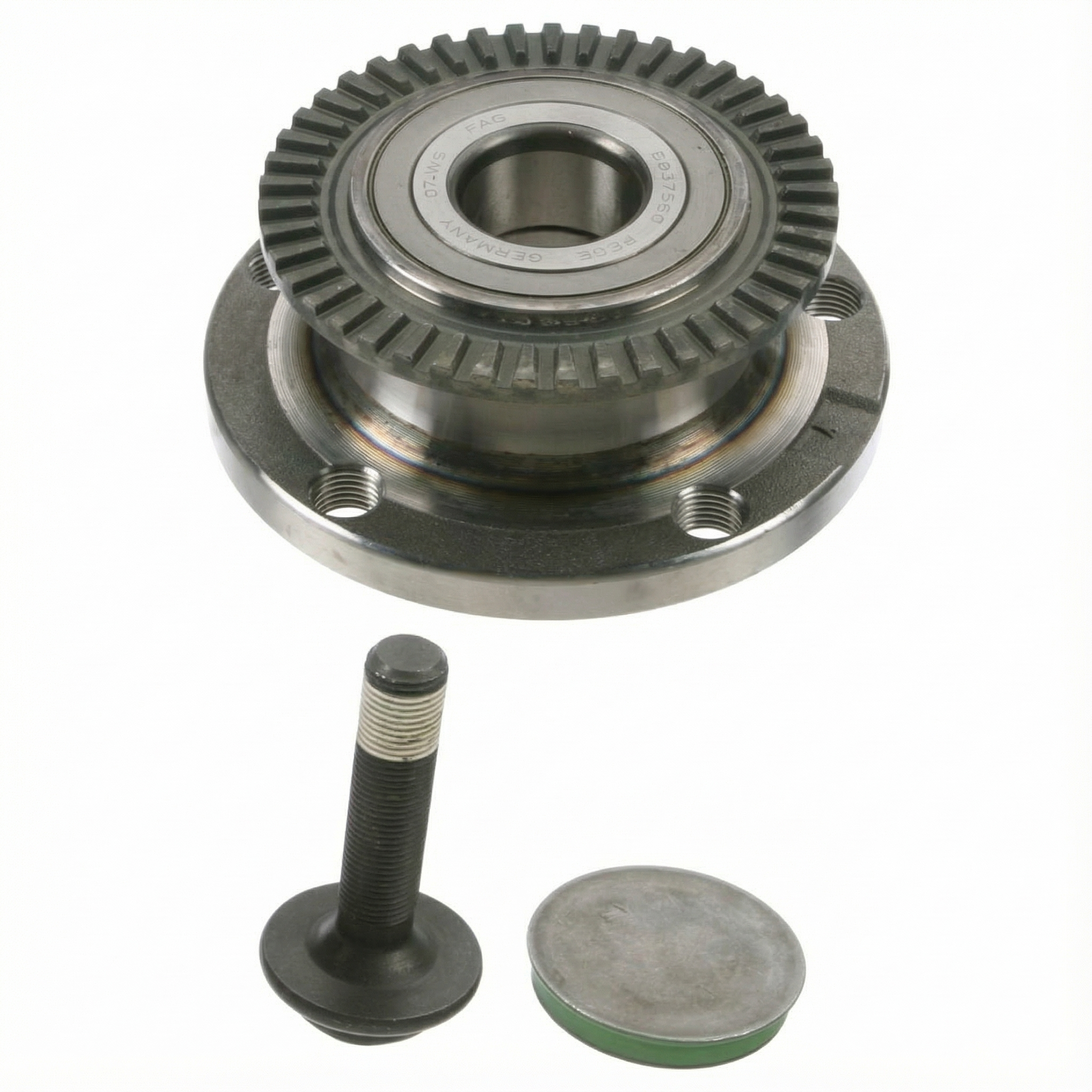
Important: This hub assembly fits the Front position on all listed vehicles. However, it only fits the Rear position on All-Wheel Drive (AWD), or Quattro, models. It will NOT fit the rear of Front-Wheel Drive (FWD) vehicles, which use a different design. Always verify fitment for your specific vehicle's position and drivetrain before purchasing.
Symptoms of a Failing Hub Assembly

A failing wheel hub assembly, also known as a wheel bearing, typically gives clear audible warnings that get worse over time. Ignoring these signs can lead to more severe damage or a loss of vehicle control.
1. Humming, Roaring, or Grinding Noise
This is the most common symptom. The noise is often described as a hum, roar, or grinding sound that starts faint and gets progressively louder. The sound's pitch and volume will increase with vehicle speed. To help pinpoint which side is failing, try safely swerving the vehicle from side to side at a moderate speed (30-40 mph). Turning the steering wheel loads and unloads the bearings; if you turn left and the noise gets louder, the right-side bearing is likely the culprit, and vice-versa.
2. Clicking or Popping Sounds
Clicking or popping noises, especially when turning or during low-speed maneuvers, can indicate a more advanced stage of bearing wear. There is also a known issue on these Audis where microscopic movements between the bearing and the steering knuckle can cause a clicking or clacking sound when parking or turning sharply. Audi has issued a Technical Service Bulletin (TSB 2024318/3) for this, which involves applying a special paste between the components.
3. Vibration in the Steering Wheel or Floor
As the bearing wears, it can develop excessive play, leading to a vibration or shudder that can be felt in the steering wheel or through the floor of the car. This vibration often becomes more noticeable at higher speeds.
4. ABS or Traction Control Warning Lights
The hub assembly contains the magnetic encoder ring that the wheel speed sensor reads. A failing bearing can damage this ring or create enough wobble to cause an erratic signal. This will trigger the ABS and/or traction control warning lights on your dashboard, disabling these important safety systems.
Known Issues, TSBs, and Recalls

While there are no widespread safety recalls for hub assembly failure on these models, Audi has released several Technical Service Bulletins (TSBs) related to wheel bearing noises.
- TSB 2024318/3 / 401774: Addresses a clicking or clacking noise from the front wheels during parking or slow maneuvers. The fix involves cleaning the contact surfaces between the wheel bearing and the housing and applying a specific lubricant paste (Part No. G 052109A2). This TSB applies to a wide range of models including the A4, A5, A6, A7, Q5, and more.
- TSB 401548 / NHTSA 10073100: Pertains to humming or roaring noises from the front wheel bearings due to mechanical damage. The solution is to replace the affected wheel bearing. The bulletin notes that the noise can be difficult to distinguish from tire noise and can be transmitted through the steering column.
Forum discussions suggest that wheel bearing failure is a relatively common issue on these platforms, with some owners reporting failures at mileages under 100,000 miles, and in some rare cases, much sooner. However, with proper installation and quality parts, they can also last well over 150,000 miles.
Buying a Used Hub Assembly: What to Look For

A high-quality, low-mileage used OEM hub assembly can be a great value compared to a new dealer part or a cheap aftermarket alternative. Here’s what to check:
- Mileage is Key: Since bearing life is finite, the lower the mileage on the donor vehicle, the better. Aim for an assembly from a vehicle with under 80,000 miles if possible. While they can last much longer, failures often begin to appear around the 100,000-mile mark.
- Check for Smoothness: Hold the hub assembly and try to spin the hub flange by hand. It should rotate smoothly and silently with no roughness, grinding, or catching.
- The Wiggle Test: Firmly grasp the hub flange and the stationary outer housing. Try to wiggle the flange. There should be absolutely zero play or movement. Any looseness indicates a worn bearing.
- Visual Inspection: Look for signs of heavy corrosion, especially around the mounting bolt holes and the hub face. Check the ABS sensor ring (if visible) for any cracks or damage. Ensure the threaded bolt holes are clean and undamaged.
- Why Used OEM is Often Better: The original Audi (FAG or SKF) bearings are made from high-quality steel and manufactured to precise tolerances. Many cheaper aftermarket bearings use inferior materials that can lead to premature failure, sometimes in just a few months. A used OEM part is often more reliable than a new, non-OEM part.
Replacement Overview & Special Procedures
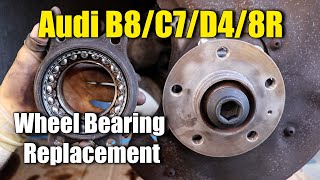
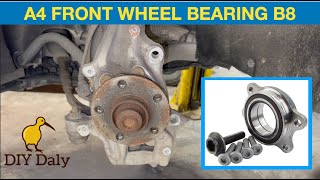
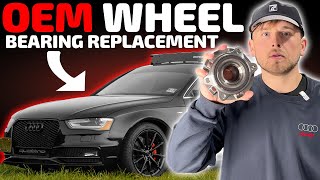
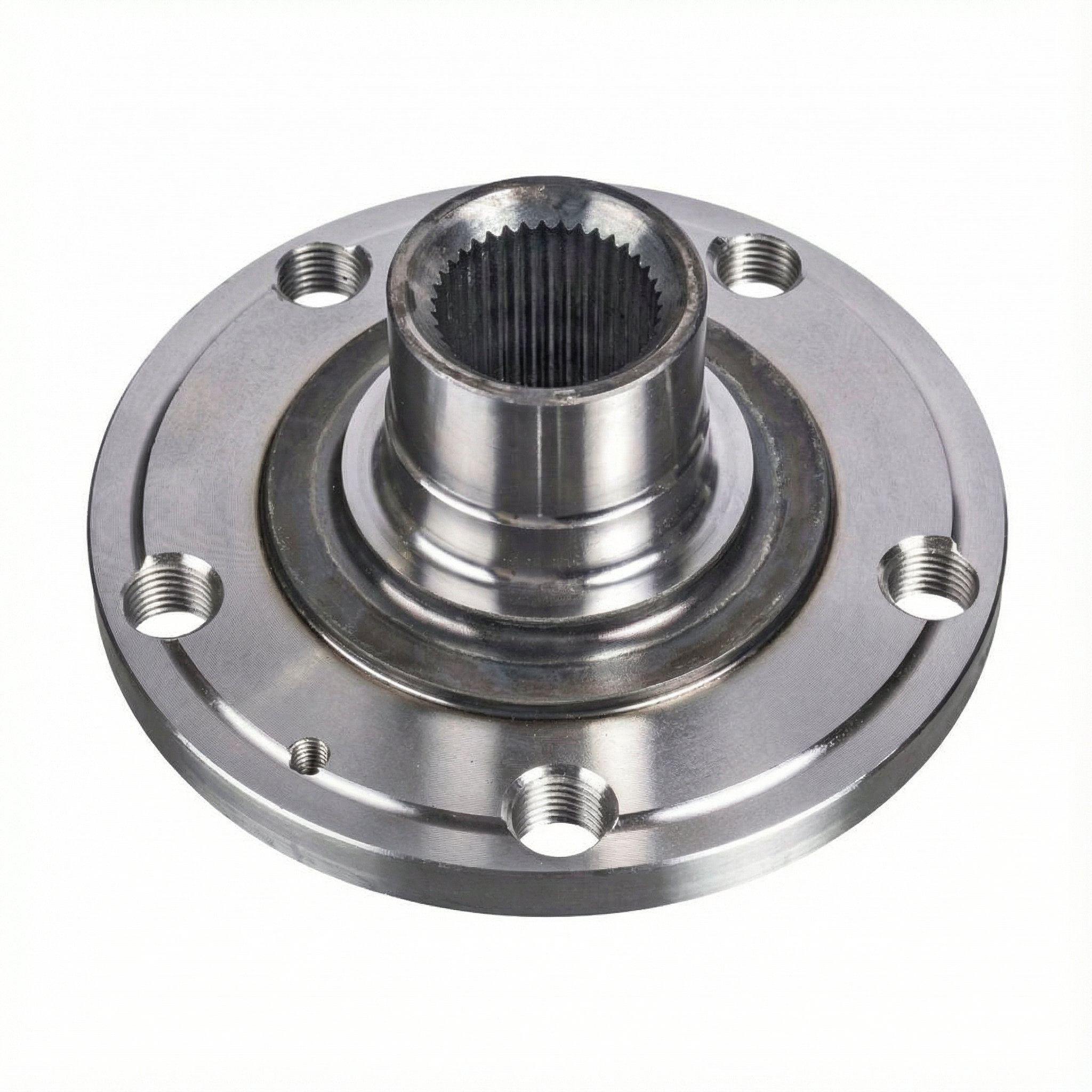
Replacing the hub assembly on these Audi models is a feasible DIY project for an experienced home mechanic 🎬 Watch this full DIY tutorial for a front wheel bearing replacement., but it requires specific tools. Unlike older designs that required a large hydraulic press, these vehicles use a bolt-in hub assembly. However, the hub flange must still be separated from the old bearing and pressed into the new one, which requires a press or a specialized puller kit.
Pro Tip: You can purchase a complete hub assembly with the flange already pressed into the bearing. This makes the job significantly easier as it eliminates the need for a hydraulic press 🎬 Watch a fast method for replacing the bearing without a press. and can be done with hand tools.
Key Steps & Tools:
- Loosen Axle Bolt: Before lifting the vehicle, remove the wheel's center cap and use a large breaker bar and a 19mm hex (Allen) socket to break the main axle bolt loose. This bolt is extremely tight.
- Disassembly: Lift and secure the vehicle. Remove the wheel, brake caliper (hang it securely, do not let it hang by the brake line), and brake rotor.
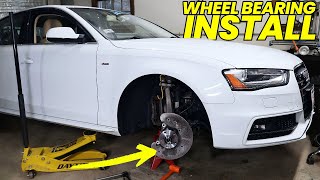
- Remove Hub Assembly: The assembly is held to the steering knuckle by four bolts from the rear. These require a size M12 Triple Square (XZN) socket. Access can be tight, especially on the rear axle of Quattro models. 🎬 See how to replace a rear wheel bearing on Quattro models. The hub may be seized in the knuckle and require a slide hammer or forceful tapping to remove.
- Pressing the Hub (if needed): If you did not buy a pre-assembled unit, you will need to use a shop press or a large puller to remove the hub flange from the old bearing and install it into the new one. The inner race of the old bearing often gets stuck on the hub flange and must be cut or pulled off.
- Installation & Torque Specs: Installation is the reverse of removal. Always use new bolts, as they are torque-to-yield (TTY), meaning they stretch when tightened and are designed for single use. Clean all mating surfaces thoroughly and apply anti-seize compound to prevent future corrosion.
- Hub Assembly to Knuckle Bolts (x4): 80 Nm (59 ft-lbs) + an additional 90-degree turn.
- Main Axle Bolt: 200 Nm (147 ft-lbs) + an additional 180-degree turn.
Warning: These torque specs are critical. The axle bolt requires a very high torque plus an angle tightening. Failure to tighten these bolts correctly can lead to premature bearing failure or a catastrophic failure where the wheel can separate from the vehicle.
Cost of Replacement
The cost to replace a hub assembly can vary significantly based on the parts used and labor rates.
| Item | Estimated Cost (Per Wheel) |
|---|---|
| New OEM (Dealer) | $350 - $500+ |
| New Aftermarket (High Quality - SKF, FAG) | $150 - $250 |
| New Aftermarket (Economy) | $70 - $120 |
| Used OEM | $80 - $180 |
| Shop Labor | $230 - $570 |
Frequently Asked Questions (FAQ)
Do I need to replace wheel bearings in pairs?
No, it is not necessary to replace them in pairs. If the bearing on the other side shows no signs of wear (no noise, no play), it can be left alone. Audi's own service documents state they should not be replaced in pairs unless both are faulty.
Can I drive with a bad wheel bearing?
It is not recommended. While the car may be drivable for a short time, a failing bearing generates excessive heat and can eventually seize or break apart, potentially causing the wheel to lock up or detach from the vehicle. This is a serious safety risk.
What are the torque specs for the wheel hub bolts?
The four M12 triple-square bolts that hold the bearing to the knuckle should be torqued to 80 Nm (59 ft-lbs), plus an additional 90-degree turn. The large center axle bolt requires 200 Nm (147 ft-lbs), plus an additional 180-degree turn. Always use new bolts.
Is this a bolt-in or press-in wheel bearing?
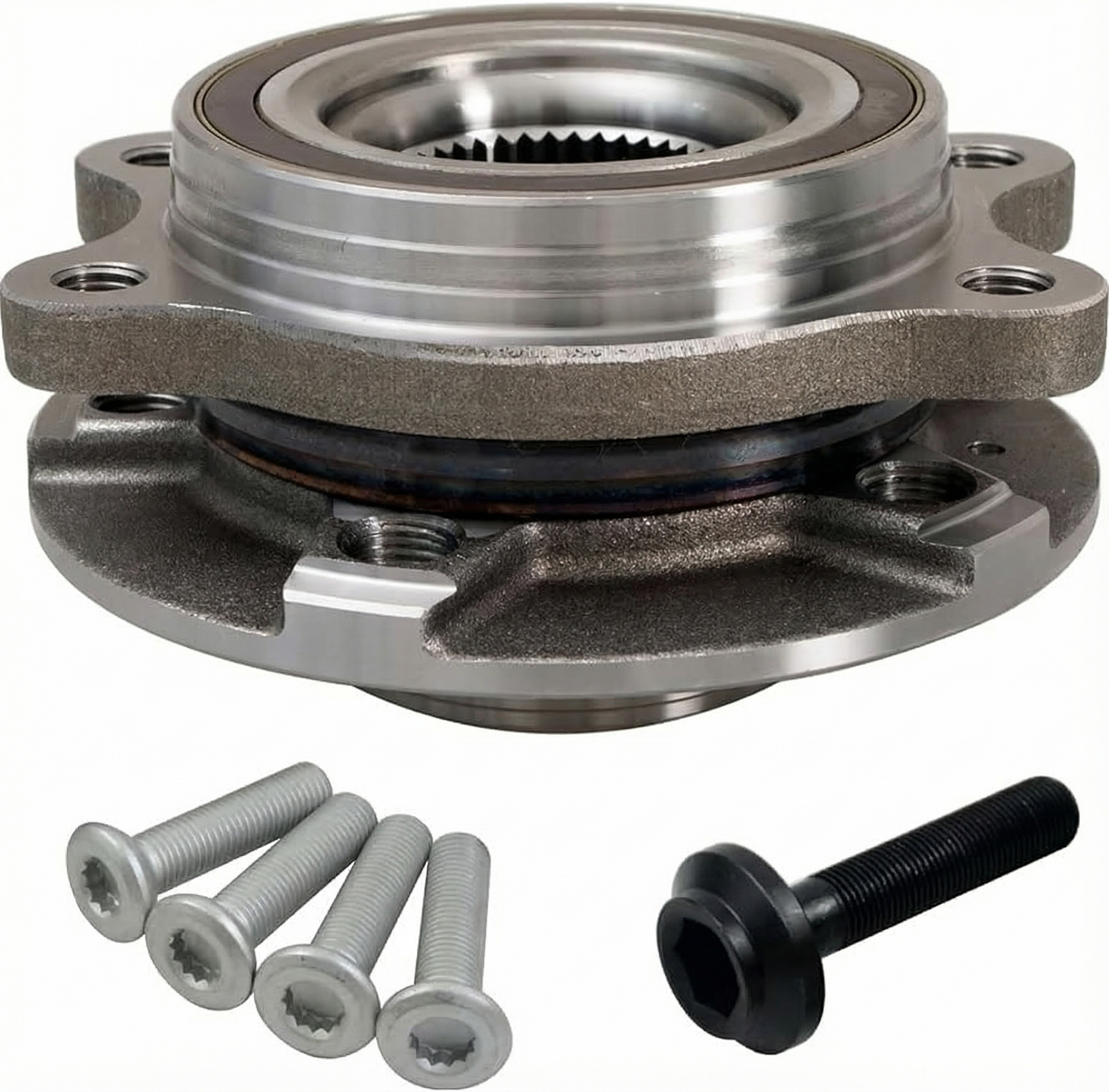
It's a bit of both. The main bearing assembly bolts into the steering knuckle, so you don't need to press the bearing into the knuckle itself. However, the wheel hub flange is pressed into the bearing. You can avoid the need for a press by purchasing a complete assembly where the hub is already installed in the bearing.
What vehicles does this hub assembly fit?
This hub assembly is used on the front of the 2009-2016 A4, 2012-2018 A6, 2008-2017 A5, 2009-2017 Q5, 2014-2017 SQ5, 2013-2016 allroad, 2013-2015 RS5, 2010-2016 S4, 2008-2017 S5, and 2012-2018 A7 Quattro. It also fits the rear position on these models ONLY if they are Quattro (AWD). It does not fit the rear of FWD models.
Helpful Videos
Technical Specifications
OEM Part Numbers: 4H0498625A 4H0498625B 4H0498625D 4H0498625E 4H0498625F 4S0598625 8K0598625
Design: Bolt-in assembly with a pressed-in hub flange. Axle Bolt Socket: 19mm Hex (Allen). Hub-to-Knuckle Bolts: M12 Triple Square (XZN).
We Have This Part in Stock




The information in this article is provided for general reference and educational purposes only. Vehicle specifications, procedures, and part compatibility can vary by production date, trim level, and region. Always consult your vehicle's factory service manual and verify part numbers before purchasing or performing repairs. Safety-critical components such as airbags, seat belts, and braking systems should be installed by a qualified professional.
- Audi A4:
- Audi A6:
- Audi A5:
- Audi Q5:
- Audi SQ5:
- Audi allroad:
- Audi RS5:
- Audi S4:
- Audi S5:
- Audi A7 Quattro:
- Audi A8 Quattro:
- Audi RS7:
- Audi S6:
- Audi S7:
- Audi S8:
- 🎬 Helpful Videos
- 🛍️ Shop This Part
- Compatibility Warning: Front vs. Rear & Drivetrain
- Symptoms of a Failing Hub Assembly
- 1. Humming, Roaring, or Grinding Noise
- 2. Clicking or Popping Sounds
- 3. Vibration in the Steering Wheel or Floor
- 4. ABS or Traction Control Warning Lights
- Known Issues, TSBs, and Recalls
- Buying a Used Hub Assembly: What to Look For
- Replacement Overview & Special Procedures
- Key Steps & Tools:
- Cost of Replacement
- Frequently Asked Questions (FAQ)
- 🎟️ Get 5% Off