

1990-1993 Mustang Heater Assembly: Fixing Airflow & Temperature Control Issues
Your definitive guide to diagnosing common heater box failures, inspecting a used unit, and understanding the difficult replacement process on the Fox Body Mustang.
- The most common failures of the heater assembly are broken internal blend/mode doors or levers, leading to incorrect airflow and temperature control.
- Replacement is a major, labor-intensive job requiring the complete removal of the dashboard, taking 8-12 hours.
- Due to the extreme labor involved, it is critical to replace the heater core and all foam seals at the same time to avoid repeating the job.
- When buying a used assembly, physically inspect it for cracks and ensure all internal doors and levers move freely without binding.
Symptoms of a Failing Heater Assembly

Failures in the heater assembly are distinct from a bad heater core or blower motor. While a bad heater core leaks coolant and a bad blower motor fails to move air, a faulty heater assembly typically involves problems with directing that air. Over decades, the plastic components can become brittle and the internal doors or levers can break.
- Air Blows from the Wrong Vents: This is a classic symptom. If you select 'FLOOR' but air only comes out the defrost vents, it often points to a problem with the mode doors inside the assembly or a vacuum leak preventing the doors from moving. The default position for a loss of vacuum is defrost.
- Inability to Control Temperature: If you move the temperature knob from cold to hot and nothing changes, the blend door inside the assembly is likely stuck or its control cable is broken. The blend door is responsible for mixing hot and cold air to achieve the desired temperature.
- Rattling or Popping Sounds from the Dash: You might hear noises from behind the dash when you change temperature or vent settings. This could be a broken door flopping around inside the housing or a stripped gear on an actuator.
- Weak Airflow to a Specific Vent: A partially broken or misaligned door might obstruct airflow to one or more vent locations, even if the blower fan is working at full speed.
Warning: Do not confuse heater assembly failure with heater core failure. A sweet, syrupy smell inside the car, a foggy film on the inside of the windshield, or a damp passenger-side floorboard are all signs of a leaking heater core, which is a separate part that resides inside the heater assembly.
Buying a Used 1990-1993 Mustang Heater Assembly

Since new OEM heater assemblies are generally no longer available, a quality used unit is the most common solution. For a part like this, which is primarily plastic and mechanical, a thorough inspection is critical. A good used OEM part is often superior to poorly made aftermarket reproductions.
Inspection Checklist:
- Check for Cracks: Carefully inspect the entire plastic housing for cracks, especially around mounting points and screw holes. Decades of heat cycles can make the plastic brittle.
- Operate All Doors Manually: Reach inside the box and move the blend door and mode doors by hand. They should move smoothly through their full range of motion without binding or popping.
- Inspect Levers and Arms: Check all external levers where control cables and vacuum actuators attach. Look for stress fractures, cracks, or stripped connection points. These are common failure points.
- Verify Foam Seal Condition: The original foam seals on the internal doors will likely be deteriorated. While this is expected, check the underlying doors for damage. Plan on replacing these seals with a new foam kit before installation.
- Confirm Compatibility: Ensure the assembly is from a 1990-1993 Mustang. While Fox Body parts have some interchangeability, it's best to stick to the correct year range. Note if there are differences between A/C and non-A/C models and purchase the correct one for your car.
Pro Tip: Many specialists offer rebuilding services for these units. They can repair cracks and replace all wear items like the heater core, evaporator, and foam seals, delivering a ready-to-install unit. This can be a good option if you don't want to tackle the refurbishment yourself.
Known Issues, TSBs, and Recalls

For vehicles of this age, formal recalls or Technical Service Bulletins (TSBs) from Ford are rare and generally not for issues like a failing heater box. The knowledge base for the 1990-1993 Mustang is now primarily community-driven.
- Brittle Plastics: The most significant known issue is the age-related degradation of the plastic housing and its internal components.
- Deteriorated Foam Seals: The foam on the blend and mode doors crumbles over time, leading to air leaks and poor temperature control. This is considered a standard maintenance item to fix whenever the box is removed.
- Vacuum Leaks: The mode doors are vacuum-operated. Cracked or disconnected vacuum lines under the dash or in the engine bay can cause the system to default to the defrost vents.
- No Recalls: Searches of the NHTSA database show no recalls specifically for the heater assembly on 1990-1993 Ford Mustangs. Recalls for this era are primarily for lighting and ignition system components.
Replacement Difficulty & Cost
Replacing the heater assembly is one of the most labor-intensive jobs on a Fox Body Mustang. The entire dashboard must be removed to access the heater box bolted to the firewall. This is not a job for a beginner.
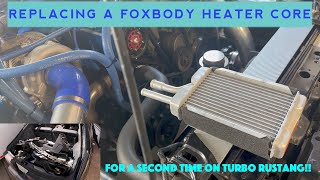
🎬 See a simplified breakdown of the heater core swap- Difficulty Rating: 5 out of 5
- Estimated Time: 8-12 hours for an experienced DIY mechanic.
- DIY Feasibility: Feasible for experienced mechanics with patience and a detailed guide, but very challenging.
Because the labor is so extensive, it is highly recommended to replace other components "while you're in there" to avoid having to do the job twice. This includes:
- Heater Core: Always replace the heater core. 🎬 Watch this full Fox Body heater core installation guide It is inexpensive, and having an old one fail after this job would be frustrating.
- A/C Evaporator: If your car has A/C, inspect and consider replacing the evaporator.
- Foam Seals: Install a new heater box foam and seal kit.
Cost Comparison
| Part/Service | Estimated Cost |
|---|---|
| New OEM Heater Assembly | N/A (Generally Discontinued) |
| New Aftermarket Heater Assembly | $150 - $250 (Availability varies, quality may differ from OEM) |
| Used OEM Heater Assembly | $75 - $150 |
| Heater Box Rebuilding Service | $450+ (Includes new core, seals, etc.) |
| Shop Labor to Replace | $650 - $950+ (Labor for heater core replacement is comparable) |
Frequently Asked Questions (FAQ)
Is a bad heater assembly the same as a bad heater core?
No. The heater assembly is the plastic box that houses everything. The heater core is a small radiator-like part inside that box that coolant flows through to create heat. A bad assembly causes airflow problems; a bad core causes coolant leaks and a lack of heat.
Do I have to remove the entire dashboard to replace the heater assembly?
Yes. Unfortunately, there is no shortcut. The entire dashboard assembly, including the instrument cluster and steering column, must be unbolted and pulled back or removed to access the heater box.
My heat is stuck on hot. Is this the heater assembly?
This is a very common symptom of a problem with the temperature blend door or its control system. The issue could be a broken blend door inside the assembly, a disconnected or broken control cable running from the dash knob, or an issue with the control head itself.
Can I repair my original heater assembly instead of replacing it?
Yes, in many cases. If the main housing is just cracked, it can often be repaired with strong epoxy or plastic welding. Broken levers can sometimes be reinforced. The most common refurbishment involves replacing the foam seals on the doors, which is a required step for any long-term repair.
Helpful Videos

Technical Specifications
OEM Part Numbers: E7ZH-AA E7ZH19740AA E7ZZ-18471-A E7ZZ18471A
Constructed of molded plastic. Contains internal doors for temperature blending and air direction. Operated by a combination of control cables and vacuum actuators.

The information in this article is provided for general reference and educational purposes only. Vehicle specifications, procedures, and part compatibility can vary by production date, trim level, and region. Always consult your vehicle's factory service manual and verify part numbers before purchasing or performing repairs. Safety-critical components such as airbags, seat belts, and braking systems should be installed by a qualified professional.
- Ford Mustang: