

2022-2024 Lucid Air Headlight Level Sensor: Faults, Aiming Issues, and Replacement
Diagnose and fix the 'Headlight Leveling Fault' warning and incorrect headlight aim on your Lucid Air with this guide to the front and rear level sensors.
- A 'Headlight Leveling Fault Detected' message is the most direct symptom of failure.
- The Lucid Air uses different part numbers for the front (P11-SSRF00-00) and rear (P11-SSRR00-00) sensors; they are not interchangeable.
- Physical damage to the sensor's plastic linkage arm is a common failure point and should be inspected first.
- Used OEM sensors are the only budget-friendly alternative, as no aftermarket options are currently available.
Symptoms of a Failing Headlight Level Sensor
When a headlight level sensor fails on a Lucid Air, you will likely see clear warning signs. Because the system is designed for safety, it defaults to a safe (often very low) headlight position and alerts the driver to the problem.
- 'Headlight Leveling Fault Detected' Message: The most common symptom is a specific warning message appearing on your driver display. Forum members have also reported seeing a more general "Headlight Control Fault" or "Front right lighting fault" message.
- Headlights Aimed Too Low: This is a primary failure mode. The system will often aim the headlights down to avoid blinding other drivers, severely limiting your own visibility at night. You might feel like you can only see one car length ahead.
- Headlights Aimed Too High: Less common, but the headlights could get stuck in a position that aims them too high, causing significant glare for oncoming traffic.
- No 'Dance' on Startup: Many adaptive headlight systems perform a self-test when the car is turned on, where the lights sweep up-and-down or side-to-side. If you notice this self-leveling check no longer happens, it could point to a sensor issue.
- Inconsistent Aim: The headlights may seem to jump or flicker over bumps or during acceleration and braking, as the faulty sensor sends erratic signals.
Known Issues, TSBs, and Recalls
As of mid-2026, there are no official recalls or Technical Service Bulletins (TSBs) from Lucid Motors or the NHTSA specifically for the headlight level sensors on the 2022-2024 Lucid Air. However, owners on forums have reported headlight control faults. In one case, a service center replaced the entire headlight assembly, but the fault message returned, suggesting the problem might be intermittent or related to wiring. In another instance, a lighting fault corrected itself after a few hours, which could indicate a loose electrical connection to the sensor or its control module.
Pro Tip: Some new owners have noticed dark spots or notches in the headlight beam pattern. This is a normal design feature of many modern LED headlights to meet regulations and reduce glare, and it is not a symptom of a faulty level sensor.
Buying a Used Headlight Level Sensor
Since new aftermarket versions for the Lucid Air are not available, a quality used OEM sensor is the most cost-effective alternative to buying a new one from a dealer. Here’s what to check before you buy:
- Verify the Part Number: The Lucid Air uses different sensors for the front and rear. Ensure you are buying the correct one for your needs. The front sensor is part number P11-SSRF00-00, while the rear is P11-SSRR00-00.
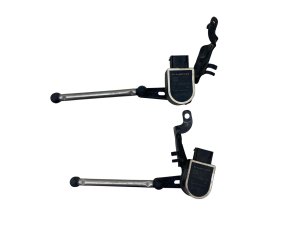
- Inspect the Linkage Arm: The most common point of failure on these sensors is the small plastic arm and its ball joints. Carefully inspect the photos or the part in person. Look for any cracks, stress marks, or outright breaks. A sensor with a damaged arm is useless.
- Check the Electrical Connector: Look at the connector housing for any cracks. Check the pins inside to ensure they are straight, clean, and free of any green or white corrosion.
- Ask About the Donor Vehicle: If possible, find out the mileage of the vehicle the part came from. A sensor from a low-mileage car is always preferable. An eBay listing showed a sensor from a car with only 11,000 miles, which is an excellent find.
Cost of Replacing a Lucid Air Headlight Level Sensor
The cost can vary depending on whether you do the work yourself or use a repair shop.
| Part or Service | Estimated Cost | Notes |
|---|---|---|
| New OEM Sensor | $150 - $250 (est.) | Must be purchased from a Lucid Service Center. Price is an estimate as it's not publicly listed. |
| New Aftermarket Sensor | Not Available | As of mid-2026, no aftermarket manufacturers produce this part. |
| Used OEM Sensor | $30 - $75 | Commonly found on sites like eBay. Price depends on condition and seller. |
| Shop Labor | $120 - $200 | Estimated 1.0 hour of labor. Independent shops may be willing to install customer-supplied used parts. |
Replacement Overview & Difficulty
Replacing a headlight level sensor is a straightforward job for a DIY mechanic with the right tools.
- Difficulty: 2 out of 5
- Estimated Time: 1 hour
- Tools Needed: Jack and jack stands, wheel lug wrench, basic socket set.
General Steps:
- Safely lift the vehicle and support it on jack stands.
- Remove the wheel corresponding to the faulty sensor (e.g., front right).
- Locate the sensor. It will be a small black box mounted to the vehicle's frame or subframe, with a thin plastic arm connected to one of the suspension control arms.
- Disconnect the electrical connector from the sensor.
- Unbolt the sensor body from its bracket (typically two small bolts).
- Carefully pop the linkage arm off the ball stud on the control arm. A small pry tool can help, but be gentle.
- Installation is the reverse of removal. Attach the new sensor, connect the linkage arm, plug in the electrical connector, and reinstall the wheel.
Pro Tip: After replacement, the system may need to recalibrate. Some vehicles require a scan tool to perform a learning procedure. However, for some systems, simply driving the car for a few minutes allows the computer to recognize the new sensor. If the fault light doesn't clear after a short drive, a visit to a shop with an advanced scan tool may be necessary.
Compatibility Warning: This sensor is not compatible with the high-performance Lucid Air Sapphire trim. The Sapphire has a unique suspension setup that requires different components. Additionally, be aware that front (P11-SSRF00-00) and rear (P11-SSRR00-00) sensors are different parts and are not interchangeable.
Frequently Asked Questions
Can I drive my Lucid Air with a bad headlight level sensor?
Yes, but it is not recommended, especially at night. A failed sensor usually causes the headlights to aim very low, which drastically reduces your visibility and is unsafe. It can also be a violation of vehicle safety standards.
Where is the headlight level sensor located on a Lucid Air?
There are multiple sensors. They are located in the wheel wells, mounted to the car's subframe with a linkage arm attached to a suspension control arm. You will need to remove a wheel to see and access one.
Do I need to replace the sensors in pairs?
No. Unlike some suspension components, you only need to replace the specific sensor that has failed. The system will function correctly with one new sensor.
Will a broken linkage arm cause a fault code?
Yes. If the arm breaks, the sensor's reading will be out of its expected range, which will trigger a "Headlight Leveling Fault" message on the dash, just as if the sensor's electronics had failed.
Technical Specifications
OEM Part Numbers: P11-SSRF00-00 P11SSRF00 P11-SSRR00-00 P11-SSRR00-01
The sensor system operates by sending a variable voltage signal to a control module based on the position of its linkage arm, which moves with the vehicle's suspension.
We Have This Part in Stock

The information in this article is provided for general reference and educational purposes only. Vehicle specifications, procedures, and part compatibility can vary by production date, trim level, and region. Always consult your vehicle's factory service manual and verify part numbers before purchasing or performing repairs. Safety-critical components such as airbags, seat belts, and braking systems should be installed by a qualified professional.
- Lucid Air: