

Porsche 911 & Boxster Headlight Leveling Faults: Fixing the 1999-2005 Litronic Control Module
This guide covers the diagnosis, replacement, and common failures of the Xenon headlight leveling control module for the Porsche 911 (996) and Boxster (986).
- The most common cause of a 'Headlight beam adjustment faulty' warning is a broken or seized level sensor on the suspension, not the control module itself.
- This module is only for cars with factory Xenon (Litronic) headlights. It does not fit 911 Turbo models.
- A replacement module may not require dealer programming, but it does need fault codes cleared and a system calibration with a Porsche-specific scan tool.
- A headlight that won't turn on is almost never caused by this module; look at the bulb, ballast, or headlight switch instead.
What is the Headlight Control Module and What Does It Do?
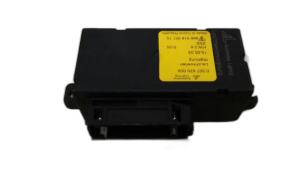
On Porsche 911 (996) and Boxster (986) models with optional Xenon headlights (Porsche's brand name is 'Litronic'), the headlights feature an automatic leveling system required by law for high-intensity lights. The Headlight Control Module is the electronic computer that operates this system. It ensures the powerful Xenon beams are always aimed correctly to maximize visibility without dazzling other road users.
The system works using three main components:
- Level Sensors: Attached to the suspension arms (typically one on the front left and one on the rear left), these sensors measure the vehicle's ride height in real-time.
- Control Module: This computer, located in the driver's footwell, processes the signals from the level sensors.
- Actuator Motors: Small electric motors inside each headlight assembly receive commands from the control module to physically tilt the projector assembly up or down.
When you start the car, the system performs a self-test, causing the headlights to dip down and then rise to their operational position. This is a normal function and confirms the system is active.
Vehicles Affected
This specific Headlight Control Module is used in the following vehicles, but only those equipped with factory-installed Xenon (Litronic) headlights:
- 1999-2005 Porsche 911 (Carrera, Carrera 4, Carrera 4S)
- 1999-2004 Porsche Boxster (Base, S)
Compatibility Warnings:
- Porsche 911 (996): This module fits non-Turbo models only. The 911 Turbo uses a different system.
- 2005 Porsche 911: This part only fits the 996 body style, which was carried over for some models in 2005. It does not fit the newer 997 body style that also began in 2005.
- Halogen vs. Xenon: Vehicles with standard halogen headlights do not have this automatic leveling system or the control module.
Symptoms of a Failing Headlight Control Module
A failure in the headlight leveling system will almost always trigger a specific warning message.
- "Headlight beam adjustment faulty" Warning: This is the most common symptom, appearing on the instrument cluster display.
- Incorrect Headlight Aim: The headlights may be stuck aiming too low, severely limiting nighttime visibility, or too high, blinding oncoming traffic.
- No "Startup Sweep": The headlights may fail to perform their characteristic up-and-down initialization sequence when the car is started.
- Erratic Headlight Movement: In some cases, the headlights may jump or flicker up and down while driving over bumps.
What It's Probably NOT
It's important to distinguish a leveling system fault from a lighting fault. The leveling control module is rarely the cause of these issues:
- One or both headlights won't turn on: This is typically caused by a failed bulb, ballast (igniter), or headlight switch, not the leveling module.
- Flickering or dim headlight: This also points toward a bad bulb or ballast.
Diagnosing Headlight Leveling System Faults
Before you replace the control module, it's critical to diagnose the system properly, as other components are more likely to fail.
- Check the Level Sensors First: The most common point of failure in this system is not the module, but the plastic connecting rods on the suspension level sensors. Get under the car (or remove the front and rear left wheels) and visually inspect the sensors attached to the control arms. The small plastic arms can become brittle and break, or the pivot points can seize. If a rod is broken, the sensor will give an out-of-range reading, triggering the dash warning.
- Observe the Startup Sweep: Turn the headlights on and watch them. Do they move at all? Do you hear the motors inside the headlights trying to work? If you hear motor noise but see no movement, the actuator inside the headlight might be jammed or disconnected.
- Scan for Fault Codes: The best way to diagnose the issue is with a Porsche-specific diagnostic tool, such as a PIWIS (dealer tool) or a capable aftermarket scanner like Durametric. This tool can communicate directly with the headlight control module and will tell you exactly where the fault lies (e.g., "Front Level Sensor Signal Implausible"). This avoids unnecessary guesswork.
Pro Tip: Owners and mechanics report that the rear level sensor's connecting rod is a very frequent failure point. Always inspect this part carefully before assuming the control module is bad.
Replacement & Programming
The Headlight Control Module is located in the driver's side footwell, mounted to the firewall or A-pillar area, often near the fuse box. Replacement involves removing the lower dash trim panels for access, disconnecting the battery, unplugging the electrical connectors, and unbolting the module.
Does a Used Module Need Programming?
This is a common question for electronic modules. For the 996 and 986 generation, a replacement Headlight Control Module is often plug-and-play and does not require complex VIN coding like in newer Porsches. However, after installation, it is highly recommended to use a Porsche-specific scan tool to:
- Clear Fault Codes: The system will have stored fault codes from the old, failed part. These must be cleared.
- Perform System Calibration: The scan tool can be used to run a basic setup or calibration routine. This ensures the module knows the correct 'zero' position and can accurately adjust the headlights based on the sensor inputs.
While a dealer visit isn't strictly necessary, the calibration step requires a tool that can access the headlight control module, which most generic OBD-II code readers cannot do. An independent Porsche specialist can easily perform this service.
Buying a Used Headlight Control Module
Since new OEM modules are expensive and aftermarket options are non-existent, a quality used OEM module is an excellent choice.
- Match the Part Number: Match your original part number exactly. The latest superseded part number is 99661815115, which replaces older versions like 99661805102 and 99661805110. Installing the latest version is generally recommended.
- Inspect for Damage: Check the casing for any cracks or signs of being opened. Most importantly, inspect the connector pins for any corrosion or water damage, as its location in the footwell can make it susceptible to moisture if the car has any water leaks.
- Reliability: These modules are generally very reliable. Failures are more often caused by external factors like water damage or electrical shorts than by internal component failure. A used module from a reputable, dry-climate recycler is a safe bet.
Cost of Replacement
Replacing the headlight control module involves both the part cost and labor. Here is an estimated breakdown:
| Part or Service | Estimated Cost |
|---|---|
| New OEM Module | $510 - $560 |
| New Aftermarket Module | Not Available |
| Used OEM Module | $30 - $120 |
| Shop Labor | $150 - $250 (1.0-1.5 hours) |
Frequently Asked Questions (FAQ)
Is a "Headlight beam adjustment faulty" warning always a bad control module?
No, in fact, it's more commonly a problem with one of the suspension level sensors or their connecting rods. These sensors live in a harsh environment under the car and their plastic parts can break or seize. Always diagnose the sensors before replacing the expensive control module.
Do I need to program a replacement headlight control module?
For the 996 and 986, full VIN programming is generally not required. However, you will need a Porsche-specific scan tool to clear old fault codes and perform a system calibration to ensure the new module functions correctly.
Where is the headlight control module located on a Porsche 911 (996) or Boxster (986)?
The module is located in the driver's side footwell. You will need to remove the plastic trim panels under the dashboard to access it. It is typically mounted near the main fuse panel or along the A-pillar.
Can I still drive my car with a faulty headlight leveling system?
Yes, but with caution. The system usually defaults the headlights to their lowest position. This is safe, as it won't blind other drivers, but it can significantly reduce your visibility at night, especially on unlit roads. It is recommended to get the issue fixed promptly for safety.
Related Parts and Issues
- Headlight Level Sensors (996-631-121-00): The most common failure point in the system. There is one in the front and one in the rear.
- Headlight Actuator Motors: Located inside the headlight housing, these can sometimes get stuck or fail.
- Headlight Switch (996-613-535-01): A separate part on the dashboard. A failure here typically causes the headlights not to turn on at all, and is unrelated to the leveling system.
- Recall ANB4: While not for the control module, a recall (NHTSA ID 22V-656) was issued for some 2003-2004 Boxster models for missing headlight horizontal adjustment screw caps. It's worth checking if a vehicle is affected as it relates to overall headlight compliance.
Technical Specifications
OEM Part Numbers: 99661805102 99661805110 99661815115
Controls the automatic leveling system for factory Xenon/Litronic headlights.
We Have This Part in Stock


The information in this article is provided for general reference and educational purposes only. Vehicle specifications, procedures, and part compatibility can vary by production date, trim level, and region. Always consult your vehicle's factory service manual and verify part numbers before purchasing or performing repairs. Safety-critical components such as airbags, seat belts, and braking systems should be installed by a qualified professional.
- Porsche 911:
- Porsche Boxster:
- 🛍️ Shop This Part
- What is the Headlight Control Module and What Does It Do?
- Vehicles Affected
- Symptoms of a Failing Headlight Control Module
- What It's Probably NOT
- Diagnosing Headlight Leveling System Faults
- Replacement & Programming
- Does a Used Module Need Programming?
- Buying a Used Headlight Control Module
- Cost of Replacement
- Frequently Asked Questions (FAQ)
- Related Parts and Issues
- 🎟️ Get 5% Off