

2003-2008 Mazda 6 Headlight: Halogen vs. HID and Other Fitment Traps
This guide clarifies the critical differences between headlight types for the first-generation Mazda 6 to ensure you buy the right part the first time.
- The most critical factor is identifying whether your car has Halogen or HID/Xenon headlights; they are not interchangeable.
- Replacement requires removing the entire front bumper cover, making it a more involved job than just changing a bulb.
- When buying used, inspect all plastic mounting tabs carefully, as broken tabs are the most common deal-breaker.
- After replacement, the headlight MUST be professionally aimed to be safe and legal.
Headlight Variants for the 2003-2008 Mazda 6

The first-generation Mazda 6 (model code GG/GY) had several headlight variations that are not interchangeable. Ordering the wrong one is a common and costly mistake. Before buying, you must identify which type your car is equipped with.
Halogen vs. HID (Xenon): The Critical Difference
- Halogen Headlights: Standard on most 'i' trim models (like i Sport). These use H1 bulbs for both the low and high beams. They are a simpler, less expensive system. The housing is physically different and the wiring is not compatible with HID components.
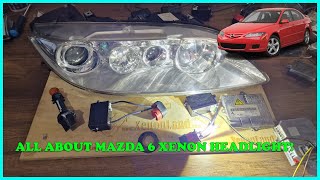
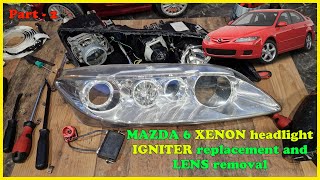
- HID/Xenon Headlights: Standard on 's' Grand Touring models and optional on others. These use a D2S bulb for the low beam and an H1 for the high beam. HID systems require a ballast (a small metal box that controls voltage) and an igniter to start the bulb. These components are often mounted to the bottom or back of the headlight assembly. You cannot put an HID bulb in a halogen housing, or vice-versa, without extensive and unsafe modifications.
Pro Tip: To quickly identify your headlight type, look at the low beam bulb when it's on. Halogen lights have a yellowish-white glow and take a moment to fade out when turned off. HID/Xenon lights have a bright, pure white or slightly blue light and may color-shift for a second when first turned on. You can also look for a warning label regarding high voltage on the back of the assembly, which indicates an HID unit.
Other Variations
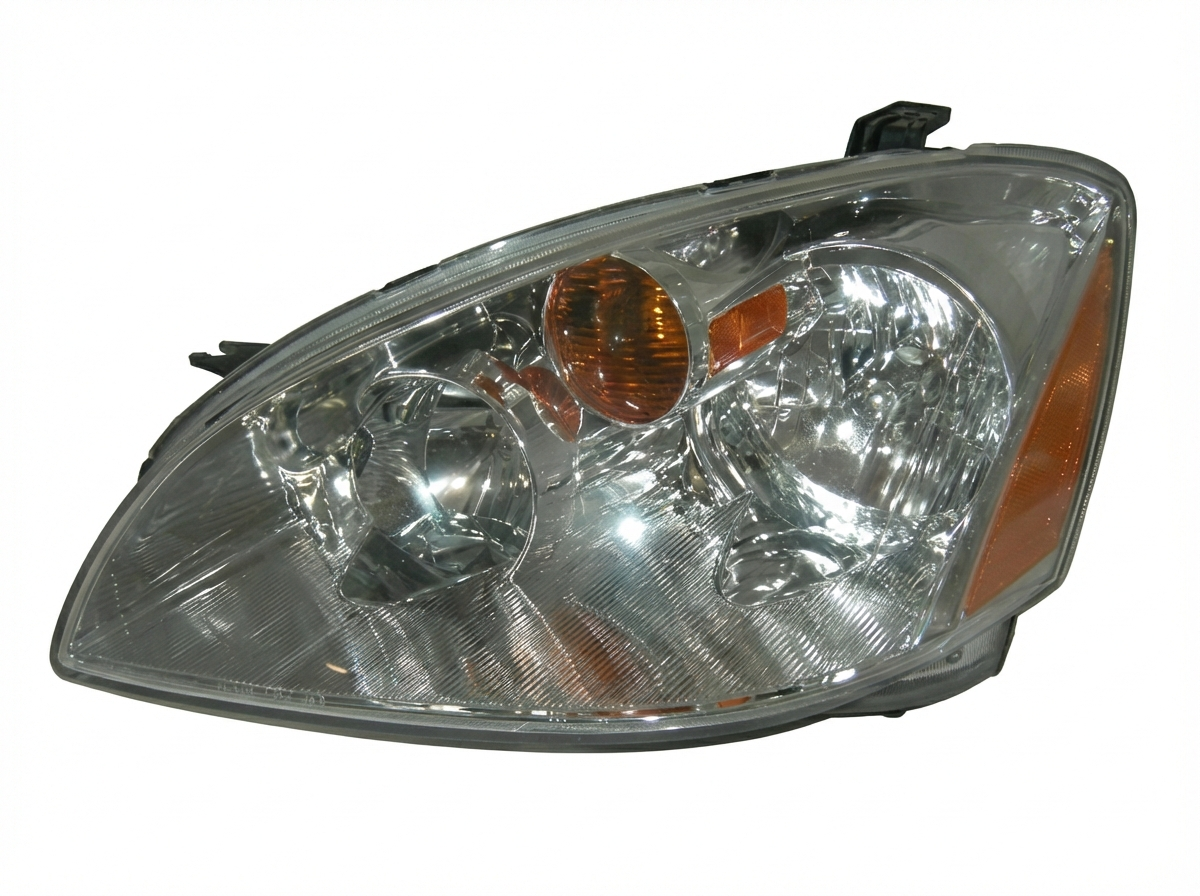
- Fog Lights: For 2003-2005 models, there were versions with and without integrated fog lights. Assemblies for cars with fog lights have an extra projector lens.
- Mazdaspeed 6: The high-performance Mazdaspeed 6 (2006-2007) has unique headlight assemblies with a darker 'blackout' or 'smoked' chrome housing. While they may look similar, their mounting and specifics can differ.
- Auto-Leveling: Some models equipped with factory HID lights also came with an auto-leveling system to prevent glaring at other drivers. This is another reason why swapping between types is not feasible.
Symptoms of a Failing Headlight Assembly

Failure isn't always a simple burnt-out bulb. The entire assembly can degrade over time, leading to various symptoms.
- Dim or Yellowed Light Output: The most common issue is the plastic lens becoming hazy, yellow, and oxidized from UV exposure. This severely restricts the amount of light that passes through, making night driving dangerous.
- Moisture or Condensation Inside: If the seal between the lens and the housing fails, moisture can get inside. This can cause a foggy appearance, water droplets, and will quickly lead to corrosion of the reflective surfaces and electrical connectors. Mazda issued a Technical Service Bulletin (TSB) for this issue.
- Flickering or Intermittent Low Beam (HID Models): This is a classic sign of a failing HID ballast. The ballast may struggle to maintain a steady electrical arc, causing the light to flicker, dim, or shut off unexpectedly.
- Delayed Startup (HID Models): A healthy HID bulb should ignite almost instantly. If it takes several seconds to light up, or if you have to cycle the light switch to get it to turn on, the ballast or igniter is likely failing.
- Color Change (HID Models): An HID bulb that is nearing the end of its life may shift color, often turning pink or purple.
- Electrical Malfunctions: Water intrusion or physical damage can cause short circuits, leading to blown fuses or problems with the turn signal or parking lights.
Recall Information: While there are no recalls for the headlight assemblies themselves, the 2003-2008 Mazda 6 was subject to numerous recalls for Takata airbags. It is critical to ensure these safety recalls have been performed on any vehicle.
Buying a Used Headlight Assembly: What to Inspect

A used OEM headlight is often a better choice than a cheap aftermarket one due to superior fit, material quality, and light beam pattern. However, careful inspection is key.
- Verify Compatibility: First and foremost, confirm you are buying the correct type (Halogen or HID) for your car's trim level. Do not attempt to 'upgrade' from Halogen to HID with a used assembly, as the wiring harnesses are different.
- Check All Mounting Tabs: This is the most critical inspection point. The plastic mounting tabs are brittle and often break during accidents or improper removal. A headlight with even one broken tab will vibrate, fit poorly, and will not hold its alignment. Ensure all tabs are present and free of cracks.
- Inspect the Lens: Look for deep scratches, cracks, and 'crazing' (a network of fine cracks in the plastic). Minor yellowing or hazing on the outside can be polished out with a restoration kit, but internal damage or heavy crazing means the lens cannot be saved.
- Look for Signs of Moisture: Check for a 'water line' or mineral deposits on the inside of the lens or on the chrome reflectors. This indicates the seal has failed and the assembly may have internal corrosion.
- For HID Assemblies: Ask About Components: A used HID assembly should ideally come with the bulb, ballast, and igniter. Ask the seller if these components were tested and are known to be working. A non-working ballast can be an expensive separate purchase.
- Check the Wiring and Connectors: Ensure the main connector plug and any internal wiring are not cut, corroded, or have visible burn marks.
Replacement Process and Required Alignment
Replacing the headlight assembly on a first-generation Mazda 6 is a moderately difficult job for a DIYer primarily because the front bumper cover must be removed to access all the mounting bolts.
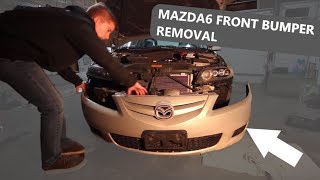
🎬 See how to remove the front bumper coverSteps Overview:
- Disconnect the negative battery terminal.
- Remove the screws and clips holding the top, sides (in the wheel wells), and bottom of the front bumper cover.
- Carefully pull the bumper cover off and disconnect any fog light wiring.
- Unbolt the headlight assembly. There are typically two bolts on top, one on the side, and one or two on the bottom.
- Disconnect the main electrical connector from the back of the assembly and remove it from the vehicle.
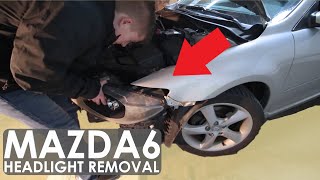
- Installation is the reverse of removal. 🎬 Watch: Step-by-step headlight removal and replacement walkthrough
Mandatory Headlight Aiming: After installing a replacement headlight, you MUST have it properly aimed. A misaligned headlight can blind oncoming drivers or fail to illuminate the road ahead properly. The adjustment is done using screws on the back of the assembly. The general procedure is to park the car on a level surface 25 feet from a flat wall and adjust the screws until the beam's cutoff line matches the height and position specified by the manufacturer. Many repair shops can do this quickly with an optical aiming machine.
Cost Comparison
| Part Type | Estimated Cost |
|---|---|
| New OEM (Dealer) | $850 - $1200+ per side |
| New Aftermarket | $150 - $300 per side |
| Used OEM | $75 - $250 per side |
| Shop Labor for Replacement | $150 - $300 |
Frequently Asked Questions
Can I put brighter LED or HID bulbs in my original halogen headlights?
No. Halogen headlight housings are designed for the specific size and light emission pattern of a halogen bulb. Putting an LED or HID bulb in a halogen reflector will scatter the light, creating excessive glare for other drivers and producing a poor, unfocused beam pattern on the road. It is both unsafe and often illegal.
My headlight is foggy on the inside. Can I fix it?
A little condensation that appears in humid weather and disappears quickly may be normal. However, if you have large water droplets or persistent fogging, the main seal has failed. The proper fix requires removing the headlight, carefully heating it to soften the sealant, prying the lens off, cleaning everything, and resealing it with new butyl sealant. For most people, replacing the assembly is a more practical solution.
One of my HID headlights went out. Is it the bulb or the ballast?
The easiest way to diagnose this is to swap the bulbs from one side to the other. If the problem moves to the other side with the bulb, you have a bad bulb. If the problem stays on the same side, the issue is most likely the ballast or igniter. A buzzing noise or a light that tries to turn on and then immediately shuts off also points to a bad ballast.
Why is my new aftermarket headlight not as bright as the OEM one?
This is a common complaint with cheaper aftermarket assemblies. The cause is often lower quality reflective material, lens plastic that isn't as clear, and less precise molding of the reflectors. This results in a less focused, dimmer beam pattern even with the same bulb. This is a primary reason why a good-condition used OEM part is often superior to a new, cheap aftermarket part.
Helpful Videos

Technical Specifications
OEM Part Numbers: GK2A-51-040E GK2A-51-0L0E GK2A510L0E GS3L-51-0L0C GS3L-51-0L0D GS3L-51-0L0E GS3L-51-0L0F GS3L-51-0L0G MA2502125
Bulb Types (Halogen Models): H1 Low Beam, H1 High Beam. Bulb Types (HID/Xenon Models): D2S Low Beam, H1 High Beam.
We Have This Part in Stock



The information in this article is provided for general reference and educational purposes only. Vehicle specifications, procedures, and part compatibility can vary by production date, trim level, and region. Always consult your vehicle's factory service manual and verify part numbers before purchasing or performing repairs. Safety-critical components such as airbags, seat belts, and braking systems should be installed by a qualified professional.
- Mazda 6:
- 🎬 Helpful Videos
- 🛍️ Shop This Part
- Headlight Variants for the 2003-2008 Mazda 6
- Halogen vs. HID (Xenon): The Critical Difference
- Other Variations
- Symptoms of a Failing Headlight Assembly
- Buying a Used Headlight Assembly: What to Inspect
- Replacement Process and Required Alignment
- Cost Comparison
- Frequently Asked Questions
- 🎟️ Get 5% Off