

2017 Mercedes-Benz SLC300 Engine Pre-Fuse Box: No-Start Diagnosis & Replacement Guide
This guide clarifies the critical difference between the simple, non-programmable engine pre-fuse box (A1725400950) and the complex Front SAM computer, helping you diagnose and fix total power failures.
- This article is for the Engine Pre-Fuse Box (A1725400950), which is a simple power distributor and requires NO programming.
- Do not confuse the Pre-Fuse Box with the Front SAM, which is a complex computer that MUST be programmed.
- Failure typically results in a critical no-start condition or a complete loss of vehicle power.
- A used OEM unit is a reliable and cost-effective replacement, provided it is inspected for corrosion or heat damage.
Is This the Right Fuse Box? Pre-Fuse Box vs. Front SAM

Before diagnosing or purchasing a part, it's crucial to understand that your 2017 SLC300 has two main components in the engine bay that are often confused: the Engine Pre-Fuse Box and the Front SAM (Signal Acquisition and Actuation Module).
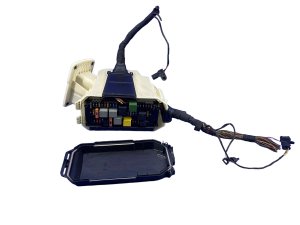
- Engine Pre-Fuse Box (Part No. A1725400950): This is a simple, high-current power distribution block. It sits near the battery and contains large, non-serviceable fuses. Its job is purely to distribute and protect major electrical circuits. This part does NOT require any programming. It is a direct, plug-and-play replacement.
- Front SAM (Part Nos. starting with 212...): This is a complex computer module that also houses many of the smaller, blade-style fuses and relays for various vehicle functions (like lights, wipers, and horn). The Front SAM controls and monitors these systems. This part MUST be programmed or coded to the vehicle after installation.
Warning: The part numbers provided in our database (1725400950, 2129002927, etc.) refer to these two separate parts. This guide focuses on the Engine Pre-Fuse Box (A1725400950), which is the common cause of complete no-start or no-power conditions. Ensure you are diagnosing and replacing the correct component.
Symptoms of a Failing Pre-Fuse Box

Failure of the engine pre-fuse box is typically catastrophic, leading to significant and sudden electrical problems. Because it's the main gateway for battery power, symptoms are rarely subtle.
- Complete No-Crank, No-Start Condition: The most common symptom. The vehicle will appear completely dead, with no power to the dashboard, interior lights, or starter when the key is turned.
- Total Loss of Electrical Power: All electrical systems in the car fail simultaneously while driving.
- Intermittent Power Failure: The vehicle may lose all power and then mysteriously regain it. This can be caused by a corroded or loose connection within the pre-fuse box.
- Multiple, Unrelated Warning Lights: A sudden loss of communication between modules due to power failure can trigger a cascade of error messages on the instrument cluster.
- Evidence of Melting or Burning: A visual inspection may reveal melted plastic or a burning smell near the battery, indicating a severe short circuit has overheated the box.
How to Diagnose a Bad Pre-Fuse Box

Diagnosing this part is straightforward for someone with a basic multimeter.
- Safety First: Ensure the vehicle is in park and the ignition is off. Wear appropriate safety gear.
- Visual Inspection: Open the hood and locate the pre-fuse box, which is typically a black plastic box connected directly to the positive battery terminal or located very close to it. Look for any signs of corrosion (white or green powder), melting plastic, or discoloration from heat.
- Check for Voltage: Using a multimeter set to DC volts, place the black probe on the negative battery terminal. Place the red probe on the main input stud of the pre-fuse box (where the thick cable from the battery connects). You should read battery voltage (approx. 12.6V).
- Check Output Voltage: Now, move the red probe to each of the output studs on the pre-fuse box. These studs have large cables that lead to the starter, alternator, and Front SAM. Each of these studs should also read full battery voltage. If you have voltage going in but no voltage (or very low voltage) on one or more of the output studs, an internal fuse has blown and the pre-fuse box must be replaced.
Pro Tip: A common cause of failure is corrosion from moisture or battery fumes. If you see any corrosion, it's a strong indicator the box is compromised, even if it hasn't failed completely yet.
Buying a Used 2017 SLC300 Pre-Fuse Box
For a part like this, a used OEM component is an excellent, cost-effective choice. Since it's not a complex electronic module, a properly inspected used part offers the same performance and reliability as a new one.
- Verify the Part Number: The most critical step is to match the part number. Ensure the replacement unit is marked with A1725400950 or a compatible superceded number. While other part numbers may look similar, they may have different internal fuse ratings.
- Physical Inspection is Key: When buying used, carefully inspect all photos. Reject any unit with signs of melting, cracking, or significant corrosion on the metal terminals. The plastic housing should be clean and intact.
- No Programming Required: Reconfirm with the seller, but this part is plug-and-play. This is a major advantage of buying a used pre-fuse box over a used Front SAM, which would require an expensive dealer visit for programming.
- Why Used OEM is a Smart Choice: This is a simple, robust component. Unlike aftermarket electronic modules which can be unreliable, a genuine used Mercedes part that has been visually inspected is a safe bet. There are no moving parts or complex software to worry about.
Known Issues, Recalls, and Service Bulletins
As of mid-2024, there are no specific recalls or Technical Service Bulletins (TSBs) from the NHTSA that directly target the engine pre-fuse box (A1725400950) for the 2017 Mercedes-Benz SLC300. However, several recalls exist for software issues in other modules that can cause electrical problems:
- NHTSA Recall 21V058000: A software issue with the eCall emergency call system could transmit the wrong vehicle location. This is resolved with a software update.
- NHTSA Recall 17V308000: An electronic stability control (ESC) software error could cause the brakes to remain slightly applied, potentially leading to overheating. This is also fixed with a software update.
While not directly related to the pre-fuse box itself, these recalls highlight the complexity of the vehicle's electrical system. A recall for loose pre-fuse box connections was issued for later model C-Class vehicles, indicating the importance of ensuring all high-current nuts are properly torqued during installation.
Replacement Overview

Replacing the pre-fuse box is a relatively simple task for a DIY mechanic comfortable with basic electrical work.
- Disconnect the negative terminal of the vehicle's 12V battery and secure it away from the terminal to prevent accidental contact.
- Remove any covers to access the pre-fuse box.
- Carefully unbolt the nuts holding the large-gauge electrical cables to the pre-fuse box studs. Note their positions.
- Unclip or unbolt the pre-fuse box housing from its mounting bracket.
- Install the new pre-fuse box and secure it.
- Clean the electrical cable terminals with a wire brush before reattaching them to ensure a good connection.
- Re-attach the electrical cables to the correct studs and torque the nuts to specification. For M8 nuts, a common torque spec is 16 Nm, and for M6 nuts, 8 Nm, but always verify for your specific application.
- Reconnect the negative battery terminal.
Cost Comparison
| Part Type | Estimated Cost |
|---|---|
| New OEM | $250 - $400 |
| New Aftermarket | Not commonly available |
| Used OEM | $75 - $175 |
| Shop Labor | $100 - $200 |
Frequently Asked Questions (FAQ)
Does the 2017 SLC300 engine fuse box need to be programmed?
No, the engine pre-fuse box (part A1725400950) does not require programming. However, the Front SAM (Signal Acquisition Module), which is the other fuse box in the engine bay, is a computer and absolutely requires programming after replacement.
Where is the engine pre-fuse box located on a 2017 SLC300?
It is located in the engine compartment, usually mounted directly on or very close to the positive terminal of the battery. It's a small box with several thick red cables connected to it.
Can I replace just one blown fuse inside the pre-fuse box?
No. The fuses inside this assembly are internal, high-current fusible links that are not designed to be serviced individually. If one of them blows, the entire pre-fuse box unit must be replaced.
What causes the pre-fuse box to fail?
The most common causes are a major downstream short circuit (e.g., a seized alternator or starter motor drawing excessive current), corrosion from moisture and battery acid fumes, or a loose connection on one of the main terminals causing it to overheat.
Technical Specifications
OEM Part Numbers: A1725400950 1725400950
This article distinguishes the Pre-Fuse Box (A1725400950) from the Front SAM (Signal Acquisition Module), which has part numbers such as A2129002927, A2129004325, A2129006429, A2129007224, and A2129009325. The Pre-Fuse Box is a non-programmable power distribution unit, while the Front SAM is a programmable control module.
We Have This Part in Stock



The information in this article is provided for general reference and educational purposes only. Vehicle specifications, procedures, and part compatibility can vary by production date, trim level, and region. Always consult your vehicle's factory service manual and verify part numbers before purchasing or performing repairs. Safety-critical components such as airbags, seat belts, and braking systems should be installed by a qualified professional.
- Mercedes-Benz SLC300:
- 🛍️ Shop This Part
- Is This the Right Fuse Box? Pre-Fuse Box vs. Front SAM
- Symptoms of a Failing Pre-Fuse Box
- How to Diagnose a Bad Pre-Fuse Box
- Buying a Used 2017 SLC300 Pre-Fuse Box
- Known Issues, Recalls, and Service Bulletins
- Replacement Overview
- Cost Comparison
- Frequently Asked Questions (FAQ)
- 🎟️ Get 5% Off